Why are copper prices still rising despite inventories surging to a two-year high? Two forces are at play after the holiday.
2026-02-24 18:36:22
On Tuesday (February 24), the global copper market saw a significant rise after the Asian session ended, with three-month copper prices on the London Metal Exchange (LME) surging to their highest level since February 12. The core driver of this rally is widely interpreted as positive sentiment from Chinese investors returning to the market after a nine-day Lunar New Year holiday.

As of 18:00 Beijing time, LME three-month copper was trading at $13,080 per tonne, up 1.6% on the day, having reached a high of $13,169 per tonne during the session. This price level not only refreshed the high point in over a week but also signified that the market had quickly resumed its upward trend after a slight pullback of 0.7% on Monday. Meanwhile, the most active copper contract on the Shanghai Futures Exchange performed strongly on the first trading day after the holiday, closing at 101,510 yuan per tonne, up 0.8%, showing a positive correlation with the LME market.
Analysts from well-known institutions pointed out that the end of the Chinese holiday directly led to a rebound in trading volume, providing momentum for the rise in base metals in the morning session. A Shanghai-based trader, commenting on the current market situation, stated that despite high inventory levels, copper prices have shown considerable resilience, reflecting overall investor optimism. However, the trader cautiously added that a new catalyst is still needed for the market to achieve a significant directional breakout.
Observing the specific price movements on the charts, LME copper prices are testing a key technical resistance zone after a period of consolidation. The recent high of $13,169/ton has become the focus of the short-term battle between bulls and bears, while the historical high of $14,527.50/ton reached on January 29th constitutes a long-term price ceiling. Support levels to watch are the lows of the previous consolidation range and the recent pullback's temporary lows.
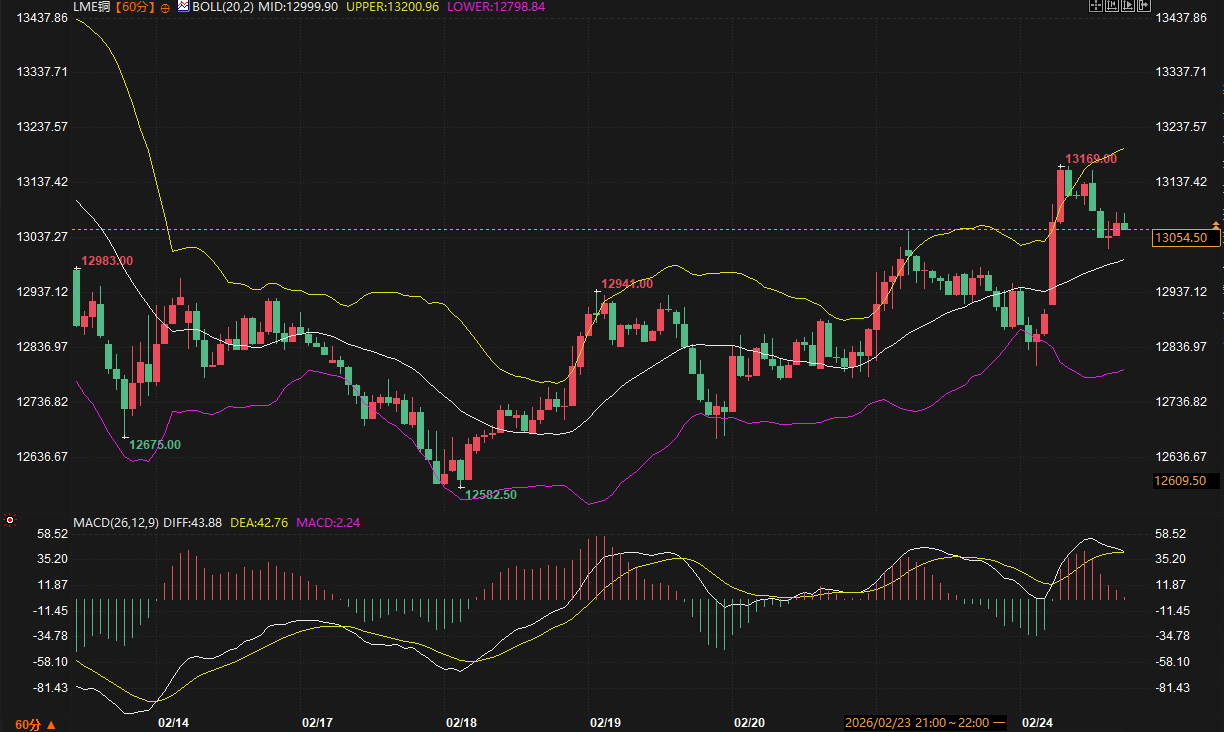
The current market complexity lies in the interplay of bullish and bearish fundamental factors. On the one hand, China, as the world's largest consumer, is experiencing positive stock market performance and anticipation of post-holiday capital inflows, creating a favorable macroeconomic environment for industrial metals. Furthermore, the US Supreme Court's ruling on the Trump-era emergency tariffs has been interpreted by some investors as potentially beneficial to China, and this macroeconomic optimism has spilled over into the commodity market, supporting copper prices.
However, undeniable negative factors also exist. LME inventory data clearly reveals the pressure on the supply side. Data released on Tuesday showed that copper inventories in LME registered warehouses increased by another 1,350 tons, climbing to a total of 243,175 tons, the highest level since March 2025. More noteworthy is that LME copper inventories have surged by 71% year-to-date. Such a massive inventory level should theoretically exert significant downward pressure on prices. However, the current price "immunity" or "diminishing" to this negative factor precisely reflects market participants' expectations for future demand, particularly the anticipation of a recovery in actual procurement after the Chinese holidays, which is dominating short-term trading logic.
In terms of cross-market correlation, the general strength of other base metals also provided positive lateral support for copper prices. LME nickel prices jumped 2.8% due to uncertainty surrounding environmental policies in Indonesia, a major producing country (considering the revocation of environmental permits for a large nickel-cobalt project), boosting sentiment across industrial metals. Aluminum, zinc, lead, tin, and other commodities also recorded varying degrees of increase, showing a sector-wide recovery.
Looking ahead, copper prices are at a critical juncture. In the short term, whether the sentiment premium brought about by the return of Chinese investors can translate into sustained spot buying will be key to determining the strength of this round of price increases. The market needs to see a recovery in actual purchasing activity in China's downstream consumption sectors (such as electricity, construction, and new energy vehicles) to digest high inventories. Without substantial improvement on the demand side, a price increase driven solely by sentiment is unlikely to be sustainable, and prices may face greater selling pressure as they approach previous technical resistance levels.
Therefore, the focus in the near future will be on two main aspects: first, whether inventory changes on the LME and Shanghai Futures Exchange will show a trend reversal; and second, the progress of resumption of work and production in various industries in China after the holiday and the resulting changes in spot premiums and discounts. At the macro level, inflation data and monetary policy trends of major global economies will remain important variables affecting overall risk appetite. In the absence of clear directional guidance, copper prices are more likely to exhibit a pattern of increased volatility at high levels, awaiting the intensification of new contradictions to determine the next direction.
As of 18:00 Beijing time, LME three-month copper was trading at $13,080 per tonne, up 1.6% on the day, having reached a high of $13,169 per tonne during the session. This price level not only refreshed the high point in over a week but also signified that the market had quickly resumed its upward trend after a slight pullback of 0.7% on Monday. Meanwhile, the most active copper contract on the Shanghai Futures Exchange performed strongly on the first trading day after the holiday, closing at 101,510 yuan per tonne, up 0.8%, showing a positive correlation with the LME market.
Analysts from well-known institutions pointed out that the end of the Chinese holiday directly led to a rebound in trading volume, providing momentum for the rise in base metals in the morning session. A Shanghai-based trader, commenting on the current market situation, stated that despite high inventory levels, copper prices have shown considerable resilience, reflecting overall investor optimism. However, the trader cautiously added that a new catalyst is still needed for the market to achieve a significant directional breakout.
Observing the specific price movements on the charts, LME copper prices are testing a key technical resistance zone after a period of consolidation. The recent high of $13,169/ton has become the focus of the short-term battle between bulls and bears, while the historical high of $14,527.50/ton reached on January 29th constitutes a long-term price ceiling. Support levels to watch are the lows of the previous consolidation range and the recent pullback's temporary lows.
The current market complexity lies in the interplay of bullish and bearish fundamental factors. On the one hand, China, as the world's largest consumer, is experiencing positive stock market performance and anticipation of post-holiday capital inflows, creating a favorable macroeconomic environment for industrial metals. Furthermore, the US Supreme Court's ruling on the Trump-era emergency tariffs has been interpreted by some investors as potentially beneficial to China, and this macroeconomic optimism has spilled over into the commodity market, supporting copper prices.
However, undeniable negative factors also exist. LME inventory data clearly reveals the pressure on the supply side. Data released on Tuesday showed that copper inventories in LME registered warehouses increased by another 1,350 tons, climbing to a total of 243,175 tons, the highest level since March 2025. More noteworthy is that LME copper inventories have surged by 71% year-to-date. Such a massive inventory level should theoretically exert significant downward pressure on prices. However, the current price "immunity" or "diminishing" to this negative factor precisely reflects market participants' expectations for future demand, particularly the anticipation of a recovery in actual procurement after the Chinese holidays, which is dominating short-term trading logic.
In terms of cross-market correlation, the general strength of other base metals also provided positive lateral support for copper prices. LME nickel prices jumped 2.8% due to uncertainty surrounding environmental policies in Indonesia, a major producing country (considering the revocation of environmental permits for a large nickel-cobalt project), boosting sentiment across industrial metals. Aluminum, zinc, lead, tin, and other commodities also recorded varying degrees of increase, showing a sector-wide recovery.
Looking ahead, copper prices are at a critical juncture. In the short term, whether the sentiment premium brought about by the return of Chinese investors can translate into sustained spot buying will be key to determining the strength of this round of price increases. The market needs to see a recovery in actual purchasing activity in China's downstream consumption sectors (such as electricity, construction, and new energy vehicles) to digest high inventories. Without substantial improvement on the demand side, a price increase driven solely by sentiment is unlikely to be sustainable, and prices may face greater selling pressure as they approach previous technical resistance levels.
Therefore, the focus in the near future will be on two main aspects: first, whether inventory changes on the LME and Shanghai Futures Exchange will show a trend reversal; and second, the progress of resumption of work and production in various industries in China after the holiday and the resulting changes in spot premiums and discounts. At the macro level, inflation data and monetary policy trends of major global economies will remain important variables affecting overall risk appetite. In the absence of clear directional guidance, copper prices are more likely to exhibit a pattern of increased volatility at high levels, awaiting the intensification of new contradictions to determine the next direction.
- Risk Warning and Disclaimer
- The market involves risk, and trading may not be suitable for all investors. This article is for reference only and does not constitute personal investment advice, nor does it take into account certain users’ specific investment objectives, financial situation, or other needs. Any investment decisions made based on this information are at your own risk.