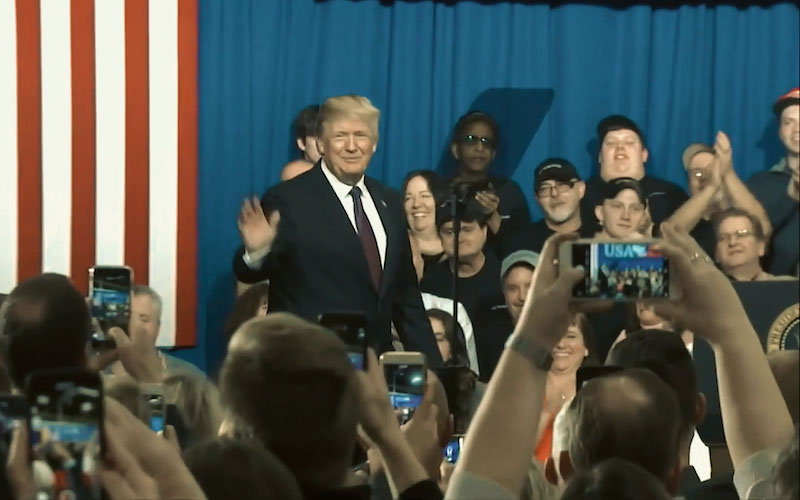
February 25th Financial Breakfast: Hawkish comments from Fed officials send gold prices testing the $5100 level; positive signals from Iran weigh on oil prices.
2026-02-25 07:31:49
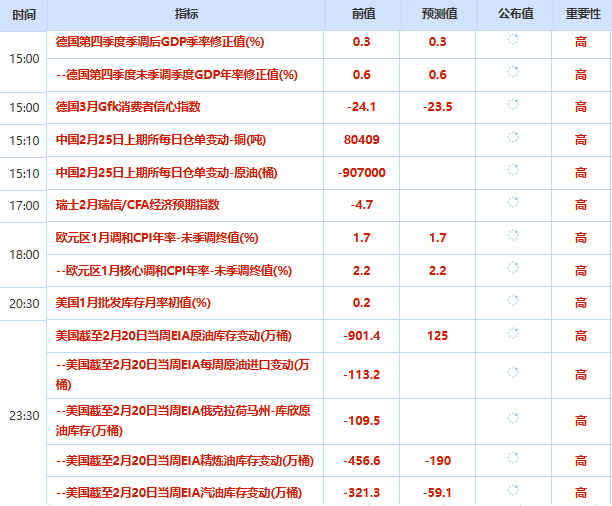
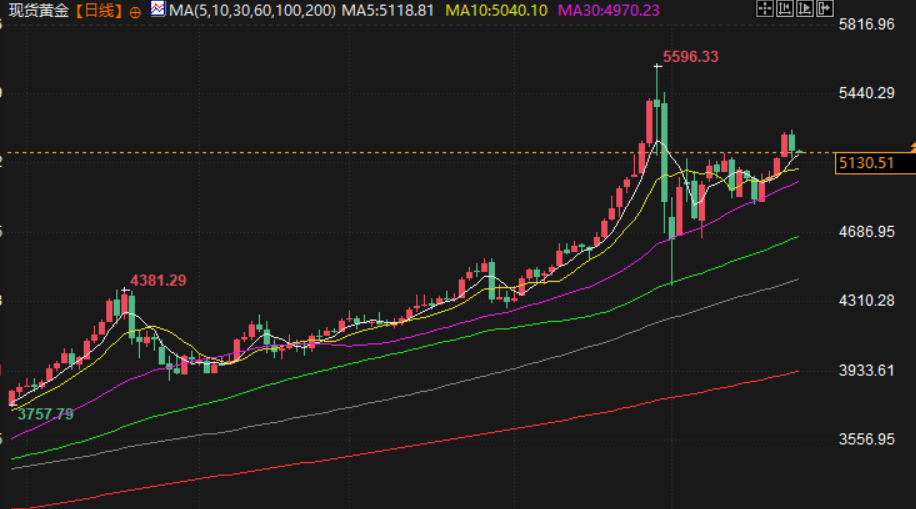
On Wednesday (February 25, Beijing time) in early Asian trading, spot gold was trading around $5,131 per ounce. Warnings from several Federal Reserve officials that inflation remained too high significantly dampened expectations of interest rate cuts, dragging down gold prices that had been driven by increased safe-haven demand. US crude oil was trading around $66 per barrel, with geopolitical tensions dominating the market. Iranian Deputy Foreign Minister Ravanchi stated that Iran was prepared to reach an agreement with the US as soon as possible, limiting oil price increases.

U.S. stocks rose on Tuesday, with the S&P 500 gaining 0.77% to close at 6,890.07, the Nasdaq Composite rising 1.04% to 22,863.68, and the Dow Jones Industrial Average gaining 0.76% to 49,174.50. The gains were mainly driven by AMD and software stocks, as investor concerns about artificial intelligence disrupting some industries eased.
AMD shares surged 8.8% after Meta Platforms announced a multi-year agreement to deploy up to 6 gigawatts of AMD GPUs for AI data centers. Meta will also invest up to 160 million shares of AMD through warrants.
DocuSign rose more than 2% as Anthropic announced that its Claude Cowork can connect to existing tools such as DocuSign and Google Drive, boosting optimism that AI may complement rather than replace software companies. Salesforce and ServiceNow rose 4% and more than 1% respectively, and the iShares Expanded Tech-Software Sector ETF rose nearly 2%.
In the Dow Jones Industrial Average, Home Depot rose nearly 2% after reporting its first earnings beat expectations in a year; IBM, which had plunged the previous trading day due to AI concerns, also contributed to the gains.
Savvy Wealth Chief Investment Officer Anshur Sharma stated that the day's gains were a relief rebound after the sell-off, and he believes that the notion that AI will immediately replace a large amount of enterprise software is too risky, as large companies would find it difficult to quickly switch to unproven internal solutions from a liability perspective. The previous day, major stock indexes fell due to renewed concerns about AI disruption, while US President Trump's threats to raise global tariffs and US-Iran tensions also weighed on the market; a 10% global US tariff took effect on Tuesday.
Gold prices fluctuated more on Tuesday, approaching $5,250 per ounce before falling back below $5,100 per ounce. Trump's raising of global tariffs to 15% increased market uncertainty, while several Federal Reserve officials warned that inflation was still too high, significantly cooling expectations for interest rate cuts and dragging down gold prices. Fed official Goolsby pointed out that a 3% inflation rate still does not meet the Fed's statutory target of 2%, and therefore opposed a concentrated, upfront interest rate cut.
The market's expectation of a rate cut in March has dropped to 4.1%, and the probability of a rate cut in June has also fallen from 50.2% last week to 43.9%.
Meanwhile, the market is paying attention to the impact of geopolitical tensions on gold prices. White House Press Secretary Levitt said that President Trump's primary option regarding Iran "has always been diplomacy," but he does not rule out "using the lethal force of the U.S. military if necessary," adding that "the final decision always rests with Trump."
Democratic leaders say negotiations with the White House to restore operations to the Department of Homeland Security (DHS) have stalled. The department's funding expired on January 30. Senate Majority Leader Chuck Schumer said that after Democrats proposed a plan to end the shutdown last week, "all I heard was silence," adding that the White House has "made no concessions" on key issues, including requiring federal immigration enforcement officers to remove masks during law enforcement and to obtain search warrants before entering residences. House Majority Leader Hakim Jeffries said the DHS funding bill "will not move forward" until these issues are addressed. He stated that there has been "virtually no substantive communication" with the White House recently.
Despite a slowdown in central bank gold demand in recent months, commodity analysts at Societe Generale expect official sector gold purchases to rebound before spring. In its latest report, the bank noted that gold, as a strategic reserve asset, is valuable for supporting credit and monetary resilience and has no counterparty risk; therefore, it cannot be considered a debt reduction tool.
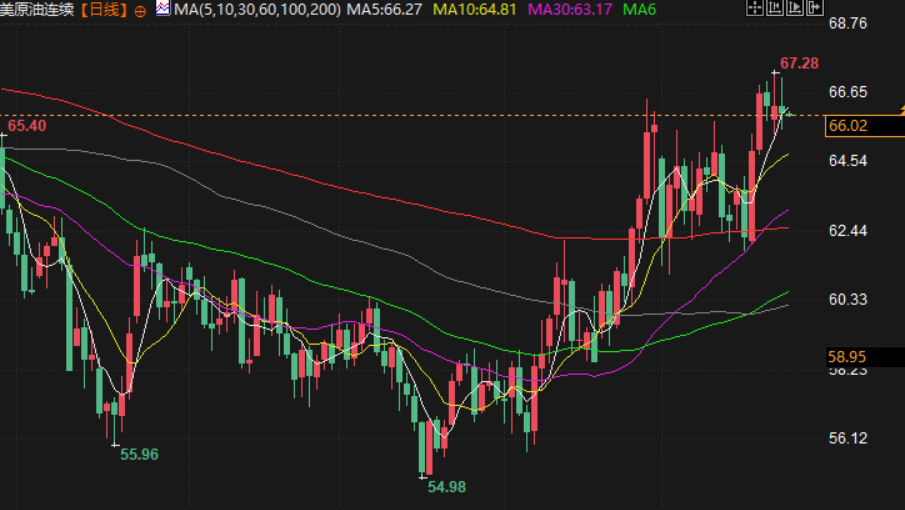
Oil prices fell slightly on Tuesday, with US crude briefly rising above $67 a barrel before retreating. Geopolitical tensions dominated the market, with Iranian Deputy Foreign Minister Ravanchi stating that Iran is prepared to reach an agreement with the US as soon as possible. He said Iran will negotiate with sincerity and goodwill, hoping for a positive response from the US, adding, "If all parties have the political will, I believe an agreement can be reached quickly." When asked about the proposals Iran plans to submit to the US in the next round of negotiations, Ravanchi emphasized that the "only issue" is the nuclear program. The White House also stated that Trump prioritizes diplomacy but does not rule out military action.
According to a statement released by the U.S. Treasury Department’s Office of Foreign Assets Control (OFAC), the U.S. Treasury Department has expanded its sanctions list against Russia to include four individuals and three entities.
UBS has moderately widened the discount of WTI crude oil to Brent crude from $3 per barrel to $4 per barrel. It has also set a new price forecast of $67 per barrel for Brent crude oil at the end of March 2027.
The dollar fluctuated near 97.80 on Tuesday, as recent hawkish comments from several Federal Reserve officials, warning that inflation remains too high, significantly cooled market expectations for interest rate cuts, providing support for the dollar's strength.
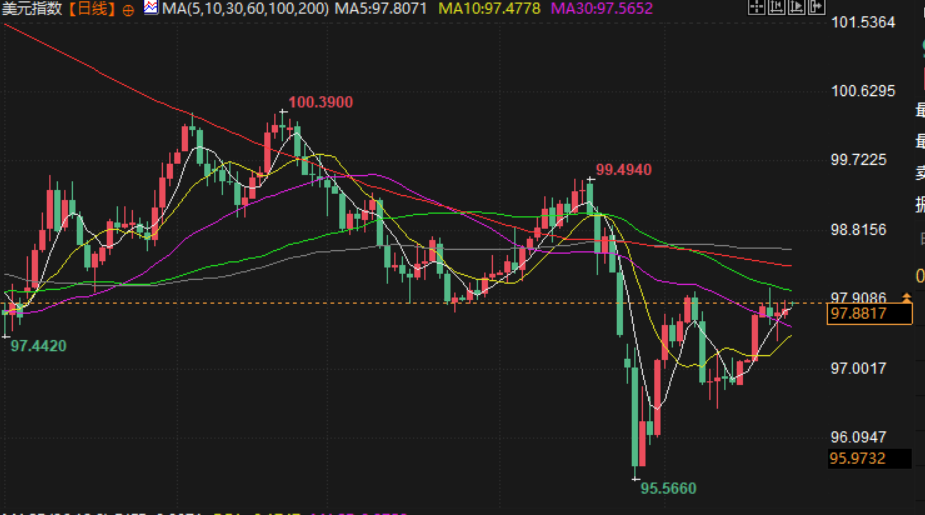
Chicago Fed President John Goolsby pointed out that the current 3% inflation rate is still far from the Fed's statutory target of 2%, therefore he opposes a concentrated series of rate cuts ahead of schedule. As a result, the market's expectation of a rate cut in March has fallen to 4.1%, and the probability of a rate cut in June has also dropped from 50.2% last week to 43.9%. Previously, Fed Governor Waller also expressed a similar hawkish stance, believing that if the job market continues to improve, the case for further rate cuts will weaken. The flurry of statements from these two officials has built a solid floor for the dollar, allowing it to maintain its strength during this data vacuum period.
The dollar rose against the yen on Tuesday after Prime Minister Sanae Takaichi reportedly expressed concerns about further interest rate hikes during a meeting with Bank of Japan Governor Kazuo Ueda last week. This could complicate the BOJ's policy plans, making coordination with the new government more challenging. The yen weakened against both the dollar and the euro following the report. Ueda stated that Monday's meeting was primarily a general exchange on the economic and financial situation, emphasizing that the prime minister did not make any specific monetary policy requests. Takaichi herself declined to discuss details of the meeting, only expressing hope that the central bank would work closely with the government to achieve the 2% inflation target accompanied by wage growth. This meeting comes amid widespread market speculation that rising living costs due to a weaker yen and other factors could prompt the BOJ to raise interest rates in March or April.
The euro closed lower against the dollar on Tuesday, but the foreign exchange options market showed that investor bullish sentiment toward the euro was rising. The risk reversal indicator—a tool used to measure the distribution of directional risk in the market—continued to favor euro call options.
Data shows that the benchmark one-month 25-delta risk reversal indicator was 0.25 on both Monday and Tuesday, favoring euro call options. This indicates a renewed increase in market demand for upside protection on the euro, with investors hedging against potential further gains.
Prior to this modest rebound, the premium for the upside option had narrowed significantly from 1.05 to 0.1 between February 10th and 20th. The current strengthening of the indicator suggests that traders perceive a greater risk of upside volatility or vulnerability in the euro.
The probability of the Federal Reserve keeping interest rates unchanged in March is 98%.
According to CME's "FedWatch": the probability of the Federal Reserve cutting interest rates by 25 basis points by March is 2%, while the probability of keeping rates unchanged is 98%. The probability of a cumulative 25 basis point rate cut by the Fed by April is 15.9%, the probability of keeping rates unchanged is 83.8%, and the probability of a cumulative 50 basis point rate cut is 0.3%. The probability of a cumulative 25 basis point rate cut by June is 42.7%.
Democrats say negotiations to halt the Department of Homeland Security shutdown have reached a stalemate.
On February 24 local time, Democratic leaders stated that negotiations with the White House to restore the Department of Homeland Security (DHS) to operations had reached a stalemate. The department's funding expired on January 30. Senate Majority Leader Schumer stated that after Democrats proposed a plan to end the shutdown last week, "all I heard was silence," saying the White House had "made no concessions" on key issues, including requiring federal immigration enforcement officers to remove masks during enforcement and to obtain search warrants before entering residences. House Majority Leader Hakim Jeffries stated that the DHS funding bill "will not move forward" until progress is made on these issues. He said there has been "virtually no substantive communication" with the White House recently. (CCTV News)
The United States imposes sanctions on Russian and UAE individuals and entities.
On February 24 local time, the U.S. Treasury Department's Office of Foreign Assets Control announced that, pursuant to the Countering America's Adversaries Through Sanctions Act (CAATSA) and related cyber sanctions, it was adding four individuals and three entities to its "Specially Designated Nationals" list, involving Russia and the United Arab Emirates. According to the announcement, the assets and interests in assets held by the sanctioned entities within the United States will be frozen, and U.S. citizens and institutions are prohibited from engaging in transactions with them. Some entities also face additional restrictions, including prohibitions on U.S. financial institutions providing loans exceeding a certain amount, restrictions on foreign exchange transactions, and prohibitions on U.S. individuals investing in their equity or debt instruments. (CCTV News)
The Trump administration is considering requiring banks to collect customers' citizenship information.
According to sources familiar with the matter, the Trump administration is considering a potential executive order or other action requiring banks to collect citizenship information from their customers, a new front in its crackdown on illegal immigration to the United States. This action could ultimately require banks to request an unprecedented new type of document, such as passports, from both new and existing customers who wish to retain bank accounts in the U.S. Discussions surrounding this potential executive order have unsettled the banking industry in recent days. Under the Know Your Customer (KYC) rules, U.S. banks are required to collect certain information to prevent money laundering and criminal activity. These rules do not explicitly include the collection of citizenship information, nor do they prohibit banks from opening accounts for non-citizens in the U.S. The Trump administration has been pushing to reduce the number of illegal immigrants in the country and has strengthened law enforcement. A White House official stated that the potential executive order is being discussed internally within the Treasury Department and has not yet been approved. The administration typically considers any idea to be undecided until announced by the president. White House spokesman Kush Desai said, "Any reports of potential decisions that have not yet been formally announced by the White House are unfounded speculation."
The White House says Trump prioritizes diplomacy but does not rule out military action.
On February 24, White House Press Secretary Robert Levitt told the media that President Trump's primary option regarding Iran "has always been diplomacy," but he did not rule out "the use of lethal force if necessary," adding that "the final decision always rests with Trump." Levitt also accused some US media outlets of citing "anonymous sources" to publish "completely untrue speculative reports." A new round of talks between the US and Iran is scheduled for this Thursday (February 26) in Geneva, Switzerland. Iranian Deputy Foreign Minister Ravanchi stated in an interview broadcast on February 24 that Iran is prepared to reach an agreement with the US as soon as possible. Meanwhile, the US is massively amassing troops in the Middle East. Trump recently admitted that he is considering a "limited military strike" against Iran. (CCTV International News)
Iranian Deputy Foreign Minister: Iran is ready to reach an agreement with the US as soon as possible.
According to Iran's Mehr News Agency on the 24th, Iranian Deputy Foreign Minister Ravanchi stated that Iran is prepared to reach an agreement with the United States as soon as possible. The report said that Ravanchi made these remarks during an interview broadcast on National Public Radio (NPR) that day. He stated that Iran will negotiate with sincerity and goodwill, hoping to receive a response from the United States. "If all parties have the political will, I believe an agreement can be reached quickly." When asked about the proposals Iran plans to submit to the United States in the next round of negotiations, Ravanchi emphasized that the "only issue" in the negotiations is the nuclear issue. (Xinhua)
British media reports that the US military can only sustain high-intensity airstrikes against Iran for 4 to 5 days.
According to a report by the Financial Times on the 24th, an Israeli intelligence official revealed that even if the USS Ford carrier strike group arrives in Iran, the US military's current capabilities can only sustain high-intensity airstrikes for four to five days, or low-intensity strikes for about a week. The report stated that after weeks of continuous pressure on Iran without yielding substantial concessions, US President Trump is weighing whether to take larger-scale military action against Iran. (Xinhua)
Payment transactions continued to grow during the 2026 Spring Festival holiday.
During the 2026 Spring Festival holiday (February 15-23, 2026), UnionPay and NetsUnion processed 39.302 billion transactions, totaling 13.12 trillion yuan. The average daily number of transactions and transaction amount increased by 37.45% and 19.26% respectively compared to the 2025 Spring Festival holiday (January 28-February 4, 2025). Among these, the average daily number of transactions and transaction amount processed by UnionPay and NetsUnion for overseas visitors to China increased by 78.10% and 44.33% respectively. (People's Bank of China)
Key Focus Today
stock market
U.S. stocks rose on Tuesday, with the S&P 500 gaining 0.77% to close at 6,890.07, the Nasdaq Composite rising 1.04% to 22,863.68, and the Dow Jones Industrial Average gaining 0.76% to 49,174.50. The gains were mainly driven by AMD and software stocks, as investor concerns about artificial intelligence disrupting some industries eased.
AMD shares surged 8.8% after Meta Platforms announced a multi-year agreement to deploy up to 6 gigawatts of AMD GPUs for AI data centers. Meta will also invest up to 160 million shares of AMD through warrants.
DocuSign rose more than 2% as Anthropic announced that its Claude Cowork can connect to existing tools such as DocuSign and Google Drive, boosting optimism that AI may complement rather than replace software companies. Salesforce and ServiceNow rose 4% and more than 1% respectively, and the iShares Expanded Tech-Software Sector ETF rose nearly 2%.
In the Dow Jones Industrial Average, Home Depot rose nearly 2% after reporting its first earnings beat expectations in a year; IBM, which had plunged the previous trading day due to AI concerns, also contributed to the gains.
Savvy Wealth Chief Investment Officer Anshur Sharma stated that the day's gains were a relief rebound after the sell-off, and he believes that the notion that AI will immediately replace a large amount of enterprise software is too risky, as large companies would find it difficult to quickly switch to unproven internal solutions from a liability perspective. The previous day, major stock indexes fell due to renewed concerns about AI disruption, while US President Trump's threats to raise global tariffs and US-Iran tensions also weighed on the market; a 10% global US tariff took effect on Tuesday.
Gold Market
Gold prices fluctuated more on Tuesday, approaching $5,250 per ounce before falling back below $5,100 per ounce. Trump's raising of global tariffs to 15% increased market uncertainty, while several Federal Reserve officials warned that inflation was still too high, significantly cooling expectations for interest rate cuts and dragging down gold prices. Fed official Goolsby pointed out that a 3% inflation rate still does not meet the Fed's statutory target of 2%, and therefore opposed a concentrated, upfront interest rate cut.
The market's expectation of a rate cut in March has dropped to 4.1%, and the probability of a rate cut in June has also fallen from 50.2% last week to 43.9%.
Meanwhile, the market is paying attention to the impact of geopolitical tensions on gold prices. White House Press Secretary Levitt said that President Trump's primary option regarding Iran "has always been diplomacy," but he does not rule out "using the lethal force of the U.S. military if necessary," adding that "the final decision always rests with Trump."
Democratic leaders say negotiations with the White House to restore operations to the Department of Homeland Security (DHS) have stalled. The department's funding expired on January 30. Senate Majority Leader Chuck Schumer said that after Democrats proposed a plan to end the shutdown last week, "all I heard was silence," adding that the White House has "made no concessions" on key issues, including requiring federal immigration enforcement officers to remove masks during law enforcement and to obtain search warrants before entering residences. House Majority Leader Hakim Jeffries said the DHS funding bill "will not move forward" until these issues are addressed. He stated that there has been "virtually no substantive communication" with the White House recently.
Despite a slowdown in central bank gold demand in recent months, commodity analysts at Societe Generale expect official sector gold purchases to rebound before spring. In its latest report, the bank noted that gold, as a strategic reserve asset, is valuable for supporting credit and monetary resilience and has no counterparty risk; therefore, it cannot be considered a debt reduction tool.
oil market
Oil prices fell slightly on Tuesday, with US crude briefly rising above $67 a barrel before retreating. Geopolitical tensions dominated the market, with Iranian Deputy Foreign Minister Ravanchi stating that Iran is prepared to reach an agreement with the US as soon as possible. He said Iran will negotiate with sincerity and goodwill, hoping for a positive response from the US, adding, "If all parties have the political will, I believe an agreement can be reached quickly." When asked about the proposals Iran plans to submit to the US in the next round of negotiations, Ravanchi emphasized that the "only issue" is the nuclear program. The White House also stated that Trump prioritizes diplomacy but does not rule out military action.
According to a statement released by the U.S. Treasury Department’s Office of Foreign Assets Control (OFAC), the U.S. Treasury Department has expanded its sanctions list against Russia to include four individuals and three entities.
UBS has moderately widened the discount of WTI crude oil to Brent crude from $3 per barrel to $4 per barrel. It has also set a new price forecast of $67 per barrel for Brent crude oil at the end of March 2027.
Foreign exchange market
The dollar fluctuated near 97.80 on Tuesday, as recent hawkish comments from several Federal Reserve officials, warning that inflation remains too high, significantly cooled market expectations for interest rate cuts, providing support for the dollar's strength.
Chicago Fed President John Goolsby pointed out that the current 3% inflation rate is still far from the Fed's statutory target of 2%, therefore he opposes a concentrated series of rate cuts ahead of schedule. As a result, the market's expectation of a rate cut in March has fallen to 4.1%, and the probability of a rate cut in June has also dropped from 50.2% last week to 43.9%. Previously, Fed Governor Waller also expressed a similar hawkish stance, believing that if the job market continues to improve, the case for further rate cuts will weaken. The flurry of statements from these two officials has built a solid floor for the dollar, allowing it to maintain its strength during this data vacuum period.
The dollar rose against the yen on Tuesday after Prime Minister Sanae Takaichi reportedly expressed concerns about further interest rate hikes during a meeting with Bank of Japan Governor Kazuo Ueda last week. This could complicate the BOJ's policy plans, making coordination with the new government more challenging. The yen weakened against both the dollar and the euro following the report. Ueda stated that Monday's meeting was primarily a general exchange on the economic and financial situation, emphasizing that the prime minister did not make any specific monetary policy requests. Takaichi herself declined to discuss details of the meeting, only expressing hope that the central bank would work closely with the government to achieve the 2% inflation target accompanied by wage growth. This meeting comes amid widespread market speculation that rising living costs due to a weaker yen and other factors could prompt the BOJ to raise interest rates in March or April.
The euro closed lower against the dollar on Tuesday, but the foreign exchange options market showed that investor bullish sentiment toward the euro was rising. The risk reversal indicator—a tool used to measure the distribution of directional risk in the market—continued to favor euro call options.
Data shows that the benchmark one-month 25-delta risk reversal indicator was 0.25 on both Monday and Tuesday, favoring euro call options. This indicates a renewed increase in market demand for upside protection on the euro, with investors hedging against potential further gains.
Prior to this modest rebound, the premium for the upside option had narrowed significantly from 1.05 to 0.1 between February 10th and 20th. The current strengthening of the indicator suggests that traders perceive a greater risk of upside volatility or vulnerability in the euro.
International News
The probability of the Federal Reserve keeping interest rates unchanged in March is 98%.
According to CME's "FedWatch": the probability of the Federal Reserve cutting interest rates by 25 basis points by March is 2%, while the probability of keeping rates unchanged is 98%. The probability of a cumulative 25 basis point rate cut by the Fed by April is 15.9%, the probability of keeping rates unchanged is 83.8%, and the probability of a cumulative 50 basis point rate cut is 0.3%. The probability of a cumulative 25 basis point rate cut by June is 42.7%.
Democrats say negotiations to halt the Department of Homeland Security shutdown have reached a stalemate.
On February 24 local time, Democratic leaders stated that negotiations with the White House to restore the Department of Homeland Security (DHS) to operations had reached a stalemate. The department's funding expired on January 30. Senate Majority Leader Schumer stated that after Democrats proposed a plan to end the shutdown last week, "all I heard was silence," saying the White House had "made no concessions" on key issues, including requiring federal immigration enforcement officers to remove masks during enforcement and to obtain search warrants before entering residences. House Majority Leader Hakim Jeffries stated that the DHS funding bill "will not move forward" until progress is made on these issues. He said there has been "virtually no substantive communication" with the White House recently. (CCTV News)
The United States imposes sanctions on Russian and UAE individuals and entities.
On February 24 local time, the U.S. Treasury Department's Office of Foreign Assets Control announced that, pursuant to the Countering America's Adversaries Through Sanctions Act (CAATSA) and related cyber sanctions, it was adding four individuals and three entities to its "Specially Designated Nationals" list, involving Russia and the United Arab Emirates. According to the announcement, the assets and interests in assets held by the sanctioned entities within the United States will be frozen, and U.S. citizens and institutions are prohibited from engaging in transactions with them. Some entities also face additional restrictions, including prohibitions on U.S. financial institutions providing loans exceeding a certain amount, restrictions on foreign exchange transactions, and prohibitions on U.S. individuals investing in their equity or debt instruments. (CCTV News)
The Trump administration is considering requiring banks to collect customers' citizenship information.
According to sources familiar with the matter, the Trump administration is considering a potential executive order or other action requiring banks to collect citizenship information from their customers, a new front in its crackdown on illegal immigration to the United States. This action could ultimately require banks to request an unprecedented new type of document, such as passports, from both new and existing customers who wish to retain bank accounts in the U.S. Discussions surrounding this potential executive order have unsettled the banking industry in recent days. Under the Know Your Customer (KYC) rules, U.S. banks are required to collect certain information to prevent money laundering and criminal activity. These rules do not explicitly include the collection of citizenship information, nor do they prohibit banks from opening accounts for non-citizens in the U.S. The Trump administration has been pushing to reduce the number of illegal immigrants in the country and has strengthened law enforcement. A White House official stated that the potential executive order is being discussed internally within the Treasury Department and has not yet been approved. The administration typically considers any idea to be undecided until announced by the president. White House spokesman Kush Desai said, "Any reports of potential decisions that have not yet been formally announced by the White House are unfounded speculation."
The White House says Trump prioritizes diplomacy but does not rule out military action.
On February 24, White House Press Secretary Robert Levitt told the media that President Trump's primary option regarding Iran "has always been diplomacy," but he did not rule out "the use of lethal force if necessary," adding that "the final decision always rests with Trump." Levitt also accused some US media outlets of citing "anonymous sources" to publish "completely untrue speculative reports." A new round of talks between the US and Iran is scheduled for this Thursday (February 26) in Geneva, Switzerland. Iranian Deputy Foreign Minister Ravanchi stated in an interview broadcast on February 24 that Iran is prepared to reach an agreement with the US as soon as possible. Meanwhile, the US is massively amassing troops in the Middle East. Trump recently admitted that he is considering a "limited military strike" against Iran. (CCTV International News)
Iranian Deputy Foreign Minister: Iran is ready to reach an agreement with the US as soon as possible.
According to Iran's Mehr News Agency on the 24th, Iranian Deputy Foreign Minister Ravanchi stated that Iran is prepared to reach an agreement with the United States as soon as possible. The report said that Ravanchi made these remarks during an interview broadcast on National Public Radio (NPR) that day. He stated that Iran will negotiate with sincerity and goodwill, hoping to receive a response from the United States. "If all parties have the political will, I believe an agreement can be reached quickly." When asked about the proposals Iran plans to submit to the United States in the next round of negotiations, Ravanchi emphasized that the "only issue" in the negotiations is the nuclear issue. (Xinhua)
British media reports that the US military can only sustain high-intensity airstrikes against Iran for 4 to 5 days.
According to a report by the Financial Times on the 24th, an Israeli intelligence official revealed that even if the USS Ford carrier strike group arrives in Iran, the US military's current capabilities can only sustain high-intensity airstrikes for four to five days, or low-intensity strikes for about a week. The report stated that after weeks of continuous pressure on Iran without yielding substantial concessions, US President Trump is weighing whether to take larger-scale military action against Iran. (Xinhua)
Domestic News
Payment transactions continued to grow during the 2026 Spring Festival holiday.
During the 2026 Spring Festival holiday (February 15-23, 2026), UnionPay and NetsUnion processed 39.302 billion transactions, totaling 13.12 trillion yuan. The average daily number of transactions and transaction amount increased by 37.45% and 19.26% respectively compared to the 2025 Spring Festival holiday (January 28-February 4, 2025). Among these, the average daily number of transactions and transaction amount processed by UnionPay and NetsUnion for overseas visitors to China increased by 78.10% and 44.33% respectively. (People's Bank of China)
- Risk Warning and Disclaimer
- The market involves risk, and trading may not be suitable for all investors. This article is for reference only and does not constitute personal investment advice, nor does it take into account certain users’ specific investment objectives, financial situation, or other needs. Any investment decisions made based on this information are at your own risk.