Gold and Trading Alert: Gold Prices Engulf Highs! A Strong Dollar and Profit-Taking Combined, Focus on Trump's State of the Union Address
2026-02-25 07:54:53
On Wednesday (February 26) in early Asian trading, spot gold traded in a narrow range, currently hovering around $5150 per ounce. On Tuesday (February 24), spot gold prices experienced a significant pullback, falling nearly 2.5% to near $5094 before closing at $5141.43 per ounce, a drop of approximately 1.65%, thus ending a four-day winning streak. This correction was primarily driven by profit-taking in the market coupled with a significant strengthening of the US dollar index, putting downward pressure on dollar-denominated precious metals. On Tuesday, gold prices reversed course after hitting a near three-week high, giving back most of Monday's gains. The daily candlestick chart formed a bearish "engulfing" pattern, indicating a weakening of short-term bullish momentum.
Despite the price pullback, bargain hunting provided support, with traders closely watching President Donald Trump's State of the Union address later that day (10:00 AM Beijing time on Wednesday). The speech is expected to address key issues such as fiscal policy, trade tariffs, and international relations, potentially providing further directional guidance for the market. Meanwhile, the hawkish signals from Federal Reserve officials continue to support the dollar. For example, Boston Fed President Susan Collins explicitly stated that interest rates will remain unchanged for an extended period given improving labor market data and lingering inflation risks. This monetary policy expectation further enhances the dollar's appeal, directly pressuring gold.
After gold hit multi-week highs, some holders chose to lock in previous gains, leading to increasing selling pressure. This typical profit-taking phenomenon is common after a rapid price increase, directly weakening gold's short-term upward momentum. Meanwhile, the continued hawkish statements from Federal Reserve officials provided solid support for the US dollar, further exacerbating gold's relative weakness. As a dollar-denominated commodity, gold prices naturally have a negative correlation with the dollar index; when the dollar strengthens, gold often faces downward pressure.
However, the downside for gold is not unlimited. Continued uncertainty surrounding US trade policy and the potential escalation of tensions in the Middle East are key factors limiting the decline in gold prices. Gold prices rebounded quickly on Tuesday after falling below $5100, closing near the $5140 level. Although the US Supreme Court rejected some of President Trump's previous tariff measures, Trump subsequently announced an increase in temporary tariffs on global imports from 10% to the legally allowed maximum of 15%, a statement that again fueled market confusion and concern about the US trade stance. Furthermore, the US and Iran will hold a new round of talks in Geneva, with the Iranian Foreign Minister stating that there is still a significant possibility of resolving the issue through diplomatic means. However, if there are any signs of deterioration in US-Iran relations, gold, a traditional safe-haven asset, often quickly attracts capital, thus providing strong support for a short-term rebound.
Despite a slowdown in global central bank gold purchases in recent months, Societe Generale's commodities research team remains optimistic, believing that official sector demand will gradually recover in the spring. The bank's latest precious metals report examines gold's unique position on central bank balance sheets from a historical perspective, emphasizing that gold is fundamentally different from government debt or other conventional reserve assets, existing instead as a strategic anchor.
The report points out that gold will continue to occupy a central position in the global foreign exchange reserve system, especially given the milestone that official gold reserves have surpassed US Treasury holdings for the first time in recent years (the first time since 1996). Analysts emphasize that gold is not a tool for short-term fiscal financing, but rather serves as an "anchor of trust"—possessing high liquidity, no burden, and no counterparty risk, primarily serving to maintain monetary credibility, enhance confidence, and improve systemic resilience. It exists independently of daily political decisions, as a last resort reserve in extreme scenarios, rather than an expedient means to address structural fiscal imbalances. Therefore, gold cannot be considered a true debt reduction tool; its core value lies in being immune to short-term policy interference and providing stable support during crises.
Amidst a global environment of rapidly expanding sovereign debt and escalating geopolitical risks, gold's appeal as a "trust anchor" is becoming increasingly prominent. Societe Generale believes that as cyclical tests of confidence in fiat currencies intensify, central banks are unlikely to abandon this unique asset.
Specifically regarding the United States, the bank explored the controversy surrounding the valuation of gold reserves. At current market prices, the ratio of US debt to gold holdings is approximately 29:1, which is not significantly different from countries like Japan and the UK. However, because the US still uses the fixed legal gold price of $42.22 per ounce, established since 1973, for accounting purposes, every $1 of gold corresponds to approximately $3484.5 of debt, creating a highly prominent "debt-gold price imbalance" globally.
The report reviews the historical precedent set by President Roosevelt during the Great Depression, when he revalued the price of gold from $20.67 to $35. This move instantly expanded the Treasury's gold-backed balance sheet and led to a real depreciation of the dollar by approximately 41%, effectively alleviating monetary tightening and deflationary pressures. Currently, US federal debt has surpassed the $38 trillion mark, while the accounting gold price remains at $42.22 per ounce. Assuming a future revaluation of the gold price to approximately $5,000 per ounce, it could generate a valuation gain of approximately $2.1 trillion, equivalent to 5%-6% of the current total debt. However, analysts explicitly warn that such a revaluation can only improve the fiscal appearance, buy time, and reshape gold's role in the monetary system, but it cannot fundamentally solve the long-term fiscal deficit and debt sustainability problems of the United States. Instead, it may be interpreted by the market as a signal of systemic pressure.
Escalating geopolitical tensions in the Middle East have become a significant driver of the recent gold market. Natixis precious metals analyst Bernard Dahdah noted in his latest report that a further escalation of the US-Iran standoff could trigger a surge in safe-haven demand, potentially pushing gold prices up by around 15% in the short term, with the price range expected to quickly reach $5,500-$5,800 per ounce. He observed that since the Trump administration has signaled a tougher stance towards Iran, gold has repeatedly exhibited safe-haven characteristics, briefly breaking through the $5,000 mark last week. Although it failed to hold above $5,200, the support level below remains relatively solid.
Dahdah also cautioned that gains driven purely by safe-haven demand are often highly volatile, and could be quickly wiped out within days to weeks should the conflict show signs of easing, even if the geopolitical event itself lasts longer. Regarding the potential scale of the conflict, Natixis believes the Trump team is likely to continue its "limited action" strategy, primarily targeting key Iranian figures while preserving the integrity of the existing regime structure and security system—similar to its approach in Venezuela, rather than the full-scale regime change model pursued by the Bush administration in Iraq and Afghanistan. The bank expects this type of Middle East crisis cycle to last approximately one month.
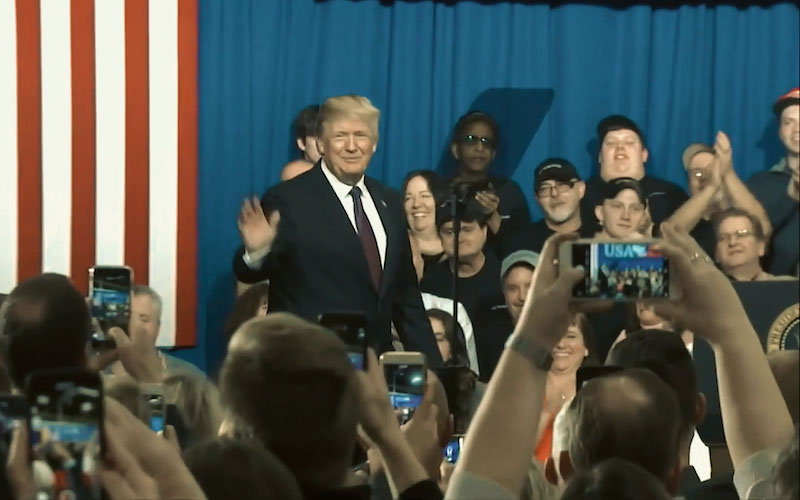
US President Donald Trump will deliver his State of the Union address to Congress on Tuesday (Wednesday morning at 10:00 AM Beijing time), amid a period of domestic and international turmoil in his 13 months in office. Polls show his approval ratings are declining, public discontent is rising over the cost of living, tensions with Iran are escalating, the Supreme Court has just overturned his global tariff measures, and economic data is slowing more than expected.
Trump is expected to publicly outline his Iran policy for the first time, touting his "achievement" in brokering the peace agreement and arguing that the Supreme Court's tariff ruling was flawed, outlining alternative legal grounds for restoring most tariffs. White House aides are urging him to focus on economic issues, touting the stock market rally, tax cuts, and border policy achievements to garner voter support.
More than 20 Democratic lawmakers opted to skip the State of the Union address and instead hold an outdoor rally on the National Mall, saying they would offer a "more honest account" of Trump's record. Last year, some Democrats walked out during the speech in protest, and the partisan divide continues this year.
Trump is known for his improvisational style, and this speech was intentionally given space for such moments, but his tendency to stray from the topic could be risky. Republican strategists say this is his "only chance to get the world's attention," and he needs to avoid going off-topic to solidify his voter base.
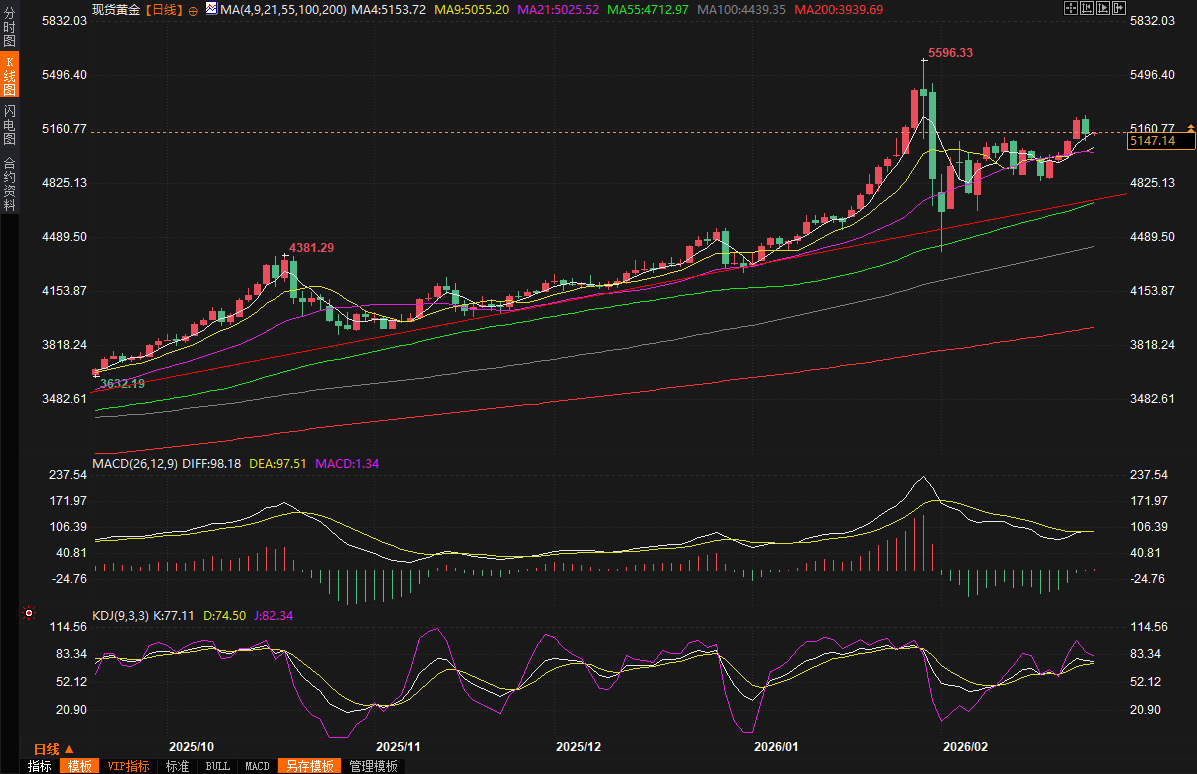
(Spot gold daily chart, source: FX678)
Overall, although gold prices have retreated in the short term due to profit-taking and a strong dollar, multiple safe-haven factors and structural demand continue to provide solid support at the bottom. Institutions generally believe that against the backdrop of continued global uncertainty, gold's long-term value as the ultimate safe-haven asset and anchor of trust remains prominent, and the possibility of a future rebound or even new highs should not be underestimated.
At 07:52 Beijing time, spot gold was trading at $5151.24 per ounce.
Despite the price pullback, bargain hunting provided support, with traders closely watching President Donald Trump's State of the Union address later that day (10:00 AM Beijing time on Wednesday). The speech is expected to address key issues such as fiscal policy, trade tariffs, and international relations, potentially providing further directional guidance for the market. Meanwhile, the hawkish signals from Federal Reserve officials continue to support the dollar. For example, Boston Fed President Susan Collins explicitly stated that interest rates will remain unchanged for an extended period given improving labor market data and lingering inflation risks. This monetary policy expectation further enhances the dollar's appeal, directly pressuring gold.
Profit-taking and a strong dollar were the main drivers of the downside, while geopolitical uncertainty provided support at the bottom.
After gold hit multi-week highs, some holders chose to lock in previous gains, leading to increasing selling pressure. This typical profit-taking phenomenon is common after a rapid price increase, directly weakening gold's short-term upward momentum. Meanwhile, the continued hawkish statements from Federal Reserve officials provided solid support for the US dollar, further exacerbating gold's relative weakness. As a dollar-denominated commodity, gold prices naturally have a negative correlation with the dollar index; when the dollar strengthens, gold often faces downward pressure.
However, the downside for gold is not unlimited. Continued uncertainty surrounding US trade policy and the potential escalation of tensions in the Middle East are key factors limiting the decline in gold prices. Gold prices rebounded quickly on Tuesday after falling below $5100, closing near the $5140 level. Although the US Supreme Court rejected some of President Trump's previous tariff measures, Trump subsequently announced an increase in temporary tariffs on global imports from 10% to the legally allowed maximum of 15%, a statement that again fueled market confusion and concern about the US trade stance. Furthermore, the US and Iran will hold a new round of talks in Geneva, with the Iranian Foreign Minister stating that there is still a significant possibility of resolving the issue through diplomatic means. However, if there are any signs of deterioration in US-Iran relations, gold, a traditional safe-haven asset, often quickly attracts capital, thus providing strong support for a short-term rebound.
Societe Generale's in-depth analysis: Gold revaluation may not solve the US debt crisis, but it could reshape fiscal perceptions.
Despite a slowdown in global central bank gold purchases in recent months, Societe Generale's commodities research team remains optimistic, believing that official sector demand will gradually recover in the spring. The bank's latest precious metals report examines gold's unique position on central bank balance sheets from a historical perspective, emphasizing that gold is fundamentally different from government debt or other conventional reserve assets, existing instead as a strategic anchor.
The report points out that gold will continue to occupy a central position in the global foreign exchange reserve system, especially given the milestone that official gold reserves have surpassed US Treasury holdings for the first time in recent years (the first time since 1996). Analysts emphasize that gold is not a tool for short-term fiscal financing, but rather serves as an "anchor of trust"—possessing high liquidity, no burden, and no counterparty risk, primarily serving to maintain monetary credibility, enhance confidence, and improve systemic resilience. It exists independently of daily political decisions, as a last resort reserve in extreme scenarios, rather than an expedient means to address structural fiscal imbalances. Therefore, gold cannot be considered a true debt reduction tool; its core value lies in being immune to short-term policy interference and providing stable support during crises.
Amidst a global environment of rapidly expanding sovereign debt and escalating geopolitical risks, gold's appeal as a "trust anchor" is becoming increasingly prominent. Societe Generale believes that as cyclical tests of confidence in fiat currencies intensify, central banks are unlikely to abandon this unique asset.
Specifically regarding the United States, the bank explored the controversy surrounding the valuation of gold reserves. At current market prices, the ratio of US debt to gold holdings is approximately 29:1, which is not significantly different from countries like Japan and the UK. However, because the US still uses the fixed legal gold price of $42.22 per ounce, established since 1973, for accounting purposes, every $1 of gold corresponds to approximately $3484.5 of debt, creating a highly prominent "debt-gold price imbalance" globally.
The report reviews the historical precedent set by President Roosevelt during the Great Depression, when he revalued the price of gold from $20.67 to $35. This move instantly expanded the Treasury's gold-backed balance sheet and led to a real depreciation of the dollar by approximately 41%, effectively alleviating monetary tightening and deflationary pressures. Currently, US federal debt has surpassed the $38 trillion mark, while the accounting gold price remains at $42.22 per ounce. Assuming a future revaluation of the gold price to approximately $5,000 per ounce, it could generate a valuation gain of approximately $2.1 trillion, equivalent to 5%-6% of the current total debt. However, analysts explicitly warn that such a revaluation can only improve the fiscal appearance, buy time, and reshape gold's role in the monetary system, but it cannot fundamentally solve the long-term fiscal deficit and debt sustainability problems of the United States. Instead, it may be interpreted by the market as a signal of systemic pressure.
Natixis predicts that gold may surge to a high of $5,800 amid escalating geopolitical conflicts.
Escalating geopolitical tensions in the Middle East have become a significant driver of the recent gold market. Natixis precious metals analyst Bernard Dahdah noted in his latest report that a further escalation of the US-Iran standoff could trigger a surge in safe-haven demand, potentially pushing gold prices up by around 15% in the short term, with the price range expected to quickly reach $5,500-$5,800 per ounce. He observed that since the Trump administration has signaled a tougher stance towards Iran, gold has repeatedly exhibited safe-haven characteristics, briefly breaking through the $5,000 mark last week. Although it failed to hold above $5,200, the support level below remains relatively solid.
Dahdah also cautioned that gains driven purely by safe-haven demand are often highly volatile, and could be quickly wiped out within days to weeks should the conflict show signs of easing, even if the geopolitical event itself lasts longer. Regarding the potential scale of the conflict, Natixis believes the Trump team is likely to continue its "limited action" strategy, primarily targeting key Iranian figures while preserving the integrity of the existing regime structure and security system—similar to its approach in Venezuela, rather than the full-scale regime change model pursued by the Bush administration in Iraq and Afghanistan. The bank expects this type of Middle East crisis cycle to last approximately one month.
Facing internal and external pressures, Trump seeks a turnaround in his State of the Union address, aiming for a policy reversal.
US President Donald Trump will deliver his State of the Union address to Congress on Tuesday (Wednesday morning at 10:00 AM Beijing time), amid a period of domestic and international turmoil in his 13 months in office. Polls show his approval ratings are declining, public discontent is rising over the cost of living, tensions with Iran are escalating, the Supreme Court has just overturned his global tariff measures, and economic data is slowing more than expected.
Trump is expected to publicly outline his Iran policy for the first time, touting his "achievement" in brokering the peace agreement and arguing that the Supreme Court's tariff ruling was flawed, outlining alternative legal grounds for restoring most tariffs. White House aides are urging him to focus on economic issues, touting the stock market rally, tax cuts, and border policy achievements to garner voter support.
More than 20 Democratic lawmakers opted to skip the State of the Union address and instead hold an outdoor rally on the National Mall, saying they would offer a "more honest account" of Trump's record. Last year, some Democrats walked out during the speech in protest, and the partisan divide continues this year.
Trump is known for his improvisational style, and this speech was intentionally given space for such moments, but his tendency to stray from the topic could be risky. Republican strategists say this is his "only chance to get the world's attention," and he needs to avoid going off-topic to solidify his voter base.
(Spot gold daily chart, source: FX678)
Overall, although gold prices have retreated in the short term due to profit-taking and a strong dollar, multiple safe-haven factors and structural demand continue to provide solid support at the bottom. Institutions generally believe that against the backdrop of continued global uncertainty, gold's long-term value as the ultimate safe-haven asset and anchor of trust remains prominent, and the possibility of a future rebound or even new highs should not be underestimated.
At 07:52 Beijing time, spot gold was trading at $5151.24 per ounce.
- Risk Warning and Disclaimer
- The market involves risk, and trading may not be suitable for all investors. This article is for reference only and does not constitute personal investment advice, nor does it take into account certain users’ specific investment objectives, financial situation, or other needs. Any investment decisions made based on this information are at your own risk.