Crude oil trading alert: Risk premiums have declined somewhat, and US crude oil prices remain volatile at high levels.
2026-02-25 09:32:57
On Wednesday during Asian trading hours, international oil prices began to pull back after rising for several weeks due to geopolitical tensions. They are currently consolidating at high levels, trading around $66. Market focus has shifted from military risks to diplomatic developments, and risk premiums have cooled significantly.
The previous rise in oil prices was mainly due to market concerns that the US military deployment in the Middle East could trigger supply disruptions. The Strait of Hormuz, a vital global energy transport route, handles approximately one-fifth of China's crude oil exports; any escalation of the situation would quickly transmit the impact to the global market.
 However, the situation has shown signs of easing as Iran signals its willingness to move forward with negotiations. Nuclear talks are expected to resume in Geneva, where US representatives Steve Witkoff and Jared Kushner will meet again with the Iranian foreign minister.
Iran's Deputy Foreign Minister publicly stated that Tehran is prepared to take necessary steps to reach an agreement, which to some extent alleviated market concerns about an escalation of the conflict. "If shipping through the Strait of Hormuz is disrupted, it will affect supply by approximately 20 million barrels per day, and oil price fluctuations may become unpredictable." — PVM Oil Associates
However, the risks have not completely disappeared. The United States continues to strengthen its military presence in the region, and the market remains cautious about the outcome of the negotiations. The current decline in oil prices does not mean that geopolitical risks have been completely eliminated, but rather reflects a reassessment of the probability of extreme scenarios.
From a fundamental perspective, supply-side pressures persist. OPEC+ and oil-producing countries in the Americas continue to increase production, global inventory levels are rising, while demand growth remains sluggish. The OPEC+ meeting next month may continue to discuss expanding production quotas, indicating that major oil-producing countries are still vying for market share.
Against the backdrop of a relatively loose supply and demand structure, oil prices lack solid support for a sustained and significant upward trend. The current market logic exhibits characteristics of a "dual game": on the one hand, diplomatic progress is lowering risk premiums; on the other hand, supply growth is exerting medium-term pressure on prices. The interplay of these two forces has led oil prices into a period of fluctuation and correction.
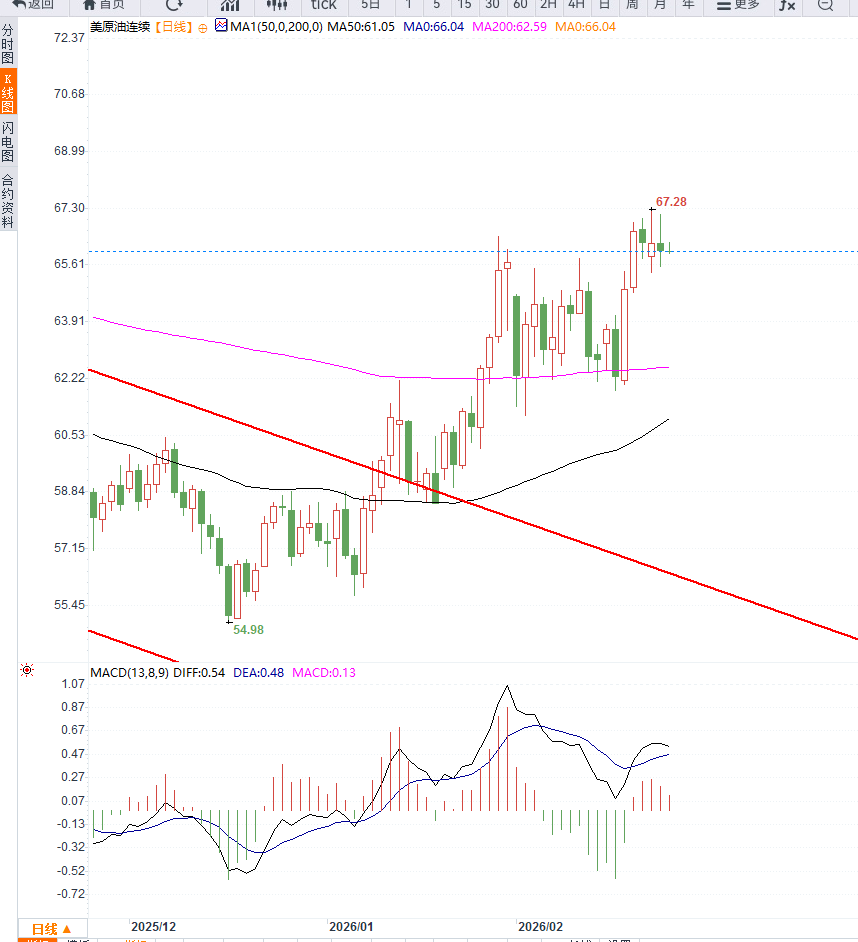
From the daily chart, WTI crude oil prices formed a temporary top after the previous surge, and the recent three consecutive bearish candles indicate increasing bearish momentum. The price has broken below short-term moving average support, and the technical pattern has turned bearish. The first support level is around $65.20, and the second support level is $63.80. The first resistance level is $67.50, and the second resistance level is $70.00.
If negotiations continue to send positive signals, oil prices may further test the $63 area; if the diplomatic process is hindered or the situation becomes tense again, oil prices are expected to quickly recover to $67 and challenge $70.
Overall, the technical structure has shifted from a risk-driven upward trend to a volatile downward trend, with a short-term bearish bias, but volatility may remain high.
Editor's Note:
This recent drop in oil prices is not due to a sudden change in fundamentals, but rather a natural correction of risk premiums. The market had previously priced in a high probability of conflict, and once diplomatic signals emerged, prices quickly corrected. However, the supply-demand balance remains the true determinant of medium-term trends.
Current rising inventories and increased production pose real pressures, meaning that even with recurring geopolitical risks, the upside potential for oil prices may be limited. Future oil price movements will depend on two variables: whether negotiations achieve substantial progress and whether OPEC+ continues to push for increased production.
In the short term, oil prices are more likely to fluctuate within the $65-$70 range rather than trend in one direction. The market is searching for a new equilibrium between risk and reality.
The previous rise in oil prices was mainly due to market concerns that the US military deployment in the Middle East could trigger supply disruptions. The Strait of Hormuz, a vital global energy transport route, handles approximately one-fifth of China's crude oil exports; any escalation of the situation would quickly transmit the impact to the global market.
However, the situation has shown signs of easing as Iran signals its willingness to move forward with negotiations. Nuclear talks are expected to resume in Geneva, where US representatives Steve Witkoff and Jared Kushner will meet again with the Iranian foreign minister.Iran's Deputy Foreign Minister publicly stated that Tehran is prepared to take necessary steps to reach an agreement, which to some extent alleviated market concerns about an escalation of the conflict. "If shipping through the Strait of Hormuz is disrupted, it will affect supply by approximately 20 million barrels per day, and oil price fluctuations may become unpredictable." — PVM Oil Associates
However, the risks have not completely disappeared. The United States continues to strengthen its military presence in the region, and the market remains cautious about the outcome of the negotiations. The current decline in oil prices does not mean that geopolitical risks have been completely eliminated, but rather reflects a reassessment of the probability of extreme scenarios.
From a fundamental perspective, supply-side pressures persist. OPEC+ and oil-producing countries in the Americas continue to increase production, global inventory levels are rising, while demand growth remains sluggish. The OPEC+ meeting next month may continue to discuss expanding production quotas, indicating that major oil-producing countries are still vying for market share.
Against the backdrop of a relatively loose supply and demand structure, oil prices lack solid support for a sustained and significant upward trend. The current market logic exhibits characteristics of a "dual game": on the one hand, diplomatic progress is lowering risk premiums; on the other hand, supply growth is exerting medium-term pressure on prices. The interplay of these two forces has led oil prices into a period of fluctuation and correction.
From the daily chart, WTI crude oil prices formed a temporary top after the previous surge, and the recent three consecutive bearish candles indicate increasing bearish momentum. The price has broken below short-term moving average support, and the technical pattern has turned bearish. The first support level is around $65.20, and the second support level is $63.80. The first resistance level is $67.50, and the second resistance level is $70.00.
If negotiations continue to send positive signals, oil prices may further test the $63 area; if the diplomatic process is hindered or the situation becomes tense again, oil prices are expected to quickly recover to $67 and challenge $70.
Overall, the technical structure has shifted from a risk-driven upward trend to a volatile downward trend, with a short-term bearish bias, but volatility may remain high.
Editor's Note:
This recent drop in oil prices is not due to a sudden change in fundamentals, but rather a natural correction of risk premiums. The market had previously priced in a high probability of conflict, and once diplomatic signals emerged, prices quickly corrected. However, the supply-demand balance remains the true determinant of medium-term trends.
Current rising inventories and increased production pose real pressures, meaning that even with recurring geopolitical risks, the upside potential for oil prices may be limited. Future oil price movements will depend on two variables: whether negotiations achieve substantial progress and whether OPEC+ continues to push for increased production.
In the short term, oil prices are more likely to fluctuate within the $65-$70 range rather than trend in one direction. The market is searching for a new equilibrium between risk and reality.
- Risk Warning and Disclaimer
- The market involves risk, and trading may not be suitable for all investors. This article is for reference only and does not constitute personal investment advice, nor does it take into account certain users’ specific investment objectives, financial situation, or other needs. Any investment decisions made based on this information are at your own risk.