Trump's war scenario: Israel strikes first, the US reaps the rewards, and the gold rush has just begun?
2026-02-26 14:23:51
Two sources familiar with White House discussions revealed that senior advisors to President Donald Trump privately strongly favored an Israeli-led military strike against Iran, rather than a direct U.S. attack. The core of this strategy was not purely military considerations, but rather a highly politicized calculation of domestic public opinion: an Israeli attack that would trigger Iranian retaliation against the U.S. or its allies would more easily garner support from American voters for subsequent U.S. military action.
These Trump administration officials privately believed that if Israel launched a unilateral attack, followed by Iranian retaliation, it would provide a stronger justification for U.S. intervention. One person directly familiar with the discussions stated, "There's a view within and around the White House that if Israel acts first, followed by Iranian retaliation against the U.S., it would provide a much stronger reason for U.S. action, and the overall political atmosphere would be much better."
Driven by safe-haven buying, spot gold rose during the Asian and European sessions on Thursday (February 26), currently trading around $5,195 per ounce, up about 0.65% on the day.

Sources familiar with the matter point out that the core of this political calculation lies in the fact that the American public is more willing to accept conflict with Iran, provided that the United States or its allies are attacked first. Recent polls show that the American public, especially Republican voters, generally support regime change in Iran, but the vast majority are unwilling to pay the price of American military casualties.
Therefore, when assessing military action against Iran, the Trump team not only focused on substantive reasons such as Iran's nuclear program, ballistic missile infrastructure, and its support for proxy forces in the region, but also paid special attention to the "perception" and political packaging of the action.
While Washington's hopes for a diplomatic solution to the Iranian impasse have waned, the focus has now shifted to when and how the United States will intervene in Iran. Although the Trump team hopes Israel will "take the lead," two sources familiar with the matter believe the most likely scenario remains a joint US-Israeli military operation.
White House spokeswoman Anna Kelly responded to a request for comment by saying, "The media can continue to speculate about the president's thoughts, but only President Trump himself knows what he or she will or will not do." The Israeli embassy in Washington declined to comment.
Last week, Israeli Prime Minister Benjamin Netanyahu visited the White House to pressure the Trump administration to take necessary measures to stop Iran's nuclear program, ballistic missile infrastructure, and its support for proxy forces in the region.
Meanwhile, Trump's chief negotiator, Special Envoy Steve Vitkov, and his son-in-law Jared Kushner will attempt to reach a deal with Iran in Geneva later Thursday. A source familiar with the matter revealed that while this diplomatic effort is seen as a "serious attempt," the prevailing view within the president's inner circle remains "we'll eventually bomb them."
The scale of the operation remains the biggest point of contention. Sources familiar with the matter mentioned two core risks:
Risk of depleted munitions stockpiles : A large-scale, sustained strike could severely deplete U.S. precision-guided munitions reserves, weakening U.S. deterrence capabilities in other potential hotspots. Pentagon officials and members of Congress have repeatedly warned recently that a prolonged strike against Iran could severely deplete U.S. military stockpiles.
The political cost of US casualties : If a full-scale attack of "regime change" is launched, Iran is highly likely to retaliate using all available means. The US has substantial assets in the Middle East, including thousands of troops and various military facilities. These assets are not under the full protection of the "Iron Dome," so the probability of US casualties is high, and any significant US casualties will trigger a huge domestic political backlash. An informed source stated, "Iran is likely to retaliate with everything it has; every asset we have in the Middle East could become a target, which will bring high casualty risks and high political costs."
Currently, the United States has amassed its largest offensive force in the Middle East since the 2003 invasion of Iraq, including two carrier strike groups, dozens of fighter jets, reconnaissance aircraft, and aerial refueling tankers. A senior U.S. intelligence official stated that intelligence agencies are "closely monitoring" potential asymmetric retaliation by Iran against U.S. military facilities and personnel in the Middle East and Europe.
Trump has several options for striking Iran, including:
Limited preemptive strikes : as a means of exerting pressure to force Iran to accept an agreement acceptable to the United States;
Escalate the large-scale strike : If negotiations fail, expand the scope of the strike;
Key targets : Iranian nuclear facilities (including remnants from the US-Israeli strikes last June) and ballistic missile production and launch infrastructure. Israel views the latter as a major threat to its security.
Extreme option : "Decapitation strike" targeting Iran's Supreme Leader Ayatollah Ali Khamenei, as well as senior members of the Islamic Revolutionary Guard Corps and key command chains.
Such operations could last from days to weeks, with highly uncertain outcomes, especially if relying solely on air power. During the conflict between Israel and Iran last June (with the US subsequently joining), Netanyahu called on the Iranian people to seize the opportunity to overthrow the regime. Trump at the time claimed that the US strikes had "completely destroyed" Iran's nuclear program, but recently he expressed doubt about whether Iran had truly abandoned its nuclear ambitions.
House Armed Services Committee Chairman Mike Rogers (Republican-Alabama) said after being briefed Wednesday morning that evidence suggests Iran is restarting its nuclear program, potentially requiring U.S. military intervention. The Iranian government has long maintained that it is not seeking nuclear weapons but insists on its right to a peaceful nuclear program, including for scientific and medical purposes. The U.S. has long been skeptical of Iran's commitments, especially given its uranium enrichment levels. Iranian government officials did not immediately respond to requests for comment.
As evidence continues to emerge that Iran has restarted its nuclear program, members of both parties in the U.S. Congress are closely monitoring developments, and the trade-off between the "political window" and the "military risks" of military intervention is becoming the Trump administration's most critical strategic choice.
The US government is already meticulously calculating "how to make the war more popular." This kind of war marketing itself erodes trust in the global governance system. The logic of gold as a "political risk hedge" is further strengthened.
If Iran retaliates, it will trigger a "huge domestic political backlash." This means that if the conflict escalates, the United States may find itself in a "dilemma"—which is exactly the kind of macroeconomic environment that gold loves (uncertainty + policy stalemate).
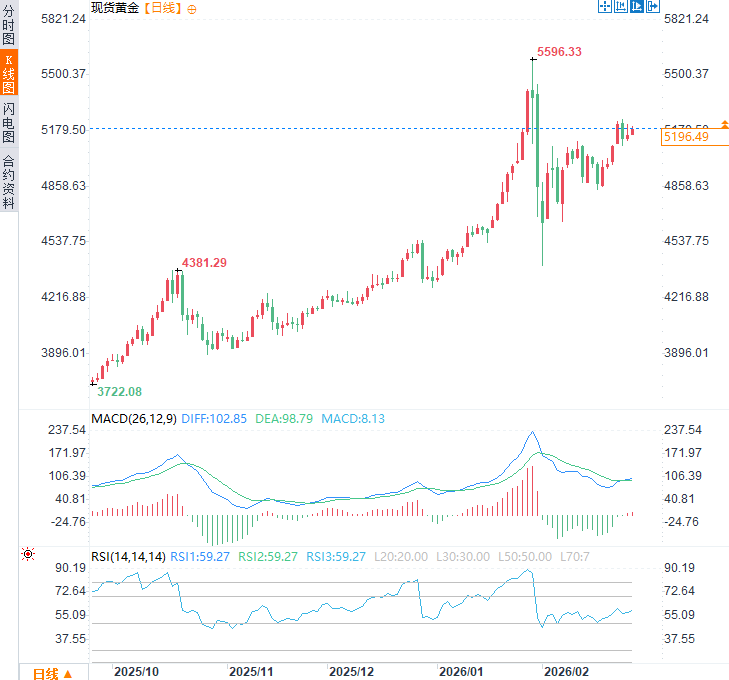
(Spot gold daily chart, source: FX678)
At 14:23 Beijing time, spot gold was trading at $5195.02 per ounce.
These Trump administration officials privately believed that if Israel launched a unilateral attack, followed by Iranian retaliation, it would provide a stronger justification for U.S. intervention. One person directly familiar with the discussions stated, "There's a view within and around the White House that if Israel acts first, followed by Iranian retaliation against the U.S., it would provide a much stronger reason for U.S. action, and the overall political atmosphere would be much better."
Driven by safe-haven buying, spot gold rose during the Asian and European sessions on Thursday (February 26), currently trading around $5,195 per ounce, up about 0.65% on the day.
Political calculation: The public is more receptive to retaliating after being attacked.
Sources familiar with the matter point out that the core of this political calculation lies in the fact that the American public is more willing to accept conflict with Iran, provided that the United States or its allies are attacked first. Recent polls show that the American public, especially Republican voters, generally support regime change in Iran, but the vast majority are unwilling to pay the price of American military casualties.
Therefore, when assessing military action against Iran, the Trump team not only focused on substantive reasons such as Iran's nuclear program, ballistic missile infrastructure, and its support for proxy forces in the region, but also paid special attention to the "perception" and political packaging of the action.
While Washington's hopes for a diplomatic solution to the Iranian impasse have waned, the focus has now shifted to when and how the United States will intervene in Iran. Although the Trump team hopes Israel will "take the lead," two sources familiar with the matter believe the most likely scenario remains a joint US-Israeli military operation.
White House spokeswoman Anna Kelly responded to a request for comment by saying, "The media can continue to speculate about the president's thoughts, but only President Trump himself knows what he or she will or will not do." The Israeli embassy in Washington declined to comment.
Netanyahu's pressure and Geneva negotiations proceed in parallel
Last week, Israeli Prime Minister Benjamin Netanyahu visited the White House to pressure the Trump administration to take necessary measures to stop Iran's nuclear program, ballistic missile infrastructure, and its support for proxy forces in the region.
Meanwhile, Trump's chief negotiator, Special Envoy Steve Vitkov, and his son-in-law Jared Kushner will attempt to reach a deal with Iran in Geneva later Thursday. A source familiar with the matter revealed that while this diplomatic effort is seen as a "serious attempt," the prevailing view within the president's inner circle remains "we'll eventually bomb them."
Two core concerns about the scale of military operations
The scale of the operation remains the biggest point of contention. Sources familiar with the matter mentioned two core risks:
Risk of depleted munitions stockpiles : A large-scale, sustained strike could severely deplete U.S. precision-guided munitions reserves, weakening U.S. deterrence capabilities in other potential hotspots. Pentagon officials and members of Congress have repeatedly warned recently that a prolonged strike against Iran could severely deplete U.S. military stockpiles.
The political cost of US casualties : If a full-scale attack of "regime change" is launched, Iran is highly likely to retaliate using all available means. The US has substantial assets in the Middle East, including thousands of troops and various military facilities. These assets are not under the full protection of the "Iron Dome," so the probability of US casualties is high, and any significant US casualties will trigger a huge domestic political backlash. An informed source stated, "Iran is likely to retaliate with everything it has; every asset we have in the Middle East could become a target, which will bring high casualty risks and high political costs."
Currently, the United States has amassed its largest offensive force in the Middle East since the 2003 invasion of Iraq, including two carrier strike groups, dozens of fighter jets, reconnaissance aircraft, and aerial refueling tankers. A senior U.S. intelligence official stated that intelligence agencies are "closely monitoring" potential asymmetric retaliation by Iran against U.S. military facilities and personnel in the Middle East and Europe.
Possible strike options and target list
Trump has several options for striking Iran, including:
Limited preemptive strikes : as a means of exerting pressure to force Iran to accept an agreement acceptable to the United States;
Escalate the large-scale strike : If negotiations fail, expand the scope of the strike;
Key targets : Iranian nuclear facilities (including remnants from the US-Israeli strikes last June) and ballistic missile production and launch infrastructure. Israel views the latter as a major threat to its security.
Extreme option : "Decapitation strike" targeting Iran's Supreme Leader Ayatollah Ali Khamenei, as well as senior members of the Islamic Revolutionary Guard Corps and key command chains.
Such operations could last from days to weeks, with highly uncertain outcomes, especially if relying solely on air power. During the conflict between Israel and Iran last June (with the US subsequently joining), Netanyahu called on the Iranian people to seize the opportunity to overthrow the regime. Trump at the time claimed that the US strikes had "completely destroyed" Iran's nuclear program, but recently he expressed doubt about whether Iran had truly abandoned its nuclear ambitions.
House Armed Services Committee Chairman Mike Rogers (Republican-Alabama) said after being briefed Wednesday morning that evidence suggests Iran is restarting its nuclear program, potentially requiring U.S. military intervention. The Iranian government has long maintained that it is not seeking nuclear weapons but insists on its right to a peaceful nuclear program, including for scientific and medical purposes. The U.S. has long been skeptical of Iran's commitments, especially given its uranium enrichment levels. Iranian government officials did not immediately respond to requests for comment.
As evidence continues to emerge that Iran has restarted its nuclear program, members of both parties in the U.S. Congress are closely monitoring developments, and the trade-off between the "political window" and the "military risks" of military intervention is becoming the Trump administration's most critical strategic choice.
The safe-haven logic of gold has been further strengthened.
The US government is already meticulously calculating "how to make the war more popular." This kind of war marketing itself erodes trust in the global governance system. The logic of gold as a "political risk hedge" is further strengthened.
If Iran retaliates, it will trigger a "huge domestic political backlash." This means that if the conflict escalates, the United States may find itself in a "dilemma"—which is exactly the kind of macroeconomic environment that gold loves (uncertainty + policy stalemate).
(Spot gold daily chart, source: FX678)
At 14:23 Beijing time, spot gold was trading at $5195.02 per ounce.
- Risk Warning and Disclaimer
- The market involves risk, and trading may not be suitable for all investors. This article is for reference only and does not constitute personal investment advice, nor does it take into account certain users’ specific investment objectives, financial situation, or other needs. Any investment decisions made based on this information are at your own risk.