US forces in the Persian Gulf have reached their peak; gold prices are consolidating as the US-Iran agreement nears its end.
2026-02-26 17:22:14
In his State of the Union address on Tuesday, Trump gave an official statement on the troop buildup around Iran, with the core objective being to prevent Iran from acquiring nuclear weapons. He also reiterated that diplomacy was the preferred solution, but did not clearly define the specific strategic objectives and red lines for deterring war against Iran.
Iran has repeatedly denied pursuing a nuclear weapons development program. On the eve of the negotiations, the Iranian Foreign Minister reiterated that Tehran has no plans to develop nuclear weapons. The Iranian Foreign Ministry also accused Trump of fabricating a "monumental lie" in his State of the Union address and accused the White House of launching a systematic disinformation campaign against Iran.
However, the market generally takes a cautious approach to Iran's statements. Historical data shows that Iran has enriched uranium to near weapons-grade levels, just one step away from producing weapons-grade nuclear materials.
The White House has never clearly defined its strategic objectives toward Iran in terms of specific demands, policy red lines, or critical conditions that would trigger an airstrike.
According to a former U.S. intelligence official, Trump's core demand was not for Iran to relinquish its existing assets, but rather to prohibit Iran from rebuilding three types of potential deterrent capabilities: first, its nuclear weapons program, which was on the verge of being implemented (this program has been significantly delayed since the U.S. and Israel claimed to have destroyed its core nuclear enrichment facility last June).
Second, the intercontinental ballistic missile program with global coverage, preventing Iran from acquiring the ability to deliver nuclear warheads across continents; third, the proxy armed network of the "Axis of Resistance" built by the Islamic Revolutionary Guard Corps (including the severely damaged Hezbollah and Yemeni Houthi rebels), Iran must promise not to rebuild this system.
In exchange, the US promised to fully lift sanctions against Iran, remove the label of "international outcast" from Iran, and allow Iran to share in the benefits of economic growth.
However, the Iranian regime was born out of revolution and has long maintained a core stance of rejecting external interference. Even with the domestic economy on the verge of collapse and frequent protests, its willingness to compromise remains uncertain.
From the perspective of US foreign policy, regime change is not its core demand in Iran.
The Venezuelan case clearly demonstrates that the US prefers to force a target regime to submit to its demands rather than investing huge sums to forcibly rebuild the regime. Although Maduro was ousted from power, the Venezuelan regime structure did not change fundamentally, and its core team ultimately yielded to US demands, cooperating with US companies and severing ties with countries such as Cuba.
The Trump administration’s core objective is to achieve a complete reshaping of the Middle East’s geopolitical landscape through military and economic pressure, in order to avoid falling into a cycle of “strike-rebuild-strike again.”
The US has made it clear that any agreement with Iran must include a strict verification mechanism to prevent funds from Iran's economic recovery from flowing back into weapons development and terrorist organizations.
Just one day before the start of the third round of indirect negotiations between the US and Iran in Geneva, the US further escalated its pressure on Iran.
On Wednesday, the United States imposed sanctions on more than 30 individuals, companies, and ships with ties to Iran, targeting Iran's oil export network and its procurement channels for ballistic missiles and advanced conventional weapons.
The core purpose of the sanctions, besides exerting pressure to increase leverage in negotiations, is also to cut off Iran's domestic "finance-weapons" chain. The US Treasury Secretary stated that this move is a continuation of the Trump administration's "maximum pressure" campaign against Iran, aimed at combating Iran's use of the global financial system to smuggle oil, launder profits, and thereby provide financial support for its nuclear program, conventional weapons projects, and proxy armed groups.
The US sanctions target oil transportation: focusing on Iran's "shadow fleet," including the Panamanian-flagged "Hot" (suspected of transporting Iranian liquefied petroleum gas to Bangladesh) and the Barbados-flagged "Ocean Koi" (carrying millions of barrels of Iranian fuel oil and condensate), among other oil tankers, which have been included in the list.
Weapons-related: Sanctions are imposed on employees of Quds Force Aeronautical Industries, which provides technical support for Iran's "Migrator" series of drones and conducts drone operations overseas;
Related entities: Companies in Türkiye and the UAE that provide financial settlement, procurement of sensitive equipment, and supply of missile raw materials to the Iranian Islamic Revolutionary Guard Corps.
Currently, the US and Iran negotiating teams are ready to hold key consultations in Geneva. Both sides agree that this round of talks is of great strategic significance, and the US has also set an informal timeline for advancing the negotiations.
From the perspective of both sides, Iran's domestic economy is on the verge of collapse and protests are frequent, making it possible for the regime to compromise in order to survive; while the United States cannot maintain a large-scale military deployment without substantial results in the long term, and both Trump and Iran's Supreme Leader Khamenei are approaching a critical point in their decision-making.
In this geopolitical game, "remaining inactive" is no longer a viable option, and the outcome of the negotiations will directly affect the geopolitical landscape of the Middle East and the trends of global energy and financial markets.
The reason the United States has pushed non-deployment to its peak is that it wants to exchange "a huge one-time investment in deterrence costs" for "the strategic benefits of not having to fight for a long time".
The probability of a full-scale war is extremely low, and the cost is too high, which would cripple the US treasury and drive up inflation, contradicting Trump's "America First" economic logic.
At the same time, escalating sanctions is also to gain more initiative at the negotiating table. If Iran compromises under the current maximum pressure, then this military expenditure will be a "highly cost-effective" deal for Trump.
Conversely, if deterrence fails, the United States will face the dilemma of either "withdrawing troops and losing prestige" or "opening fire and causing economic turmoil." However, the United States previously set the negotiation period for March 1-March 6. As the date approaches, it may be difficult for the United States and Iran to arrange the next round of negotiations. Therefore, this negotiation is indeed the most important, but the probability of de-escalation should be greater.
From a technical perspective, gold prices are still in a consolidation phase. The 20-day moving average is still turning downwards, and after the recent pullback from the high of 5249, gold prices have not yet recovered from Tuesday's large bearish candle. Currently, facing extreme pressure from the United States, gold prices have not shown significant strength, and the market is still betting that the negotiations will not lead to a further deterioration of the situation.
However, the trend of gold prices shows that funds involved in geopolitical games tend to be relatively conservative when it comes to negotiation points. This demonstrates the resilience of gold, indicating that even detached from recent geopolitical issues, gold prices still have some support.
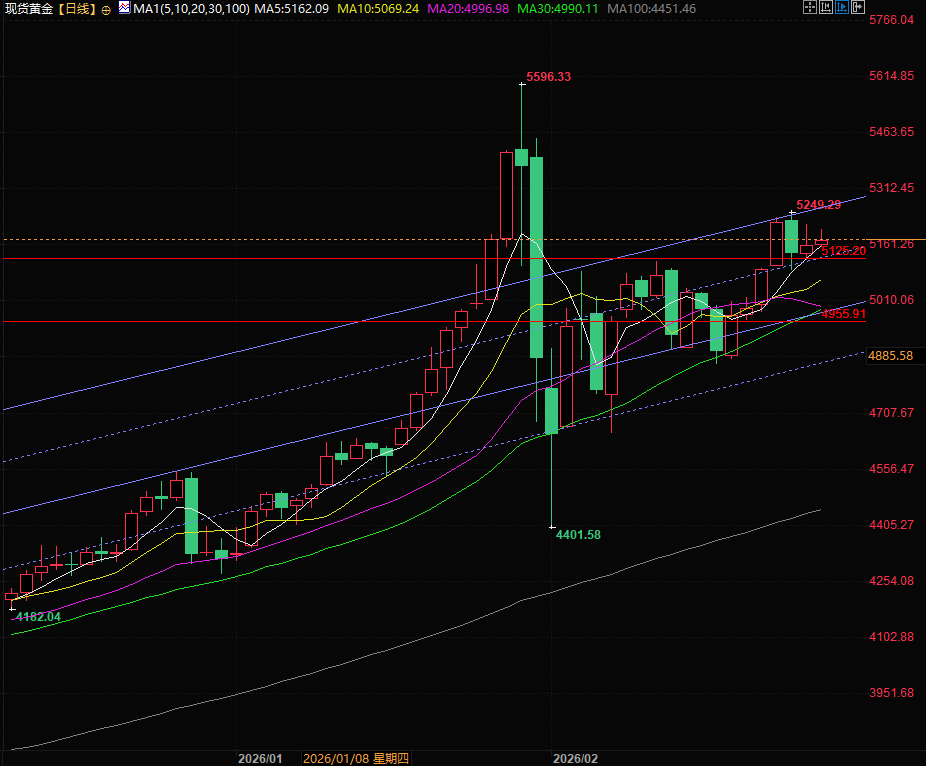
(Spot gold daily chart, source: FX678)
At 17:18 Beijing time, spot gold was trading at $5,176 per ounce.
Iran has repeatedly denied pursuing a nuclear weapons development program. On the eve of the negotiations, the Iranian Foreign Minister reiterated that Tehran has no plans to develop nuclear weapons. The Iranian Foreign Ministry also accused Trump of fabricating a "monumental lie" in his State of the Union address and accused the White House of launching a systematic disinformation campaign against Iran.
However, the market generally takes a cautious approach to Iran's statements. Historical data shows that Iran has enriched uranium to near weapons-grade levels, just one step away from producing weapons-grade nuclear materials.
Breaking down the core demands: The US's demands and Iran's "trade-off dilemma"
The White House has never clearly defined its strategic objectives toward Iran in terms of specific demands, policy red lines, or critical conditions that would trigger an airstrike.
According to a former U.S. intelligence official, Trump's core demand was not for Iran to relinquish its existing assets, but rather to prohibit Iran from rebuilding three types of potential deterrent capabilities: first, its nuclear weapons program, which was on the verge of being implemented (this program has been significantly delayed since the U.S. and Israel claimed to have destroyed its core nuclear enrichment facility last June).
Second, the intercontinental ballistic missile program with global coverage, preventing Iran from acquiring the ability to deliver nuclear warheads across continents; third, the proxy armed network of the "Axis of Resistance" built by the Islamic Revolutionary Guard Corps (including the severely damaged Hezbollah and Yemeni Houthi rebels), Iran must promise not to rebuild this system.
In exchange, the US promised to fully lift sanctions against Iran, remove the label of "international outcast" from Iran, and allow Iran to share in the benefits of economic growth.
However, the Iranian regime was born out of revolution and has long maintained a core stance of rejecting external interference. Even with the domestic economy on the verge of collapse and frequent protests, its willingness to compromise remains uncertain.
The US strategic logic: Abandon regime change and focus on geopolitical resetting in the Middle East.
From the perspective of US foreign policy, regime change is not its core demand in Iran.
The Venezuelan case clearly demonstrates that the US prefers to force a target regime to submit to its demands rather than investing huge sums to forcibly rebuild the regime. Although Maduro was ousted from power, the Venezuelan regime structure did not change fundamentally, and its core team ultimately yielded to US demands, cooperating with US companies and severing ties with countries such as Cuba.
The Trump administration’s core objective is to achieve a complete reshaping of the Middle East’s geopolitical landscape through military and economic pressure, in order to avoid falling into a cycle of “strike-rebuild-strike again.”
The US has made it clear that any agreement with Iran must include a strict verification mechanism to prevent funds from Iran's economic recovery from flowing back into weapons development and terrorist organizations.
The US intensifies pressure on Iran on the eve of negotiations: a new round of sanctions.
Just one day before the start of the third round of indirect negotiations between the US and Iran in Geneva, the US further escalated its pressure on Iran.
On Wednesday, the United States imposed sanctions on more than 30 individuals, companies, and ships with ties to Iran, targeting Iran's oil export network and its procurement channels for ballistic missiles and advanced conventional weapons.
The core purpose of the sanctions, besides exerting pressure to increase leverage in negotiations, is also to cut off Iran's domestic "finance-weapons" chain. The US Treasury Secretary stated that this move is a continuation of the Trump administration's "maximum pressure" campaign against Iran, aimed at combating Iran's use of the global financial system to smuggle oil, launder profits, and thereby provide financial support for its nuclear program, conventional weapons projects, and proxy armed groups.
The US sanctions target oil transportation: focusing on Iran's "shadow fleet," including the Panamanian-flagged "Hot" (suspected of transporting Iranian liquefied petroleum gas to Bangladesh) and the Barbados-flagged "Ocean Koi" (carrying millions of barrels of Iranian fuel oil and condensate), among other oil tankers, which have been included in the list.
Weapons-related: Sanctions are imposed on employees of Quds Force Aeronautical Industries, which provides technical support for Iran's "Migrator" series of drones and conducts drone operations overseas;
Related entities: Companies in Türkiye and the UAE that provide financial settlement, procurement of sensitive equipment, and supply of missile raw materials to the Iranian Islamic Revolutionary Guard Corps.
Negotiations enter a critical phase: Both sides approach a decision-making threshold
Currently, the US and Iran negotiating teams are ready to hold key consultations in Geneva. Both sides agree that this round of talks is of great strategic significance, and the US has also set an informal timeline for advancing the negotiations.
From the perspective of both sides, Iran's domestic economy is on the verge of collapse and protests are frequent, making it possible for the regime to compromise in order to survive; while the United States cannot maintain a large-scale military deployment without substantial results in the long term, and both Trump and Iran's Supreme Leader Khamenei are approaching a critical point in their decision-making.
In this geopolitical game, "remaining inactive" is no longer a viable option, and the outcome of the negotiations will directly affect the geopolitical landscape of the Middle East and the trends of global energy and financial markets.
Summary and Technical Analysis:
The reason the United States has pushed non-deployment to its peak is that it wants to exchange "a huge one-time investment in deterrence costs" for "the strategic benefits of not having to fight for a long time".
The probability of a full-scale war is extremely low, and the cost is too high, which would cripple the US treasury and drive up inflation, contradicting Trump's "America First" economic logic.
At the same time, escalating sanctions is also to gain more initiative at the negotiating table. If Iran compromises under the current maximum pressure, then this military expenditure will be a "highly cost-effective" deal for Trump.
Conversely, if deterrence fails, the United States will face the dilemma of either "withdrawing troops and losing prestige" or "opening fire and causing economic turmoil." However, the United States previously set the negotiation period for March 1-March 6. As the date approaches, it may be difficult for the United States and Iran to arrange the next round of negotiations. Therefore, this negotiation is indeed the most important, but the probability of de-escalation should be greater.
From a technical perspective, gold prices are still in a consolidation phase. The 20-day moving average is still turning downwards, and after the recent pullback from the high of 5249, gold prices have not yet recovered from Tuesday's large bearish candle. Currently, facing extreme pressure from the United States, gold prices have not shown significant strength, and the market is still betting that the negotiations will not lead to a further deterioration of the situation.
However, the trend of gold prices shows that funds involved in geopolitical games tend to be relatively conservative when it comes to negotiation points. This demonstrates the resilience of gold, indicating that even detached from recent geopolitical issues, gold prices still have some support.
(Spot gold daily chart, source: FX678)
At 17:18 Beijing time, spot gold was trading at $5,176 per ounce.
- Risk Warning and Disclaimer
- The market involves risk, and trading may not be suitable for all investors. This article is for reference only and does not constitute personal investment advice, nor does it take into account certain users’ specific investment objectives, financial situation, or other needs. Any investment decisions made based on this information are at your own risk.