Lagarde urged Europeans to read more and understand the euro, which then began to correct.
2026-02-26 18:52:50
On Thursday (February 26), during the Asian and European sessions, European Central Bank President Christine Lagarde addressed the European Parliament, expressing her dilemma of wanting to cut interest rates but having to keep an eye on the Federal Reserve and the European people. In contrast to the recent calls for a slowdown in US dollar interest rate cuts, the euro continued to retreat against the dollar during the speech.
In a policy dialogue, European Central Bank President Christine Lagarde comprehensively elaborated on the Eurozone's economic, inflation, and monetary policy stance. Coupled with the International Monetary Fund's (IMF) latest assessment of the Federal Reserve's policies, the difference in the pace of monetary policy between Europe and the United States has become the core theme of the current euro exchange rate and Eurozone asset pricing. With the interplay of internal and external factors, the medium-term trend of the euro is becoming increasingly clear.
Lagarde stated that the eurozone had previously suffered from high inflation, putting pressure on household consumption and business operations, and that the ECB's tightening policies had achieved significant results.
Eurozone inflation fell sharply from its peak of 10.6% in October 2022, fluctuated around the 2% target in the second half of 2025, and further declined to 1.7% in January 2026. Core inflation, excluding energy and food, also fell to 2.2%, showing a comprehensive decline in inflation.
On the economic front, the Eurozone's GDP is projected to grow by 1.5% for the whole of 2025, with a quarter-on-quarter growth of 0.3% in the fourth quarter, both exceeding initial expectations.
Growth was driven by domestic demand, with information and communication services being the core engine. The manufacturing sector remained resilient despite high tariffs and geopolitical uncertainties, while the construction industry gradually recovered.
A robust labor market, rising household incomes, and investment in related sectors will support the recovery, but high tariffs, a stronger euro, and global policy volatility will continue to suppress external demand.
Based on the assessment that inflation will remain stable at the 2% target in the medium term, the ECB kept its three key interest rates unchanged at the beginning of this month. Going forward, it will adhere to data-driven decision-making and make decisions on a meeting-by-meeting basis, without pre-setting an interest rate path. The euro's movement will closely follow changes in key data such as inflation, wages, and economic growth.
This global phenomenon is particularly evident in the Eurozone, where perceived inflation is on average 1.2 percentage points higher than the actual value. Even when the actual inflation has fallen, people still feel that prices are rising faster.
This divergence could affect consumption and savings, wage negotiations, weaken public trust in the ECB, and disrupt the transmission of monetary policy.
Lagarde pointed out that differences in consumption patterns, loss aversion, media coverage, and insufficient financial literacy among the public are the main causes. The ECB will narrow these discrepancies through three main approaches: stabilizing inflation, simplifying policy communication, and improving the financial literacy of the general public.
On February 25 local time, the IMF released a report giving a clear assessment: the Federal Reserve will only cut interest rates by 25 basis points in 2026, bringing the federal funds rate down to 3.25%-3.50% by the end of the year. This prediction is in stark contrast to the Trump administration's demand for significant interest rate cuts.
Regarding inflation, the US PCE price index is expected to rise by 0.5 percentage points at the beginning of the year due to tariff policies, with the impact gradually subsiding and falling back to the Fed's 2% policy target by early 2027. In terms of the economy and employment, the IMF projects US economic growth of 2.4% in 2026, with the unemployment rate remaining stable at around 4% within the full employment range, but job growth will be significantly lower than pre-pandemic levels.
Meanwhile, the IMF gave a negative assessment of the US tariff and immigration control policies:
Imposing tariffs will distort resource allocation and disrupt global supply chains; trade policy uncertainty may slow the economy.
Tighter immigration restrictions will compress the labor supply, drag down employment, and raise inflation. Over the next few years, this will reduce US economic activity by 0.4 percentage points and will also indirectly affect the Eurozone's external environment through global trade and financial channels.
The ECB adopted a cautious wait-and-see approach and kept interest rates unchanged, while the Fed cut rates very slowly, with only one operation throughout the year. The clear divergence in monetary policy between Europe and the US became the core support for the euro's performance.
Within the Eurozone, economic resilience and a steady decline in inflation provide fundamental support for the currency's value, but the divergence in perceived inflation and the suppression of external demand by a stronger euro remain potential constraints. Externally, US tariff policies disrupt global trade, and tightening labor markets raise concerns about inflation, which will affect risk appetite for the euro through global market volatility.
Overall, the medium-term trend of the euro will be highly dependent on two core factors: first, the marginal changes in the ECB's inflation, wage, and economic data will determine whether it adjusts its policy stance; second, the actual pace of the Fed's interest rate cuts and the effects of the implementation of US tariffs will influence the strength of the dollar and the interest rate differential between the US and Europe.
Against the backdrop of the ECB's "no predetermined path" and the Fed's "gradual interest rate cuts," the euro is expected to fluctuate, awaiting key data to provide a clear direction.
Lagarde introduced the concept of public perception of inflation and urged everyone to "read more books and learn more common sense" because she realized that in a society lacking economic common sense, the effectiveness of rational monetary policy is diminished.
She needs the public to understand the logic behind "declining inflation," thereby lowering wage expectations, stopping panic buying, and cooperating with the ECB to achieve a soft landing for the economy.
The European Central Bank (ECB) wants to maintain a moderately loose monetary policy while keeping inflation under control, but it also fears that the public's perception of high inflation will persist, ultimately leading to a rebound in actual inflation. Therefore, it chose to act at the opportune moment, which creates a new balance with the recent slowdown in the pace of interest rate cuts in the United States. This caused the euro to begin a correction against the US dollar after Lagarde's speech.
From a technical perspective, the euro has formed a minor triple top against the US dollar. Currently, the exchange rate is consolidating between the 0.5 and 0.382 Fibonacci retracements of this upward move, indicating a retracement of more than 50%, which is a very weak performance.
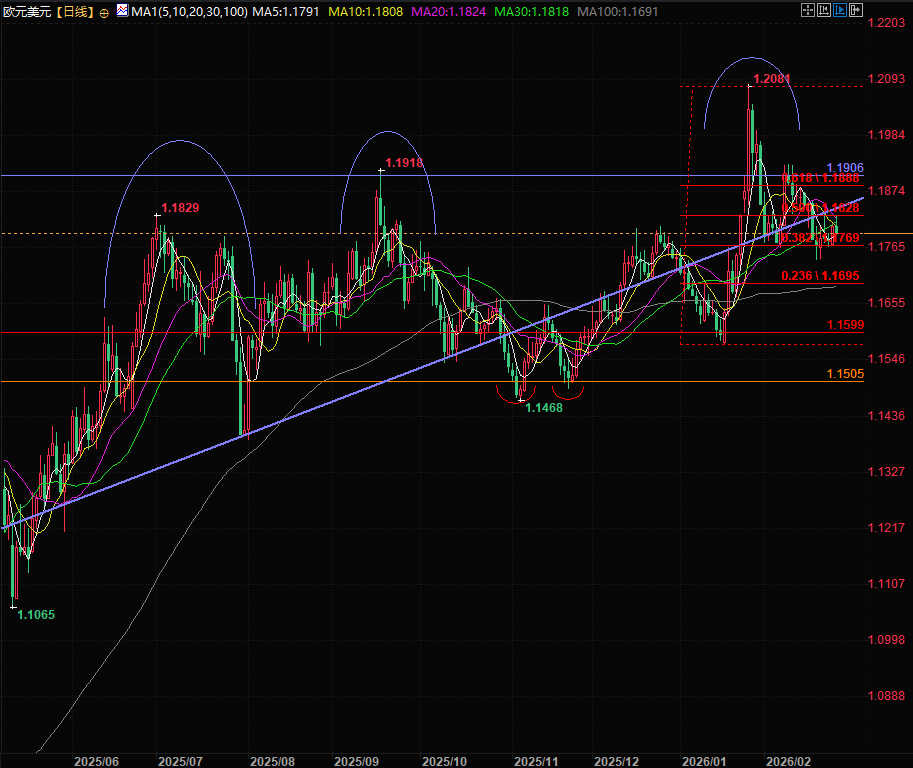
(Euro/USD daily chart, source: FX678)
At 18:48 Beijing time, the euro was trading at 1.1795/96 against the US dollar.
In a policy dialogue, European Central Bank President Christine Lagarde comprehensively elaborated on the Eurozone's economic, inflation, and monetary policy stance. Coupled with the International Monetary Fund's (IMF) latest assessment of the Federal Reserve's policies, the difference in the pace of monetary policy between Europe and the United States has become the core theme of the current euro exchange rate and Eurozone asset pricing. With the interplay of internal and external factors, the medium-term trend of the euro is becoming increasingly clear.
ECB: Interest rates to remain unchanged; divergent inflation perceptions become core concern.
Lagarde stated that the eurozone had previously suffered from high inflation, putting pressure on household consumption and business operations, and that the ECB's tightening policies had achieved significant results.
Eurozone inflation fell sharply from its peak of 10.6% in October 2022, fluctuated around the 2% target in the second half of 2025, and further declined to 1.7% in January 2026. Core inflation, excluding energy and food, also fell to 2.2%, showing a comprehensive decline in inflation.
On the economic front, the Eurozone's GDP is projected to grow by 1.5% for the whole of 2025, with a quarter-on-quarter growth of 0.3% in the fourth quarter, both exceeding initial expectations.
Growth was driven by domestic demand, with information and communication services being the core engine. The manufacturing sector remained resilient despite high tariffs and geopolitical uncertainties, while the construction industry gradually recovered.
A robust labor market, rising household incomes, and investment in related sectors will support the recovery, but high tariffs, a stronger euro, and global policy volatility will continue to suppress external demand.
Based on the assessment that inflation will remain stable at the 2% target in the medium term, the ECB kept its three key interest rates unchanged at the beginning of this month. Going forward, it will adhere to data-driven decision-making and make decisions on a meeting-by-meeting basis, without pre-setting an interest rate path. The euro's movement will closely follow changes in key data such as inflation, wages, and economic growth.
Core issue: The discrepancy between actual inflation and public perception of inflation
This global phenomenon is particularly evident in the Eurozone, where perceived inflation is on average 1.2 percentage points higher than the actual value. Even when the actual inflation has fallen, people still feel that prices are rising faster.
This divergence could affect consumption and savings, wage negotiations, weaken public trust in the ECB, and disrupt the transmission of monetary policy.
Lagarde pointed out that differences in consumption patterns, loss aversion, media coverage, and insufficient financial literacy among the public are the main causes. The ECB will narrow these discrepancies through three main approaches: stabilizing inflation, simplifying policy communication, and improving the financial literacy of the general public.
IMF: Sets course for only one rate cut this year; dollar policy pace slower than expected.
On February 25 local time, the IMF released a report giving a clear assessment: the Federal Reserve will only cut interest rates by 25 basis points in 2026, bringing the federal funds rate down to 3.25%-3.50% by the end of the year. This prediction is in stark contrast to the Trump administration's demand for significant interest rate cuts.
Regarding inflation, the US PCE price index is expected to rise by 0.5 percentage points at the beginning of the year due to tariff policies, with the impact gradually subsiding and falling back to the Fed's 2% policy target by early 2027. In terms of the economy and employment, the IMF projects US economic growth of 2.4% in 2026, with the unemployment rate remaining stable at around 4% within the full employment range, but job growth will be significantly lower than pre-pandemic levels.
Meanwhile, the IMF gave a negative assessment of the US tariff and immigration control policies:
Imposing tariffs will distort resource allocation and disrupt global supply chains; trade policy uncertainty may slow the economy.
Tighter immigration restrictions will compress the labor supply, drag down employment, and raise inflation. Over the next few years, this will reduce US economic activity by 0.4 percentage points and will also indirectly affect the Eurozone's external environment through global trade and financial channels.
The core logic behind the euro's trajectory amid policy divergence between Europe and the US
The ECB adopted a cautious wait-and-see approach and kept interest rates unchanged, while the Fed cut rates very slowly, with only one operation throughout the year. The clear divergence in monetary policy between Europe and the US became the core support for the euro's performance.
Within the Eurozone, economic resilience and a steady decline in inflation provide fundamental support for the currency's value, but the divergence in perceived inflation and the suppression of external demand by a stronger euro remain potential constraints. Externally, US tariff policies disrupt global trade, and tightening labor markets raise concerns about inflation, which will affect risk appetite for the euro through global market volatility.
Overall, the medium-term trend of the euro will be highly dependent on two core factors: first, the marginal changes in the ECB's inflation, wage, and economic data will determine whether it adjusts its policy stance; second, the actual pace of the Fed's interest rate cuts and the effects of the implementation of US tariffs will influence the strength of the dollar and the interest rate differential between the US and Europe.
Against the backdrop of the ECB's "no predetermined path" and the Fed's "gradual interest rate cuts," the euro is expected to fluctuate, awaiting key data to provide a clear direction.
Summary of technical analysis:
Lagarde introduced the concept of public perception of inflation and urged everyone to "read more books and learn more common sense" because she realized that in a society lacking economic common sense, the effectiveness of rational monetary policy is diminished.
She needs the public to understand the logic behind "declining inflation," thereby lowering wage expectations, stopping panic buying, and cooperating with the ECB to achieve a soft landing for the economy.
The European Central Bank (ECB) wants to maintain a moderately loose monetary policy while keeping inflation under control, but it also fears that the public's perception of high inflation will persist, ultimately leading to a rebound in actual inflation. Therefore, it chose to act at the opportune moment, which creates a new balance with the recent slowdown in the pace of interest rate cuts in the United States. This caused the euro to begin a correction against the US dollar after Lagarde's speech.
From a technical perspective, the euro has formed a minor triple top against the US dollar. Currently, the exchange rate is consolidating between the 0.5 and 0.382 Fibonacci retracements of this upward move, indicating a retracement of more than 50%, which is a very weak performance.
(Euro/USD daily chart, source: FX678)
At 18:48 Beijing time, the euro was trading at 1.1795/96 against the US dollar.
- Risk Warning and Disclaimer
- The market involves risk, and trading may not be suitable for all investors. This article is for reference only and does not constitute personal investment advice, nor does it take into account certain users’ specific investment objectives, financial situation, or other needs. Any investment decisions made based on this information are at your own risk.