The Geneva standoff between the US and Iran failed, with Vienna next week becoming the final window of opportunity! The oil market is holding its breath.
2026-02-27 11:55:01
The latest round of indirect nuclear talks between the US and Iran in Geneva concluded without an agreement, but both sides agreed to continue technical details consultations in Vienna next week. Oman stated that the talks had made "significant progress," but core differences remain: the US demands that Iran permanently abandon its nuclear weapons, dismantle its nuclear facilities, and transfer enriched uranium; Iran insists on its right to peaceful uranium enrichment and demands the complete lifting of sanctions. The talks have expanded to missile and regional issues. Without a diplomatic breakthrough, military risks will increase significantly. On Friday (February 27th) during Asian trading hours, US crude oil fluctuated around $65.20 per barrel, with the market also focused on the OPEC+ production decision.
The latest round of indirect nuclear talks between the US and Iran, which began on Thursday, concluded in Geneva. While no final agreement was reached, the two sides agreed to extend the consultation process. Iranian Foreign Minister Seyed Abbas Araqchi stated that the discussions were the "most intense and longest" to date, with further progress made in diplomatic contacts. Both sides plan to engage in more detailed discussions on key issues, including the lifting of US sanctions against Iran and Iran's nuclear-related steps.
As a mediator in the negotiations, Omani Foreign Minister Badr Al-Busaidi noted that the US and Iran achieved "significant progress" in their high-stakes talks in Geneva, Switzerland, and agreed to continue negotiations on technical details in Vienna next week. Vienna, home to the International Atomic Energy Agency (IAEA), will be a key venue for subsequent expert-level discussions.
In his State of the Union address this week, US President Donald Trump reiterated that Iran must make a clear commitment to "never possess nuclear weapons" or an agreement will be difficult to reach. He emphasized, "They (Iran) want a deal, but we haven't heard that crucial phrase yet: We will never develop nuclear weapons." The Trump administration has previously made tough demands of Iran, including dismantling its three main nuclear facilities in Fordow, Natanz, and Isfahan; transferring all remaining enriched uranium to the United States; and ensuring that the agreement is permanent and without a "sunset clause."
Iran, however, firmly opposes these conditions, insisting on its right to enrich uranium within its borders, stating that it will be used for peaceful energy production. Iranian officials have stated that they will not destroy nuclear facilities or transport enriched uranium out of the country.
The core of the negotiations focused on Iran's nuclear program, but the United States also pressured Iran to limit its ballistic missile development and cease supporting regional armed groups and suppressing domestic protests. Iran, on the other hand, prioritized the lifting of comprehensive sanctions, which had severely hampered its economy, leading to a currency crisis and triggering massive protests last December.
Analysts warn that if diplomatic efforts fail to yield substantial breakthroughs in the short term, the risk of a military conflict between the US and Iran will increase significantly, potentially triggering wider instability in the Middle East and impacting global energy supplies. Michael Hannah, director of the Brussels-based International Crisis Group, stated, "If there is no diplomatic breakthrough in the coming days, the US could be drawn into a military conflict with significant escalation potential." He also noted that Washington's priorities remain unclear, and its broad list of demands on Iran obscures its ultimate goals.
Regarding oil prices, influenced by the uncertainty surrounding negotiations, WTI crude oil fluctuated around $65.20 per barrel during Friday's Asian trading session. Warren Patterson, head of commodity strategy at ING Bank, analyzed that the market may be watching the scale of potential US action against Iran. If it is only a "targeted, short-term" strike that avoids energy infrastructure, oil prices may rise temporarily; however, if it evolves into a prolonged confrontation and triggers a tougher retaliation from Iran, supply risks will push up the long-term trend of oil prices.
In addition, traders will be watching OPEC+'s decision this weekend regarding April production levels. Patterson expects that if US-Iran tensions ease and OPEC+ agrees to resume production increases starting in April, weak crude oil fundamentals will further depress prices.
Overall, while this round of Geneva talks demonstrated some diplomatic sincerity, the core differences—zero enrichment, facility dismantling, a permanent agreement, and comprehensive lifting of sanctions—remain unresolved. Next week's Vienna technical consultations will be a crucial window for observing whether the US and Iran can avoid military escalation.
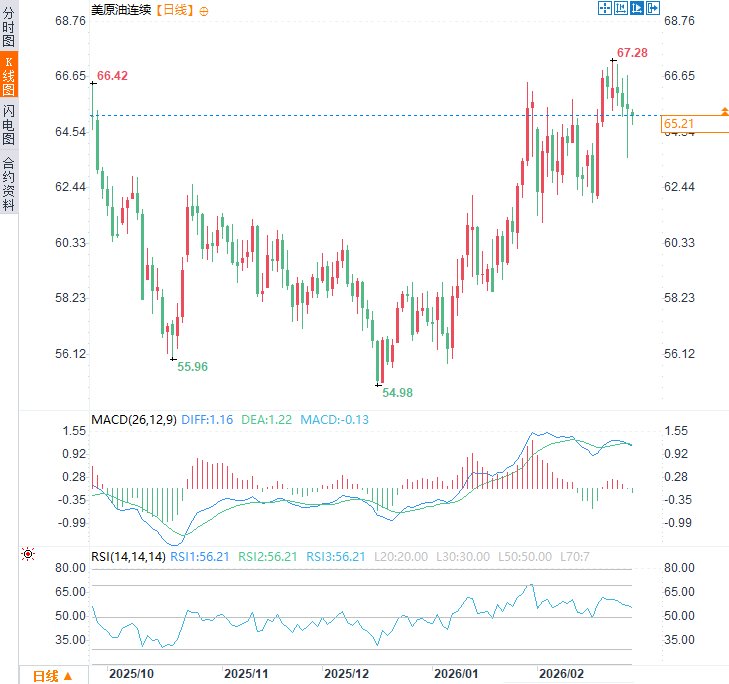
(US crude oil daily chart, source: FX678)
At 11:54 Beijing time, US crude oil futures were trading at $65.28 per barrel.
Negotiations proceeded vigorously, but without any breakthrough.
The latest round of indirect nuclear talks between the US and Iran, which began on Thursday, concluded in Geneva. While no final agreement was reached, the two sides agreed to extend the consultation process. Iranian Foreign Minister Seyed Abbas Araqchi stated that the discussions were the "most intense and longest" to date, with further progress made in diplomatic contacts. Both sides plan to engage in more detailed discussions on key issues, including the lifting of US sanctions against Iran and Iran's nuclear-related steps.
Significant progress has been made under Oman's mediation; technical details will be discussed again in Vienna next week.
As a mediator in the negotiations, Omani Foreign Minister Badr Al-Busaidi noted that the US and Iran achieved "significant progress" in their high-stakes talks in Geneva, Switzerland, and agreed to continue negotiations on technical details in Vienna next week. Vienna, home to the International Atomic Energy Agency (IAEA), will be a key venue for subsequent expert-level discussions.
Trump's pressure and the differences in stance with Iran become more apparent.
In his State of the Union address this week, US President Donald Trump reiterated that Iran must make a clear commitment to "never possess nuclear weapons" or an agreement will be difficult to reach. He emphasized, "They (Iran) want a deal, but we haven't heard that crucial phrase yet: We will never develop nuclear weapons." The Trump administration has previously made tough demands of Iran, including dismantling its three main nuclear facilities in Fordow, Natanz, and Isfahan; transferring all remaining enriched uranium to the United States; and ensuring that the agreement is permanent and without a "sunset clause."
Iran, however, firmly opposes these conditions, insisting on its right to enrich uranium within its borders, stating that it will be used for peaceful energy production. Iranian officials have stated that they will not destroy nuclear facilities or transport enriched uranium out of the country.
The scope of negotiations has been expanded to include missile and regional issues.
The core of the negotiations focused on Iran's nuclear program, but the United States also pressured Iran to limit its ballistic missile development and cease supporting regional armed groups and suppressing domestic protests. Iran, on the other hand, prioritized the lifting of comprehensive sanctions, which had severely hampered its economy, leading to a currency crisis and triggering massive protests last December.
Rising geopolitical risks are being closely monitored in the oil market.
Analysts warn that if diplomatic efforts fail to yield substantial breakthroughs in the short term, the risk of a military conflict between the US and Iran will increase significantly, potentially triggering wider instability in the Middle East and impacting global energy supplies. Michael Hannah, director of the Brussels-based International Crisis Group, stated, "If there is no diplomatic breakthrough in the coming days, the US could be drawn into a military conflict with significant escalation potential." He also noted that Washington's priorities remain unclear, and its broad list of demands on Iran obscures its ultimate goals.
Regarding oil prices, influenced by the uncertainty surrounding negotiations, WTI crude oil fluctuated around $65.20 per barrel during Friday's Asian trading session. Warren Patterson, head of commodity strategy at ING Bank, analyzed that the market may be watching the scale of potential US action against Iran. If it is only a "targeted, short-term" strike that avoids energy infrastructure, oil prices may rise temporarily; however, if it evolves into a prolonged confrontation and triggers a tougher retaliation from Iran, supply risks will push up the long-term trend of oil prices.
In addition, traders will be watching OPEC+'s decision this weekend regarding April production levels. Patterson expects that if US-Iran tensions ease and OPEC+ agrees to resume production increases starting in April, weak crude oil fundamentals will further depress prices.
Overall, while this round of Geneva talks demonstrated some diplomatic sincerity, the core differences—zero enrichment, facility dismantling, a permanent agreement, and comprehensive lifting of sanctions—remain unresolved. Next week's Vienna technical consultations will be a crucial window for observing whether the US and Iran can avoid military escalation.
(US crude oil daily chart, source: FX678)
At 11:54 Beijing time, US crude oil futures were trading at $65.28 per barrel.
- Risk Warning and Disclaimer
- The market involves risk, and trading may not be suitable for all investors. This article is for reference only and does not constitute personal investment advice, nor does it take into account certain users’ specific investment objectives, financial situation, or other needs. Any investment decisions made based on this information are at your own risk.