Japanese inflation has eased, but the central bank remains hawkish, putting short-term pressure on USD/JPY.
2026-02-27 13:13:43
The USD/JPY pair fell for the second consecutive trading day in Asian trading, dipping to around 155.65, but still maintaining an overall upward trend on the weekly chart. The recent performance of the yen has been primarily influenced by expectations of the Bank of Japan's policy and changes in inflation data.
Core CPI data from Tokyo, Japan, showed that inflation fell below the Bank of Japan's (BOJ) 2% target for the first time since 2024. However, inflation remains at a relatively high historical level, leading markets to continue betting on a possible gradual interest rate hike by the central bank.
Bank of Japan Governor Kazuo Ueda stated that the central bank will continue to gradually raise interest rates as long as the probability of economic and price forecasts being realized increases. Bank of Japan policy board member Kumiko Tanaka also emphasized the need to proceed with monetary tightening at a moderate pace.
hawkish policy expectations coupled with geopolitical risks have created some safe-haven demand for the yen. However, Prime Minister Sanae Takaichi expressed caution about further tightening during a meeting with the central bank, and fiscal pressures in Japan may still limit the yen's potential for significant appreciation.
Regarding the US dollar, expectations for a Federal Reserve rate cut have clearly subsided. The minutes of the Fed's January FOMC meeting showed that policymakers were in no hurry to cut rates and even discussed reconsidering rate hikes if inflation remained high. This signal supported the dollar's strength, limiting the downside potential of USD/JPY.
The current core trading logic in the market is: expectations of yen policy tightening provide bottom support, while the dollar's interest rate advantage provides upward pressure. Short-term pullbacks are more likely to be absorbed by buying, and the overall market remains in a high-level range-bound trading phase.
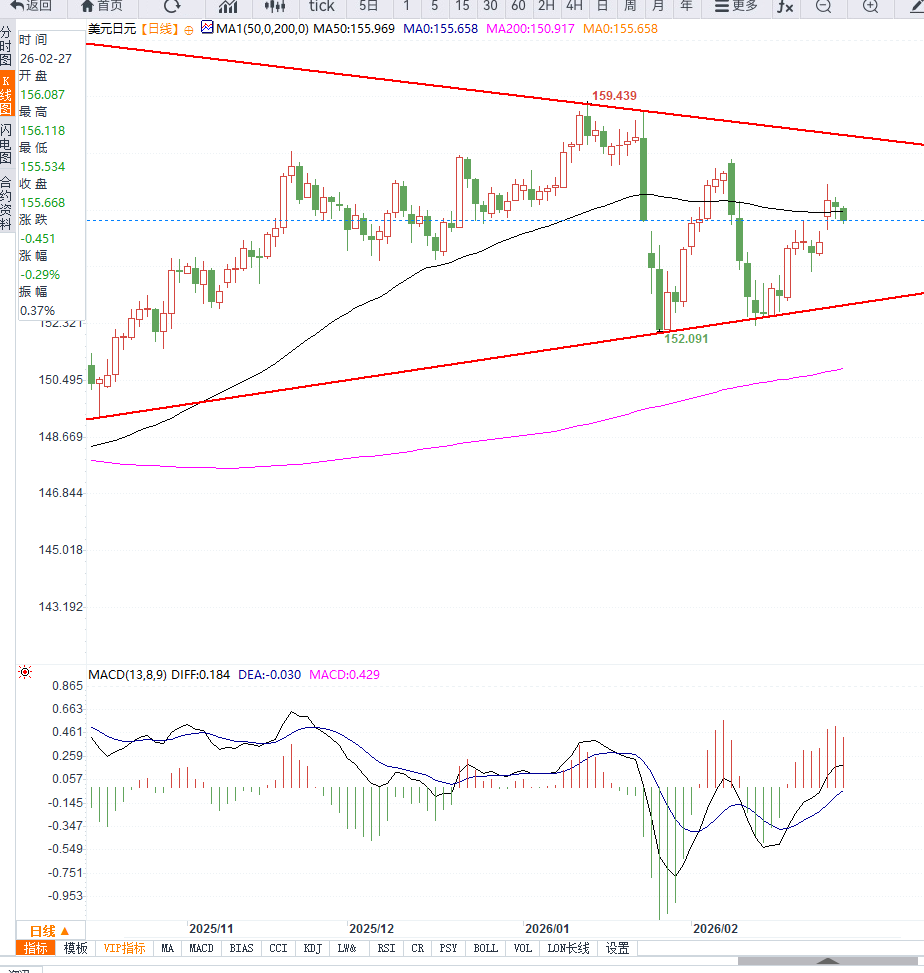
On the daily chart, USD/JPY remains within a medium- to long-term upward channel, but the upward slope has slowed slightly. The price encountered resistance near a two-week high, resulting in a technical pullback. The moving average system maintains a bullish alignment, but short-term moving averages are beginning to turn downwards, indicating weakening short-term bullish momentum but the overall trend remains intact.
The MACD indicator shows a gradual contraction of the bullish histogram, indicating a slowdown in the upward momentum. The RSI is in the 55-65 range, indicating a slightly bullish but not overheated state. The Bollinger Bands are widening, but the price is gradually approaching the middle band, suggesting a slowdown in upward volatility. The key daily support level is in the 155.00-154.50 area, which is the bulls' defensive zone; a break below this level could lead to a pullback to around 153.00.
The upside resistance is at the psychological level of 157.00; a break above this level could lead to tests of the 158.50 or even 160.00 area.
Editor's Note:
The current USD/JPY exchange rate movement is essentially a game between the "USD-Japan interest rate differential advantage" and "expectations of a tightening policy from the Bank of Japan." The Federal Reserve's slower pace of policy shifts is maintaining the dollar's structural strength, while Japan's gradual interest rate hikes are limiting the yen's depreciation potential.
In the short term, the exchange rate is more likely to remain range-bound between 155 and 158, with the trend direction depending on US inflation data and the attitude of Federal Reserve officials. If US inflation rises again, USD/JPY may still have the potential to break upwards; if US inflation continues to decline, the yen may strengthen in the short term.
Core CPI data from Tokyo, Japan, showed that inflation fell below the Bank of Japan's (BOJ) 2% target for the first time since 2024. However, inflation remains at a relatively high historical level, leading markets to continue betting on a possible gradual interest rate hike by the central bank.
Bank of Japan Governor Kazuo Ueda stated that the central bank will continue to gradually raise interest rates as long as the probability of economic and price forecasts being realized increases. Bank of Japan policy board member Kumiko Tanaka also emphasized the need to proceed with monetary tightening at a moderate pace.
hawkish policy expectations coupled with geopolitical risks have created some safe-haven demand for the yen. However, Prime Minister Sanae Takaichi expressed caution about further tightening during a meeting with the central bank, and fiscal pressures in Japan may still limit the yen's potential for significant appreciation.
Regarding the US dollar, expectations for a Federal Reserve rate cut have clearly subsided. The minutes of the Fed's January FOMC meeting showed that policymakers were in no hurry to cut rates and even discussed reconsidering rate hikes if inflation remained high. This signal supported the dollar's strength, limiting the downside potential of USD/JPY.
The current core trading logic in the market is: expectations of yen policy tightening provide bottom support, while the dollar's interest rate advantage provides upward pressure. Short-term pullbacks are more likely to be absorbed by buying, and the overall market remains in a high-level range-bound trading phase.
On the daily chart, USD/JPY remains within a medium- to long-term upward channel, but the upward slope has slowed slightly. The price encountered resistance near a two-week high, resulting in a technical pullback. The moving average system maintains a bullish alignment, but short-term moving averages are beginning to turn downwards, indicating weakening short-term bullish momentum but the overall trend remains intact.
The MACD indicator shows a gradual contraction of the bullish histogram, indicating a slowdown in the upward momentum. The RSI is in the 55-65 range, indicating a slightly bullish but not overheated state. The Bollinger Bands are widening, but the price is gradually approaching the middle band, suggesting a slowdown in upward volatility. The key daily support level is in the 155.00-154.50 area, which is the bulls' defensive zone; a break below this level could lead to a pullback to around 153.00.
The upside resistance is at the psychological level of 157.00; a break above this level could lead to tests of the 158.50 or even 160.00 area.
Editor's Note:
The current USD/JPY exchange rate movement is essentially a game between the "USD-Japan interest rate differential advantage" and "expectations of a tightening policy from the Bank of Japan." The Federal Reserve's slower pace of policy shifts is maintaining the dollar's structural strength, while Japan's gradual interest rate hikes are limiting the yen's depreciation potential.
In the short term, the exchange rate is more likely to remain range-bound between 155 and 158, with the trend direction depending on US inflation data and the attitude of Federal Reserve officials. If US inflation rises again, USD/JPY may still have the potential to break upwards; if US inflation continues to decline, the yen may strengthen in the short term.
- Risk Warning and Disclaimer
- The market involves risk, and trading may not be suitable for all investors. This article is for reference only and does not constitute personal investment advice, nor does it take into account certain users’ specific investment objectives, financial situation, or other needs. Any investment decisions made based on this information are at your own risk.