The US and Iran: From allies to bitter enemies, a half-century-long struggle for civilization and power.
2026-03-02 15:04:14
In the modern international political landscape, the relationship between the United States and Iran is arguably the most acute and enduring example of hostility.
This journey from close allies to bitter enemies began with geopolitical interests, erupted during the Iranian hostage crisis, and ultimately solidified into a fundamental opposition between two political civilizations and two power logics, profoundly influencing the trajectory of global energy, security, and financial markets.
Before the 1970s, Iran under the rule of Shah Pahlavi was the most solid strategic foothold for the United States in the Middle East.
A pro-Western policy, a containment stance against the Soviet Union, and a stable oil supply allowed the US and Iran to maintain a close alliance.
However, the heavy reliance on the West, the vast gap between the rich and the poor, and the social divisions caused by forced secularization ultimately triggered the Iranian Islamic Revolution in 1979.
The overthrow of Shah Pahlavi and the rise of the Islamic regime led by Khomeini completely rewrote Iran's relationship with the world.
The contradictions after the revolution quickly intensified. In October 1979, the United States allowed Pahlavi, who was suffering from cancer, to enter the country for treatment, which Iran saw as a signal that the United States was trying to launch another coup and restore the monarchy.
On November 4, 1979, Iranian students occupied the U.S. Embassy in Tehran and took 52 Americans hostage. The crisis lasted 444 days.
The US sanctions, diplomatic severance, and the disastrous failure of the military rescue operation "Operation Eagle Claw" not only directly led to the Carter administration's failure to win re-election, but also resulted in the complete severance of diplomatic relations between the US and Iran.
The hostages were released on the day of Reagan's inauguration in 1981, seemingly ending the crisis, but in reality, it marked the beginning of decades of hostility between the two countries.
The subsequent Iran-Iraq War further solidified Iran's external pressures and internal course of action: Iraq launched a war while Iran was in political turmoil and undergoing military purges after the revolution, and Iran, beset by internal and external difficulties, became even more determined to embark on a path of independence and confrontation with the West.
The essence of this confrontation goes far beyond oil, territory, or geopolitical interests; it is two completely opposing systems of national governance and legitimacy.
Source of power: Divine sovereignty vs. popular sovereignty
Iran’s core political structure is the guardianship of jurists (the fakih system), sovereignty derives from God, the state is supervised and guided by the Supreme Leader, and elected institutions and candidates must operate within the framework of Islam.
The United States is founded on Enlightenment ideas and a social contract. Sovereignty belongs to the people, the legitimacy of the government comes from the consent of the ruled, and it insists on the separation of church and state, with elections and the separation of powers as its political foundation.
Rule of Law and Society: Sacred Law vs. Secular Law
Iran's legal system is based on Sharia law, which combines religious and moral constraints, and public life, dress, and speech are all incorporated into religious norms.
The United States adheres to secular law, with legislation passed by the legislature and interpretation by the judiciary. It emphasizes the protection of individual freedoms and rights, and offers a high degree of autonomy in speech, dress, and lifestyle.
The two systems have drastically different understandings of gender, minority groups, and public order, leaving almost no room for compromise.
Iran's internal turmoil also revolves around the struggle between secular and religious forces.
The Pahlavi era saw a strong push for Westernization, abolishing headscarves, encouraging women's liberation, and rapidly modernizing cities, which was viewed by conservative forces as an insult to faith. After the 1979 revolution, policies shifted dramatically to conservatism, and the headscarf went from being a symbol of resistance to a mandatory requirement.
For decades, Iranian society has oscillated dramatically between openness and conservatism, with the younger generation's pursuit of individual rights constantly clashing with the constraints of religious law, becoming the core social contradiction in Iran.
Due to the sharp depreciation of the local currency, high inflation, and hardship for the people, the public's demands quickly escalated from asking for economic improvement to political protests against the system and the union of church and state. In January 2026, the protests were violently suppressed by the authorities, resulting in a large number of casualties and arrests. In February, campus protests reignited, with students speaking out for the victims and resisting authoritarian rule.
Following the death of Iran's Supreme Leader Ayatollah Khamenei in an airstrike in early March, Iranian society was utterly torn apart. Conservatives mourned and demanded revenge, while anti-government groups openly celebrated and called for an end to religious rule. The authorities immediately implemented wartime control to suppress the protests. The root of this turmoil lies in Iran's economic collapse, the sharp conflict between theocracy and individual rights, and the vicious cycle of external confrontation and internal economic strain. The situation is expected to remain volatile, impacting the Middle East geopolitical landscape and the price of safe-haven assets such as gold.
Externally, Iran positions itself as a "resistance against Western hegemony" and views the United States as "the Great Satan"; the United States, on the other hand, uses democracy and human rights as its banner to exert long-term maximum pressure on Iran.
The mutual distrust and refusal to compromise between the two sides have kept the situation in the Middle East in a state of high tension for a long time.
This ongoing geopolitical confrontation, cycle of sanctions, and risk of conflict will ultimately be directly reflected in the trend of global safe-haven assets.
Meanwhile, given Iran's large territory and sufficient military depth, the conflict may not end so quickly. Traders can try to find a turning point in the military conflict and observe the relationship between the domestic political and religious authorities through leadership changes, which is also an important turning point in US-Iran relations.
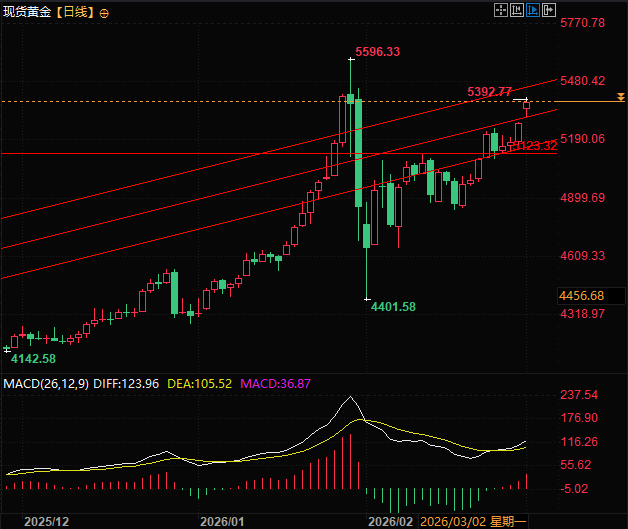
(Spot gold daily chart)
Meanwhile, after the Iraq War in 2003, the Saddam Hussein regime fell, and Iraq's Shia-dominated political scene emerged. Iran, leveraging religious ties and geopolitical influence, formed a close alliance with its former enemy, Iraq, and deeply intervened in Iraq's internal affairs and security. In addition, Saudi Arabia and Iran restored diplomatic relations in 2023, and the regional situation eased for a time. Therefore, for both Iraq and Saudi Arabia, the long-term closure of the Strait of Hormuz is contrary to their interests. As a result, the impact on oil prices is more of a one-off stimulus. Consequently, oil prices opened high and then fell on Monday morning, reflecting the market's "buy the rumor, sell the fact" mentality.
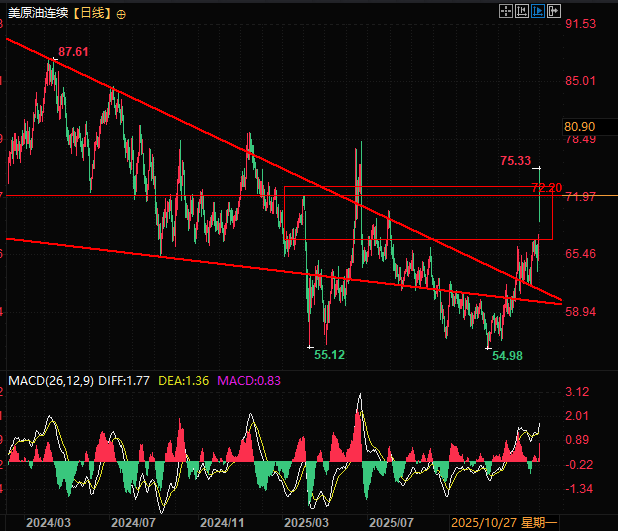
(US crude oil daily chart, source: FX678)
At 15:02 Beijing time, spot gold is currently trading at $5,389 per ounce, and US crude oil is currently trading at $72.53 per barrel.
This journey from close allies to bitter enemies began with geopolitical interests, erupted during the Iranian hostage crisis, and ultimately solidified into a fundamental opposition between two political civilizations and two power logics, profoundly influencing the trajectory of global energy, security, and financial markets.
From Close Allies to Regime Change: The Turning Point of the 1979 Revolution
Before the 1970s, Iran under the rule of Shah Pahlavi was the most solid strategic foothold for the United States in the Middle East.
A pro-Western policy, a containment stance against the Soviet Union, and a stable oil supply allowed the US and Iran to maintain a close alliance.
However, the heavy reliance on the West, the vast gap between the rich and the poor, and the social divisions caused by forced secularization ultimately triggered the Iranian Islamic Revolution in 1979.
The overthrow of Shah Pahlavi and the rise of the Islamic regime led by Khomeini completely rewrote Iran's relationship with the world.
Igniting Full-Scale Hostility: The Story of the Iranian Hostage Crisis
The contradictions after the revolution quickly intensified. In October 1979, the United States allowed Pahlavi, who was suffering from cancer, to enter the country for treatment, which Iran saw as a signal that the United States was trying to launch another coup and restore the monarchy.
On November 4, 1979, Iranian students occupied the U.S. Embassy in Tehran and took 52 Americans hostage. The crisis lasted 444 days.
The US sanctions, diplomatic severance, and the disastrous failure of the military rescue operation "Operation Eagle Claw" not only directly led to the Carter administration's failure to win re-election, but also resulted in the complete severance of diplomatic relations between the US and Iran.
The hostages were released on the day of Reagan's inauguration in 1981, seemingly ending the crisis, but in reality, it marked the beginning of decades of hostility between the two countries.
The subsequent Iran-Iraq War further solidified Iran's external pressures and internal course of action: Iraq launched a war while Iran was in political turmoil and undergoing military purges after the revolution, and Iran, beset by internal and external difficulties, became even more determined to embark on a path of independence and confrontation with the West.
The essence of the confrontation: two completely opposing governance systems
The essence of this confrontation goes far beyond oil, territory, or geopolitical interests; it is two completely opposing systems of national governance and legitimacy.
Source of power: Divine sovereignty vs. popular sovereignty
Iran’s core political structure is the guardianship of jurists (the fakih system), sovereignty derives from God, the state is supervised and guided by the Supreme Leader, and elected institutions and candidates must operate within the framework of Islam.
The United States is founded on Enlightenment ideas and a social contract. Sovereignty belongs to the people, the legitimacy of the government comes from the consent of the ruled, and it insists on the separation of church and state, with elections and the separation of powers as its political foundation.
Rule of Law and Society: Sacred Law vs. Secular Law
Iran's legal system is based on Sharia law, which combines religious and moral constraints, and public life, dress, and speech are all incorporated into religious norms.
The United States adheres to secular law, with legislation passed by the legislature and interpretation by the judiciary. It emphasizes the protection of individual freedoms and rights, and offers a high degree of autonomy in speech, dress, and lifestyle.
The two systems have drastically different understandings of gender, minority groups, and public order, leaving almost no room for compromise.
Iran's internal predicament: the recurring rift between Westernization and conservatism
Iran's internal turmoil also revolves around the struggle between secular and religious forces.
The Pahlavi era saw a strong push for Westernization, abolishing headscarves, encouraging women's liberation, and rapidly modernizing cities, which was viewed by conservative forces as an insult to faith. After the 1979 revolution, policies shifted dramatically to conservatism, and the headscarf went from being a symbol of resistance to a mandatory requirement.
For decades, Iranian society has oscillated dramatically between openness and conservatism, with the younger generation's pursuit of individual rights constantly clashing with the constraints of religious law, becoming the core social contradiction in Iran.
Due to the sharp depreciation of the local currency, high inflation, and hardship for the people, the public's demands quickly escalated from asking for economic improvement to political protests against the system and the union of church and state. In January 2026, the protests were violently suppressed by the authorities, resulting in a large number of casualties and arrests. In February, campus protests reignited, with students speaking out for the victims and resisting authoritarian rule.
Following the death of Iran's Supreme Leader Ayatollah Khamenei in an airstrike in early March, Iranian society was utterly torn apart. Conservatives mourned and demanded revenge, while anti-government groups openly celebrated and called for an end to religious rule. The authorities immediately implemented wartime control to suppress the protests. The root of this turmoil lies in Iran's economic collapse, the sharp conflict between theocracy and individual rights, and the vicious cycle of external confrontation and internal economic strain. The situation is expected to remain volatile, impacting the Middle East geopolitical landscape and the price of safe-haven assets such as gold.
The ultimate impact of geopolitical games: the trajectory of gold and crude oil.
Externally, Iran positions itself as a "resistance against Western hegemony" and views the United States as "the Great Satan"; the United States, on the other hand, uses democracy and human rights as its banner to exert long-term maximum pressure on Iran.
The mutual distrust and refusal to compromise between the two sides have kept the situation in the Middle East in a state of high tension for a long time.
This ongoing geopolitical confrontation, cycle of sanctions, and risk of conflict will ultimately be directly reflected in the trend of global safe-haven assets.
Meanwhile, given Iran's large territory and sufficient military depth, the conflict may not end so quickly. Traders can try to find a turning point in the military conflict and observe the relationship between the domestic political and religious authorities through leadership changes, which is also an important turning point in US-Iran relations.
(Spot gold daily chart)
Meanwhile, after the Iraq War in 2003, the Saddam Hussein regime fell, and Iraq's Shia-dominated political scene emerged. Iran, leveraging religious ties and geopolitical influence, formed a close alliance with its former enemy, Iraq, and deeply intervened in Iraq's internal affairs and security. In addition, Saudi Arabia and Iran restored diplomatic relations in 2023, and the regional situation eased for a time. Therefore, for both Iraq and Saudi Arabia, the long-term closure of the Strait of Hormuz is contrary to their interests. As a result, the impact on oil prices is more of a one-off stimulus. Consequently, oil prices opened high and then fell on Monday morning, reflecting the market's "buy the rumor, sell the fact" mentality.
(US crude oil daily chart, source: FX678)
At 15:02 Beijing time, spot gold is currently trading at $5,389 per ounce, and US crude oil is currently trading at $72.53 per barrel.
- Risk Warning and Disclaimer
- The market involves risk, and trading may not be suitable for all investors. This article is for reference only and does not constitute personal investment advice, nor does it take into account certain users’ specific investment objectives, financial situation, or other needs. Any investment decisions made based on this information are at your own risk.