













Despite relentless bombardment, Iran's political and religious foundations remain unshaken, allowing it to continue to stalemate in the conflict.
2026-03-03 08:07:40
In late February local time, the United States and Israel launched a joint military strike codenamed "Epic Fury," ostensibly to "stop Iran's nuclear program and ballistic missile expansion," and carried out intensive airstrikes against targets within Iran.
On Monday local time, US President Trump made it clear at the White House that the operation was initially expected to last four to five weeks, but the US has the capability for a long-term operation, and "a larger wave of offensives is yet to come."
Pentagon data shows that the U.S. military has struck more than 1,250 targets inside Iran and destroyed 11 Iranian ships. Meanwhile, more reinforcements are being deployed to the Middle East. Chairman of the Joint Chiefs of Staff General Kane emphasized that "this is by no means an operation that can be completed in a short period of time."
The key consequence of this airstrike was the death of Iran's Supreme Leader Ayatollah Khamenei. Iranian Foreign Minister Araqchi denounced it as a "religious crime" and vowed that it would have serious consequences.
Ali Larijani, Khamenei's senior advisor and one of the most powerful successors in Iran, has made it clear that he refuses to negotiate with the Trump administration, accusing it of having "delusional ambitions."
In response to the US and Israeli strikes, Iran denied seeking nuclear weapons, saying that it was negotiating a nuclear program limitation plan when the attack occurred.
Following Khamenei's death, Iran quickly established a temporary leadership council, with Larijani, leveraging his strong military and political background, becoming the core figure in power. Conservative religious leaders and the Islamic Revolutionary Guard Corps showed no signs of relinquishing power.
The Revolutionary Guard then launched Operation True Commitment-4, deploying 1,200 missiles of various types, severely damaging 27 US military bases in Bahrain, Qatar, Kuwait, and other countries. Among them, key facilities such as the Kuwaiti Arifjan Marine Corps Base and the Qatari strategic early warning radar station were severely damaged.
More globally impactful was the announcement by Abrahim Jabari, a senior advisor to the Iranian Revolutionary Guard, that "the Strait of Hormuz is closed," threatening to attack any ships attempting to pass through.
This vital shipping route, on which one-fifth of the world's oil trade depends, has seen its traffic volume plummet by more than 80% since the outbreak of the conflict. The average daily traffic volume of 140 ships during peacetime has been reduced to only one crude oil tanker passing through on a single day, causing international oil prices to soar.
In addition, Iran has attacked at least five oil tankers, killing one crew member, and continues to launch drone strikes against targets of U.S. allies around Tehran.
Hezbollah, an ally of Iran, was the first to join the conflict, launching missiles and drones at Israel on March 2, triggering a large-scale retaliatory airstrike by Israel. The Israeli military targeted Hezbollah-controlled areas in the southern suburbs of Beirut, killing several militant leaders. The Lebanese National News Agency confirmed that the attack resulted in at least 31 deaths and 149 injuries.
Israel immediately declared Hezbollah leader Naim Qassem a "target for elimination" but did not plan to launch a ground offensive at the moment, while the Lebanese government urgently banned Hezbollah from carrying out military activities.
The conflict has further spilled over to neighboring countries. Cyprus confirmed that an Iranian Shahed missile, suspected to have been launched by Hezbollah, struck the British airbase in Akrotiri, Cyprus, causing limited damage. British Prime Minister Starmer stated that the country would protect its citizens but would not take offensive action. More dramatically, Kuwaiti air defenses mistakenly shot down three US F-15E fighter jets during the Iranian attack; all six crew members ejected safely. US Central Command has confirmed the incident.
Domestic support for the war is only a quarter of the total in the United States. Large-scale anti-war protests have erupted in dozens of cities, including Washington and New York, with people chanting "Trump must step down" and accusing him of launching the war without congressional authorization.
The conflict has pushed the average retail price of gasoline in the United States above $3 per gallon, posing a political risk to the Republican Party as the midterm elections approach. However, Trump insists he "doesn't care about the polls and is doing the right thing." As of March 2, six U.S. military personnel had been killed, prompting the U.S. State Department to issue an emergency evacuation order, urging Americans in 15 Middle Eastern countries, including Bahrain, Egypt, and Iraq, to leave as soon as possible.
The international community is clearly divided: Türkiye, Russia, and China jointly condemned the US and Israel's actions as a "blatant violation of international law," while Oman and other countries called on all parties to exercise restraint;
Of the United States’ Western allies, only Israel was fully involved, while the Gulf Arab states only “reserved the right to retaliate.” Other allies did not intervene, and Western diplomats revealed that they were “unaware of the United States’ long-term plans for Iraq.”
Despite the attacks on British bases, the UK explicitly refused to participate in the war, highlighting the isolated situation of the United States in this military operation.
In the early hours of March 3, the Israeli Air Force launched a new round of precision strikes against Tehran, dropping dozens of bombs to destroy the "propaganda and media center" surrounding Iranian state television. Thick smoke billowed from the site, but the broadcast was not affected.
The Israeli military had previously issued an evacuation warning, urging Tehran residents to stay away from the area around the headquarters of the national broadcaster.
U.S. Defense Secretary Hergace revealed that the possibility of deploying ground troops to Iran could not be ruled out, while military experts questioned whether "regime change can be achieved solely through air strikes."
The most critical uncertainty at present lies in the direction of power in Iran: the market is closely watching whether the interim government led by Larijani can consolidate its power, and whether the future rulers will continue the hardline theocratic approach or turn to reformists or pro-American factions, which will directly determine the long-term course of the conflict.
Trump admitted he "didn't know who the new Iranian leadership was," but US Secretary of State Rubio emphasized that "the heaviest blows from the US military are yet to come," indicating that the Middle East crisis will continue to escalate.
At a critical juncture for Iran, a religiously founded state, the death of the Supreme Leader will likely be sanctified in the domestic political narrative, and may not have a severe impact on the stability of the regime. The war situation is likely to remain in a state of stalemate.
Crude oil's unexpected 12% surge on Monday priced in the possibility of a prolonged blockade of the Strait of Hormuz. Consequently, after Iran announced the blockade of the strait yesterday, crude oil did not rebound significantly and is currently consolidating, awaiting the upward movement of the 5-day moving average.
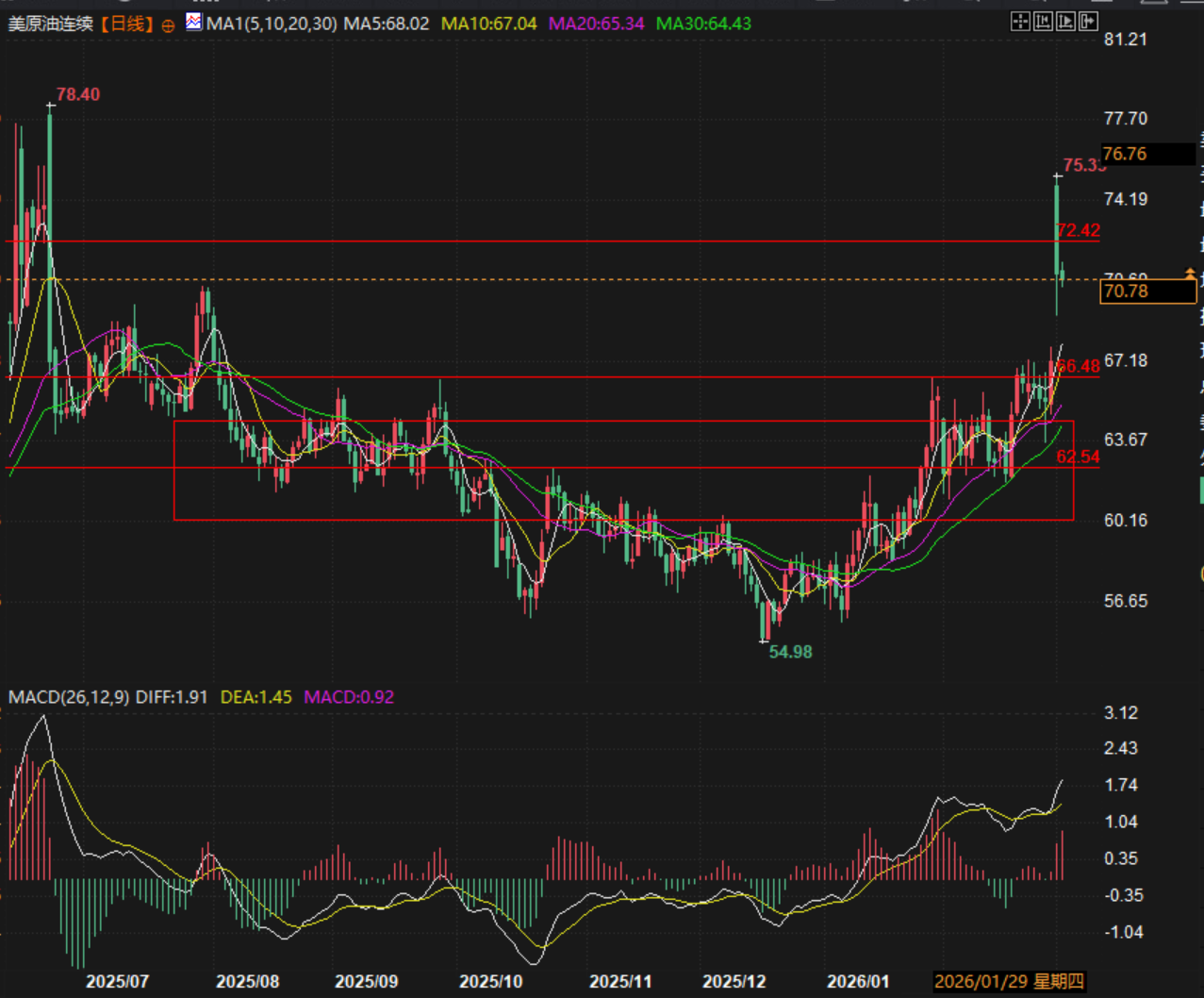
(US crude oil futures daily chart)
After opening higher and breaking through the middle line of the upward channel, spot gold is currently supported by the middle line. Since the US has only used airstrikes against Israel so far, and it is very difficult to overthrow a country's regime through airstrikes, and Iran's regime is relatively stable in the Middle East, and it still has military strike capabilities, gold still has a good chance to rise steadily, which is the current trend.
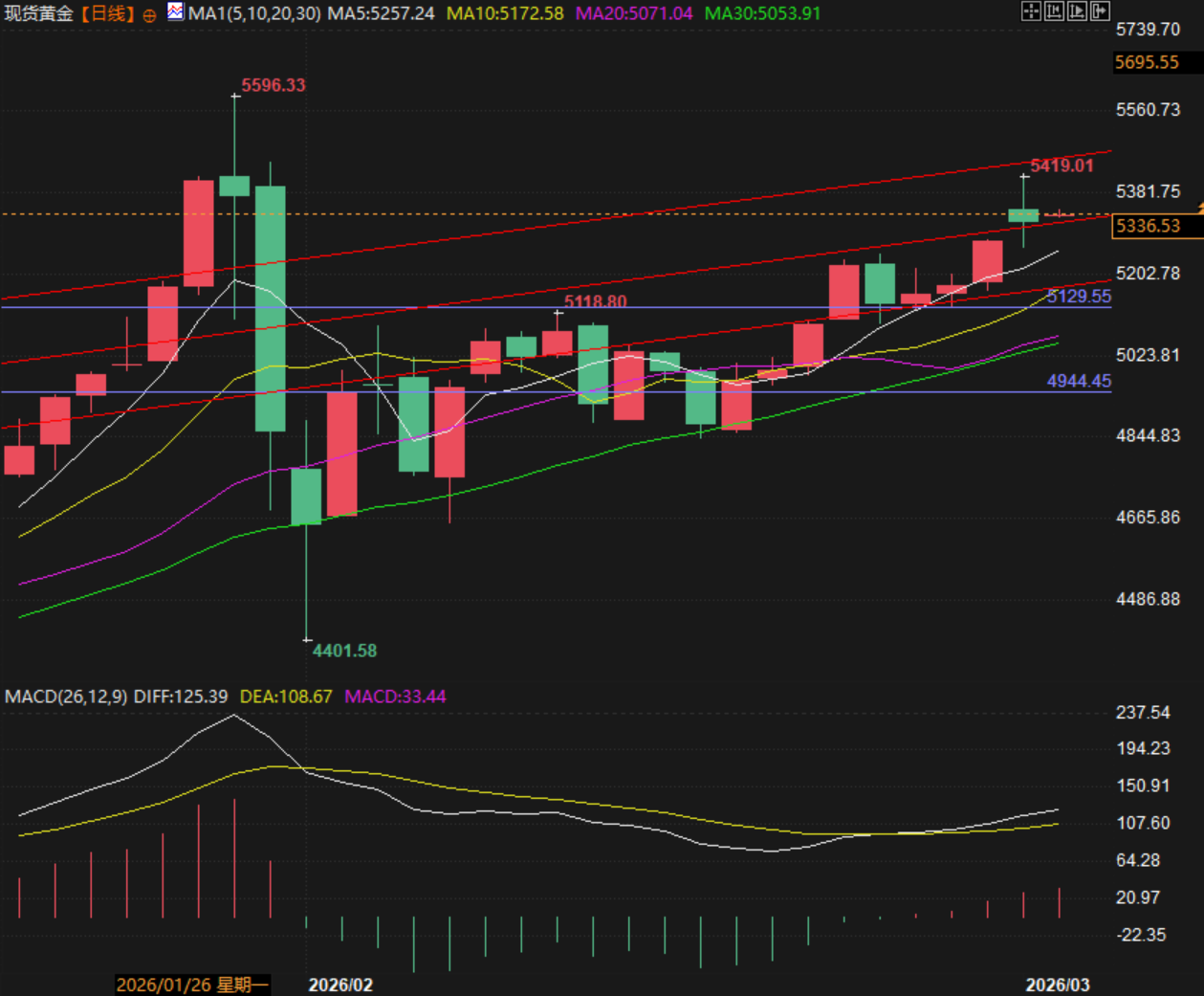
(Spot gold daily chart, source: FX678)
At 8:03 AM Beijing time, US crude oil futures were trading at $71.08 per barrel, and spot gold was trading at $5341 per ounce.
On Monday local time, US President Trump made it clear at the White House that the operation was initially expected to last four to five weeks, but the US has the capability for a long-term operation, and "a larger wave of offensives is yet to come."
Pentagon data shows that the U.S. military has struck more than 1,250 targets inside Iran and destroyed 11 Iranian ships. Meanwhile, more reinforcements are being deployed to the Middle East. Chairman of the Joint Chiefs of Staff General Kane emphasized that "this is by no means an operation that can be completed in a short period of time."
The key consequence of this airstrike was the death of Iran's Supreme Leader Ayatollah Khamenei. Iranian Foreign Minister Araqchi denounced it as a "religious crime" and vowed that it would have serious consequences.
Ali Larijani, Khamenei's senior advisor and one of the most powerful successors in Iran, has made it clear that he refuses to negotiate with the Trump administration, accusing it of having "delusional ambitions."
Iran's tough response and power structure
In response to the US and Israeli strikes, Iran denied seeking nuclear weapons, saying that it was negotiating a nuclear program limitation plan when the attack occurred.
Following Khamenei's death, Iran quickly established a temporary leadership council, with Larijani, leveraging his strong military and political background, becoming the core figure in power. Conservative religious leaders and the Islamic Revolutionary Guard Corps showed no signs of relinquishing power.
The Revolutionary Guard then launched Operation True Commitment-4, deploying 1,200 missiles of various types, severely damaging 27 US military bases in Bahrain, Qatar, Kuwait, and other countries. Among them, key facilities such as the Kuwaiti Arifjan Marine Corps Base and the Qatari strategic early warning radar station were severely damaged.
More globally impactful was the announcement by Abrahim Jabari, a senior advisor to the Iranian Revolutionary Guard, that "the Strait of Hormuz is closed," threatening to attack any ships attempting to pass through.
This vital shipping route, on which one-fifth of the world's oil trade depends, has seen its traffic volume plummet by more than 80% since the outbreak of the conflict. The average daily traffic volume of 140 ships during peacetime has been reduced to only one crude oil tanker passing through on a single day, causing international oil prices to soar.
In addition, Iran has attacked at least five oil tankers, killing one crew member, and continues to launch drone strikes against targets of U.S. allies around Tehran.
Regional forces drawn in: The war spreads to Lebanon and Cyprus
Hezbollah, an ally of Iran, was the first to join the conflict, launching missiles and drones at Israel on March 2, triggering a large-scale retaliatory airstrike by Israel. The Israeli military targeted Hezbollah-controlled areas in the southern suburbs of Beirut, killing several militant leaders. The Lebanese National News Agency confirmed that the attack resulted in at least 31 deaths and 149 injuries.
Israel immediately declared Hezbollah leader Naim Qassem a "target for elimination" but did not plan to launch a ground offensive at the moment, while the Lebanese government urgently banned Hezbollah from carrying out military activities.
The conflict has further spilled over to neighboring countries. Cyprus confirmed that an Iranian Shahed missile, suspected to have been launched by Hezbollah, struck the British airbase in Akrotiri, Cyprus, causing limited damage. British Prime Minister Starmer stated that the country would protect its citizens but would not take offensive action. More dramatically, Kuwaiti air defenses mistakenly shot down three US F-15E fighter jets during the Iranian attack; all six crew members ejected safely. US Central Command has confirmed the incident.
The United States' Internal and External Dilemmas and International Reactions
Domestic support for the war is only a quarter of the total in the United States. Large-scale anti-war protests have erupted in dozens of cities, including Washington and New York, with people chanting "Trump must step down" and accusing him of launching the war without congressional authorization.
The conflict has pushed the average retail price of gasoline in the United States above $3 per gallon, posing a political risk to the Republican Party as the midterm elections approach. However, Trump insists he "doesn't care about the polls and is doing the right thing." As of March 2, six U.S. military personnel had been killed, prompting the U.S. State Department to issue an emergency evacuation order, urging Americans in 15 Middle Eastern countries, including Bahrain, Egypt, and Iraq, to leave as soon as possible.
The international community is clearly divided: Türkiye, Russia, and China jointly condemned the US and Israel's actions as a "blatant violation of international law," while Oman and other countries called on all parties to exercise restraint;
Of the United States’ Western allies, only Israel was fully involved, while the Gulf Arab states only “reserved the right to retaliate.” Other allies did not intervene, and Western diplomats revealed that they were “unaware of the United States’ long-term plans for Iraq.”
Despite the attacks on British bases, the UK explicitly refused to participate in the war, highlighting the isolated situation of the United States in this military operation.
Escalation of the conflict: A new wave of airstrikes and an unknown power vacuum
In the early hours of March 3, the Israeli Air Force launched a new round of precision strikes against Tehran, dropping dozens of bombs to destroy the "propaganda and media center" surrounding Iranian state television. Thick smoke billowed from the site, but the broadcast was not affected.
The Israeli military had previously issued an evacuation warning, urging Tehran residents to stay away from the area around the headquarters of the national broadcaster.
U.S. Defense Secretary Hergace revealed that the possibility of deploying ground troops to Iran could not be ruled out, while military experts questioned whether "regime change can be achieved solely through air strikes."
The most critical uncertainty at present lies in the direction of power in Iran: the market is closely watching whether the interim government led by Larijani can consolidate its power, and whether the future rulers will continue the hardline theocratic approach or turn to reformists or pro-American factions, which will directly determine the long-term course of the conflict.
Trump admitted he "didn't know who the new Iranian leadership was," but US Secretary of State Rubio emphasized that "the heaviest blows from the US military are yet to come," indicating that the Middle East crisis will continue to escalate.
Summary and Technical Analysis
At a critical juncture for Iran, a religiously founded state, the death of the Supreme Leader will likely be sanctified in the domestic political narrative, and may not have a severe impact on the stability of the regime. The war situation is likely to remain in a state of stalemate.
Crude oil's unexpected 12% surge on Monday priced in the possibility of a prolonged blockade of the Strait of Hormuz. Consequently, after Iran announced the blockade of the strait yesterday, crude oil did not rebound significantly and is currently consolidating, awaiting the upward movement of the 5-day moving average.
(US crude oil futures daily chart)
After opening higher and breaking through the middle line of the upward channel, spot gold is currently supported by the middle line. Since the US has only used airstrikes against Israel so far, and it is very difficult to overthrow a country's regime through airstrikes, and Iran's regime is relatively stable in the Middle East, and it still has military strike capabilities, gold still has a good chance to rise steadily, which is the current trend.
(Spot gold daily chart, source: FX678)
At 8:03 AM Beijing time, US crude oil futures were trading at $71.08 per barrel, and spot gold was trading at $5341 per ounce.
- Risk Warning and Disclaimer
- The market involves risk, and trading may not be suitable for all investors. This article is for reference only and does not constitute personal investment advice, nor does it take into account certain users’ specific investment objectives, financial situation, or other needs. Any investment decisions made based on this information are at your own risk.

