"De facto shut down!" The global oil shipping artery has come to a standstill, and Wall Street warns: oil prices are about to skyrocket.
2026-03-03 11:55:47
On Tuesday (March 3) during the Asian trading session, influenced by the continued escalation of tensions in the Strait of Hormuz, US crude oil prices fluctuated upwards, currently trading around $72.45 per barrel, with a daily increase of about 1.7%, and oil prices have risen significantly since before the US-Iran conflict.
The Strait of Hormuz, a vital global energy transport chokepoint, handles approximately 20% of global oil consumption. With the escalating conflict between the US and Iran, traffic through the strait has shrunk dramatically, with several major shipping companies suspending passage, effectively rendering it "closed."
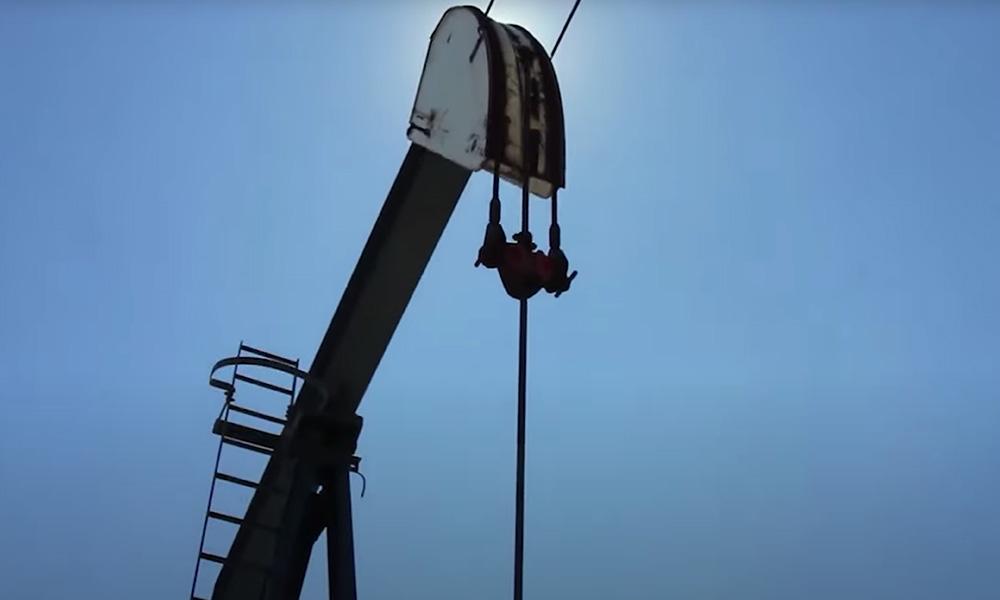
The Strait of Hormuz, a crucial waterway connecting the Persian Gulf and the Gulf of Oman, carries approximately 20% of global oil consumption daily, along with a large amount of liquefied natural gas. Major exporting countries include Saudi Arabia, the United Arab Emirates, Iraq, Kuwait, Qatar, and Iran. Any disruption to the strait would directly impact the global energy supply chain.
The Strait of Hormuz has become a focal point as US and Israeli military action against Iran escalates. Following the outbreak of conflict last weekend, shipping traffic has shrunk dramatically, almost to a standstill. Several shipping giants, such as Maersk and Hapag-Lloyd, have suspended all transport through the strait. A report from the UK's Maritime Trade Operations Centre indicates that vessels in the vicinity have been attacked, and their navigation systems have faced severe electronic interference.
Although no formal physical blockade has yet been implemented, Iranian threats, drone and missile attacks have deterred most oil tankers from passing through. Arne Lohman Rasmussen, chief analyst at Global Risk Management, noted, "In effect, the Strait is closed. Ships face the risk of attack, insurance is difficult to obtain or extremely expensive, and they can only wait for the security situation to improve."
Senior Iranian officials even declared the strait "closed" and threatened to attack any ships attempting to pass through. Although the U.S. Central Command stated that the strait remains technically open, commercial oil tanker traffic has collapsed dramatically, with at least 150 ships stranded at anchor and several tankers damaged or on fire.
Due to the spillover risks from US and Israeli attacks on Iran affecting international shipping, several marine insurers announced on the 2nd that they will cancel war insurance for vessels operating in the Gulf region starting from the 5th. This move will further restrict ships from transiting the Gulf region.
Several major marine insurers headquartered in the UK, Norway, and the US have reportedly announced the cancellation of war insurance coverage in Iranian waters and the Gulf and adjacent waters, effective March 5. War insurance typically provides compensation for losses and damages suffered by shipowners due to acts of war and terrorism. The surge in insurance costs could further disrupt commercial shipping in the Gulf region.
Kevin Booker, managing director of Clearview Energy Partners, stated that infrastructure across the region is at risk, not only from deliberate attacks but also from accidental strikes by shrapnel from missile intercepts, which could cripple facilities. In a region where global energy production is highly concentrated, these multiple challenges should not be underestimated.
Jim Burkhard, head of crude oil research at S&P Global, warned that if the reduction in tanker traffic lasts for a week, it will be a record-breaking event; if it exceeds a week, it will be a "landmark" event for the oil market, with oil prices rising sharply due to the allocation of scarce supply, and impacting financial markets.
If the closure of the Strait of Hormuz is extended for weeks or even months, oil prices could surge to triple digits (above $100). Several institutions, such as Wood Mackenzie and Bernstein, believe that a 3-4 week restriction could push oil prices above $100, and even as high as $120-$150 in extreme cases. Rasmussen warned: "The consequences will be extremely serious, potentially dragging down the global economy and even triggering a recession. This is a very powerful weapon."
Some experts hold a cautious view. For example, Benny Wang, senior energy analyst at PitchBook, pointed out that with ample US inventories and weak global demand, a disruption lasting only a few days would have a limited impact on consumers. However, a prolonged disruption would create a double supply shock: current exports are disrupted, and OPEC+ spare capacity cannot be released through the Straits.
The Strait of Hormuz lacks large-scale alternative routes. The Saudi East-West oil pipeline and the UAE Abu Dhabi oil pipeline have limited capacity, handling only a small fraction of daily traffic and unable to fill the major gap. Benny Wong emphasized, "For this volume, there are virtually no meaningful alternatives."
The current situation highlights the fragility of global energy supplies. The duration of the conflict will be key to determining oil price trends. Markets are closely watching the extent of the weakening of Iran's naval capabilities, the progress of US-Israeli actions, and the possibility of wider infrastructure damage. A rapid de-escalation of tensions could ease pressure on oil prices; conversely, a prolonged escalation will pose a severe test for global energy markets, potentially triggering rising inflation and an economic recession.
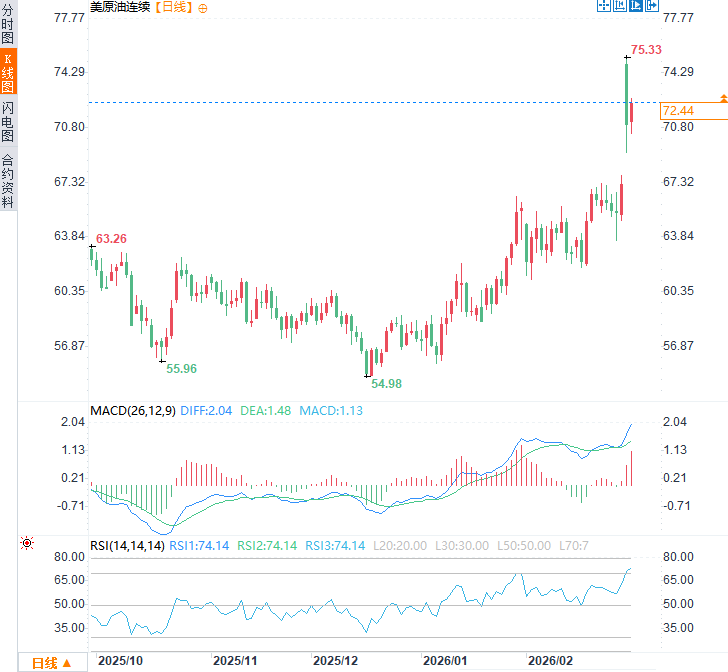
(US crude oil daily chart, source: FX678)
At 11:55 Beijing time, US crude oil futures were trading at $72.42 per barrel.
The Strait of Hormuz, a vital global energy transport chokepoint, handles approximately 20% of global oil consumption. With the escalating conflict between the US and Iran, traffic through the strait has shrunk dramatically, with several major shipping companies suspending passage, effectively rendering it "closed."
The extreme importance of the strategic choke point
The Strait of Hormuz, a crucial waterway connecting the Persian Gulf and the Gulf of Oman, carries approximately 20% of global oil consumption daily, along with a large amount of liquefied natural gas. Major exporting countries include Saudi Arabia, the United Arab Emirates, Iraq, Kuwait, Qatar, and Iran. Any disruption to the strait would directly impact the global energy supply chain.
The Strait of Hormuz has become a focal point as US and Israeli military action against Iran escalates. Following the outbreak of conflict last weekend, shipping traffic has shrunk dramatically, almost to a standstill. Several shipping giants, such as Maersk and Hapag-Lloyd, have suspended all transport through the strait. A report from the UK's Maritime Trade Operations Centre indicates that vessels in the vicinity have been attacked, and their navigation systems have faced severe electronic interference.
Currently in a de facto closed state
Although no formal physical blockade has yet been implemented, Iranian threats, drone and missile attacks have deterred most oil tankers from passing through. Arne Lohman Rasmussen, chief analyst at Global Risk Management, noted, "In effect, the Strait is closed. Ships face the risk of attack, insurance is difficult to obtain or extremely expensive, and they can only wait for the security situation to improve."
Senior Iranian officials even declared the strait "closed" and threatened to attack any ships attempting to pass through. Although the U.S. Central Command stated that the strait remains technically open, commercial oil tanker traffic has collapsed dramatically, with at least 150 ships stranded at anchor and several tankers damaged or on fire.
Several marine insurers will cancel war insurance for vessels operating in the Gulf region.
Due to the spillover risks from US and Israeli attacks on Iran affecting international shipping, several marine insurers announced on the 2nd that they will cancel war insurance for vessels operating in the Gulf region starting from the 5th. This move will further restrict ships from transiting the Gulf region.
Several major marine insurers headquartered in the UK, Norway, and the US have reportedly announced the cancellation of war insurance coverage in Iranian waters and the Gulf and adjacent waters, effective March 5. War insurance typically provides compensation for losses and damages suffered by shipowners due to acts of war and terrorism. The surge in insurance costs could further disrupt commercial shipping in the Gulf region.
Experts' warnings about infrastructure risks
Kevin Booker, managing director of Clearview Energy Partners, stated that infrastructure across the region is at risk, not only from deliberate attacks but also from accidental strikes by shrapnel from missile intercepts, which could cripple facilities. In a region where global energy production is highly concentrated, these multiple challenges should not be underestimated.
Jim Burkhard, head of crude oil research at S&P Global, warned that if the reduction in tanker traffic lasts for a week, it will be a record-breaking event; if it exceeds a week, it will be a "landmark" event for the oil market, with oil prices rising sharply due to the allocation of scarce supply, and impacting financial markets.
Potential oil price increases and economic impact
If the closure of the Strait of Hormuz is extended for weeks or even months, oil prices could surge to triple digits (above $100). Several institutions, such as Wood Mackenzie and Bernstein, believe that a 3-4 week restriction could push oil prices above $100, and even as high as $120-$150 in extreme cases. Rasmussen warned: "The consequences will be extremely serious, potentially dragging down the global economy and even triggering a recession. This is a very powerful weapon."
Some experts hold a cautious view. For example, Benny Wang, senior energy analyst at PitchBook, pointed out that with ample US inventories and weak global demand, a disruption lasting only a few days would have a limited impact on consumers. However, a prolonged disruption would create a double supply shock: current exports are disrupted, and OPEC+ spare capacity cannot be released through the Straits.
Limitations of alternative routes
The Strait of Hormuz lacks large-scale alternative routes. The Saudi East-West oil pipeline and the UAE Abu Dhabi oil pipeline have limited capacity, handling only a small fraction of daily traffic and unable to fill the major gap. Benny Wong emphasized, "For this volume, there are virtually no meaningful alternatives."
The highlight of global energy vulnerability
The current situation highlights the fragility of global energy supplies. The duration of the conflict will be key to determining oil price trends. Markets are closely watching the extent of the weakening of Iran's naval capabilities, the progress of US-Israeli actions, and the possibility of wider infrastructure damage. A rapid de-escalation of tensions could ease pressure on oil prices; conversely, a prolonged escalation will pose a severe test for global energy markets, potentially triggering rising inflation and an economic recession.
(US crude oil daily chart, source: FX678)
At 11:55 Beijing time, US crude oil futures were trading at $72.42 per barrel.
- Risk Warning and Disclaimer
- The market involves risk, and trading may not be suitable for all investors. This article is for reference only and does not constitute personal investment advice, nor does it take into account certain users’ specific investment objectives, financial situation, or other needs. Any investment decisions made based on this information are at your own risk.