Why did gold prices surge and then fall as the US-Iran conflict continues? Was it profit-taking or a buying opportunity?
2026-03-03 15:56:02
Spot gold experienced a significant surge followed by a pullback on Tuesday (March 3). In the early session, it rose sharply by over 1%, reaching a high of $5379.74 per ounce, primarily driven by safe-haven demand amid escalating US-Israeli airstrikes on Iran. However, as some of these risks had already been priced into the market, many long positions opted for profit-taking, causing gold prices to quickly erase all gains, briefly falling below the key $5300 level to a low of $5279.37 per ounce, a decline of approximately 0.65%. Although the continued strengthening of the US dollar index exerted significant downward pressure on gold prices, substantial bargain hunting provided strong support, and gold is currently trading steadily around $5325 per ounce.

Tim Waterer, chief market analyst at KCM Trade, recently commented on the conflict, saying, "Against this backdrop, gold is accounting for the vast majority of safe-haven demand, as the scope and duration of the conflict remain highly uncertain."
He further emphasized that although a stronger dollar usually puts downward pressure on gold prices, during periods of escalating conflict, investors often buy both the dollar and gold as dual safe-haven assets.
Tim Waterer added that without the influence of a stronger dollar, gold prices should be at higher levels, and the current pullback is mainly due to profit-taking rather than a deterioration in fundamentals.
A senior official of Iran's Revolutionary Guard declared on Monday that the Strait of Hormuz was closed and warned that it would fire on any ships attempting to pass through, marking Iran's strongest statement since last Saturday. This move could directly disrupt one-fifth of the world's oil shipping routes, severely hindering crude oil supplies and further driving up global energy prices.
The market generally believes that this threat has pushed the Gulf region into a state of actual war, causing not only a large number of civilian casualties, but also disrupting global air transport and bringing shipping in the Strait of Hormuz to a near standstill.
Former US President Donald Trump recently vowed to continue the conflict with Iran until the necessary objectives are achieved, and warned that "a new wave of large-scale strikes is imminent." This tough stance has further exacerbated market concerns about prolonged instability in the Middle East, prompting investors to seek safe-haven protection between gold and the US dollar.
Trump's remarks are seen as a major catalyst for this event, directly amplifying the short-term volatility of gold prices.
With a sharp decline in traffic in the Strait of Hormuz, crude oil prices rose rapidly. During Tuesday's Asian trading session, US crude oil prices fluctuated upwards, currently trading around $73.95 per barrel, a daily increase of approximately 3.8%. Inflation concerns have become a core focus for traders.
The sharp rise in oil prices has directly boosted inflation expectations, which in turn has provided medium- to long-term support for gold. The market expects that if the conflict continues, gold prices may return to above $5,400 per ounce.
From an objective perspective, the recent decline in gold prices is mainly due to the combined effect of short-term profit-taking and a strong US dollar, rather than a disappearance of safe-haven demand. Iran's threat in the Strait of Hormuz and Trump's tough stance have pushed Middle East geopolitical risks to new heights, and the risk of oil supply disruptions will provide long-term support for gold as an inflation hedge.
Investors need to closely monitor the progress of the conflict and the Federal Reserve's policy moves. Short-term volatility may continue to intensify, but gold's safe-haven status remains solid in the medium to long term.
Q: Why did spot gold suddenly fall below the $5,300 mark?
A: This was mainly because the market had already priced in the risk of a US-Israeli airstrike on Iran, and profit-taking by long positions in the morning led to a rapid decline. At the same time, a stronger US dollar index created double pressure. Nevertheless, bargain hunting still provided support around $5310.
Q: What impact will Iran's closure of the Strait of Hormuz have on the global economy?
A: This strait carries one-fifth of the world's oil shipments. If it were to be completely closed, it would cause a major disruption to crude oil supply, and oil prices could surge to over $100, directly pushing up global inflation and dragging down economic growth.
Q: A stronger dollar usually puts downward pressure on gold, so why did both rise simultaneously during this conflict?
A: During periods of escalating conflict, investors tend to buy both the US dollar and gold as dual safe-haven assets. KCM Trade analyst Tim Waterer explicitly points out that in environments of extreme uncertainty, gold still dominates the demand for safe-haven assets.
Q: What specific impact will Trump's remarks have on gold prices?
A: Trump’s vow to continue the conflict and his warning of a new round of large-scale strikes have further amplified market concerns about long-term turmoil in the Middle East, directly driving safe-haven buying of gold and strengthening the dollar.
Q: What will the future trend of gold prices be? What should investors do?
A: Gold prices are likely to continue fluctuating between $5300 and $5400 in the short term, but with the continued rise in oil prices and increasing inflation concerns, gold is expected to return to new highs in the medium to long term. Investors are advised to pay close attention to the actual developments in the Strait of Hormuz and the Federal Reserve's policies.
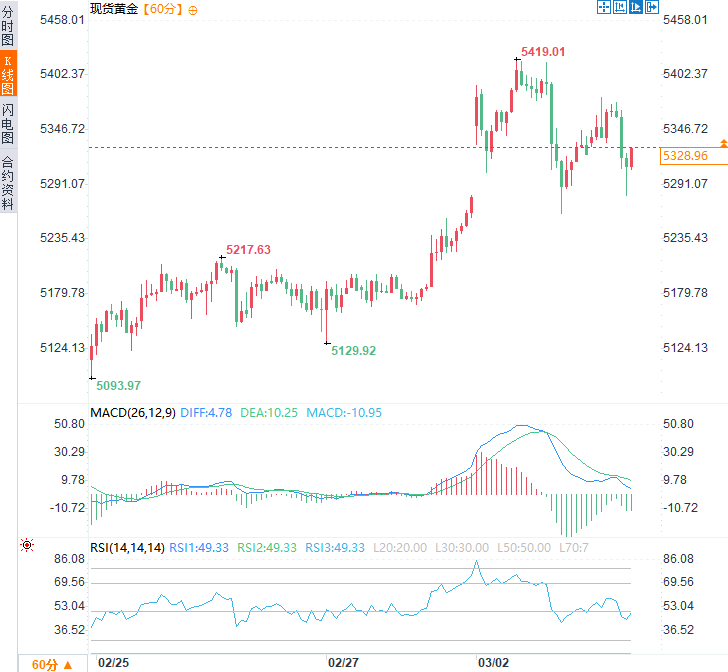
(Spot gold hourly chart, source: EasyForex)
At 15:51 Beijing time, spot gold was trading at $5326.18 per ounce.
Analyst's Viewpoint Interpretation
Tim Waterer, chief market analyst at KCM Trade, recently commented on the conflict, saying, "Against this backdrop, gold is accounting for the vast majority of safe-haven demand, as the scope and duration of the conflict remain highly uncertain."
He further emphasized that although a stronger dollar usually puts downward pressure on gold prices, during periods of escalating conflict, investors often buy both the dollar and gold as dual safe-haven assets.
Tim Waterer added that without the influence of a stronger dollar, gold prices should be at higher levels, and the current pullback is mainly due to profit-taking rather than a deterioration in fundamentals.
Threat of closing the Strait of Hormuz
A senior official of Iran's Revolutionary Guard declared on Monday that the Strait of Hormuz was closed and warned that it would fire on any ships attempting to pass through, marking Iran's strongest statement since last Saturday. This move could directly disrupt one-fifth of the world's oil shipping routes, severely hindering crude oil supplies and further driving up global energy prices.
The market generally believes that this threat has pushed the Gulf region into a state of actual war, causing not only a large number of civilian casualties, but also disrupting global air transport and bringing shipping in the Strait of Hormuz to a near standstill.
Impact of Trump's statements on the conflict
Former US President Donald Trump recently vowed to continue the conflict with Iran until the necessary objectives are achieved, and warned that "a new wave of large-scale strikes is imminent." This tough stance has further exacerbated market concerns about prolonged instability in the Middle East, prompting investors to seek safe-haven protection between gold and the US dollar.
Trump's remarks are seen as a major catalyst for this event, directly amplifying the short-term volatility of gold prices.
Inflation concerns and oil prices support gold
With a sharp decline in traffic in the Strait of Hormuz, crude oil prices rose rapidly. During Tuesday's Asian trading session, US crude oil prices fluctuated upwards, currently trading around $73.95 per barrel, a daily increase of approximately 3.8%. Inflation concerns have become a core focus for traders.
The sharp rise in oil prices has directly boosted inflation expectations, which in turn has provided medium- to long-term support for gold. The market expects that if the conflict continues, gold prices may return to above $5,400 per ounce.
Editor's Summary
From an objective perspective, the recent decline in gold prices is mainly due to the combined effect of short-term profit-taking and a strong US dollar, rather than a disappearance of safe-haven demand. Iran's threat in the Strait of Hormuz and Trump's tough stance have pushed Middle East geopolitical risks to new heights, and the risk of oil supply disruptions will provide long-term support for gold as an inflation hedge.
Investors need to closely monitor the progress of the conflict and the Federal Reserve's policy moves. Short-term volatility may continue to intensify, but gold's safe-haven status remains solid in the medium to long term.
Frequently Asked Questions
Q: Why did spot gold suddenly fall below the $5,300 mark?
A: This was mainly because the market had already priced in the risk of a US-Israeli airstrike on Iran, and profit-taking by long positions in the morning led to a rapid decline. At the same time, a stronger US dollar index created double pressure. Nevertheless, bargain hunting still provided support around $5310.
Q: What impact will Iran's closure of the Strait of Hormuz have on the global economy?
A: This strait carries one-fifth of the world's oil shipments. If it were to be completely closed, it would cause a major disruption to crude oil supply, and oil prices could surge to over $100, directly pushing up global inflation and dragging down economic growth.
Q: A stronger dollar usually puts downward pressure on gold, so why did both rise simultaneously during this conflict?
A: During periods of escalating conflict, investors tend to buy both the US dollar and gold as dual safe-haven assets. KCM Trade analyst Tim Waterer explicitly points out that in environments of extreme uncertainty, gold still dominates the demand for safe-haven assets.
Q: What specific impact will Trump's remarks have on gold prices?
A: Trump’s vow to continue the conflict and his warning of a new round of large-scale strikes have further amplified market concerns about long-term turmoil in the Middle East, directly driving safe-haven buying of gold and strengthening the dollar.
Q: What will the future trend of gold prices be? What should investors do?
A: Gold prices are likely to continue fluctuating between $5300 and $5400 in the short term, but with the continued rise in oil prices and increasing inflation concerns, gold is expected to return to new highs in the medium to long term. Investors are advised to pay close attention to the actual developments in the Strait of Hormuz and the Federal Reserve's policies.
(Spot gold hourly chart, source: EasyForex)
At 15:51 Beijing time, spot gold was trading at $5326.18 per ounce.
- Risk Warning and Disclaimer
- The market involves risk, and trading may not be suitable for all investors. This article is for reference only and does not constitute personal investment advice, nor does it take into account certain users’ specific investment objectives, financial situation, or other needs. Any investment decisions made based on this information are at your own risk.