The shutdown of Qatari energy facilities triggered a market surge: European natural gas prices rose by over 50% in two days, with a single-day spike of 30%.
2026-03-03 16:08:00
According to APP, European natural gas futures prices rose sharply for the second consecutive trading day due to the shutdown of some facilities of Qatar Energy.
The benchmark TTF contract rose more than 30% at one point during the session, and has accumulated a gain of more than 50% since last Friday's close, marking a rare and dramatic fluctuation since the European energy crisis in 2022 .
The core driver of this price surge is the high degree of uncertainty surrounding the duration of supply disruptions . Qatar is one of the world's largest exporters of liquefied natural gas (LNG), accounting for approximately 20% of global LNG trade.
Any short-term supply contraction will quickly spread to European and Asian markets. Asian buying sprees have driven up global premiums following the closure of Qatari facilities. Several importers have requested early delivery of LNG cargoes to ensure power and industrial needs are met.
Buyers in the Asia-Pacific region have raised their bids in the spot market, driving a rapid increase in spot premiums. Ross Wyeno, head of short-term LNG analysis at S&P Global, said: “Prices are expected to fluctuate significantly in the coming days as the market reassesses supply mix risks. The most aggressive buyers in the short-term spot market are likely to be from the Asia-Pacific region.” This trend is having a direct impact on Europe.
Because LNG has global liquidity, if Asian countries are willing to pay higher prices, European importers must raise their bids to lock in supplies, further pushing up TTF futures prices . While current volatility has increased rapidly compared to historical crises, the market fundamentals differ from those of 2022. The following is a comparative analysis:
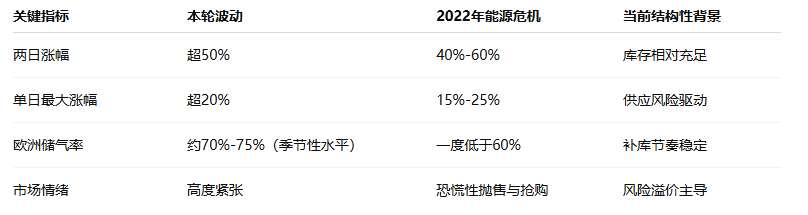
It can be seen that this round of price increases is more a reflection of the rapid pricing of risk premiums than an actual inventory shortage.
How does supply risk affect price structure?
The most critical variables in the market at present include: whether the facility shutdown will last for more than several weeks; whether it will affect regional energy transportation corridors; and whether there will be a structural reduction in LNG exports. If the shutdown is short, prices may experience a technical decline.
If the duration of this period is prolonged, the market may enter a phase of high volatility. Looking at the price structure, the price increase for near-month contracts is significantly higher than that for far-month contracts, indicating that market pricing is focused on short-term spot tightness . The supply chain transmission effect is evident in the electricity market : rising gas-fired power generation costs are putting pressure on forward electricity contracts.
Industrial enterprises : Costs are rising in the chemical, metallurgical, and glass industries. LNG shipping : Spot shipping demand is increasing, and the chartering market is tightening. Inflation expectations : Rising energy prices may influence the European Central Bank's policy path.
However, compared to 2022, Europe's gas storage capacity and import channels are now more diversified, and systemic risks are controllable.
The editor's summary indicates that the recent surge in European natural gas prices reflects the global energy market's high sensitivity to supply disruptions. While inventory levels provide some buffer, supply uncertainty has driven a rapid release of risk premiums. Market volatility is expected to remain high in the short term, with price movements depending on the progress of Qatari facility recovery and the Asia-Europe LNG price competition.
If supply recovers quickly, prices may rebound; if the conflict continues, the energy market will enter a period of high volatility.
Frequently Asked Questions
1. Why would changes in Qatar's supply chain affect Europe?
Qatar is one of the world's major LNG exporters. Europe is heavily reliant on LNG imports due to reduced pipeline gas supplies, so any supply disruptions from exporting countries are quickly reflected in European TTF prices.
2. Why did prices surge despite high inventory levels?
The market trades on expectations, not the status quo. Even with ample inventory, if there is uncertainty about future supply, traders will buy in advance, causing prices to rise sharply in the short term.
3. Why are Asian buyers key?
LNG cargoes can be distributed globally. Increased bids from Asian buyers drive up global spot benchmark prices, forcing Europe to follow suit and secure supply.
4. Will the 2022 energy crisis repeat itself?
Current gas storage rates in Europe are higher than at the beginning of the crisis, and import sources are more diversified, thus systemic risk is lower. However, if supply disruptions persist, prices could still fluctuate dramatically.
5. What will determine the subsequent price trend?
The key factors are the facility recovery time, whether it escalates into a regional transport risk, and the intensity of competition between Asia and Europe. If the shutdown is short-lived, prices may correct; if it is prolonged, the risk premium will remain high.
The benchmark TTF contract rose more than 30% at one point during the session, and has accumulated a gain of more than 50% since last Friday's close, marking a rare and dramatic fluctuation since the European energy crisis in 2022 .
The core driver of this price surge is the high degree of uncertainty surrounding the duration of supply disruptions . Qatar is one of the world's largest exporters of liquefied natural gas (LNG), accounting for approximately 20% of global LNG trade.
Any short-term supply contraction will quickly spread to European and Asian markets. Asian buying sprees have driven up global premiums following the closure of Qatari facilities. Several importers have requested early delivery of LNG cargoes to ensure power and industrial needs are met.
Buyers in the Asia-Pacific region have raised their bids in the spot market, driving a rapid increase in spot premiums. Ross Wyeno, head of short-term LNG analysis at S&P Global, said: “Prices are expected to fluctuate significantly in the coming days as the market reassesses supply mix risks. The most aggressive buyers in the short-term spot market are likely to be from the Asia-Pacific region.” This trend is having a direct impact on Europe.
Because LNG has global liquidity, if Asian countries are willing to pay higher prices, European importers must raise their bids to lock in supplies, further pushing up TTF futures prices . While current volatility has increased rapidly compared to historical crises, the market fundamentals differ from those of 2022. The following is a comparative analysis:
It can be seen that this round of price increases is more a reflection of the rapid pricing of risk premiums than an actual inventory shortage.
How does supply risk affect price structure?
The most critical variables in the market at present include: whether the facility shutdown will last for more than several weeks; whether it will affect regional energy transportation corridors; and whether there will be a structural reduction in LNG exports. If the shutdown is short, prices may experience a technical decline.
If the duration of this period is prolonged, the market may enter a phase of high volatility. Looking at the price structure, the price increase for near-month contracts is significantly higher than that for far-month contracts, indicating that market pricing is focused on short-term spot tightness . The supply chain transmission effect is evident in the electricity market : rising gas-fired power generation costs are putting pressure on forward electricity contracts.
Industrial enterprises : Costs are rising in the chemical, metallurgical, and glass industries. LNG shipping : Spot shipping demand is increasing, and the chartering market is tightening. Inflation expectations : Rising energy prices may influence the European Central Bank's policy path.
However, compared to 2022, Europe's gas storage capacity and import channels are now more diversified, and systemic risks are controllable.
The editor's summary indicates that the recent surge in European natural gas prices reflects the global energy market's high sensitivity to supply disruptions. While inventory levels provide some buffer, supply uncertainty has driven a rapid release of risk premiums. Market volatility is expected to remain high in the short term, with price movements depending on the progress of Qatari facility recovery and the Asia-Europe LNG price competition.
If supply recovers quickly, prices may rebound; if the conflict continues, the energy market will enter a period of high volatility.
Frequently Asked Questions
1. Why would changes in Qatar's supply chain affect Europe?
Qatar is one of the world's major LNG exporters. Europe is heavily reliant on LNG imports due to reduced pipeline gas supplies, so any supply disruptions from exporting countries are quickly reflected in European TTF prices.
2. Why did prices surge despite high inventory levels?
The market trades on expectations, not the status quo. Even with ample inventory, if there is uncertainty about future supply, traders will buy in advance, causing prices to rise sharply in the short term.
3. Why are Asian buyers key?
LNG cargoes can be distributed globally. Increased bids from Asian buyers drive up global spot benchmark prices, forcing Europe to follow suit and secure supply.
4. Will the 2022 energy crisis repeat itself?
Current gas storage rates in Europe are higher than at the beginning of the crisis, and import sources are more diversified, thus systemic risk is lower. However, if supply disruptions persist, prices could still fluctuate dramatically.
5. What will determine the subsequent price trend?
The key factors are the facility recovery time, whether it escalates into a regional transport risk, and the intensity of competition between Asia and Europe. If the shutdown is short-lived, prices may correct; if it is prolonged, the risk premium will remain high.
- Risk Warning and Disclaimer
- The market involves risk, and trading may not be suitable for all investors. This article is for reference only and does not constitute personal investment advice, nor does it take into account certain users’ specific investment objectives, financial situation, or other needs. Any investment decisions made based on this information are at your own risk.