Trump's "quick victory" and Iran's "Strait chokehold": Is an oil crisis on the horizon?
2026-03-03 16:32:31
A joint US-Israeli airstrike on Iran killed Supreme Leader Ayatollah Khamenei, escalating geopolitical tensions in the Middle East. Trump vowed "retaliation will come soon," and Iran's Revolutionary Guard announced the closure of the Strait of Hormuz and threatened to attack ships passing through. The US embassy in Saudi Arabia was damaged in a drone strike.
If the conflict continues to escalate, high oil prices will translate into inflation, exacerbating pressure on global supply chains, with Asian importing countries bearing the brunt. The market is closely watching developments in the Strait of Hormuz and subsequent actions by the US.

The joint US-Israeli preemptive airstrikes against Iran, which killed Iran's Supreme Leader Ayatollah Khamenei, marked a sharp escalation of geopolitical conflicts in the Middle East.
In his latest statement, US President Trump emphasized: "People will soon see retaliatory action from the United States," "A nuclear-armed Iran is intolerable to the United States," and "Military action will not take years."
Iran's Revolutionary Guard claimed to have closed the Strait of Hormuz and threatened to strike all ships passing through. The U.S. Central Command denied a complete closure of the strait, but tensions have led to a drone strike on the U.S. embassy in Saudi Arabia, causing damage and a fire. Iran vowed strong retaliation, and the conflict has spread to Saudi Arabia, Hezbollah targets in Lebanon, and other parties.
Escalating conflict triggered a surge in global risk aversion. Japan's TOPIX index fell by 2%, and South Korea's KOSPI index dropped by over 3%. The three major A-share indices all retreated, with the Shanghai Composite, Shenzhen Component, and ChiNext all falling by more than 1%, and nearly 4,200 stocks declining. The Dow Jones Industrial Average dipped slightly, while the Nasdaq and S&P 500 rebounded slightly, but overall trading activity was concentrated in the energy and defense sectors. The US dollar index strengthened to a high of 98.98, the highest level since January 20th. On Monday (March 2nd), US crude oil prices jumped more than 12%, reaching a near nine-month high of $75.33 per barrel. On Tuesday, US crude oil prices fluctuated upwards and are currently trading around $74.00 per barrel, with a daily increase of approximately 3.85%.
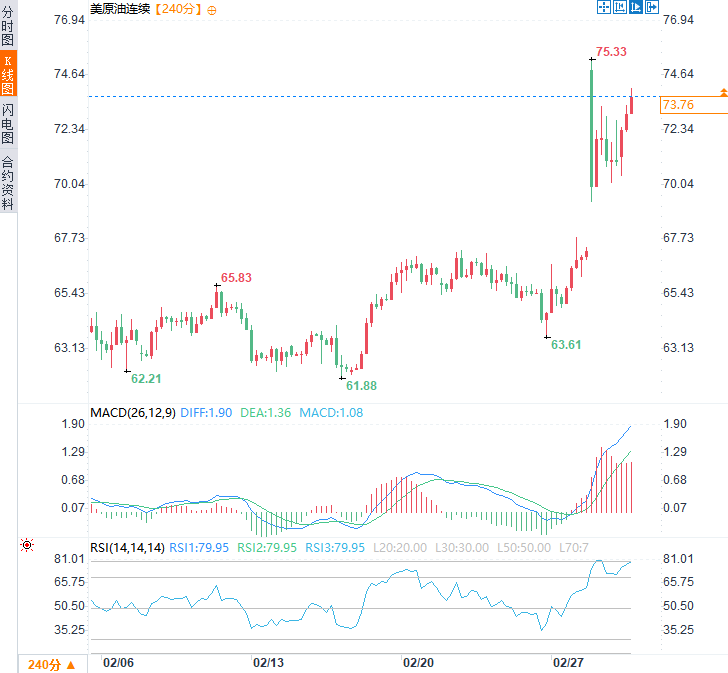
(US crude oil 4-hour chart, source: FX678)
The Strait of Hormuz, a vital waterway for nearly one-third of the world's seaborne oil, faces the direct risk of closure, pushing up energy prices. International oil prices surged due to supply concerns, and tanker freight rates soared to record highs. The benchmark rate for clean petroleum products on the Persian Gulf-Japan route rose by 36%, generating daily revenue of $424,000.
Several crude oil-themed funds (such as Southern Crude Oil LOF) resumed trading with limit-up prices or were temporarily suspended, indicating a significant market panic premium. Analysts point out that if the Taiwan Strait remains blocked for an extended period, the global energy crisis will intensify, and inflationary pressures will reappear.
Spot gold saw a significant surge followed by a pullback on Tuesday. In the early session, it rose sharply by more than 1%, reaching a high of $5,379.74 per ounce, as the Iranian rial depreciated sharply.
Technology stocks showed mixed performance. Nvidia closed up 2.93% after announcing a $2 billion investment each in optical communications companies Coherent and Lumentum, totaling $4 billion, to strengthen its AI supply chain. OpenAI secured approximately $110 billion in funding, while giants like Meta are expected to invest nearly $700 billion in building AI data centers. However, overall market risk appetite declined, with defense and energy stocks becoming safe havens for funds.
This conflict could escalate into a long-term crisis, with high oil prices leading to inflation and limiting the Federal Reserve's policy space. Shipping disruptions have driven up global logistics costs, exposing the fragility of supply chains. Asian economies (such as Japan and South Korea) are most affected by oil shipping disruptions, while increased energy dependence in Europe exacerbates uncertainty. In the long term, geopolitical risks will reshape the energy landscape and accelerate the renewable energy transition, but market volatility will continue to amplify in the short term.
The US-Israeli airstrikes on Iran have triggered a chain reaction, with the Strait of Hormuz crisis becoming the biggest source of uncertainty. The surge in oil and gold prices and the subsequent stock market plunge reflect a prevailing risk-averse sentiment, with the energy and defense sectors showing relative resilience. If the conflict continues to escalate, global inflation and supply chain pressures will increase significantly. Investors need to closely monitor developments in the Strait, subsequent US retaliatory measures, and the strength of Iran's response. Short-term market volatility may persist, while long-term prospects depend on the outcome of the great power rivalry and the progress of diplomatic maneuvering.
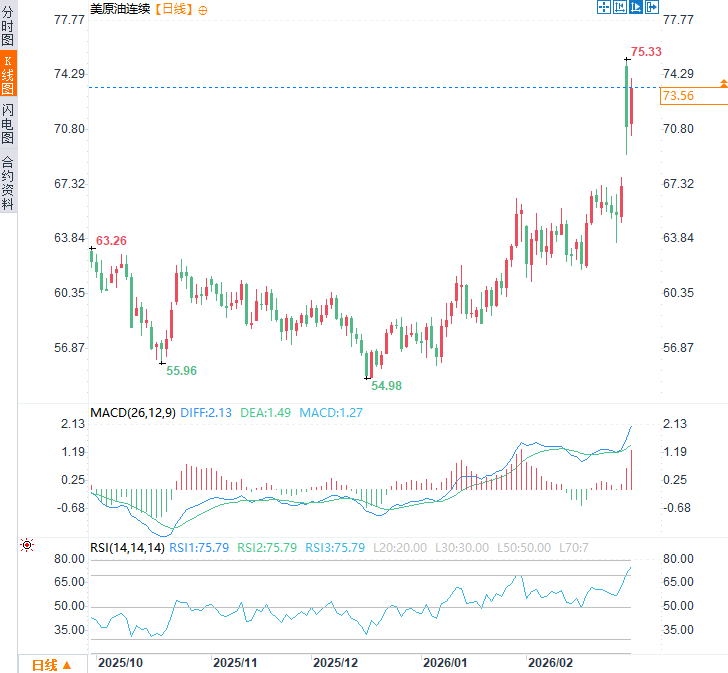
(US crude oil daily chart, source: FX678)
1. What are the direct consequences of closing the Strait of Hormuz?
The Strait of Hormuz is the world's most critical waterway for oil transportation, with approximately 20 million barrels of crude oil passing through daily. If it were to be truly closed, oil prices could surge by more than 20% in the short term, immediately straining global energy supplies and causing shipping costs to skyrocket, pushing up inflation in importing countries. Iran has claimed responsibility for the closure, but the US has denied this, making it a deterrent statement. Currently, the rerouting of ships has already led to a 36% increase in freight rates.
2. What does Trump's latest statement mean for the market?
Trump emphasized that "retaliation will come soon" and "it won't take years," demonstrating the US's strong resolve but also its desire for a swift resolution. This alleviated fears of a "protracted war," but also suggested the conflict would be difficult to quell in the short term. The market interpreted this as a continued energy risk premium, benefiting oil and gas stocks and increasing overall volatility.
At 16:30 Beijing time, US crude oil futures were trading at $74.05 per barrel.
If the conflict continues to escalate, high oil prices will translate into inflation, exacerbating pressure on global supply chains, with Asian importing countries bearing the brunt. The market is closely watching developments in the Strait of Hormuz and subsequent actions by the US.
The trigger for the incident and its latest developments
The joint US-Israeli preemptive airstrikes against Iran, which killed Iran's Supreme Leader Ayatollah Khamenei, marked a sharp escalation of geopolitical conflicts in the Middle East.
In his latest statement, US President Trump emphasized: "People will soon see retaliatory action from the United States," "A nuclear-armed Iran is intolerable to the United States," and "Military action will not take years."
Iran's Revolutionary Guard claimed to have closed the Strait of Hormuz and threatened to strike all ships passing through. The U.S. Central Command denied a complete closure of the strait, but tensions have led to a drone strike on the U.S. embassy in Saudi Arabia, causing damage and a fire. Iran vowed strong retaliation, and the conflict has spread to Saudi Arabia, Hezbollah targets in Lebanon, and other parties.
Real-time reaction of global financial markets
Escalating conflict triggered a surge in global risk aversion. Japan's TOPIX index fell by 2%, and South Korea's KOSPI index dropped by over 3%. The three major A-share indices all retreated, with the Shanghai Composite, Shenzhen Component, and ChiNext all falling by more than 1%, and nearly 4,200 stocks declining. The Dow Jones Industrial Average dipped slightly, while the Nasdaq and S&P 500 rebounded slightly, but overall trading activity was concentrated in the energy and defense sectors. The US dollar index strengthened to a high of 98.98, the highest level since January 20th. On Monday (March 2nd), US crude oil prices jumped more than 12%, reaching a near nine-month high of $75.33 per barrel. On Tuesday, US crude oil prices fluctuated upwards and are currently trading around $74.00 per barrel, with a daily increase of approximately 3.85%.
(US crude oil 4-hour chart, source: FX678)
Analysis of dramatic fluctuations in the energy market
The Strait of Hormuz, a vital waterway for nearly one-third of the world's seaborne oil, faces the direct risk of closure, pushing up energy prices. International oil prices surged due to supply concerns, and tanker freight rates soared to record highs. The benchmark rate for clean petroleum products on the Persian Gulf-Japan route rose by 36%, generating daily revenue of $424,000.
Several crude oil-themed funds (such as Southern Crude Oil LOF) resumed trading with limit-up prices or were temporarily suspended, indicating a significant market panic premium. Analysts point out that if the Taiwan Strait remains blocked for an extended period, the global energy crisis will intensify, and inflationary pressures will reappear.
Divergence between safe-haven assets and the technology sector
Spot gold saw a significant surge followed by a pullback on Tuesday. In the early session, it rose sharply by more than 1%, reaching a high of $5,379.74 per ounce, as the Iranian rial depreciated sharply.
Technology stocks showed mixed performance. Nvidia closed up 2.93% after announcing a $2 billion investment each in optical communications companies Coherent and Lumentum, totaling $4 billion, to strengthen its AI supply chain. OpenAI secured approximately $110 billion in funding, while giants like Meta are expected to invest nearly $700 billion in building AI data centers. However, overall market risk appetite declined, with defense and energy stocks becoming safe havens for funds.
Profound impact on the global economy and supply chains
This conflict could escalate into a long-term crisis, with high oil prices leading to inflation and limiting the Federal Reserve's policy space. Shipping disruptions have driven up global logistics costs, exposing the fragility of supply chains. Asian economies (such as Japan and South Korea) are most affected by oil shipping disruptions, while increased energy dependence in Europe exacerbates uncertainty. In the long term, geopolitical risks will reshape the energy landscape and accelerate the renewable energy transition, but market volatility will continue to amplify in the short term.
Editor's Summary
The US-Israeli airstrikes on Iran have triggered a chain reaction, with the Strait of Hormuz crisis becoming the biggest source of uncertainty. The surge in oil and gold prices and the subsequent stock market plunge reflect a prevailing risk-averse sentiment, with the energy and defense sectors showing relative resilience. If the conflict continues to escalate, global inflation and supply chain pressures will increase significantly. Investors need to closely monitor developments in the Strait, subsequent US retaliatory measures, and the strength of Iran's response. Short-term market volatility may persist, while long-term prospects depend on the outcome of the great power rivalry and the progress of diplomatic maneuvering.
(US crude oil daily chart, source: FX678)
Frequently Asked Questions
1. What are the direct consequences of closing the Strait of Hormuz?
The Strait of Hormuz is the world's most critical waterway for oil transportation, with approximately 20 million barrels of crude oil passing through daily. If it were to be truly closed, oil prices could surge by more than 20% in the short term, immediately straining global energy supplies and causing shipping costs to skyrocket, pushing up inflation in importing countries. Iran has claimed responsibility for the closure, but the US has denied this, making it a deterrent statement. Currently, the rerouting of ships has already led to a 36% increase in freight rates.
2. What does Trump's latest statement mean for the market?
Trump emphasized that "retaliation will come soon" and "it won't take years," demonstrating the US's strong resolve but also its desire for a swift resolution. This alleviated fears of a "protracted war," but also suggested the conflict would be difficult to quell in the short term. The market interpreted this as a continued energy risk premium, benefiting oil and gas stocks and increasing overall volatility.
At 16:30 Beijing time, US crude oil futures were trading at $74.05 per barrel.
- Risk Warning and Disclaimer
- The market involves risk, and trading may not be suitable for all investors. This article is for reference only and does not constitute personal investment advice, nor does it take into account certain users’ specific investment objectives, financial situation, or other needs. Any investment decisions made based on this information are at your own risk.