













New York Fed President says: Don't be afraid of war, interest rate cuts will continue! Is the dollar's rally about to be "hijacked"?
2026-03-04 09:22:19
New York Federal Reserve President John Williams, in an interview following a conference in Washington on Tuesday (March 3), stated unequivocally that it is "too early" to assess the full impact of the Iraq War on the U.S. economy, inflation, and growth. He emphasized that the U.S. economy's dependence on imported oil has significantly decreased, and past experience shows that current oil price fluctuations will not fundamentally alter the economic fundamentals. If inflation gradually eases as expected, the Federal Reserve still has room to further cut interest rates as planned to avoid unintentionally tightening monetary policy.
Williams pointed out that the impact of the war is currently being transmitted primarily through asset prices and financial markets, and the overall response has been mild. He reiterated that the current monetary policy stance is "well-positioned," supporting both labor market stability and pushing inflation back to the 2% target. The U.S. economy is on solid ground, with growth expected to reach 2.5% this year, thanks to fiscal stimulus, favorable financial conditions, and strong investment in artificial intelligence.
New York Federal Reserve President John Williams conveyed cautious optimism in his remarks and subsequent interviews. He explicitly stated that it was "too early" to assess the long-term impact of the Iraq War on the U.S. economy, inflation, and growth.
He emphasized that monetary policy is currently positioned appropriately, enabling it to flexibly address potential risks while maintaining confidence in inflation returning to the 2% target. If inflation follows expectations, the Federal Reserve will have reason to further lower the federal funds rate.
Williams believes the current impact of the war is primarily reflected in asset prices and financial market volatility, and these reactions are "relatively mild overall." He points out, "No one can be sure how long this situation will last, or its broader impact... Past experience suggests that the oil price volatility we have seen so far has not fundamentally changed the economy, but let's wait and see."
He specifically mentioned that the United States' dependence on imported oil is far below historical levels, and its economy has shown strong resilience in the face of energy price shocks.
Williams expects that if inflation follows its anticipated path of gradual easing, it will eventually justify further interest rate cuts to prevent policy from unintentionally becoming too tight. He stated, "Current monetary policy is well-positioned to support labor market stability while simultaneously pushing inflation back to the 2% target."
Markets have lowered their expectations for interest rate cuts this year due to the war driving up energy prices, but Williams maintained his assessment that inflation will return to 2% in 2027, leaving room for further easing.
The US economy's reliance on Middle Eastern oil has decreased significantly, thanks to the shale oil revolution, energy diversification, and improved strategic reserves. Williams believes this has weakened the transmission effect of current oil price increases on the overall economy compared to the past.
While energy price fluctuations caused by war may exacerbate inflationary pressures in the short term, they are unlikely to fundamentally overturn the economic fundamentals. Past experience with geopolitical conflicts also supports this assessment: oil price shocks are often short-term and unlikely to alter the long-term growth trajectory.
Williams described the current job market as "low hiring, low laying off," indicating it has stabilized. He predicts a slight decline in the unemployment rate this year and in 2027.
The U.S. economy is on track for 2.5% growth this year, driven primarily by fiscal stimulus, favorable financial conditions, and robust investment in artificial intelligence. These structural advantages provide a buffer for the economy and mitigate the destructive power of geopolitical risks.
Williams sees tariffs as a major driver of inflation this year, but his impact will gradually diminish by mid-year. He expects overall inflation, as measured by the PCE price index, to fall by 2.5% this year and return to the 2% target by 2027.
A study by the Federal Reserve Bank of New York showed that the "vast majority" of the costs of U.S. import tariffs are borne by domestic consumers and businesses, rather than foreign producers—a conclusion that has sparked controversy. The researcher argued that while tariffs may raise prices in the short term, their effects will diminish in the medium term and will not permanently alter the central level of inflation.
Williams' remarks were geared towards curbing excessive short-term gains in the dollar. He was trying to reassure the market: Don't worry, this time is different, the US can hold on, and we will proceed with the planned rate cuts.
Therefore, if the situation does not deteriorate significantly, the US dollar may experience some pullback or weakening due to the repricing of interest rate cut expectations. However, it should be noted that this analysis is highly dependent on the stability of the situation. Once Williams's "moderate" assessment is contradicted by actual data, the US dollar will quickly shift to a safe-haven and inflation-hedging mode, initiating a new round of appreciation.
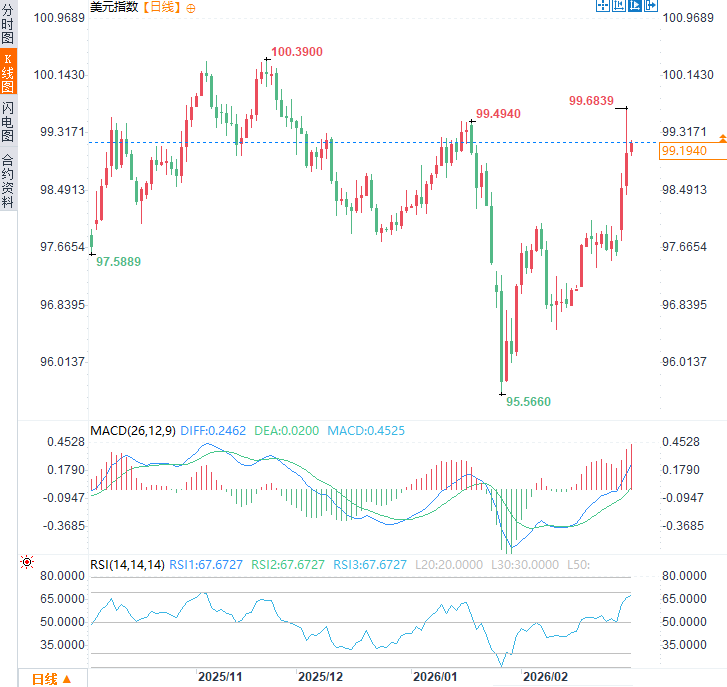
(US Dollar Index Daily Chart, Source: FX678)
New York Fed President Williams expressed caution regarding the impact of the Iraq War, emphasizing the increased resilience of the US economy and reduced energy dependence, stating that current oil price fluctuations are unlikely to fundamentally alter the growth and inflation trajectory. He maintains a flexible monetary policy stance, and if inflation eases as expected, the path of interest rate cuts can continue. He believes tariffs will push up prices in the short term but will weaken in the medium term, while investment in artificial intelligence and fiscal stimulus will support growth. The market should focus on the duration of the conflict and actual inflation data, rather than prematurely adjusting policy expectations.
At 9:22 AM Beijing time, the US dollar index is currently at 99.28.
Williams pointed out that the impact of the war is currently being transmitted primarily through asset prices and financial markets, and the overall response has been mild. He reiterated that the current monetary policy stance is "well-positioned," supporting both labor market stability and pushing inflation back to the 2% target. The U.S. economy is on solid ground, with growth expected to reach 2.5% this year, thanks to fiscal stimulus, favorable financial conditions, and strong investment in artificial intelligence.
Key points of Williams' latest statement
New York Federal Reserve President John Williams conveyed cautious optimism in his remarks and subsequent interviews. He explicitly stated that it was "too early" to assess the long-term impact of the Iraq War on the U.S. economy, inflation, and growth.
He emphasized that monetary policy is currently positioned appropriately, enabling it to flexibly address potential risks while maintaining confidence in inflation returning to the 2% target. If inflation follows expectations, the Federal Reserve will have reason to further lower the federal funds rate.
A prudent assessment of the impact of the Iraq War
Williams believes the current impact of the war is primarily reflected in asset prices and financial market volatility, and these reactions are "relatively mild overall." He points out, "No one can be sure how long this situation will last, or its broader impact... Past experience suggests that the oil price volatility we have seen so far has not fundamentally changed the economy, but let's wait and see."
He specifically mentioned that the United States' dependence on imported oil is far below historical levels, and its economy has shown strong resilience in the face of energy price shocks.
Analysis of Inflation Path and Interest Rate Cut Expectations
Williams expects that if inflation follows its anticipated path of gradual easing, it will eventually justify further interest rate cuts to prevent policy from unintentionally becoming too tight. He stated, "Current monetary policy is well-positioned to support labor market stability while simultaneously pushing inflation back to the 2% target."
Markets have lowered their expectations for interest rate cuts this year due to the war driving up energy prices, but Williams maintained his assessment that inflation will return to 2% in 2027, leaving room for further easing.
US economic resilience and changes in energy dependence
The US economy's reliance on Middle Eastern oil has decreased significantly, thanks to the shale oil revolution, energy diversification, and improved strategic reserves. Williams believes this has weakened the transmission effect of current oil price increases on the overall economy compared to the past.
While energy price fluctuations caused by war may exacerbate inflationary pressures in the short term, they are unlikely to fundamentally overturn the economic fundamentals. Past experience with geopolitical conflicts also supports this assessment: oil price shocks are often short-term and unlikely to alter the long-term growth trajectory.
Labor Market and Growth Outlook
Williams described the current job market as "low hiring, low laying off," indicating it has stabilized. He predicts a slight decline in the unemployment rate this year and in 2027.
The U.S. economy is on track for 2.5% growth this year, driven primarily by fiscal stimulus, favorable financial conditions, and robust investment in artificial intelligence. These structural advantages provide a buffer for the economy and mitigate the destructive power of geopolitical risks.
The short- and medium-term effects of tariffs on inflation.
Williams sees tariffs as a major driver of inflation this year, but his impact will gradually diminish by mid-year. He expects overall inflation, as measured by the PCE price index, to fall by 2.5% this year and return to the 2% target by 2027.
A study by the Federal Reserve Bank of New York showed that the "vast majority" of the costs of U.S. import tariffs are borne by domestic consumers and businesses, rather than foreign producers—a conclusion that has sparked controversy. The researcher argued that while tariffs may raise prices in the short term, their effects will diminish in the medium term and will not permanently alter the central level of inflation.
Analysis of the impact on the US dollar
Williams' remarks were geared towards curbing excessive short-term gains in the dollar. He was trying to reassure the market: Don't worry, this time is different, the US can hold on, and we will proceed with the planned rate cuts.
Therefore, if the situation does not deteriorate significantly, the US dollar may experience some pullback or weakening due to the repricing of interest rate cut expectations. However, it should be noted that this analysis is highly dependent on the stability of the situation. Once Williams's "moderate" assessment is contradicted by actual data, the US dollar will quickly shift to a safe-haven and inflation-hedging mode, initiating a new round of appreciation.
(US Dollar Index Daily Chart, Source: FX678)
Editor's Summary
New York Fed President Williams expressed caution regarding the impact of the Iraq War, emphasizing the increased resilience of the US economy and reduced energy dependence, stating that current oil price fluctuations are unlikely to fundamentally alter the growth and inflation trajectory. He maintains a flexible monetary policy stance, and if inflation eases as expected, the path of interest rate cuts can continue. He believes tariffs will push up prices in the short term but will weaken in the medium term, while investment in artificial intelligence and fiscal stimulus will support growth. The market should focus on the duration of the conflict and actual inflation data, rather than prematurely adjusting policy expectations.
At 9:22 AM Beijing time, the US dollar index is currently at 99.28.
- Risk Warning and Disclaimer
- The market involves risk, and trading may not be suitable for all investors. This article is for reference only and does not constitute personal investment advice, nor does it take into account certain users’ specific investment objectives, financial situation, or other needs. Any investment decisions made based on this information are at your own risk.

