Is the strengthening of the US dollar due to taxation? Unveiling the logic of monetary hegemony behind war.
2026-03-04 15:29:47
The Middle East energy crisis sweeps through markets: Multiple drivers behind the strong US dollar index on March 4.
On Wednesday (March 4th) during the Asian and European sessions, the US dollar index (DXY) continued its strong performance, recording its third consecutive day of gains, rising as much as 0.2% to 99.284. This index measures the performance of the US dollar against a basket of six major currencies. The strength of the dollar is largely attributed to rising oil prices , the emergence of the narrative surrounding a dollar tax , and, on the data front, market focus on the US ISM Services PMI data to be released later in the day.
The current strengthening of the US dollar is driven by multiple factors, including escalating tensions in the Middle East , the resulting tax effect from soaring energy prices , a cooling expectation of a Federal Reserve rate cut, and an influx of safe-haven funds. Geopolitical risks are being transformed into a structural advantage for the US dollar through energy channels, a situation that warrants close attention from investors.

Middle East conflict disrupts energy supply: oil and gas prices surge
The escalating conflict in the Middle East has become a key market variable. Following the joint US-Israeli strikes against targets inside Iran, the region's energy export order has been severely disrupted. Iranian attacks on ships and energy facilities led to the blockade of shipping lanes in the Gulf, forcing a halt to energy production along the Qatar-Iraq route.
Affected by supply shocks, US crude oil futures rose 2.96% to $76.80 per barrel in early trading on Wednesday, hitting a new high since July 2024, with a cumulative increase of 14% since last Friday; European natural gas prices surged 70% compared to last weekend, and global inflation fears intensified sharply.
In-depth analysis: This conflict directly disrupted approximately 20% of global oil transportation routes. The contraction in supply coupled with a seasonal recovery in demand created a spiral of rising prices. The surge in energy prices not only increased production costs for businesses but also amplified the economic vulnerabilities of emerging markets and Europe through import dependence, laying the groundwork for future inflationary transmission.
The "dollar tax" effect is becoming increasingly apparent: providing structural support for the dollar.
The core support for the US dollar from soaring energy prices lies in the key logic of dollar taxation . George Saravilos, global head of FX research at Deutsche Bank, explicitly pointed out that the core impact of the Iranian conflict on the euro against the dollar is concentrated in the energy sector.
The current negative shocks to the energy supply side are tantamount to a direct tax on the European economy, and the related costs must be paid to overseas energy suppliers in US dollars . As an economy highly dependent on energy imports, Europe is forced to passively increase its holdings of US dollars for energy settlements, directly weakening the purchasing power of the euro and providing sustained structural upward momentum for the US dollar index .
In-depth analysis: This mechanism is essentially "forced dollarization." European companies must sell euros and buy dollars to pay higher oil and gas bills, creating a continuous buying pressure. Unlike traditional hedging strategies, dollar taxes represent a rigid demand driven by supply shocks and are unlikely to be replaced by other currencies in the short term.
Inflationary pressures coupled with a continued cooling of expectations for a Federal Reserve rate cut
Prior to the outbreak of the Middle East conflict, Eurozone inflation data for February had already exceeded market expectations, and high oil prices further exacerbated global inflationary pressures. Continued inflation concerns pushed the 10-year US Treasury yield up for two consecutive days, currently holding steady around 4.06%.
The market subsequently significantly reduced its bets on short-term easing by the Federal Reserve. Even though US President Trump called for lower borrowing costs, investors generally still expect the Fed to keep interest rates unchanged until summer. The cooling of expectations for interest rate cuts became a direct driver of the dollar's strength.
In-depth analysis: High oil prices rapidly transmitted to PCE and CPI through a cost-push inflation path, forcing the Federal Reserve to extend its tightening cycle due to its "data-dependent" principle. This reversal in expectations directly increased the real yield of the US dollar , attracting global capital back to the United States.
Non-US currencies collectively came under pressure, which in turn boosted the strength of the US dollar.
Escalating tensions in the Middle East have triggered concerns in the energy market, coupled with diverging policy expectations, leading to a general weakening of non-US currencies. The following table compares the performance of major non-US currencies:
| currency | Variation range | Current exchange rate | Main sources of pressure |
|---|---|---|---|
| EUR | Significant pressure | — | Rising energy import costs + deteriorating ECB policy |
| JPY | poor performance | — | Increased energy import costs |
| GBP | Down 0.3% | 1.3315 | Energy shock + Divergent UK economic data |
| Australian Dollar | Down 0.6% | 0.6995 | Global risk appetite declined (despite better-than-expected GDP growth). |
ING analysts point out that the European Central Bank's previously favorable policy environment is suddenly under pressure and unlikely to recover in the short term. Expectations of a renewed interest rate hike will impact carry trades, widen Eurozone government bond spreads, and further suppress the euro. Capital Economics analysts believe the Reserve Bank of Australia will remain wary of the risk of economic growth exceeding potential growth.
Summary and Technical Analysis: Multiple Logical Factors Resonate, Dollar Strength Continues
The oil price surge triggered by Middle East geopolitical conflicts , coupled with the effects of dollar taxes , rising inflation, cooling expectations of a Federal Reserve rate cut, and the influx of global safe-haven funds, have created a synergistic effect, becoming the core driving force behind the current rise in the US dollar index . Until the situation in the Middle East shows significant signs of easing, energy and policy logic will continue to dominate the dollar's trajectory.
Technical Analysis: The US dollar index has risen to the neckline of a previous double-top pattern. Currently, the MACD indicates a bullish bias for the dollar , with support at the upper edge of the trading range around 98.60 and near the 5-day moving average. Geopolitical developments will continue to influence the dollar's direction; if the conflict escalates, the dollar may challenge the 100 level.
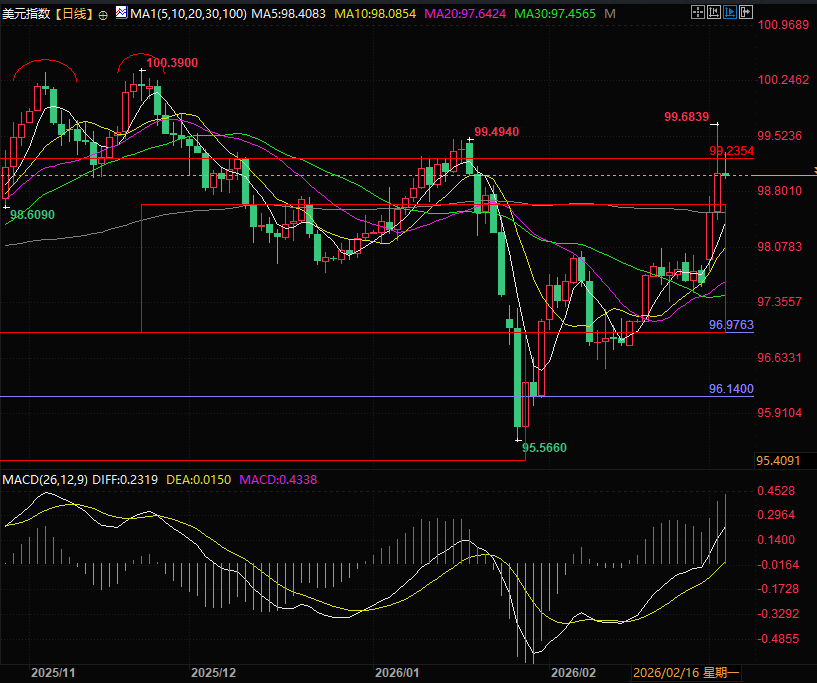
(US Dollar Index Daily Chart, Source: FX678)
At 15:26 Beijing time, the US dollar index was at 98.97.
Frequently Asked Questions
Question 1: How did the Middle East energy crisis become the core driver of the strengthening of the US dollar index?
Answer: The escalation of the Middle East conflict directly disrupted oil and gas supplies, causing oil prices to surge by 14% and European natural gas prices to surge by 70%. This supply shock translated into a "dollar tax" effect, forcing importing countries such as Europe to increase their holdings of energy settled in US dollars, creating structural buying pressure; at the same time, it pushed up global inflation and cooled expectations of a Federal Reserve interest rate cut. Multiple factors combined to support the dollar index's three-day winning streak.
Question 2: What exactly does the "dollar tax" effect refer to? Why does it provide sustained support for the dollar?
Answer: The "dollar tax" refers to the phenomenon where soaring energy prices are equivalent to a tax on the European economy, requiring payments to overseas suppliers to be made in US dollars. As a country heavily reliant on energy imports, Europe is forced to sell euros and buy dollars, directly weakening the euro's purchasing power. Deutsche Bank analysts point out that this mechanism represents a rigid demand, unlike traditional hedging, and is unlikely to reverse in the short term, providing structural upward momentum for the dollar index.
Question 3: How do inflationary pressures and expectations of Fed rate cuts reinforce each other?
Answer: Eurozone inflation exceeded expectations in February, and high oil prices further exacerbated global inflation concerns, pushing US Treasury yields up to 4.06%. The market significantly reduced its bets on short-term easing by the Federal Reserve; even with Trump's calls for rate cuts, investors still expect the Fed to maintain rates until summer. This reversal of expectations raised real dollar yields, becoming a direct driver of the dollar's strength.
Question 4: Why are non-US currencies under pressure? What are the differences in the performance of major currencies?
Answer: The Middle East situation triggered energy concerns coupled with policy divergence, putting pressure on the euro due to both import costs and a deteriorating environment for the ECB. The yen was dragged down by energy costs, the pound fell 0.3% to 1.3315, and the Australian dollar fell 0.6% to 0.6995 (despite better-than-expected GDP). Expectations of the ECB restarting interest rate hikes impacted carry trades, further amplifying interest rate differentials in the Eurozone.
Question 5: How will geopolitical shifts influence the long-term trend of the US dollar? What technical signals are there?
Answer: Until the situation in the Middle East eases, oil prices and the effects of dollar tariffs will continue to dominate. Technically, the dollar index has broken above the neckline of a double top, with the MACD in a bullish alignment. Support levels are at 98.60 and the 5-day moving average. If the conflict escalates, the dollar may challenge the 100 level; conversely, if the situation eases, profit-taking may occur. Investors need to closely monitor the ISM Services PMI and geopolitical developments.
- Risk Warning and Disclaimer
- The market involves risk, and trading may not be suitable for all investors. This article is for reference only and does not constitute personal investment advice, nor does it take into account certain users’ specific investment objectives, financial situation, or other needs. Any investment decisions made based on this information are at your own risk.