US Treasury Secretary hints: Tariffs to rise to 15% this week, even more so in five months, could trigger an inflationary bomb?
2026-03-05 10:26:52
U.S. Treasury Secretary Scott Bessant stated clearly on Wednesday (March 4) that President Trump's recently announced 15% global tariffs are likely to be formally implemented this week, increasing from the current 10%. He also predicted that by August 2026 (within five months), U.S. tariff rates will return to the higher levels unilaterally imposed by Trump before last year's Supreme Court ruling.
Bessant emphasized, "I firmly believe that tariff rates will return to their original levels within five months, and these original powers are very sufficient." He pointed out that these "old tariffs" have successfully withstood more than 4,000 legal challenges, and although the progress has been slower, their legal effect is more solid.
Shortly after his re-election as Prime Minister last year, Trump repeatedly invoked the International Emergency Economic Powers Act (IEEPA) to impose broad and high tariffs on imports from most countries around the world without congressional authorization. On February 20, 2026, the Supreme Court ruled 6-3 that Trump did not have the authority to unilaterally impose such tariffs by bypassing Congress using IEEPA.
Hours after the ruling, Trump signed an executive order imposing a 10% global tariff on another legal basis; the following day he announced an increase to 15%, claiming it would "take effect immediately." However, in practice, the tariff remained at 10%. Bessant confirmed that the 15% increase would "most likely be completed this week."
The Supreme Court ruling directly repealed the steep tariffs Trump imposed last year based on IEEPA, forcing the administration to turn to other trade law tools. Bessant stated that the current tariffs are based on Section 122 of the Trade Act of 1974, which allows the president to temporarily impose import tariffs of up to 15% in the event of a balance of payments emergency, but only for 150 days unless Congress approves an extension.
Within this 150-day window, the Office of the United States Trade Representative (USTR) and the Department of Commerce will complete relevant trade studies, paving the way for more sustained and comprehensive tariff measures. Bessant believes these follow-up measures will replicate the strength and scope of last year's "old tariffs."
Bessant emphasized that while the subsequent path is slower, it is "more robust" and is expected to become a long-term pillar of Trump's trade policy.
If the 15% global tariff takes effect this week, it will directly increase import costs, impacting prices of consumer goods, industrial raw materials, and intermediate products. US importers and retailers may face a new round of inflationary pressures, and some companies may accelerate the relocation of their supply chains to tariff-exempt or low-tax regions. Global trading partners, especially major exporting countries such as the EU, Canada, and Mexico, will suffer significant impacts.
Bessant is optimistic that the return of tariffs to "old levels" will enhance the competitiveness of U.S. manufacturing, but the market may fluctuate in the short term, and investors need to pay attention to the progress of the USTR and the Department of Commerce's subsequent research and the attitude of Congress.
In the short term, this will provide a strong boost to the US dollar. Bessant's confirmation of tariff increases this week and its forecast of further increases in tariffs is likely to directly boost market expectations that the Federal Reserve will maintain its tightening stance, attracting arbitrage funds into the dollar and pushing the dollar index higher in the short term. During Thursday's Asian session, the dollar index fluctuated narrowly around 98.80. However, the risk of a pullback after the positive news has been fully priced in should be noted. A cautious approach is advised in the medium to long term, paying attention to the potential damage to the long-term credibility of the dollar caused by escalating trade unilateralism.
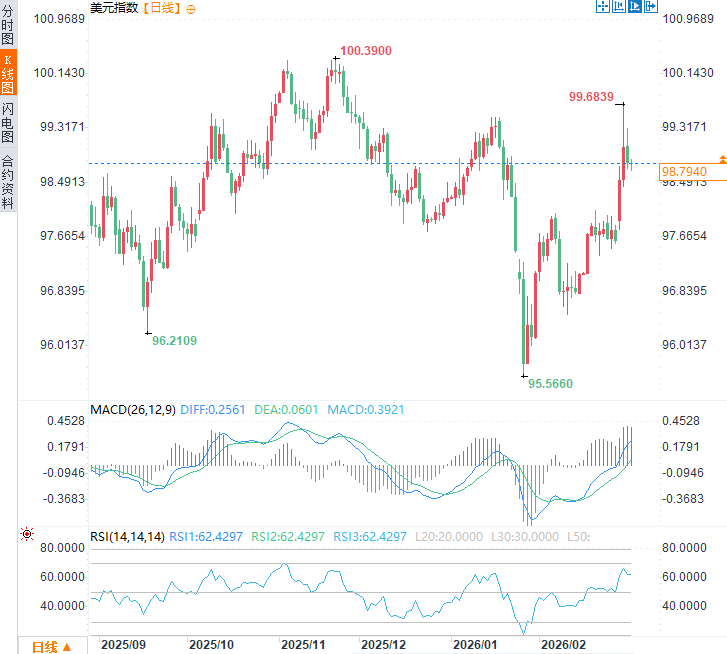
(US Dollar Index Daily Chart, Source: FX678)
Treasury Secretary Bessant confirmed that the 15% global tariffs will be implemented this week and predicted that U.S. tariffs will return to last year's high levels within five months, indicating that the Trump administration is continuing to advance protectionist trade policies through a multi-layered legal framework.
While the Supreme Court ruling limited the IEEPA path, Section 122 of the Trade Act of 1974 provided a short-term legal buffer, and subsequent mechanisms such as Section 301 are expected to rebuild a more sustainable high-tariff framework.
This round of adjustments will exacerbate the pressure of global supply chain restructuring, pushing up inflation expectations in the short term. The long-term effects will depend on the response of trading partners, the adaptability of domestic industries in the United States, and whether Congress will cooperate in extending or authorizing the adjustment.
At 10:26 Beijing time, the US dollar index is currently at 98.84.
Bessant emphasized, "I firmly believe that tariff rates will return to their original levels within five months, and these original powers are very sufficient." He pointed out that these "old tariffs" have successfully withstood more than 4,000 legal challenges, and although the progress has been slower, their legal effect is more solid.
Tariff Adjustment Process and Legal Basis
Shortly after his re-election as Prime Minister last year, Trump repeatedly invoked the International Emergency Economic Powers Act (IEEPA) to impose broad and high tariffs on imports from most countries around the world without congressional authorization. On February 20, 2026, the Supreme Court ruled 6-3 that Trump did not have the authority to unilaterally impose such tariffs by bypassing Congress using IEEPA.
Hours after the ruling, Trump signed an executive order imposing a 10% global tariff on another legal basis; the following day he announced an increase to 15%, claiming it would "take effect immediately." However, in practice, the tariff remained at 10%. Bessant confirmed that the 15% increase would "most likely be completed this week."
Impact of the Supreme Court ruling on Trump's tariffs
The Supreme Court ruling directly repealed the steep tariffs Trump imposed last year based on IEEPA, forcing the administration to turn to other trade law tools. Bessant stated that the current tariffs are based on Section 122 of the Trade Act of 1974, which allows the president to temporarily impose import tariffs of up to 15% in the event of a balance of payments emergency, but only for 150 days unless Congress approves an extension.
Within this 150-day window, the Office of the United States Trade Representative (USTR) and the Department of Commerce will complete relevant trade studies, paving the way for more sustained and comprehensive tariff measures. Bessant believes these follow-up measures will replicate the strength and scope of last year's "old tariffs."
Bessant emphasized that while the subsequent path is slower, it is "more robust" and is expected to become a long-term pillar of Trump's trade policy.
Potential impact on global trade and the US economy
If the 15% global tariff takes effect this week, it will directly increase import costs, impacting prices of consumer goods, industrial raw materials, and intermediate products. US importers and retailers may face a new round of inflationary pressures, and some companies may accelerate the relocation of their supply chains to tariff-exempt or low-tax regions. Global trading partners, especially major exporting countries such as the EU, Canada, and Mexico, will suffer significant impacts.
Bessant is optimistic that the return of tariffs to "old levels" will enhance the competitiveness of U.S. manufacturing, but the market may fluctuate in the short term, and investors need to pay attention to the progress of the USTR and the Department of Commerce's subsequent research and the attitude of Congress.
In the short term, this will provide a strong boost to the US dollar. Bessant's confirmation of tariff increases this week and its forecast of further increases in tariffs is likely to directly boost market expectations that the Federal Reserve will maintain its tightening stance, attracting arbitrage funds into the dollar and pushing the dollar index higher in the short term. During Thursday's Asian session, the dollar index fluctuated narrowly around 98.80. However, the risk of a pullback after the positive news has been fully priced in should be noted. A cautious approach is advised in the medium to long term, paying attention to the potential damage to the long-term credibility of the dollar caused by escalating trade unilateralism.
(US Dollar Index Daily Chart, Source: FX678)
Editor's Summary
Treasury Secretary Bessant confirmed that the 15% global tariffs will be implemented this week and predicted that U.S. tariffs will return to last year's high levels within five months, indicating that the Trump administration is continuing to advance protectionist trade policies through a multi-layered legal framework.
While the Supreme Court ruling limited the IEEPA path, Section 122 of the Trade Act of 1974 provided a short-term legal buffer, and subsequent mechanisms such as Section 301 are expected to rebuild a more sustainable high-tariff framework.
This round of adjustments will exacerbate the pressure of global supply chain restructuring, pushing up inflation expectations in the short term. The long-term effects will depend on the response of trading partners, the adaptability of domestic industries in the United States, and whether Congress will cooperate in extending or authorizing the adjustment.
At 10:26 Beijing time, the US dollar index is currently at 98.84.
- Risk Warning and Disclaimer
- The market involves risk, and trading may not be suitable for all investors. This article is for reference only and does not constitute personal investment advice, nor does it take into account certain users’ specific investment objectives, financial situation, or other needs. Any investment decisions made based on this information are at your own risk.