Trump boasts of a "quick victory" and a retreat, but experts warn of long-term risks to global energy.
2026-03-05 12:12:51
The US-Israeli coalition launched "Operation Epic Fury" against Iran, with airstrikes killing Iranian Supreme Leader Ayatollah Khamenei, rapidly escalating the conflict. Iran subsequently launched multiple retaliatory missile attacks, disrupting shipping in the Strait of Hormuz. The Trump administration claimed the operation was expected to end in 4-5 weeks, avoiding ground intervention, but experts disagreed on whether a swift resolution was possible.

In late February 2026, the US-Israeli coalition launched a joint air strike codenamed Operation Epic Fury, directly hitting the residence of Iran's Supreme Leader Ali Khamenei in Tehran, killing him within hours. This action signified the US and Israel's strategic intention to "decapitate" Iran and destroy its nuclear and missile capabilities. Iran immediately launched multiple retaliatory missile and drone strikes, targeting Israel and several Gulf states, and also attacking US military bases. As of Thursday (March 5), the conflict had lasted for nearly a week, with the US and Israel continuing to carry out high-intensity precision strikes against Iranian command centers, missile production facilities, and naval assets. While the intensity of Iran's retaliation has decreased, it has not ceased.
The situation changed rapidly in the early stages of the operation, with Khamenei and several of his senior generals killed, severely damaging Iran's command chain. However, the Iranian regime demonstrated resilience, quickly initiating succession procedures and expanding the regional conflict through a network of proxies.
US President Donald Trump has repeatedly stated publicly that this operation is not a "perpetual war" like those in Afghanistan or Iraq, but rather a "rapid and decisive" limited military intervention. Trump stated, "It was planned for four to five weeks from the beginning, but we have the capability to fight for much longer."
Defense Minister Peter Hegses emphasized that the operation was focused on destroying Iran's missile production and naval capabilities, not a regime change war, but "the regime has indeed changed." Vice President Vance also reiterated the need to avoid ground troop intervention.
The White House has repeatedly emphasized "peaceful passage of power," aiming to end the Iranian nuclear threat and regional terrorist support, rather than a long-term occupation.
Expert opinions are sharply divided. Suzanne Maloney, vice president of Brookings Institution, stated on March 4th, "The White House's hope for a quick victory is overly optimistic. Iran is escalating its regional ambitions according to a long-term strategy, and we are unlikely to see a swift resolution." Torbjorn Soltvedt, Middle East analyst at Verisk Maplecroft, warned, "Iran's vast territory, large population, and massive security apparatus make a rapid disintegration and transition plan extremely difficult."
On the other hand, Charles Myers of Signum Global Advisors is optimistic, believing that "Iran is doomed to defeat against the two strongest militaries, the US and Israel. The kinetic warfare phase may end in 3-4 days, followed by negotiations and a declaration of victory." Former British Ambassador to Iran Robert Macaire points out that Iran's retaliatory capabilities are limited, and once the launchers and command systems are destroyed, the counterattacks will become sporadic, and the conflict can gradually de-escalate.
Khamenei's death has created a power vacuum, and Iran is urgently electing a new Supreme Leader, but the legitimacy and control of the successor remain questionable. The Trump administration has publicly denied a "war of regime change," but its actions have objectively increased the possibility of regime collapse.
Former British Foreign and Defence Secretary Malcolm Rifkind warned: "Invading a country the size of Iran is absolutely impossible; that would be a repeat of the Iraq disaster." Without US ground troops, achieving stable regime change would be extremely difficult and could lead to internal strife, factional infighting, or the rise of extremist forces.
Polls show that only 25% of Americans support a strike on Iran, and protests have already erupted in Washington. Trump's MAGA base strongly opposes "foreign adventures" and prioritizes domestic issues. William Roebuck, executive vice president of the Arab Gulf States Institute, pointed out: "Trump is extremely focused on the economy and the stock market; energy market turmoil and stock price fluctuations will directly impact his approval rating. He has not yet clearly convinced the public of the legitimacy of the action, and his reasons keep changing."
On Thursday (March 5) during Asian trading hours, US crude oil prices fluctuated upwards, currently trading around $77.30 per barrel, up about 3.5% on the day, continuing the gains of the previous two trading days. Continued disruptions to shipping in the Strait of Hormuz have exacerbated supply concerns. If the conflict prolongs, oil prices may further test the $90-$100 range, putting significant pressure on global inflation and economic growth.
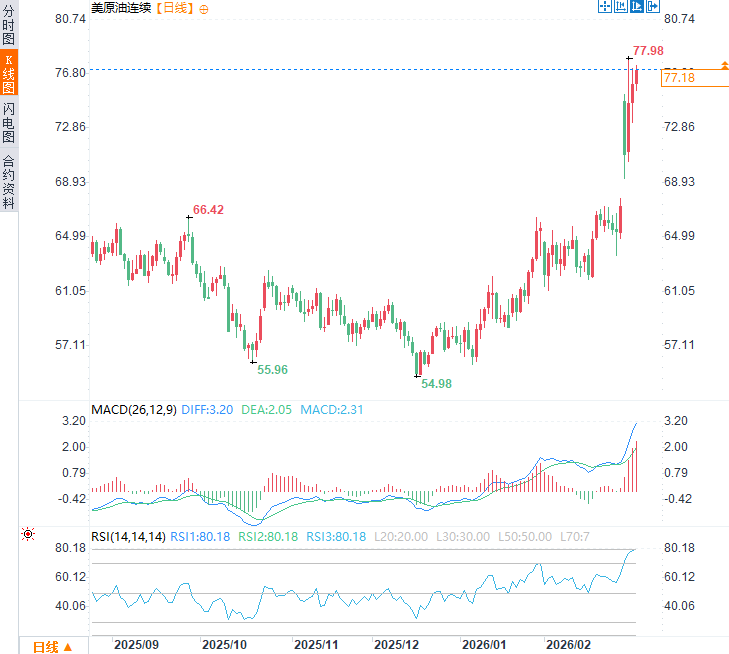
(US crude oil daily chart, source: FX678)
The US and Israel possess significant air superiority, while Iran's conventional military strength is rapidly weakening. However, the lack of a clear exit mechanism, the active network of Iranian proxies, and the potential for internal strife and regional spillover effects due to the power vacuum all increase the risk of a "perpetual war." Trump faces a difficult choice between a "quick victory declaration" and a "forced extension."
Operation Epic Fury began with the assassination of Khamenei, which severely damaged Iran's command and missile systems in the short term. However, the regime's resilience exceeded expectations, and the succession arrangements and proxy counterattacks made it easy for the conflict to evolve from limited strikes into a regional war of attrition.
The Trump administration has insisted on a narrative of “non-permanent war” and avoided ground intervention, but lacks a clear endgame plan and broad public support, and the political and economic costs are accumulating rapidly.
The probability of a short-term regime collapse in Iran has increased, but without strong external intervention, the power vacuum could fuel even more unpredictable chaos. Global energy security and geopolitical stability face severe challenges, and the situation is highly uncertain.
At 12:12 Beijing time, US crude oil futures were trading at $77.44 per barrel.
US and Israel launch surprise attack on Iran, rapidly escalating the conflict.
In late February 2026, the US-Israeli coalition launched a joint air strike codenamed Operation Epic Fury, directly hitting the residence of Iran's Supreme Leader Ali Khamenei in Tehran, killing him within hours. This action signified the US and Israel's strategic intention to "decapitate" Iran and destroy its nuclear and missile capabilities. Iran immediately launched multiple retaliatory missile and drone strikes, targeting Israel and several Gulf states, and also attacking US military bases. As of Thursday (March 5), the conflict had lasted for nearly a week, with the US and Israel continuing to carry out high-intensity precision strikes against Iranian command centers, missile production facilities, and naval assets. While the intensity of Iran's retaliation has decreased, it has not ceased.
The situation changed rapidly in the early stages of the operation, with Khamenei and several of his senior generals killed, severely damaging Iran's command chain. However, the Iranian regime demonstrated resilience, quickly initiating succession procedures and expanding the regional conflict through a network of proxies.
Trump insists it is not a permanent war and expects the operation to conclude in 4-5 weeks.
US President Donald Trump has repeatedly stated publicly that this operation is not a "perpetual war" like those in Afghanistan or Iraq, but rather a "rapid and decisive" limited military intervention. Trump stated, "It was planned for four to five weeks from the beginning, but we have the capability to fight for much longer."
Defense Minister Peter Hegses emphasized that the operation was focused on destroying Iran's missile production and naval capabilities, not a regime change war, but "the regime has indeed changed." Vice President Vance also reiterated the need to avoid ground troop intervention.
The White House has repeatedly emphasized "peaceful passage of power," aiming to end the Iranian nuclear threat and regional terrorist support, rather than a long-term occupation.
Experts disagree: a quick end or a protracted struggle?
Expert opinions are sharply divided. Suzanne Maloney, vice president of Brookings Institution, stated on March 4th, "The White House's hope for a quick victory is overly optimistic. Iran is escalating its regional ambitions according to a long-term strategy, and we are unlikely to see a swift resolution." Torbjorn Soltvedt, Middle East analyst at Verisk Maplecroft, warned, "Iran's vast territory, large population, and massive security apparatus make a rapid disintegration and transition plan extremely difficult."
On the other hand, Charles Myers of Signum Global Advisors is optimistic, believing that "Iran is doomed to defeat against the two strongest militaries, the US and Israel. The kinetic warfare phase may end in 3-4 days, followed by negotiations and a declaration of victory." Former British Ambassador to Iran Robert Macaire points out that Iran's retaliatory capabilities are limited, and once the launchers and command systems are destroyed, the counterattacks will become sporadic, and the conflict can gradually de-escalate.
Regime change is the biggest uncertainty; how can it be achieved without ground troops?
Khamenei's death has created a power vacuum, and Iran is urgently electing a new Supreme Leader, but the legitimacy and control of the successor remain questionable. The Trump administration has publicly denied a "war of regime change," but its actions have objectively increased the possibility of regime collapse.
Former British Foreign and Defence Secretary Malcolm Rifkind warned: "Invading a country the size of Iran is absolutely impossible; that would be a repeat of the Iraq disaster." Without US ground troops, achieving stable regime change would be extremely difficult and could lead to internal strife, factional infighting, or the rise of extremist forces.
Strong public opposition in the United States increases Trump's political risk.
Polls show that only 25% of Americans support a strike on Iran, and protests have already erupted in Washington. Trump's MAGA base strongly opposes "foreign adventures" and prioritizes domestic issues. William Roebuck, executive vice president of the Arab Gulf States Institute, pointed out: "Trump is extremely focused on the economy and the stock market; energy market turmoil and stock price fluctuations will directly impact his approval rating. He has not yet clearly convinced the public of the legitimacy of the action, and his reasons keep changing."
Energy markets turmoil, oil prices soar
On Thursday (March 5) during Asian trading hours, US crude oil prices fluctuated upwards, currently trading around $77.30 per barrel, up about 3.5% on the day, continuing the gains of the previous two trading days. Continued disruptions to shipping in the Strait of Hormuz have exacerbated supply concerns. If the conflict prolongs, oil prices may further test the $90-$100 range, putting significant pressure on global inflation and economic growth.
(US crude oil daily chart, source: FX678)
A short-term end to the conflict is possible, but the long-term risks are enormous.
The US and Israel possess significant air superiority, while Iran's conventional military strength is rapidly weakening. However, the lack of a clear exit mechanism, the active network of Iranian proxies, and the potential for internal strife and regional spillover effects due to the power vacuum all increase the risk of a "perpetual war." Trump faces a difficult choice between a "quick victory declaration" and a "forced extension."
Editor's Summary
Operation Epic Fury began with the assassination of Khamenei, which severely damaged Iran's command and missile systems in the short term. However, the regime's resilience exceeded expectations, and the succession arrangements and proxy counterattacks made it easy for the conflict to evolve from limited strikes into a regional war of attrition.
The Trump administration has insisted on a narrative of “non-permanent war” and avoided ground intervention, but lacks a clear endgame plan and broad public support, and the political and economic costs are accumulating rapidly.
The probability of a short-term regime collapse in Iran has increased, but without strong external intervention, the power vacuum could fuel even more unpredictable chaos. Global energy security and geopolitical stability face severe challenges, and the situation is highly uncertain.
At 12:12 Beijing time, US crude oil futures were trading at $77.44 per barrel.
- Risk Warning and Disclaimer
- The market involves risk, and trading may not be suitable for all investors. This article is for reference only and does not constitute personal investment advice, nor does it take into account certain users’ specific investment objectives, financial situation, or other needs. Any investment decisions made based on this information are at your own risk.