Strategists: Gold and silver need further consolidation; bonds remain attractive.
2026-03-05 12:17:46
Amid escalating geopolitical tensions in the Middle East, the joint US-Israeli military action against Iran, while underway, has not triggered sustained safe-haven buying in the gold and silver markets.
According to an analysis by a senior market strategist, current price movements suggest that precious metals may still need further consolidation, as the valuations of other safe-haven assets such as bonds have not yet fully reflected the risks.
This article will analyze this phenomenon in detail, starting with short-term price resistance and support levels, exploring the competitive rise of the bond market, the key signals of the gold-silver ratio, and the long-term support logic of precious metals, providing investors with a comprehensive perspective.

Ahead of the weekend's US missile strikes, MarketGauge's chief market strategist, Schneider, said she did not see gold with enough momentum to break through the $5,400 resistance level and expected silver's gains to be limited to below $100.
Following the attack, gold and silver prices briefly touched their respective resistance zones before encountering significant selling pressure. Gold prices retreated to test the $5,000/oz support level, while silver briefly fell below $80/oz. Although both rebounded from their lows, Schneider believes this volatility is part of a broader consolidation process. She emphasizes that the next decisive move in the market may depend less on short-term geopolitical headlines and more on structural changes in the financial markets.
She specifically pointed out: "The only exception is if the conflict evolves into a larger-scale, protracted confrontation, then all predictions will become invalid. We might see a sharp rise in oil prices, and gold and silver prices will also rise sharply as a result."
Schneider's analysis suggests that the biggest risk to gold and silver in the short term lies in the attractiveness of the bond market. Last week, the yield on the 10-year US Treasury note fell below 4%, and investors appear to be reassessing their asset allocation strategies in an environment of macroeconomic uncertainty.
She observed that the bond market is gradually becoming an alternative safe-haven asset, especially as concerns about the stability of credit markets and the global financial system intensify. She stated, "I think a huge shift is taking place. Speculators and bond traders may begin to see bonds as a more reliable safety net than gold."
This shift reflects growing market concerns about the credit system and expectations that governments might prioritize financial stability over combating inflation should economic conditions worsen. While investors previously shunned bonds due to concerns about the unsustainable size of U.S. government debt, pushing up yields, Schneider points out that this fear has limitations: the Federal Reserve will always intervene as a buyer of last resort to maintain financial market stability.
For precious metals investors, Schneider believes the most important indicator is the gold-silver ratio. This ratio surged to extreme levels above 100 early in the bull market, before falling sharply as silver prices soared to triple digits. Currently, the ratio appears to be stabilizing again, trading around 61.
She stated explicitly, "If the gold-silver ratio falls below 55, it will be a buying opportunity for silver; if it breaks above 65, it's best to look at other assets." She has long viewed the gold-silver ratio as a reliable indicator, and currently, the indicator is in a relatively neutral range. She believes that a downward break in the ratio would suggest that silver may outperform gold again, while a rise above the mid-65 range could indicate weakening momentum in the entire precious metals sector.
She concluded, "This ratio has been a good friend of mine for years, and it will soon resolve itself in some way, and that's when it's time to act."
Despite short-term consolidation pressures, Schneider remains constructive about the long-term outlook for precious metals. She points out that commodities from copper to crude oil are strengthening, while macroeconomic risks are accumulating.
She emphasized, "We live in an unprecedented world. Geopolitical tensions, trade conflicts, and various uncertainties are intertwined, and anything can happen." In this environment, gold and silver remain an indispensable part of a diversified investment portfolio, and even after a strong year-long rally, investors may need more patience.
She recalled, "This round of market movement was very interesting and exciting. But now we must pause and carefully observe the signals."
Overall, while the joint US-Israeli military action against Iran has exacerbated uncertainty in the Middle East, it has not immediately translated into sustained safe-haven demand for gold and silver.
Schneider's analysis indicates that precious metals are currently in a consolidation phase, with the competitive rise of assets such as bonds and the neutral position of the gold-silver ratio being key points to watch. Despite increased short-term volatility, long-term supporting factors (geopolitical risks, supply bottlenecks, and structural economic uncertainties) remain solid.
Investors should remain vigilant and pay attention to signals of a gold-silver ratio breakout and changes in macro capital flows in order to seize potential opportunities.
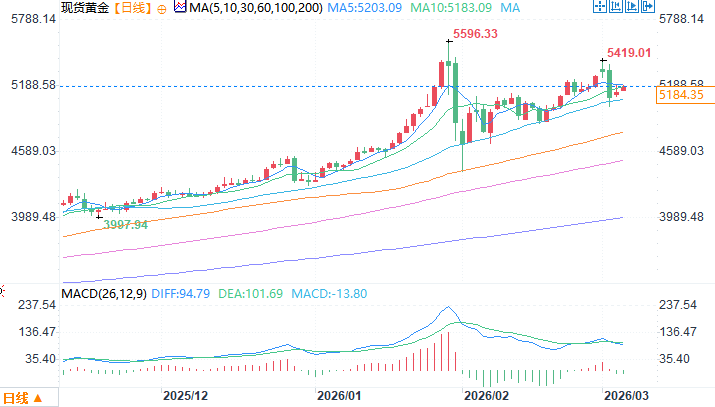
Spot gold daily chart source: EasyForex
At 12:17 Beijing time on March 5, spot gold was trading at $5182.35 per ounce.
According to an analysis by a senior market strategist, current price movements suggest that precious metals may still need further consolidation, as the valuations of other safe-haven assets such as bonds have not yet fully reflected the risks.
This article will analyze this phenomenon in detail, starting with short-term price resistance and support levels, exploring the competitive rise of the bond market, the key signals of the gold-silver ratio, and the long-term support logic of precious metals, providing investors with a comprehensive perspective.
Short-term prices are under pressure: Gold and silver prices have pulled back significantly after encountering resistance levels.
Ahead of the weekend's US missile strikes, MarketGauge's chief market strategist, Schneider, said she did not see gold with enough momentum to break through the $5,400 resistance level and expected silver's gains to be limited to below $100.
Following the attack, gold and silver prices briefly touched their respective resistance zones before encountering significant selling pressure. Gold prices retreated to test the $5,000/oz support level, while silver briefly fell below $80/oz. Although both rebounded from their lows, Schneider believes this volatility is part of a broader consolidation process. She emphasizes that the next decisive move in the market may depend less on short-term geopolitical headlines and more on structural changes in the financial markets.
She specifically pointed out: "The only exception is if the conflict evolves into a larger-scale, protracted confrontation, then all predictions will become invalid. We might see a sharp rise in oil prices, and gold and silver prices will also rise sharply as a result."
The bond market is booming: the biggest short-term risk comes from valuation attractiveness.
Schneider's analysis suggests that the biggest risk to gold and silver in the short term lies in the attractiveness of the bond market. Last week, the yield on the 10-year US Treasury note fell below 4%, and investors appear to be reassessing their asset allocation strategies in an environment of macroeconomic uncertainty.
She observed that the bond market is gradually becoming an alternative safe-haven asset, especially as concerns about the stability of credit markets and the global financial system intensify. She stated, "I think a huge shift is taking place. Speculators and bond traders may begin to see bonds as a more reliable safety net than gold."
This shift reflects growing market concerns about the credit system and expectations that governments might prioritize financial stability over combating inflation should economic conditions worsen. While investors previously shunned bonds due to concerns about the unsustainable size of U.S. government debt, pushing up yields, Schneider points out that this fear has limitations: the Federal Reserve will always intervene as a buyer of last resort to maintain financial market stability.
The gold-silver ratio is sending a key signal: hovering in a neutral range, a breakout will determine the direction.
For precious metals investors, Schneider believes the most important indicator is the gold-silver ratio. This ratio surged to extreme levels above 100 early in the bull market, before falling sharply as silver prices soared to triple digits. Currently, the ratio appears to be stabilizing again, trading around 61.
She stated explicitly, "If the gold-silver ratio falls below 55, it will be a buying opportunity for silver; if it breaks above 65, it's best to look at other assets." She has long viewed the gold-silver ratio as a reliable indicator, and currently, the indicator is in a relatively neutral range. She believes that a downward break in the ratio would suggest that silver may outperform gold again, while a rise above the mid-65 range could indicate weakening momentum in the entire precious metals sector.
She concluded, "This ratio has been a good friend of mine for years, and it will soon resolve itself in some way, and that's when it's time to act."
The long-term logic remains solid: geopolitical and structural uncertainties provide support.
Despite short-term consolidation pressures, Schneider remains constructive about the long-term outlook for precious metals. She points out that commodities from copper to crude oil are strengthening, while macroeconomic risks are accumulating.
She emphasized, "We live in an unprecedented world. Geopolitical tensions, trade conflicts, and various uncertainties are intertwined, and anything can happen." In this environment, gold and silver remain an indispensable part of a diversified investment portfolio, and even after a strong year-long rally, investors may need more patience.
She recalled, "This round of market movement was very interesting and exciting. But now we must pause and carefully observe the signals."
Overall, while the joint US-Israeli military action against Iran has exacerbated uncertainty in the Middle East, it has not immediately translated into sustained safe-haven demand for gold and silver.
Schneider's analysis indicates that precious metals are currently in a consolidation phase, with the competitive rise of assets such as bonds and the neutral position of the gold-silver ratio being key points to watch. Despite increased short-term volatility, long-term supporting factors (geopolitical risks, supply bottlenecks, and structural economic uncertainties) remain solid.
Investors should remain vigilant and pay attention to signals of a gold-silver ratio breakout and changes in macro capital flows in order to seize potential opportunities.
Spot gold daily chart source: EasyForex
At 12:17 Beijing time on March 5, spot gold was trading at $5182.35 per ounce.
- Risk Warning and Disclaimer
- The market involves risk, and trading may not be suitable for all investors. This article is for reference only and does not constitute personal investment advice, nor does it take into account certain users’ specific investment objectives, financial situation, or other needs. Any investment decisions made based on this information are at your own risk.