Analysis of Gold's "Plunge": The Battle Between Safe-Haven Demand and Negative Macroeconomic Factors
2026-03-05 23:56:36
On Thursday (March 5, 2026) in early US trading, spot gold fluctuated between $5080 and $5170 per ounce, with an intraday price of around $5088 per ounce, a drop of about 1.03%. Earlier this week, gold prices plummeted 4-6% from a record high of $5400, hitting a low of around $4996, marking a rare single-day drop in recent years. Subsequently, with US weekly initial jobless claims data stabilizing, gold prices rebounded to the $5130-$5170 range, exhibiting a typical pattern of sharp fluctuations: "rise-plunge-rebound".

In the initial stages of the conflict, the situation in the Middle East escalated rapidly. The United States and Israel launched airstrikes against Iran, and Iran's retaliation involved the Strait of Hormuz, causing market concerns about disruptions to oil shipments. Safe-haven funds quickly flowed into gold and silver, with April gold futures briefly breaking through $5,400 per ounce and silver rising to around $85 per ounce. Crude oil prices surged to $82-84 per barrel, further exacerbating market panic. During this phase, geopolitical uncertainty became the core factor driving the short-term rise in gold prices.
Macroeconomic factors and short-term correction
As the conflict continues, soaring oil prices have fueled inflation expectations, prompting investors to reprice the Federal Reserve's monetary policy path. Expectations for interest rate cuts have been significantly lowered, with the 10-year US Treasury yield rising to 4.1-4.15%, and the dollar index rebounding to around 99. High yields and a strong dollar have increased the opportunity cost of holding gold, and the short-term safe-haven effect has been overshadowed by macroeconomic pressures, resulting in a 4% single-day drop in gold prices, with silver prices falling even more. This reflects the double-edged sword effect of war: while geopolitical safe-haven benefits exist, they are offset by inflation expectations and a stronger dollar.
Subsequently, the U.S. Labor Department released weekly initial jobless claims figures of 213,000, in line with market expectations. This stable data eased investors' extreme concerns about a hard landing for the economy, triggering a technical rebound in gold prices, which quickly rose from a low to $5,130. Currently, the price is around $5,088 per ounce, a drop of approximately 1.03%. This rebound was mainly driven by short covering and bargain hunting, but core macroeconomic pressures remain unresolved, thus the market is expected to remain volatile in the short term.
The underlying reasons for risk aversion failure
The core reason for the failure of this round of safe-haven demand lies in the inflationary pressures triggered by the war and the repricing of the Federal Reserve's investment path. The risk in the Strait of Hormuz caused a sharp rise in oil prices, increasing by about $10 per barrel, which could push up the US CPI by about 0.2-0.3 percentage points. The market is concerned that the Federal Reserve will maintain high interest rates to combat inflation, thereby increasing the opportunity cost of holding gold. Furthermore, a sharp drop in expectations for interest rate cuts, a rebound in real yields, and a strong dollar have increased the cost of purchasing gold for investors holding non-US currencies.
Structural factors continue to support gold prices, including continued gold purchases by emerging market central banks, persistently high ETF holdings, and stable mineral supply. Historically, similar to the initial stages of the Russia-Ukraine conflict in 2022, gold prices rose initially before falling. This current market trend continues this pattern, but with a higher starting point, having already broken through the psychological barrier of $5,000.
Technical analysis and asset linkage
Gold's short-term support level is at $5000-$5050 (psychological level + previous low consolidation zone), while resistance is at $5130-$5200. The RSI indicator has fallen from overbought to neutral, and the MACD has formed a death cross but the histogram is narrowing, indicating that the market is mainly consolidating and the trend is not yet clear. Implied volatility has risen to historical highs, indicating that market sentiment is tense, making options strategies more suitable than naked long positions.
The current price has rebounded significantly from the low of $4,996, but if negative macroeconomic factors intensify (such as a continued strong dollar, rising US Treasury yields, or stronger-than-expected non-farm payroll/CPI data next week), there is a possibility of retesting $4,996 (or even lower to $4,950-$4,980). This represents a technical retest of the bottom (approximately 40-50% in the short term), and caution is advised regarding stop-loss triggers and amplified volatility due to increased liquidity.
Silver fell more sharply due to its high beta and industrial properties, but the gold-silver ratio rose to a historical high of 60:1, providing a clear safety margin. Bitcoin, as a risk asset, rose initially before falling, decoupling from gold in the short term. Crude oil directly benefited from the conflict, with Brent crude breaking through $84/barrel, validating the "war-induced inflation" logic. Rising US Treasury yields were bearish for bonds, leading to capital flows into the dollar cash market.
Medium- to long-term outlook and investment strategy
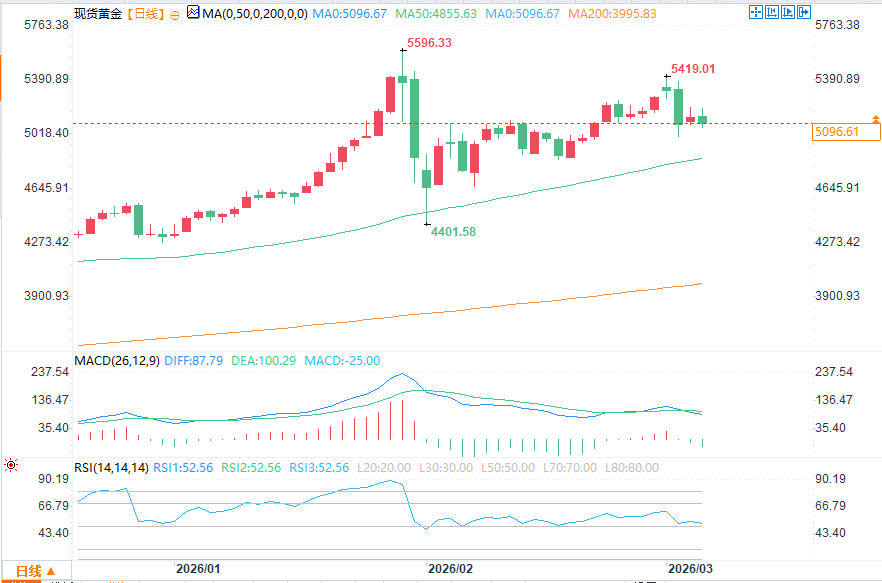
(Spot gold daily chart source: FX678)
Gold prices are likely to remain weak and volatile in the short term, requiring close attention to US February non-farm payrolls (around March 7th) and CPI data. If inflation remains sticky, oil prices remain high, or the US dollar index breaks 100, gold prices may retest $5050 or even below $4996; if the conflict eases or the data is weak, it may rebound to $5300.
The probability of a bullish outlook in the medium term is approximately 70%. Gold will gain upward momentum should the Federal Reserve signal renewed interest rate cuts or the conflict enter a controlled stalemate. JPMorgan predicts a gold price target of $5,000-$5,500 by the end of 2026, with an extreme scenario potentially reaching $6,300. In the long term, a structural bull market remains, with central bank reserve diversification, growing demand for green energy, and high global debt levels continuing to support gold's value.
In terms of investment strategy, it is recommended to wait and see or build a small position during the period of high-level fluctuation (enter in batches below $5130).
Risk warnings include a rapid de-escalation of the conflict, a stronger-than-expected US economy, the US dollar breaking 100, or oil prices exceeding $100 per barrel (short-term bearish for gold, but potentially bullish in the medium term). Regarding position control, each investment should not exceed 5-10% of total assets, and a stop-loss should be set below $4900 (if this level is breached, it should be strictly enforced).
Overall, this round of gold price plunges is not due to a failure of the safe-haven logic, but rather a result of the short-term dominance of macroeconomic repricing triggered by war and inflation. Historical experience shows that after short-term fluctuations (including retesting lows), gold still has strong medium- to long-term upside potential. The current price range (especially around $5,000-$5,100) may be a window for positioning after panic selling, providing an opportunity for the continuation of a structural bull market. Markets are constantly changing; it is recommended to make decisions based on real-time data and professional advice.
In the initial stages of the conflict, the situation in the Middle East escalated rapidly. The United States and Israel launched airstrikes against Iran, and Iran's retaliation involved the Strait of Hormuz, causing market concerns about disruptions to oil shipments. Safe-haven funds quickly flowed into gold and silver, with April gold futures briefly breaking through $5,400 per ounce and silver rising to around $85 per ounce. Crude oil prices surged to $82-84 per barrel, further exacerbating market panic. During this phase, geopolitical uncertainty became the core factor driving the short-term rise in gold prices.
Macroeconomic factors and short-term correction
As the conflict continues, soaring oil prices have fueled inflation expectations, prompting investors to reprice the Federal Reserve's monetary policy path. Expectations for interest rate cuts have been significantly lowered, with the 10-year US Treasury yield rising to 4.1-4.15%, and the dollar index rebounding to around 99. High yields and a strong dollar have increased the opportunity cost of holding gold, and the short-term safe-haven effect has been overshadowed by macroeconomic pressures, resulting in a 4% single-day drop in gold prices, with silver prices falling even more. This reflects the double-edged sword effect of war: while geopolitical safe-haven benefits exist, they are offset by inflation expectations and a stronger dollar.
Subsequently, the U.S. Labor Department released weekly initial jobless claims figures of 213,000, in line with market expectations. This stable data eased investors' extreme concerns about a hard landing for the economy, triggering a technical rebound in gold prices, which quickly rose from a low to $5,130. Currently, the price is around $5,088 per ounce, a drop of approximately 1.03%. This rebound was mainly driven by short covering and bargain hunting, but core macroeconomic pressures remain unresolved, thus the market is expected to remain volatile in the short term.
The underlying reasons for risk aversion failure
The core reason for the failure of this round of safe-haven demand lies in the inflationary pressures triggered by the war and the repricing of the Federal Reserve's investment path. The risk in the Strait of Hormuz caused a sharp rise in oil prices, increasing by about $10 per barrel, which could push up the US CPI by about 0.2-0.3 percentage points. The market is concerned that the Federal Reserve will maintain high interest rates to combat inflation, thereby increasing the opportunity cost of holding gold. Furthermore, a sharp drop in expectations for interest rate cuts, a rebound in real yields, and a strong dollar have increased the cost of purchasing gold for investors holding non-US currencies.
Structural factors continue to support gold prices, including continued gold purchases by emerging market central banks, persistently high ETF holdings, and stable mineral supply. Historically, similar to the initial stages of the Russia-Ukraine conflict in 2022, gold prices rose initially before falling. This current market trend continues this pattern, but with a higher starting point, having already broken through the psychological barrier of $5,000.
Technical analysis and asset linkage
Gold's short-term support level is at $5000-$5050 (psychological level + previous low consolidation zone), while resistance is at $5130-$5200. The RSI indicator has fallen from overbought to neutral, and the MACD has formed a death cross but the histogram is narrowing, indicating that the market is mainly consolidating and the trend is not yet clear. Implied volatility has risen to historical highs, indicating that market sentiment is tense, making options strategies more suitable than naked long positions.
The current price has rebounded significantly from the low of $4,996, but if negative macroeconomic factors intensify (such as a continued strong dollar, rising US Treasury yields, or stronger-than-expected non-farm payroll/CPI data next week), there is a possibility of retesting $4,996 (or even lower to $4,950-$4,980). This represents a technical retest of the bottom (approximately 40-50% in the short term), and caution is advised regarding stop-loss triggers and amplified volatility due to increased liquidity.
Silver fell more sharply due to its high beta and industrial properties, but the gold-silver ratio rose to a historical high of 60:1, providing a clear safety margin. Bitcoin, as a risk asset, rose initially before falling, decoupling from gold in the short term. Crude oil directly benefited from the conflict, with Brent crude breaking through $84/barrel, validating the "war-induced inflation" logic. Rising US Treasury yields were bearish for bonds, leading to capital flows into the dollar cash market.
Medium- to long-term outlook and investment strategy
(Spot gold daily chart source: FX678)
Gold prices are likely to remain weak and volatile in the short term, requiring close attention to US February non-farm payrolls (around March 7th) and CPI data. If inflation remains sticky, oil prices remain high, or the US dollar index breaks 100, gold prices may retest $5050 or even below $4996; if the conflict eases or the data is weak, it may rebound to $5300.
The probability of a bullish outlook in the medium term is approximately 70%. Gold will gain upward momentum should the Federal Reserve signal renewed interest rate cuts or the conflict enter a controlled stalemate. JPMorgan predicts a gold price target of $5,000-$5,500 by the end of 2026, with an extreme scenario potentially reaching $6,300. In the long term, a structural bull market remains, with central bank reserve diversification, growing demand for green energy, and high global debt levels continuing to support gold's value.
In terms of investment strategy, it is recommended to wait and see or build a small position during the period of high-level fluctuation (enter in batches below $5130).
Risk warnings include a rapid de-escalation of the conflict, a stronger-than-expected US economy, the US dollar breaking 100, or oil prices exceeding $100 per barrel (short-term bearish for gold, but potentially bullish in the medium term). Regarding position control, each investment should not exceed 5-10% of total assets, and a stop-loss should be set below $4900 (if this level is breached, it should be strictly enforced).
Overall, this round of gold price plunges is not due to a failure of the safe-haven logic, but rather a result of the short-term dominance of macroeconomic repricing triggered by war and inflation. Historical experience shows that after short-term fluctuations (including retesting lows), gold still has strong medium- to long-term upside potential. The current price range (especially around $5,000-$5,100) may be a window for positioning after panic selling, providing an opportunity for the continuation of a structural bull market. Markets are constantly changing; it is recommended to make decisions based on real-time data and professional advice.
- Risk Warning and Disclaimer
- The market involves risk, and trading may not be suitable for all investors. This article is for reference only and does not constitute personal investment advice, nor does it take into account certain users’ specific investment objectives, financial situation, or other needs. Any investment decisions made based on this information are at your own risk.