Warming current expectations and inventory rebuilding risks have increased volatility and put overall pressure on natural gas futures.
2026-03-05 22:06:50
On Thursday (March 5), April natural gas futures (NGJ26) were quoted at approximately $2.969–2.981/MMBtu, up about $0.052–0.064 (+1.78–2.06%) on the day, with a trading volume exceeding 28,000 contracts. The contract remains positive for the week, but has fallen significantly from its weekly high of $3.188. Geopolitical premiums provided strong downside support, but weak domestic demand and expectations of a spring inventory rebuild have begun to dominate short-term price action, with traders highly wary of oversupply.

Natural gas futures prices fluctuated more sharply after the EIA report, as supply concerns in Europe continued to escalate.
U.S. natural gas futures rose slightly in early trading on Thursday, but the reaction was mixed after the EIA report: some traders viewed the inventory withdrawals as meeting or slightly below expectations as bearish, while others remained cautiously optimistic due to geopolitical support. The April contract was last quoted at approximately $2.969–2.981/MMBtu (up $0.052–0.064 intraday), with active trading. The core driver of the market remains the Middle East crisis: Iranian drone attacks on Qatar's Ras Laffan and Mesaieed facilities led to a complete shutdown of the world's largest LNG producer; the Strait of Hormuz is effectively closed (shipping data has plummeted, some vessels have been attacked), and the cancellation of war insurance has caused insurance costs to soar. The U.S. Navy's escort commitment is unlikely to reverse the traffic disruptions in the short term, raising energy security alarms in Europe, and the surge in TTF prices highlights the vulnerability of the global LNG market. It is reported that the main contract for Dutch TTF natural gas futures, the European benchmark, has risen by about 56% since February 28. On March 4, it once broke through 61 euros/MWh during trading, and fell back to about 54.9 euros/MWh on March 5. The Northeast Asian LNG benchmark JKM price also reached its highest level since February last year on March 2, highlighting the tight situation in the global LNG market.
Iran denounces talks as "psychological warfare," and the conflict continues to escalate.
Prices surged initially this week before retreating, with reports suggesting Iran was willing to negotiate for a temporary respite from panic, but Iran's Tasnim news agency dismissed this as "psychological warfare." Latest developments indicate an escalation of the conflict: Iran's retaliatory strikes against regional energy facilities continue, the US sank an Iranian warship, and several vessels around the Hormuz were damaged, with geopolitical premiums continuing to dominate sentiment. A senior Iranian military officer threatened "not to let a single drop of oil leave the region" and stated he would "ignite" any ships attempting to pass through, further exacerbating panic in global energy markets. A spokesperson for the Qatari Ministry of Foreign Affairs stated on March 3 that the damage to Qatar's energy facilities caused by the Iranian attacks had been contained, and technical assessments were underway, but production had not yet resumed. Qatar has not been in contact with Iran since February 28 and is committed to resolving the conflict peacefully.
Trump's promise of escort missions in the Strait of Hormuz vs. the actual increase in disruptions
Trump stated that the US would provide naval escorts and political risk insurance, but the Strait of Hormuz has been effectively closed for several days, leaving hundreds of oil tankers and LNG carriers stranded or forced to detour. According to shipping industry analysts, at least 100 oil tankers are currently trapped inside the Strait of Hormuz, with over 100 more waiting to enter from outside. Major global shipping companies such as Hapag-Lloyd, CMA CGM, and Maersk have completely suspended ship passage through the strait, with some vessels forced to divert to the Cape of Good Hope. This has caused Very Large Crude Carrier (VLCC) freight rates to surge to twice their pre-conflict levels. In March, the average VLCC freight rate on Middle East-to-global routes was equivalent to approximately $10-11 per barrel. The Qatar production halt, coupled with the amplified European crisis, may force more LNG to be diverted to the US market. Approximately 20% of global LNG traffic is disrupted, with at least 11 LNG carriers suspending their voyages. Asian and European buyers are scrambling to purchase alternative sources, pushing up the risk of energy inflation. Goldman Sachs warns that if LNG transport through the Strait of Hormuz is disrupted for a month, TTF and JKM prices could rise by more than 100%, further increasing global energy inflationary pressures.
Warmer weather and the release of the EIA report strengthen expectations for demand reconstruction.
Commodity Weather Group and NOAA models consistently indicate that the East Coast, Midwest, and high-demand areas will experience slightly above-normal warmer weather in early March (high probability), continuing until around mid-March, significantly weakening heating loads. While power burning saw a short-term rebound of about 9% this week (average generating load around 180GW), the overall characteristics of the late winter are evident, with inventory rebuilding expectations gradually strengthening. The EIA report confirmed a slowdown in extractions (only 52 Bcf the previous week, approximately 120 Bcf this time, close to or slightly below the consensus of 122–124 Bcf), with total inventories at 2,018 Bcf, 141 Bcf higher than the same period last year (+7.5%), and 7 Bcf lower than the five-year average (-0.3%). If the warm spell continues, inventories at the end of March may fall below 1.9 trillion cubic feet, which would be bearish for prices in the short term, but geopolitical support may partially offset the downward pressure.
Technical Analysis: Range-bound trading, geopolitical catalysts may trigger a breakout.
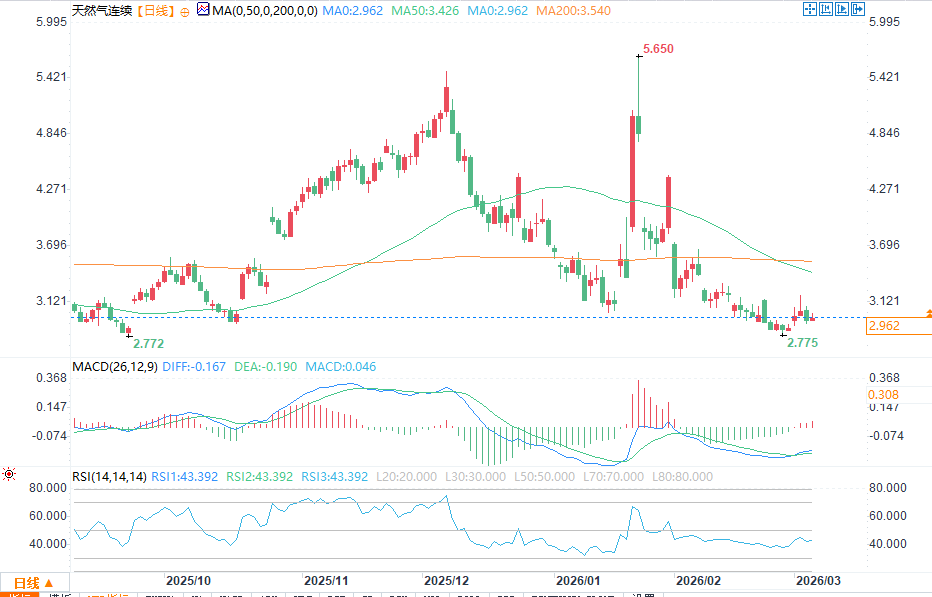
(Natural gas futures daily chart source: FX678)
The April contract daily chart shows an overall bearish trend, with the 50-day moving average around $3.426 acting as key resistance. A sustained break below this level would strengthen downward momentum, testing last week's low of $2.775, with further support in the $2.627–$2.604 range. Conversely, a strong break above the 50-day moving average catalyzed by geopolitical events would trigger a bullish rebound, targeting the pivot points of $3.345 and $3.430, and potentially challenging the 200-day moving average around $3.540 in the longer term.
From a trend chart perspective, the April contract is attempting to form a potential bullish secondary bottom within the $2.775–$3.188 range. The longer this range-bound trading continues, the higher the probability of an upward breakout should the situation in the Middle East deteriorate further (e.g., more facilities are damaged, the Straits issue becomes protracted, or Iranian retaliation escalates), forcing Europe to massively shift towards US LNG.
Natural gas futures prices fluctuated more sharply after the EIA report, as supply concerns in Europe continued to escalate.
U.S. natural gas futures rose slightly in early trading on Thursday, but the reaction was mixed after the EIA report: some traders viewed the inventory withdrawals as meeting or slightly below expectations as bearish, while others remained cautiously optimistic due to geopolitical support. The April contract was last quoted at approximately $2.969–2.981/MMBtu (up $0.052–0.064 intraday), with active trading. The core driver of the market remains the Middle East crisis: Iranian drone attacks on Qatar's Ras Laffan and Mesaieed facilities led to a complete shutdown of the world's largest LNG producer; the Strait of Hormuz is effectively closed (shipping data has plummeted, some vessels have been attacked), and the cancellation of war insurance has caused insurance costs to soar. The U.S. Navy's escort commitment is unlikely to reverse the traffic disruptions in the short term, raising energy security alarms in Europe, and the surge in TTF prices highlights the vulnerability of the global LNG market. It is reported that the main contract for Dutch TTF natural gas futures, the European benchmark, has risen by about 56% since February 28. On March 4, it once broke through 61 euros/MWh during trading, and fell back to about 54.9 euros/MWh on March 5. The Northeast Asian LNG benchmark JKM price also reached its highest level since February last year on March 2, highlighting the tight situation in the global LNG market.
Iran denounces talks as "psychological warfare," and the conflict continues to escalate.
Prices surged initially this week before retreating, with reports suggesting Iran was willing to negotiate for a temporary respite from panic, but Iran's Tasnim news agency dismissed this as "psychological warfare." Latest developments indicate an escalation of the conflict: Iran's retaliatory strikes against regional energy facilities continue, the US sank an Iranian warship, and several vessels around the Hormuz were damaged, with geopolitical premiums continuing to dominate sentiment. A senior Iranian military officer threatened "not to let a single drop of oil leave the region" and stated he would "ignite" any ships attempting to pass through, further exacerbating panic in global energy markets. A spokesperson for the Qatari Ministry of Foreign Affairs stated on March 3 that the damage to Qatar's energy facilities caused by the Iranian attacks had been contained, and technical assessments were underway, but production had not yet resumed. Qatar has not been in contact with Iran since February 28 and is committed to resolving the conflict peacefully.
Trump's promise of escort missions in the Strait of Hormuz vs. the actual increase in disruptions
Trump stated that the US would provide naval escorts and political risk insurance, but the Strait of Hormuz has been effectively closed for several days, leaving hundreds of oil tankers and LNG carriers stranded or forced to detour. According to shipping industry analysts, at least 100 oil tankers are currently trapped inside the Strait of Hormuz, with over 100 more waiting to enter from outside. Major global shipping companies such as Hapag-Lloyd, CMA CGM, and Maersk have completely suspended ship passage through the strait, with some vessels forced to divert to the Cape of Good Hope. This has caused Very Large Crude Carrier (VLCC) freight rates to surge to twice their pre-conflict levels. In March, the average VLCC freight rate on Middle East-to-global routes was equivalent to approximately $10-11 per barrel. The Qatar production halt, coupled with the amplified European crisis, may force more LNG to be diverted to the US market. Approximately 20% of global LNG traffic is disrupted, with at least 11 LNG carriers suspending their voyages. Asian and European buyers are scrambling to purchase alternative sources, pushing up the risk of energy inflation. Goldman Sachs warns that if LNG transport through the Strait of Hormuz is disrupted for a month, TTF and JKM prices could rise by more than 100%, further increasing global energy inflationary pressures.
Warmer weather and the release of the EIA report strengthen expectations for demand reconstruction.
Commodity Weather Group and NOAA models consistently indicate that the East Coast, Midwest, and high-demand areas will experience slightly above-normal warmer weather in early March (high probability), continuing until around mid-March, significantly weakening heating loads. While power burning saw a short-term rebound of about 9% this week (average generating load around 180GW), the overall characteristics of the late winter are evident, with inventory rebuilding expectations gradually strengthening. The EIA report confirmed a slowdown in extractions (only 52 Bcf the previous week, approximately 120 Bcf this time, close to or slightly below the consensus of 122–124 Bcf), with total inventories at 2,018 Bcf, 141 Bcf higher than the same period last year (+7.5%), and 7 Bcf lower than the five-year average (-0.3%). If the warm spell continues, inventories at the end of March may fall below 1.9 trillion cubic feet, which would be bearish for prices in the short term, but geopolitical support may partially offset the downward pressure.
Technical Analysis: Range-bound trading, geopolitical catalysts may trigger a breakout.
(Natural gas futures daily chart source: FX678)
The April contract daily chart shows an overall bearish trend, with the 50-day moving average around $3.426 acting as key resistance. A sustained break below this level would strengthen downward momentum, testing last week's low of $2.775, with further support in the $2.627–$2.604 range. Conversely, a strong break above the 50-day moving average catalyzed by geopolitical events would trigger a bullish rebound, targeting the pivot points of $3.345 and $3.430, and potentially challenging the 200-day moving average around $3.540 in the longer term.
From a trend chart perspective, the April contract is attempting to form a potential bullish secondary bottom within the $2.775–$3.188 range. The longer this range-bound trading continues, the higher the probability of an upward breakout should the situation in the Middle East deteriorate further (e.g., more facilities are damaged, the Straits issue becomes protracted, or Iranian retaliation escalates), forcing Europe to massively shift towards US LNG.
- Risk Warning and Disclaimer
- The market involves risk, and trading may not be suitable for all investors. This article is for reference only and does not constitute personal investment advice, nor does it take into account certain users’ specific investment objectives, financial situation, or other needs. Any investment decisions made based on this information are at your own risk.