Gold Trading Alert: US Treasury bonds and the US dollar join forces in a "slaughter," putting downward pressure on gold prices, which fall by more than 1%! With the Middle East conflict ongoing, can the bulls mount a counterattack?
2026-03-06 07:27:42
A dramatic "safe-haven paradox" is unfolding in the global gold market: With the Middle East conflict entering its sixth day, oil prices soaring, and inflation looming, what should have been a safe haven for investors has been completely reversed by a strengthening dollar and soaring US Treasury yields. On Thursday (March 6), spot gold plunged 1.2%, closing at $5080.88 per ounce. Although it briefly surged to a high of $5194.59 during the session, it ultimately succumbed to the combined pressure from these two major factors. April gold futures also settled down 1.1% at $5078.70. This scene has left countless bulls lamenting the "failure of safe-haven demand!" On Friday (March 6) in early Asian trading, spot gold fluctuated slightly higher, currently trading around $5095 per ounce.
From its all-time high of $5,594.82 on January 29th, to its brief breakthrough of the $5,400 mark this Monday, and its current rapid decline, the dramatic fluctuations in gold prices reflect the market's difficult choices amidst the combined forces of war, inflation, and monetary policy. Bart Melek, Global Head of Commodity Strategy at TD Securities, points out: "The market is focused on rising oil prices and inflation risks, while rising US Treasury yields are generally unfavorable for gold."

Gold prices briefly rose after opening on Thursday due to escalating tensions in the Middle East, but quickly reversed course and fell. The difference between the intraday high of $5194.59 and the closing price of $5080.88 was more than $110. This "rise and fall" was not accidental, but rather an inevitable result of the combined strength of the US dollar index and US Treasury yields. The US dollar index rose 0.25% to close at 99.05, making dollar-denominated gold more expensive for overseas buyers; at the same time, the yield on the 10-year US Treasury note climbed to a three-week high, further increasing the opportunity cost of holding non-interest-bearing gold.
It's worth noting that the Chicago Mercantile Exchange (CME) just announced a reduction in the initial margin for COMEX 100 gold futures from 9% to 7%, and silver futures from 18% to 14%. While this move was intended to lower trading barriers and boost market liquidity, it seems somewhat ineffective in the current volatile market. Investors are still weighing whether the risk aversion stemming from the war can outweigh the double squeeze from yields and the US dollar.
As the conflict enters its sixth day, the US-Israeli coalition's military operation against Iran intensifies. Local residents report increasingly heavy bombing, following a previous US attack on an Iranian warship far from the main combat zone, prompting Iran to vow full retaliation. President Trump, in an interview, stated that he "hopes to participate in the selection of Iran's next leader" and explicitly stated that he would not accept Khamenei's son as successor. This statement further exacerbates the situation, drawing Azerbaijan, coastal areas of Sri Lanka, and even several European countries into the fray, making the spread of the conflict unprecedented.
Oil prices surged as a result: U.S. crude oil jumped 8.91% to $81.29 a barrel, and Brent crude rose 5.17% to $85.61 a barrel, representing a cumulative increase of over 18% since the outbreak of the war. The surge in energy prices directly pushed up inflation expectations, raising market concerns that the Federal Reserve's interest rate cut path would be completely disrupted. Bart Melek emphasized that it was precisely this combination of rising oil prices and inflation risk that rapidly dimmed gold's traditional safe-haven appeal.
The dollar index rose as much as 0.6% to 99.41 during the session, before closing up 0.25%. Elisabeth Colleran, co-head of the emerging market debt team at Loomis Sayles, remarked, "De-dollarization used to be a hot topic, but when market volatility intensifies, the dollar inevitably strengthens." Meanwhile, the yield on the 10-year US Treasury note rose to 4.138%, and the yield on the 10-year German government bond also touched 2.829%, as investors sold bonds and chased the dollar, the "ultimate safe-haven."
Interestingly, traditional safe-haven assets such as gold, German bonds, and US Treasuries collectively experienced a sell-off, leading to a steepening of the yield curve and a widening of the spread between 2-year and 10-year yields to 54.4 basis points. All of this serves as a reminder to the market that when inflation risk dominates the narrative, gold's "interest-free" nature becomes its biggest weakness.
U.S. initial jobless claims, released Thursday, remained unchanged at 213,000, while layoffs in February fell sharply, indicating a continued robust labor market. The Federal Reserve also stated on Wednesday that "recent economic activity has risen slightly, prices have continued to rise, and employment has remained stable." Market expectations for an interest rate cut at the March 18 meeting have completely failed to materialize, and investors are now focusing on Friday's February non-farm payroll report (expected to show an increase of 59,000 jobs).
More importantly, US interest rate futures indicate that the Fed's rate cuts this year have plummeted from 59 basis points before the conflict to just 40 basis points! The probability of at least a 25 basis point rate cut in June has fallen from 75% a month ago to 32.2%. Expectations for rate cuts by the Bank of England and the European Central Bank have also been revised downwards, with some institutions even betting on a possible rate hike by the ECB. Jayati Bharadwaj, head of foreign exchange strategy at TD Securities, believes that "as long as the oil risk premium remains high, the dollar's upward trend is likely to continue."
Despite significant short-term pressures, Bart Melek emphasized that gold's fundamentals have not collapsed: "Signs of a sharp increase in the US fiscal deficit will eventually emerge...and there is a great deal of uncertainty." Uncertainty surrounding war, geopolitical risks, and long-term inflation concerns still provide a safety net for gold.
The Trump administration's hardline stance towards Iran and the US House of Representatives' rejection of the war authorization resolution (219-212 votes in favor of Trump) have increased the risk of a protracted conflict. Furthermore, events such as the hacking of Iranian television and the release of videos by the exiled prince highlight the uncertainty surrounding regime change. These variables could potentially cause gold to regain its safe-haven appeal at any time.
In conclusion, the current decline in gold prices is essentially due to the suppression of safe-haven demand by the "dollar + yield" factor, rather than a deterioration in fundamentals. The oil price and inflationary pressures brought about by the Middle East conflict are a double-edged sword: short-term bearish for gold, but long-term support for a solid bottom. Investors need to closely monitor Friday's non-farm payroll data, crude oil price movements, and potential retaliatory actions from Iran.
In 2026, a year of unprecedented global uncertainty, gold may be experiencing a "darkest hour before dawn." For long-term investors, the area around $5080 may represent a rare strategic entry window—after all, when fiscal deficits, war risks, and inflation expectations converge, gold's value-preserving properties will eventually return to the forefront. Markets are always in rotation; bulls simply need to patiently wait for the next turning point where "risk aversion" completely overwhelms "yield logic."
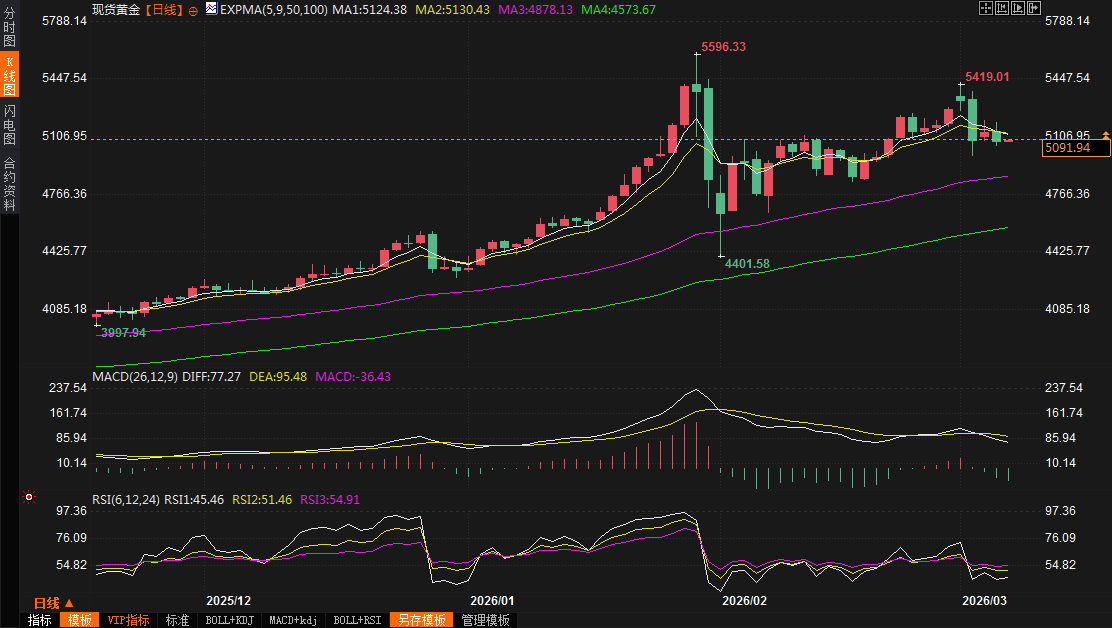
(Spot gold daily chart, source: FX678)
At 07:25 Beijing time, spot gold was trading at $5092.87 per ounce.
From its all-time high of $5,594.82 on January 29th, to its brief breakthrough of the $5,400 mark this Monday, and its current rapid decline, the dramatic fluctuations in gold prices reflect the market's difficult choices amidst the combined forces of war, inflation, and monetary policy. Bart Melek, Global Head of Commodity Strategy at TD Securities, points out: "The market is focused on rising oil prices and inflation risks, while rising US Treasury yields are generally unfavorable for gold."
Spot gold prices fell sharply, and futures prices also came under pressure.
Gold prices briefly rose after opening on Thursday due to escalating tensions in the Middle East, but quickly reversed course and fell. The difference between the intraday high of $5194.59 and the closing price of $5080.88 was more than $110. This "rise and fall" was not accidental, but rather an inevitable result of the combined strength of the US dollar index and US Treasury yields. The US dollar index rose 0.25% to close at 99.05, making dollar-denominated gold more expensive for overseas buyers; at the same time, the yield on the 10-year US Treasury note climbed to a three-week high, further increasing the opportunity cost of holding non-interest-bearing gold.
It's worth noting that the Chicago Mercantile Exchange (CME) just announced a reduction in the initial margin for COMEX 100 gold futures from 9% to 7%, and silver futures from 18% to 14%. While this move was intended to lower trading barriers and boost market liquidity, it seems somewhat ineffective in the current volatile market. Investors are still weighing whether the risk aversion stemming from the war can outweigh the double squeeze from yields and the US dollar.
The Middle East conflict escalated on its sixth day, with soaring oil prices exacerbating inflation concerns.
As the conflict enters its sixth day, the US-Israeli coalition's military operation against Iran intensifies. Local residents report increasingly heavy bombing, following a previous US attack on an Iranian warship far from the main combat zone, prompting Iran to vow full retaliation. President Trump, in an interview, stated that he "hopes to participate in the selection of Iran's next leader" and explicitly stated that he would not accept Khamenei's son as successor. This statement further exacerbates the situation, drawing Azerbaijan, coastal areas of Sri Lanka, and even several European countries into the fray, making the spread of the conflict unprecedented.
Oil prices surged as a result: U.S. crude oil jumped 8.91% to $81.29 a barrel, and Brent crude rose 5.17% to $85.61 a barrel, representing a cumulative increase of over 18% since the outbreak of the war. The surge in energy prices directly pushed up inflation expectations, raising market concerns that the Federal Reserve's interest rate cut path would be completely disrupted. Bart Melek emphasized that it was precisely this combination of rising oil prices and inflation risk that rapidly dimmed gold's traditional safe-haven appeal.
The rise of the US dollar and US Treasury bonds has rendered traditional safe-haven assets collectively ineffective.
The dollar index rose as much as 0.6% to 99.41 during the session, before closing up 0.25%. Elisabeth Colleran, co-head of the emerging market debt team at Loomis Sayles, remarked, "De-dollarization used to be a hot topic, but when market volatility intensifies, the dollar inevitably strengthens." Meanwhile, the yield on the 10-year US Treasury note rose to 4.138%, and the yield on the 10-year German government bond also touched 2.829%, as investors sold bonds and chased the dollar, the "ultimate safe-haven."
Interestingly, traditional safe-haven assets such as gold, German bonds, and US Treasuries collectively experienced a sell-off, leading to a steepening of the yield curve and a widening of the spread between 2-year and 10-year yields to 54.4 basis points. All of this serves as a reminder to the market that when inflation risk dominates the narrative, gold's "interest-free" nature becomes its biggest weakness.
Expectations of a Fed rate cut have been halved, and robust employment data has intensified policy uncertainty.
U.S. initial jobless claims, released Thursday, remained unchanged at 213,000, while layoffs in February fell sharply, indicating a continued robust labor market. The Federal Reserve also stated on Wednesday that "recent economic activity has risen slightly, prices have continued to rise, and employment has remained stable." Market expectations for an interest rate cut at the March 18 meeting have completely failed to materialize, and investors are now focusing on Friday's February non-farm payroll report (expected to show an increase of 59,000 jobs).
More importantly, US interest rate futures indicate that the Fed's rate cuts this year have plummeted from 59 basis points before the conflict to just 40 basis points! The probability of at least a 25 basis point rate cut in June has fallen from 75% a month ago to 32.2%. Expectations for rate cuts by the Bank of England and the European Central Bank have also been revised downwards, with some institutions even betting on a possible rate hike by the ECB. Jayati Bharadwaj, head of foreign exchange strategy at TD Securities, believes that "as long as the oil risk premium remains high, the dollar's upward trend is likely to continue."
Experts offer a two-sided interpretation: Short-term pressure exists, but long-term fundamentals remain supportive.
Despite significant short-term pressures, Bart Melek emphasized that gold's fundamentals have not collapsed: "Signs of a sharp increase in the US fiscal deficit will eventually emerge...and there is a great deal of uncertainty." Uncertainty surrounding war, geopolitical risks, and long-term inflation concerns still provide a safety net for gold.
The Trump administration's hardline stance towards Iran and the US House of Representatives' rejection of the war authorization resolution (219-212 votes in favor of Trump) have increased the risk of a protracted conflict. Furthermore, events such as the hacking of Iranian television and the release of videos by the exiled prince highlight the uncertainty surrounding regime change. These variables could potentially cause gold to regain its safe-haven appeal at any time.
Where is the gold bulls headed? Short-term fluctuations, but the long-term outlook remains bullish.
In conclusion, the current decline in gold prices is essentially due to the suppression of safe-haven demand by the "dollar + yield" factor, rather than a deterioration in fundamentals. The oil price and inflationary pressures brought about by the Middle East conflict are a double-edged sword: short-term bearish for gold, but long-term support for a solid bottom. Investors need to closely monitor Friday's non-farm payroll data, crude oil price movements, and potential retaliatory actions from Iran.
In 2026, a year of unprecedented global uncertainty, gold may be experiencing a "darkest hour before dawn." For long-term investors, the area around $5080 may represent a rare strategic entry window—after all, when fiscal deficits, war risks, and inflation expectations converge, gold's value-preserving properties will eventually return to the forefront. Markets are always in rotation; bulls simply need to patiently wait for the next turning point where "risk aversion" completely overwhelms "yield logic."
(Spot gold daily chart, source: FX678)
At 07:25 Beijing time, spot gold was trading at $5092.87 per ounce.
- Risk Warning and Disclaimer
- The market involves risk, and trading may not be suitable for all investors. This article is for reference only and does not constitute personal investment advice, nor does it take into account certain users’ specific investment objectives, financial situation, or other needs. Any investment decisions made based on this information are at your own risk.