A strong dollar offset safe-haven demand, and gold remained range-bound.
2026-03-06 09:52:24
According to the APP, gold prices (XAU/USD) fell significantly in early Asian trading on Friday. The latest real-time data shows that the spot price is hovering around $5,120, a clear pullback from the previous day's high.
This adjustment was mainly due to the strong performance of the US dollar index. The surge in oil and gas prices triggered by geopolitical conflicts in the Middle East reignited inflation concerns, and traders significantly reduced their expectations for further interest rate cuts by the Federal Reserve, thereby boosting the dollar and putting downward pressure on dollar-denominated gold .

Despite short-term pressure, gold has risen nearly 75% year-to-date, reflecting the continued strong structural demand for it as a safe-haven asset. The escalating tensions in the Middle East have become the biggest source of uncertainty in global markets.
Iran launched a new round of missile and drone attacks on Thursday, targeting multiple Gulf states including the United Arab Emirates, Bahrain, Qatar, and Kuwait. The attacks primarily targeted U.S. military assets and infrastructure. Iran has now launched hundreds of ballistic missiles and thousands of drones at Gulf countries, most of which have been intercepted but have caused localized damage and casualties.
Iranian Foreign Minister Abbas Araqchi stated unequivocally on March 5 that "Iran has not demanded a ceasefire, nor does it have the will to negotiate with the United States," emphasizing that Iran is prepared for a US ground invasion and rejecting any easy ceasefire agreement. The Iranian Islamic Revolutionary Guard Corps also pledged further escalation of retaliatory actions.
These developments have severely disrupted energy transport through the Strait of Hormuz, causing Brent crude oil prices to surge to around $83-85 per barrel, a nearly 20% increase this week. The sharp rise in oil prices has directly amplified inflationary pressures, prompting market expectations that the Federal Reserve will maintain its tightening stance for longer, thus strengthening the dollar and putting downward pressure on gold . Morgan Stanley analysts emphasized in a recent report that "recent gold volatility does not represent a weakening of safe-haven demand; the main drivers are a stronger dollar and investor liquidity needs." They maintain their long-term optimistic outlook for gold , predicting that prices could climb further to higher levels in the second half of 2026 (such as the previously updated target of $5700) given continued geopolitical risks and central bank gold purchases. This view aligns with market consensus: despite short-term pullbacks, continued central bank buying and the global de-dollarization process provide solid bottom support for gold .
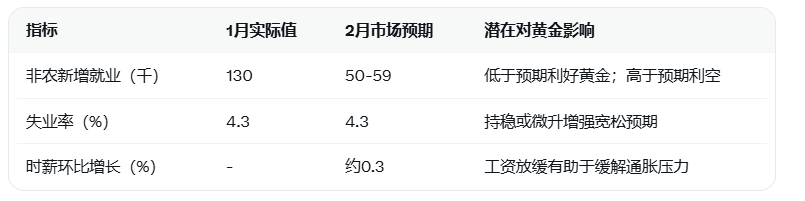
On the US economic data front, the upcoming February non-farm payroll report is highly anticipated. According to the latest forecasts, the market expects approximately 50,000-59,000 new jobs to be added in February, significantly lower than January's 130,000, with the unemployment rate expected to remain stable at 4.3%. ADP private sector employment data showed approximately 63,000 new jobs added in February, indicating signs of a slowdown in the labor market. If the actual data is weak, it will revive expectations of interest rate cuts, weaken the dollar , and benefit gold ; conversely, a strong report will reinforce the inflation narrative, further pressuring gold prices.
For ease of comparison, the following table summarizes recent key employment indicators and market expectations:
From a technical perspective, gold is currently fluctuating between $5060 and $5200, with short-term support levels near $5050-$5080. If geopolitical conflicts continue to escalate and trigger a return of safe-haven funds, prices may break through $5200 and resume their upward trend; conversely, a break below $5000 would deepen the correction.
Investors should be wary of the ripple effects of energy disruptions on global supply chains, which could amplify inflationary effects and influence the Federal Reserve's course of action. Overall, the persistence of the Middle East conflict, coupled with oil price volatility and uncertainty surrounding US data, poses a short-term downside risk to gold , dominated by the US dollar. However, its long-term safe-haven appeal and structural demand are expected to support its price action at high levels, with opportunities for a rebound.
Editor's Summary : Escalating geopolitical tensions have driven up energy prices and reinforced inflation expectations, with a strong US dollar driving a short-term pullback in gold prices . While employment data may trigger a shift, the continued spread of Middle East risks is expected to maintain market volatility, and precious metals will remain resilient as a safe-haven asset.
Frequently Asked Questions
Question 1: Why did the price of gold fall?
The main reasons for the decline in gold prices were the strengthening US dollar and the Middle East conflict, which caused oil prices to surge to $83-85 per barrel, reigniting inflation concerns and reducing market bets on further easing by the Federal Reserve. The rebounding dollar made gold more expensive for non-dollar holders, while liquidity demand also triggered some selling pressure. However, gold has risen nearly 75% this year, and its safe-haven appeal remains unchanged.
Question 2: What dual impact does the Middle East conflict have on gold?
On the one hand, Iran's attacks on several Gulf states disrupted energy supplies, causing oil prices to surge 20% this week. Rising inflation expectations indirectly supported the US dollar and put pressure on gold. On the other hand, escalating conflict amplified uncertainty, reviving traditional safe-haven demand for gold. If retaliatory actions continue, the pullback could be reversed, pushing prices back above $5,200.
Question 3: What potential impact will the US February jobs report have on gold prices?
The expected increase in jobs is 50,000-59,000, significantly lower than the 130,000 added in January. Weak data would increase the probability of an interest rate cut, weaken the dollar, and benefit gold; strong data would reinforce the inflation narrative, further pressuring gold prices. A stable unemployment rate of 4.3% and signs of slowing wage growth could amplify easing signals.
Question 4: What is Morgan Stanley's latest view on gold?
Analysts believe the volatility stems from a strong dollar and liquidity needs, rather than a decline in safe-haven demand. They are optimistic about 2026, anticipating further price increases (such as the previous target of $5,700) driven by geopolitical risks, central bank gold purchases, and investor inflows. This reflects the structural bull market characteristics of gold.
Question 5: How do investors view opportunities in gold under the current environment?
In the short term, focus on employment data and technical support (such as $5050-$5080). Escalating risks in the Middle East may create buying opportunities at lower levels. Long-term factors include inflation, geopolitical uncertainty, and the trend towards de-dollarization, supporting upside potential. It is recommended to allocate to safe-haven assets but control leverage to avoid chasing highs or panic selling.
This adjustment was mainly due to the strong performance of the US dollar index. The surge in oil and gas prices triggered by geopolitical conflicts in the Middle East reignited inflation concerns, and traders significantly reduced their expectations for further interest rate cuts by the Federal Reserve, thereby boosting the dollar and putting downward pressure on dollar-denominated gold .
Despite short-term pressure, gold has risen nearly 75% year-to-date, reflecting the continued strong structural demand for it as a safe-haven asset. The escalating tensions in the Middle East have become the biggest source of uncertainty in global markets.
Iran launched a new round of missile and drone attacks on Thursday, targeting multiple Gulf states including the United Arab Emirates, Bahrain, Qatar, and Kuwait. The attacks primarily targeted U.S. military assets and infrastructure. Iran has now launched hundreds of ballistic missiles and thousands of drones at Gulf countries, most of which have been intercepted but have caused localized damage and casualties.
Iranian Foreign Minister Abbas Araqchi stated unequivocally on March 5 that "Iran has not demanded a ceasefire, nor does it have the will to negotiate with the United States," emphasizing that Iran is prepared for a US ground invasion and rejecting any easy ceasefire agreement. The Iranian Islamic Revolutionary Guard Corps also pledged further escalation of retaliatory actions.
These developments have severely disrupted energy transport through the Strait of Hormuz, causing Brent crude oil prices to surge to around $83-85 per barrel, a nearly 20% increase this week. The sharp rise in oil prices has directly amplified inflationary pressures, prompting market expectations that the Federal Reserve will maintain its tightening stance for longer, thus strengthening the dollar and putting downward pressure on gold . Morgan Stanley analysts emphasized in a recent report that "recent gold volatility does not represent a weakening of safe-haven demand; the main drivers are a stronger dollar and investor liquidity needs." They maintain their long-term optimistic outlook for gold , predicting that prices could climb further to higher levels in the second half of 2026 (such as the previously updated target of $5700) given continued geopolitical risks and central bank gold purchases. This view aligns with market consensus: despite short-term pullbacks, continued central bank buying and the global de-dollarization process provide solid bottom support for gold .
On the US economic data front, the upcoming February non-farm payroll report is highly anticipated. According to the latest forecasts, the market expects approximately 50,000-59,000 new jobs to be added in February, significantly lower than January's 130,000, with the unemployment rate expected to remain stable at 4.3%. ADP private sector employment data showed approximately 63,000 new jobs added in February, indicating signs of a slowdown in the labor market. If the actual data is weak, it will revive expectations of interest rate cuts, weaken the dollar , and benefit gold ; conversely, a strong report will reinforce the inflation narrative, further pressuring gold prices.
For ease of comparison, the following table summarizes recent key employment indicators and market expectations:
From a technical perspective, gold is currently fluctuating between $5060 and $5200, with short-term support levels near $5050-$5080. If geopolitical conflicts continue to escalate and trigger a return of safe-haven funds, prices may break through $5200 and resume their upward trend; conversely, a break below $5000 would deepen the correction.
Investors should be wary of the ripple effects of energy disruptions on global supply chains, which could amplify inflationary effects and influence the Federal Reserve's course of action. Overall, the persistence of the Middle East conflict, coupled with oil price volatility and uncertainty surrounding US data, poses a short-term downside risk to gold , dominated by the US dollar. However, its long-term safe-haven appeal and structural demand are expected to support its price action at high levels, with opportunities for a rebound.
Editor's Summary : Escalating geopolitical tensions have driven up energy prices and reinforced inflation expectations, with a strong US dollar driving a short-term pullback in gold prices . While employment data may trigger a shift, the continued spread of Middle East risks is expected to maintain market volatility, and precious metals will remain resilient as a safe-haven asset.
Frequently Asked Questions
Question 1: Why did the price of gold fall?
The main reasons for the decline in gold prices were the strengthening US dollar and the Middle East conflict, which caused oil prices to surge to $83-85 per barrel, reigniting inflation concerns and reducing market bets on further easing by the Federal Reserve. The rebounding dollar made gold more expensive for non-dollar holders, while liquidity demand also triggered some selling pressure. However, gold has risen nearly 75% this year, and its safe-haven appeal remains unchanged.
Question 2: What dual impact does the Middle East conflict have on gold?
On the one hand, Iran's attacks on several Gulf states disrupted energy supplies, causing oil prices to surge 20% this week. Rising inflation expectations indirectly supported the US dollar and put pressure on gold. On the other hand, escalating conflict amplified uncertainty, reviving traditional safe-haven demand for gold. If retaliatory actions continue, the pullback could be reversed, pushing prices back above $5,200.
Question 3: What potential impact will the US February jobs report have on gold prices?
The expected increase in jobs is 50,000-59,000, significantly lower than the 130,000 added in January. Weak data would increase the probability of an interest rate cut, weaken the dollar, and benefit gold; strong data would reinforce the inflation narrative, further pressuring gold prices. A stable unemployment rate of 4.3% and signs of slowing wage growth could amplify easing signals.
Question 4: What is Morgan Stanley's latest view on gold?
Analysts believe the volatility stems from a strong dollar and liquidity needs, rather than a decline in safe-haven demand. They are optimistic about 2026, anticipating further price increases (such as the previous target of $5,700) driven by geopolitical risks, central bank gold purchases, and investor inflows. This reflects the structural bull market characteristics of gold.
Question 5: How do investors view opportunities in gold under the current environment?
In the short term, focus on employment data and technical support (such as $5050-$5080). Escalating risks in the Middle East may create buying opportunities at lower levels. Long-term factors include inflation, geopolitical uncertainty, and the trend towards de-dollarization, supporting upside potential. It is recommended to allocate to safe-haven assets but control leverage to avoid chasing highs or panic selling.
- Risk Warning and Disclaimer
- The market involves risk, and trading may not be suitable for all investors. This article is for reference only and does not constitute personal investment advice, nor does it take into account certain users’ specific investment objectives, financial situation, or other needs. Any investment decisions made based on this information are at your own risk.