Cutting off India's oil lifeline: India forced to return to Russia's embrace, Urals oil prices dramatically reversed.
2026-03-06 09:56:28
The escalating conflict with Iran has nearly paralyzed shipping in the Strait of Hormuz, directly disrupting approximately 40% of India's crude oil imports (around 2.5 million barrels per day, mainly from Iraq, Saudi Arabia, the UAE, and Kuwait). As the world's third-largest crude oil importer, with an import dependency exceeding 85%, India faces a sharply increased risk of supply disruptions. Sources familiar with the matter revealed that Indian state-owned refiners have initiated emergency procurement, shifting to Russian spot crude oil to fill the gap and avoid a decline in refinery operating rates and fuel shortages.
Russia seized the window of opportunity and responded quickly to supply demands. Previously, due to the US-India trade agreement, India had significantly reduced its purchases of Russian oil (down to about 1.1 million barrels per day in January). Now, supply security takes precedence over geopolitical constraints.
Indian state-owned refiners have purchased approximately 20 million barrels of Russian crude oil from traders, with delivery windows concentrated in March and early April. These immediate supplies largely consist of Russian crude oil previously stored in Asia, which can quickly reach Indian ports, alleviating short-term supply pressures. Traders emphasized, "Currently, the supply of raw materials is more pressing than price."
This amount is equivalent to about 4-5 days of India's total imports, which can significantly buffer the initial impact of the Hormuz disruption. If the conflict continues, India may further increase its purchases.
Russian Urals crude oil has seen a dramatic reversal in its price relative to Brent crude: February deliveries were trading at a discount of approximately $13 per barrel, while March-April deliveries are now trading at a premium of $4-5 per barrel (CIF India). This shift stems from supply urgency dominating the market, with Indian buyers eager to secure supplies rather than waiting for discounts. While the premium increases import costs, it remains relatively competitive, well below Brent crude's current level of around $83-84 per barrel.
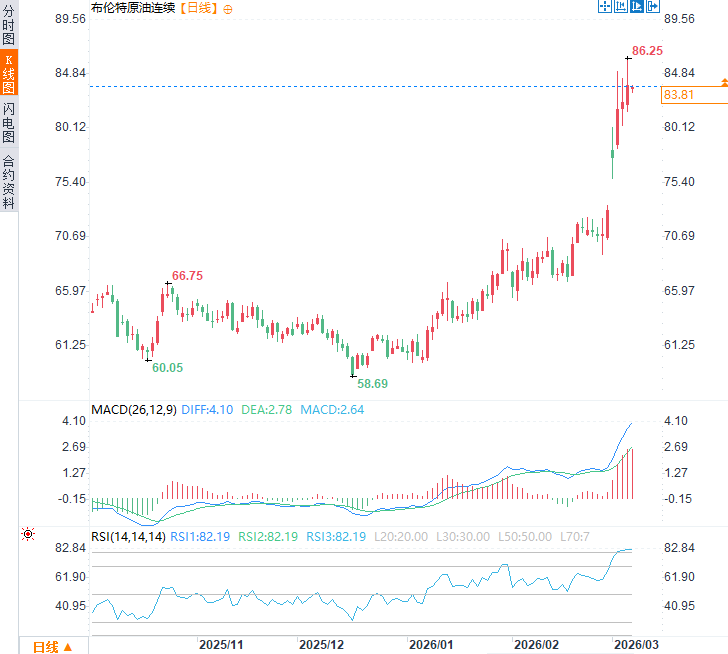
(Brent crude oil daily chart, source: EasyForex)
Indian government sources, consistent with Kpler data, indicate that commercial crude oil inventories plus strategic reserves cover approximately 25 days of demand (about 100 million barrels, including underground reserves in Mangalore, Padur, and Visakhapatnam). Refined petroleum products (gasoline, diesel, etc.) provide an additional 25 days, for a total buffer period of approximately 40-50 days (some sources claim 74 days, including transit and additional commercial storage). If the Hormuz disruption exceeds one month, reliance on alternative imports will be necessary; otherwise, the risk of refinery production cuts increases, putting downward pressure on fuel prices and inflation.
India's oil minister emphasized that diversifying sources (the United States, West Africa, Latin America, and Russia) can extend the actual coverage period.
For months, the US pressured India to reduce its purchases of Russian oil in an effort to cut off Russia's war funding; in January, Indian refiners drastically cut back, in exchange for a 25% tariff exemption and a temporary trade agreement with the US. However, since the outbreak of conflict, supply security has taken precedence over geopolitical considerations. India is now seeking special permission from the Trump administration to expand its Russian oil imports. Trump previously claimed that India had agreed to "stop buying Russian oil," but India denies this, emphasizing that energy decisions are based on market forces and national interests.
If permitted, Russia's share of oil production could rebound from its recent low to over 30%; otherwise, diplomatic friction could reignite, affecting US-India trade relations.
State-owned refiners involved in the emergency procurement include Indian Oil Corporation (IOC), Bharat Petroleum (BPCL), Hindustan Petroleum Corporation (HPCL), and Mangalore Petrochemicals (MRPL). Private giant Reliance Industries has also been contacted by traders for procurement negotiations. The state-owned enterprises spearheaded this action to prioritize ensuring a stable domestic fuel supply.
The Hormuz trade dispute forced India to shift from reducing its reliance on Russian oil to aggressively acquiring it, with the emergency sale of 20 million barrels signifying that energy security has transcended the constraints of the US-India trade agreement. Urals prices shifted from a deep discount to a premium, highlighting the market logic driven by supply scarcity. While there is a 40-50 day inventory buffer, the long-term risks of reliance on the Middle East are now fully exposed.
India's pursuit of a US waiver to expand its Russian oil purchases offers short-term relief from the crisis, but persistent geopolitical uncertainty could trigger a new round of US-India friction and reshape the global energy landscape. Russia is using this opportunity to expand its market share in Asia, and the spillover effects of the conflict are reshaping the trade landscape.
At 9:56 AM Beijing time, Brent crude oil futures were trading at $84.13 per barrel.
Russia seized the window of opportunity and responded quickly to supply demands. Previously, due to the US-India trade agreement, India had significantly reduced its purchases of Russian oil (down to about 1.1 million barrels per day in January). Now, supply security takes precedence over geopolitical constraints.
20 million barrels of Russian crude oil were traded on the spot, with deliveries concentrated in March and April.
Indian state-owned refiners have purchased approximately 20 million barrels of Russian crude oil from traders, with delivery windows concentrated in March and early April. These immediate supplies largely consist of Russian crude oil previously stored in Asia, which can quickly reach Indian ports, alleviating short-term supply pressures. Traders emphasized, "Currently, the supply of raw materials is more pressing than price."
This amount is equivalent to about 4-5 days of India's total imports, which can significantly buffer the initial impact of the Hormuz disruption. If the conflict continues, India may further increase its purchases.
Urals crude oil has shifted from a discount of $13 to a premium of $4-5.
Russian Urals crude oil has seen a dramatic reversal in its price relative to Brent crude: February deliveries were trading at a discount of approximately $13 per barrel, while March-April deliveries are now trading at a premium of $4-5 per barrel (CIF India). This shift stems from supply urgency dominating the market, with Indian buyers eager to secure supplies rather than waiting for discounts. While the premium increases import costs, it remains relatively competitive, well below Brent crude's current level of around $83-84 per barrel.
(Brent crude oil daily chart, source: EasyForex)
India's crude oil inventory is only 25 days old, with a total buffer estimated at 40-50 days.
Indian government sources, consistent with Kpler data, indicate that commercial crude oil inventories plus strategic reserves cover approximately 25 days of demand (about 100 million barrels, including underground reserves in Mangalore, Padur, and Visakhapatnam). Refined petroleum products (gasoline, diesel, etc.) provide an additional 25 days, for a total buffer period of approximately 40-50 days (some sources claim 74 days, including transit and additional commercial storage). If the Hormuz disruption exceeds one month, reliance on alternative imports will be necessary; otherwise, the risk of refinery production cuts increases, putting downward pressure on fuel prices and inflation.
India's oil minister emphasized that diversifying sources (the United States, West Africa, Latin America, and Russia) can extend the actual coverage period.
Seeking US permission to expand Russian oil purchases exacerbates geopolitical risks.
For months, the US pressured India to reduce its purchases of Russian oil in an effort to cut off Russia's war funding; in January, Indian refiners drastically cut back, in exchange for a 25% tariff exemption and a temporary trade agreement with the US. However, since the outbreak of conflict, supply security has taken precedence over geopolitical considerations. India is now seeking special permission from the Trump administration to expand its Russian oil imports. Trump previously claimed that India had agreed to "stop buying Russian oil," but India denies this, emphasizing that energy decisions are based on market forces and national interests.
If permitted, Russia's share of oil production could rebound from its recent low to over 30%; otherwise, diplomatic friction could reignite, affecting US-India trade relations.
Major state-owned oil refiners were involved, and Reliance Industries was also in talks for acquisition.
State-owned refiners involved in the emergency procurement include Indian Oil Corporation (IOC), Bharat Petroleum (BPCL), Hindustan Petroleum Corporation (HPCL), and Mangalore Petrochemicals (MRPL). Private giant Reliance Industries has also been contacted by traders for procurement negotiations. The state-owned enterprises spearheaded this action to prioritize ensuring a stable domestic fuel supply.
Editor's Summary
The Hormuz trade dispute forced India to shift from reducing its reliance on Russian oil to aggressively acquiring it, with the emergency sale of 20 million barrels signifying that energy security has transcended the constraints of the US-India trade agreement. Urals prices shifted from a deep discount to a premium, highlighting the market logic driven by supply scarcity. While there is a 40-50 day inventory buffer, the long-term risks of reliance on the Middle East are now fully exposed.
India's pursuit of a US waiver to expand its Russian oil purchases offers short-term relief from the crisis, but persistent geopolitical uncertainty could trigger a new round of US-India friction and reshape the global energy landscape. Russia is using this opportunity to expand its market share in Asia, and the spillover effects of the conflict are reshaping the trade landscape.
At 9:56 AM Beijing time, Brent crude oil futures were trading at $84.13 per barrel.
- Risk Warning and Disclaimer
- The market involves risk, and trading may not be suitable for all investors. This article is for reference only and does not constitute personal investment advice, nor does it take into account certain users’ specific investment objectives, financial situation, or other needs. Any investment decisions made based on this information are at your own risk.