Is a slowdown in US non-farm payroll data for February presenting an opportunity for a euro-dollar rebound?
2026-03-06 14:26:12
The U.S. Bureau of Labor Statistics (BLS) will release its February non-farm payrolls report at 9:30 p.m. Beijing time on Friday (March 6).
The release of this jobs data is expected to significantly increase dollar volatility, as investors will seek new clues about the Federal Reserve's interest rate path, especially given renewed inflation concerns stemming from the Middle East crisis.
The market has cautious expectations for the upcoming February non-farm payrolls report. Investors generally expect non-farm payrolls to increase by 59,000, following January's higher-than-expected 130,000. The unemployment rate is expected to remain unchanged at 4.3%, while average hourly earnings (a measure of wage inflation) are expected to remain unchanged at 3.7%.

TD Securities analysts, in a preview of the jobs report, noted that they expect job growth to slow to 90,000 in February. They added that this slowdown was primarily led by healthcare, which recorded unusually strong growth last month. Private sector employment is expected to increase by 100,000, while government employment may decrease by 10,000. They also expect the unemployment rate to remain at 4.3%, but warned of the risk of it rising to 4.4%. Average hourly earnings are expected to slow to 0.2% month-over-month (compared to 3.7% year-over-year).
Recent US employment data releases indicate a relatively healthy labor market in February. The ISM Manufacturing PMI employment index rose slightly to 48.8 from 48.1 in January (though still in contraction territory). ADP reported a private sector job increase of 63,000, exceeding market expectations of 50,000. Furthermore, the ISM Services PMI employment index rose to 51.8 from 50.3, reflecting accelerated job creation in key service sectors. These leading indicators provide a positive backdrop for the non-farm payroll report, but overall, job growth remains moderate.
The US dollar benefited from safe-haven inflows and had a solid start to the month following the joint US-Israeli attack on Iran, putting significant bearish pressure on the euro against the dollar.
Earlier this week, the US Senate rejected a resolution aimed at forcing President Trump to seek congressional approval for further military action against Iran. Furthermore, media reports indicated that a senior US official stated the US military will begin a deeper attack on Iran, noting that the operation is still in its early stages.

From a monetary policy perspective, investors are closely watching the impact of the Middle East crisis on energy prices and how this will change the inflation outlook. According to the CME Group's FedWatch Tool, the probability of the Federal Reserve keeping policy rates unchanged in the next three meetings has risen from about 50% before the outbreak of the Iran war to nearly 70%. Minneapolis Fed President Kashkari stated earlier this week that it is too early to judge how the Iran war will affect inflation, but he acknowledged that it could have an impact on monetary policy.
If the non-farm payrolls figure reaches 70,000 or higher, and the unemployment rate remains at 4.3% as expected, the market may interpret this jobs report as "good enough" to allow the Federal Reserve to postpone interest rate cuts until the second half of the year. In this scenario, the US dollar may continue to strengthen, pushing the euro down further against the dollar.
Conversely, investors might revert to favoring a June rate cut if non-farm payroll data significantly misses expectations (reaching or falling below 30,000) and is accompanied by a rise in unemployment. However, even in this scenario, the dollar's decline could be limited unless the Middle East conflict de-escalates. The most bearish scenario for the dollar (which would drive a strong euro-dollar rebound) is a sharp correction in Brent crude oil prices, a return to normal shipping activity in the Strait of Hormuz, and a jobs report highlighting a deteriorating labor market.
Analysts at Societe Generale noted that after all four indicators of the US labor market exceeded expectations, they expect the non-farm payroll data to be robust. They added that concluding that "good data is reassuring and therefore positive for risk assets and currencies (negative for the dollar)" is somewhat far-fetched in the current environment. They assume that a job increase of 30,000 to 70,000 will not significantly alter market trends, and that the closing levels of oil and natural gas prices this week will dominate price action.
Analyst Sengze provided a brief technical outlook for the euro against the dollar. He stated that the short-term outlook for the pair is clearly bearish. For the first time in a year, the pair closed below its 200-day simple moving average (SMA) on a daily chart, and the relative strength index (RSI) fell below 40.
He pointed out that 1.1500 (static level, psychological level) is the first important support level, followed by 1.1400 (static level, psychological level) and 1.1300-1.1290 (psychological level, static level). On the upside, 1.1670-1.1700 (200-day SMA, 100-day SMA) appears to have formed a strong resistance zone. The pair needs to break through this level and stabilize to attract technical buying. In this scenario, the 50-day SMA may act as the next resistance at 1.1770.
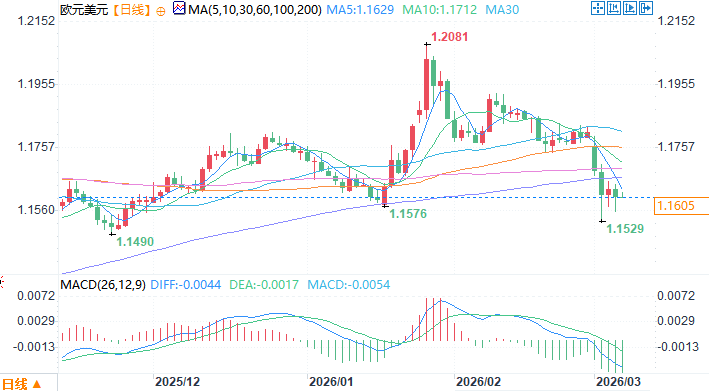
EUR/USD daily chart source: FX678
At 14:26 Beijing time on March 6, the euro was trading at 1.1604/05 against the US dollar.
The release of this jobs data is expected to significantly increase dollar volatility, as investors will seek new clues about the Federal Reserve's interest rate path, especially given renewed inflation concerns stemming from the Middle East crisis.
Non-farm payroll report expected: Employment growth slows while key indicators remain stable
The market has cautious expectations for the upcoming February non-farm payrolls report. Investors generally expect non-farm payrolls to increase by 59,000, following January's higher-than-expected 130,000. The unemployment rate is expected to remain unchanged at 4.3%, while average hourly earnings (a measure of wage inflation) are expected to remain unchanged at 3.7%.
TD Securities analysts, in a preview of the jobs report, noted that they expect job growth to slow to 90,000 in February. They added that this slowdown was primarily led by healthcare, which recorded unusually strong growth last month. Private sector employment is expected to increase by 100,000, while government employment may decrease by 10,000. They also expect the unemployment rate to remain at 4.3%, but warned of the risk of it rising to 4.4%. Average hourly earnings are expected to slow to 0.2% month-over-month (compared to 3.7% year-over-year).
Recent US employment data releases indicate a relatively healthy labor market in February. The ISM Manufacturing PMI employment index rose slightly to 48.8 from 48.1 in January (though still in contraction territory). ADP reported a private sector job increase of 63,000, exceeding market expectations of 50,000. Furthermore, the ISM Services PMI employment index rose to 51.8 from 50.3, reflecting accelerated job creation in key service sectors. These leading indicators provide a positive backdrop for the non-farm payroll report, but overall, job growth remains moderate.
Amid the Middle East crisis, a strong dollar puts pressure on the euro against the dollar.
The US dollar benefited from safe-haven inflows and had a solid start to the month following the joint US-Israeli attack on Iran, putting significant bearish pressure on the euro against the dollar.
Earlier this week, the US Senate rejected a resolution aimed at forcing President Trump to seek congressional approval for further military action against Iran. Furthermore, media reports indicated that a senior US official stated the US military will begin a deeper attack on Iran, noting that the operation is still in its early stages.
From a monetary policy perspective, investors are closely watching the impact of the Middle East crisis on energy prices and how this will change the inflation outlook. According to the CME Group's FedWatch Tool, the probability of the Federal Reserve keeping policy rates unchanged in the next three meetings has risen from about 50% before the outbreak of the Iran war to nearly 70%. Minneapolis Fed President Kashkari stated earlier this week that it is too early to judge how the Iran war will affect inflation, but he acknowledged that it could have an impact on monetary policy.
If the non-farm payrolls figure reaches 70,000 or higher, and the unemployment rate remains at 4.3% as expected, the market may interpret this jobs report as "good enough" to allow the Federal Reserve to postpone interest rate cuts until the second half of the year. In this scenario, the US dollar may continue to strengthen, pushing the euro down further against the dollar.
Conversely, investors might revert to favoring a June rate cut if non-farm payroll data significantly misses expectations (reaching or falling below 30,000) and is accompanied by a rise in unemployment. However, even in this scenario, the dollar's decline could be limited unless the Middle East conflict de-escalates. The most bearish scenario for the dollar (which would drive a strong euro-dollar rebound) is a sharp correction in Brent crude oil prices, a return to normal shipping activity in the Strait of Hormuz, and a jobs report highlighting a deteriorating labor market.
Analysts at Societe Generale noted that after all four indicators of the US labor market exceeded expectations, they expect the non-farm payroll data to be robust. They added that concluding that "good data is reassuring and therefore positive for risk assets and currencies (negative for the dollar)" is somewhat far-fetched in the current environment. They assume that a job increase of 30,000 to 70,000 will not significantly alter market trends, and that the closing levels of oil and natural gas prices this week will dominate price action.
Analyst Sengze provided a brief technical outlook for the euro against the dollar. He stated that the short-term outlook for the pair is clearly bearish. For the first time in a year, the pair closed below its 200-day simple moving average (SMA) on a daily chart, and the relative strength index (RSI) fell below 40.
He pointed out that 1.1500 (static level, psychological level) is the first important support level, followed by 1.1400 (static level, psychological level) and 1.1300-1.1290 (psychological level, static level). On the upside, 1.1670-1.1700 (200-day SMA, 100-day SMA) appears to have formed a strong resistance zone. The pair needs to break through this level and stabilize to attract technical buying. In this scenario, the 50-day SMA may act as the next resistance at 1.1770.
EUR/USD daily chart source: FX678
At 14:26 Beijing time on March 6, the euro was trading at 1.1604/05 against the US dollar.
- Risk Warning and Disclaimer
- The market involves risk, and trading may not be suitable for all investors. This article is for reference only and does not constitute personal investment advice, nor does it take into account certain users’ specific investment objectives, financial situation, or other needs. Any investment decisions made based on this information are at your own risk.