Oil prices surged 20% in a week! Deutsche Bank warns: ECB policy may be completely reversed.
2026-03-06 17:26:57
On Friday, March 6, Brent crude oil traded around $85.50 per barrel during the European session, having recently reached a high of $86.25 per barrel, rebounding more than 10% from its low a week earlier. Geopolitical conflicts in the Middle East have brought shipping in the Strait of Hormuz to a near standstill, and concerns about supply disruptions have pushed up benchmark oil prices, with gains approaching 20% this week. Against this backdrop, the Eurozone's energy input costs have risen sharply. A Deutsche Bank report points out that the risk of oil-driven inflation has led to a complete shift in market expectations regarding the European Central Bank's policy path, with the probability of an interest rate hike before the end of 2026 reversing from 55% (priced in a rate cut) last Friday to 63%.
Brent crude oil prices surged from the $63/barrel range at the end of February 2026 to above $85/barrel, directly impacting Eurozone energy prices. Energy accounts for approximately 10% of the Eurozone's HICP basket, but through transmission effects in transportation, chemicals, and manufacturing, the actual impact can be amplified to over 0.5 percentage points. Deutsche Bank's calculations show that if oil prices remain at current levels until the end of the year, the core inflation rate for 2026 will be revised upward from the original forecast of 1.8% to over 2.3%. More crucially, there is a secondary effect: rising business costs will drive the resumption of service price and wage negotiations, and market inflation expectations have already risen from 1.7% to 1.95%. The ECB's 2% symmetric target faces upward pressure; if expectations deviate from this target, policy space will be significantly compressed.
A week ago, the money market was pricing in a 55% probability of a rate cut at the December 2026 meeting, with the OIS curve indicating a cumulative easing of 25 basis points for the year. After the surge in oil prices, pricing has completely reversed: a Deutsche Bank report explicitly states a 63% probability of a 25 basis point rate hike before the end of December, the first time it has exceeded 50% since 2026. The Eurozone swap market also reflects a shift in the year-end deposit rate from the previously expected 2.00% to 2.35%. This pricing change is not isolated; natural gas futures have also risen by 32% alongside oil prices, jointly pushing up energy-imported inflation. Traders are quickly removing any bets on further easing in 2026 and preparing for a hawkish shift.
European Central Bank (ECB) Vice President Charles de Guindos stated bluntly at the Brussels meeting: "If the Middle East conflict prolongs, it will push up inflation expectations and prompt a change in policy stance." This statement was seen by the market as the strongest signal yet. Bank of France Governor Robert Villeroy, however, remained cautious: "Today I see no reason for the ECB to raise interest rates; we will assess this at each meeting." Their statements complemented each other: no immediate action in the short term, but long-term risk exposure has been opened. ECB Chief Economist Ryan warned at the same time that a protracted war could lead to a sharp rise in Eurozone inflation, while simultaneously dragging down economic growth. Officials unanimously emphasized that policy will be strictly data-driven, rather than relying solely on oil price indicators.
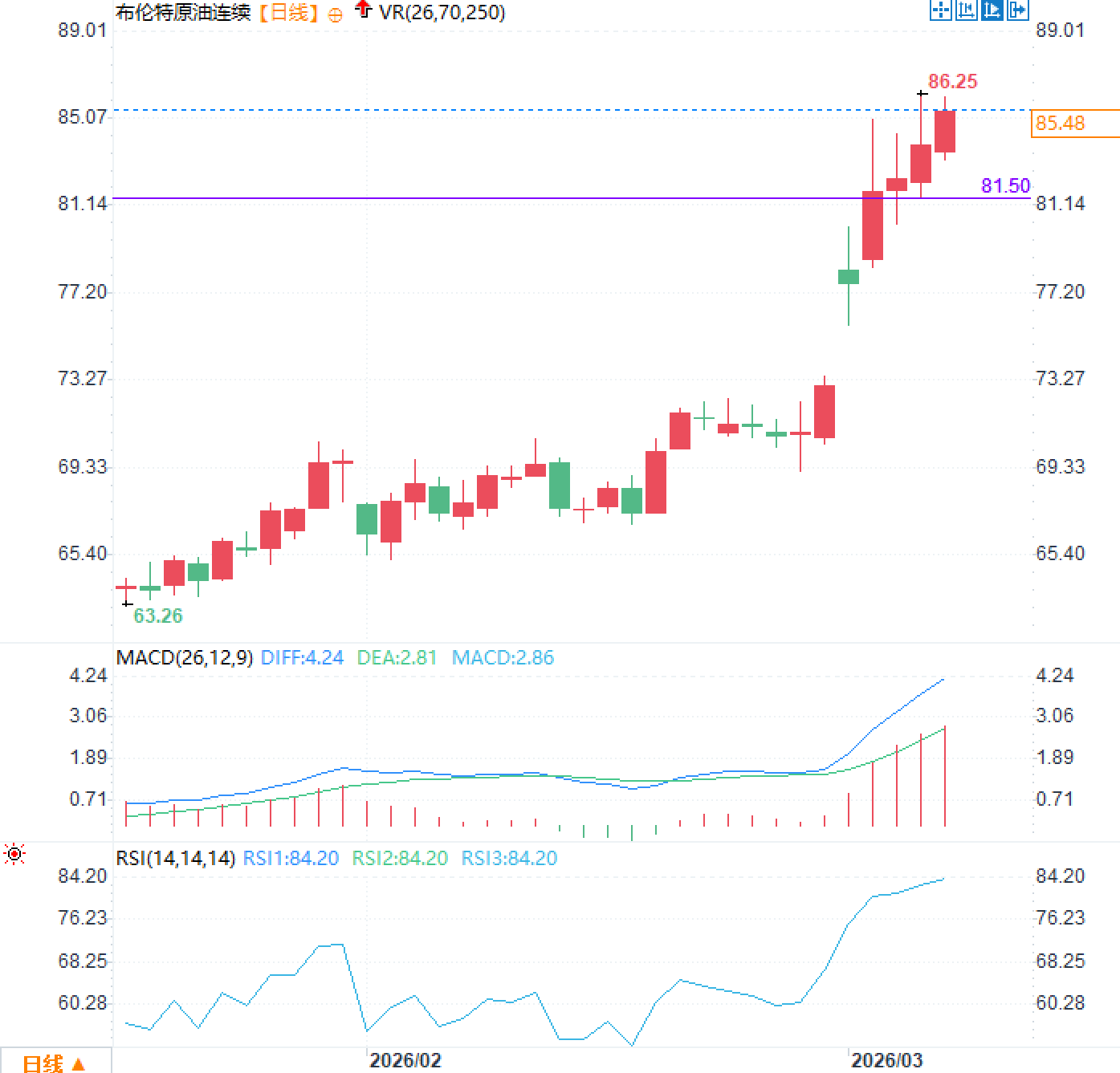
The daily chart shows that Brent crude oil futures contracts have risen in five waves since the low of $63.26/barrel, and the current price has stabilized at $85/barrel, with the support level of $81.50/barrel providing a solid bottom. The MACD histogram has expanded to 2.86, the DIFF and DEA golden cross continues, and the RSI (14) has reached 84.20, indicating overbought conditions but no momentum divergence. Recent candlestick patterns are dominated by consecutive positive lines, accompanied by increased trading volume. With the fundamentals and technicals resonating, the upward trend in oil prices is likely to continue. Unless geopolitical conflicts suddenly ease, $85/barrel will become the new equilibrium range.
How soaring oil prices are reshaping the eurozone's inflation path
Brent crude oil prices surged from the $63/barrel range at the end of February 2026 to above $85/barrel, directly impacting Eurozone energy prices. Energy accounts for approximately 10% of the Eurozone's HICP basket, but through transmission effects in transportation, chemicals, and manufacturing, the actual impact can be amplified to over 0.5 percentage points. Deutsche Bank's calculations show that if oil prices remain at current levels until the end of the year, the core inflation rate for 2026 will be revised upward from the original forecast of 1.8% to over 2.3%. More crucially, there is a secondary effect: rising business costs will drive the resumption of service price and wage negotiations, and market inflation expectations have already risen from 1.7% to 1.95%. The ECB's 2% symmetric target faces upward pressure; if expectations deviate from this target, policy space will be significantly compressed.
| scene | 2026 HICP Prediction | Core inflation upward revision |
|---|---|---|
| Oil prices fell back to $70 per barrel | 1.75% | 0.1 percentage points |
| Oil prices remain at $85 per barrel | 2.35% | 0.55 percentage points |
| Oil prices surge to $95 per barrel | 2.75% | 0.95 percentage points |
Market pricing has shifted from expectations of interest rate cuts to the probability of interest rate hikes.
A week ago, the money market was pricing in a 55% probability of a rate cut at the December 2026 meeting, with the OIS curve indicating a cumulative easing of 25 basis points for the year. After the surge in oil prices, pricing has completely reversed: a Deutsche Bank report explicitly states a 63% probability of a 25 basis point rate hike before the end of December, the first time it has exceeded 50% since 2026. The Eurozone swap market also reflects a shift in the year-end deposit rate from the previously expected 2.00% to 2.35%. This pricing change is not isolated; natural gas futures have also risen by 32% alongside oil prices, jointly pushing up energy-imported inflation. Traders are quickly removing any bets on further easing in 2026 and preparing for a hawkish shift.
In-depth analysis of the latest statements by European Central Bank officials
European Central Bank (ECB) Vice President Charles de Guindos stated bluntly at the Brussels meeting: "If the Middle East conflict prolongs, it will push up inflation expectations and prompt a change in policy stance." This statement was seen by the market as the strongest signal yet. Bank of France Governor Robert Villeroy, however, remained cautious: "Today I see no reason for the ECB to raise interest rates; we will assess this at each meeting." Their statements complemented each other: no immediate action in the short term, but long-term risk exposure has been opened. ECB Chief Economist Ryan warned at the same time that a protracted war could lead to a sharp rise in Eurozone inflation, while simultaneously dragging down economic growth. Officials unanimously emphasized that policy will be strictly data-driven, rather than relying solely on oil price indicators.
Brent crude oil daily chart shows a convergence of technical and fundamental factors.
The daily chart shows that Brent crude oil futures contracts have risen in five waves since the low of $63.26/barrel, and the current price has stabilized at $85/barrel, with the support level of $81.50/barrel providing a solid bottom. The MACD histogram has expanded to 2.86, the DIFF and DEA golden cross continues, and the RSI (14) has reached 84.20, indicating overbought conditions but no momentum divergence. Recent candlestick patterns are dominated by consecutive positive lines, accompanied by increased trading volume. With the fundamentals and technicals resonating, the upward trend in oil prices is likely to continue. Unless geopolitical conflicts suddenly ease, $85/barrel will become the new equilibrium range.
Frequently Asked Questions
Question 1: Why can rising oil prices so quickly change the European Central Bank's policy expectations for 2026?
A: For every $10 increase in oil prices per barrel, the Eurozone's HICP directly contributes approximately 0.4-0.6 percentage points. Combined with the secondary effects of cost transmission and expectations, the total impact can reach 1 percentage point. A Deutsche Bank report estimates that current oil prices have already revised the 2026 inflation target upwards by 0.55 percentage points, exceeding the ECB's 2% target and forcing the market to repric the probability of an interest rate hike to 63%.
Question 2: What is the pricing basis for the 63% probability of an interest rate hike?
A: This probability comes from the real-time implied pricing of the Eurozone OIS curve and the swap market. Last Friday, the market still expected a 25 basis point rate cut for the whole year. After a 20% weekly increase in oil prices, the probability of a 25 basis point rate hike at the December meeting jumped to 63%. Deutsche Bank emphasized that this is the first time it has exceeded 50% in 2026, reflecting traders' concerns about the persistence of the energy shock.
Question 3: Is it possible that the European Central Bank will actually raise interest rates in 2026 due to oil price factors?
A: It's possible, but two conditions must be met: first, inflation expectations must continue to rise and decouple; second, a wage-price spiral must begin. De Guindos has clearly stated that "prolonging the war will change the policy stance," while Villeroy has emphasized "assessment at each meeting." If oil prices remain above $85/barrel into the second quarter, the ECB meeting may discuss the option of raising interest rates for the first time.
- Risk Warning and Disclaimer
- The market involves risk, and trading may not be suitable for all investors. This article is for reference only and does not constitute personal investment advice, nor does it take into account certain users’ specific investment objectives, financial situation, or other needs. Any investment decisions made based on this information are at your own risk.