March 10th Financial Breakfast: A stronger dollar pressured gold prices; Trump declared the war "basically over"; several countries considered releasing oil reserves, causing oil prices to rise and then fall.
2026-03-10 07:24:24
On Tuesday (March 10, Beijing time) in early Asian trading, spot gold was trading around $5,150 per ounce. Gold prices fell on Monday, mainly pressured by a stronger dollar and rising market expectations of interest rate increases. US crude oil was trading around $87.70 per barrel. Oil prices rose and then fell on Monday, surging more than 30% at one point, approaching the $129 per barrel mark. However, the rise in oil prices was limited by the Trump administration's consideration of further easing of oil sanctions against Russia to curb oil prices, Trump's hint that the "war" against Iran was "basically over," and various countries considering releasing oil reserves.

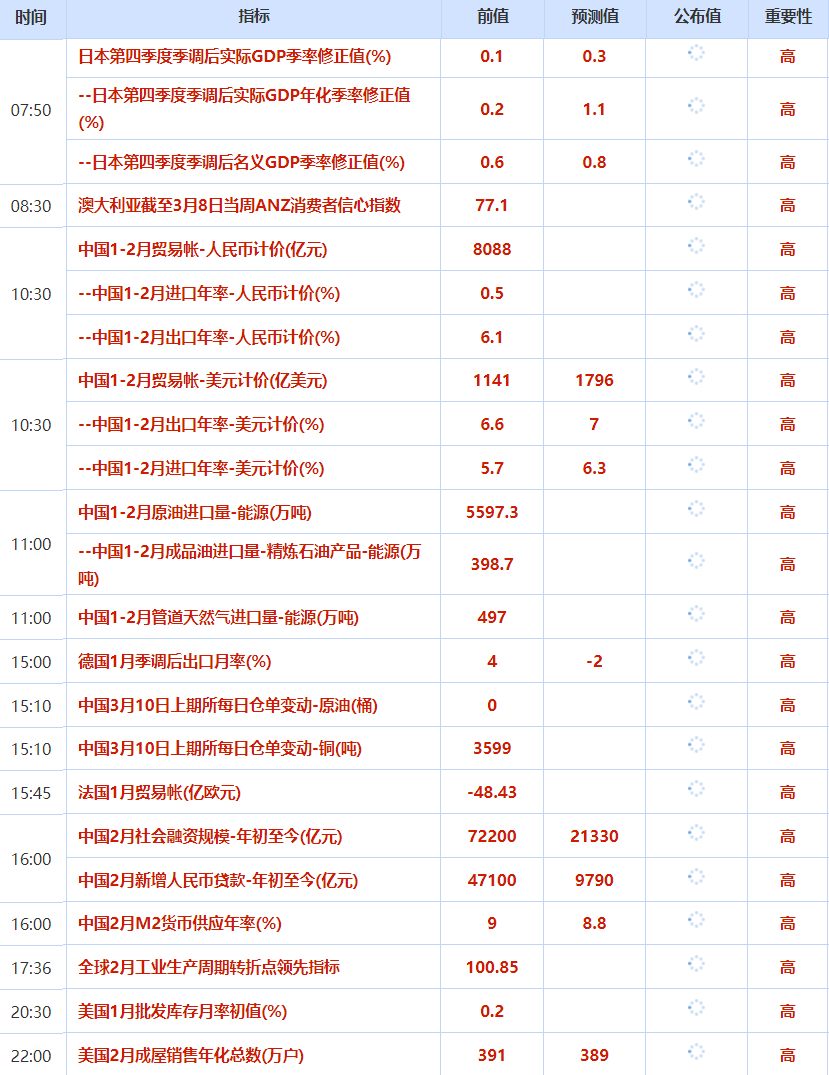
U.S. stocks rebounded on Monday amid sharp fluctuations, mainly driven by comments from U.S. President Trump suggesting that the war between the U.S. and Israel against Iran might be nearing its end, with the market reversing losses in the final hour of trading.
Despite inflation concerns exacerbated by oil prices hitting their highest level since 2022, subsequent news that the Trump administration was considering easing sanctions on Russian oil caused prices to fall back, easing some of the pressure.
The Dow Jones Industrial Average rose 0.50%, the S&P 500 gained 0.83%, and the Nasdaq Composite climbed 1.38%, with the technology sector leading the gains, while homebuilders, banks, and energy sectors underperformed.
Last Friday's weak jobs report, coupled with high energy costs, fueled market concerns about rising stagflation risks, potentially putting the Federal Reserve in a policy dilemma.
Investors are closely watching this week's CPI, GDP, and PCE data releases to gauge future economic trends and market direction. Trading was active that day, with a total turnover of 22.41 billion shares, exceeding the average daily turnover of the past 20 trading days.
Gold prices fell more than 1% on Monday to settle at $5,091.62 an ounce, mainly pressured by a stronger dollar and rising market expectations of interest rate hikes.
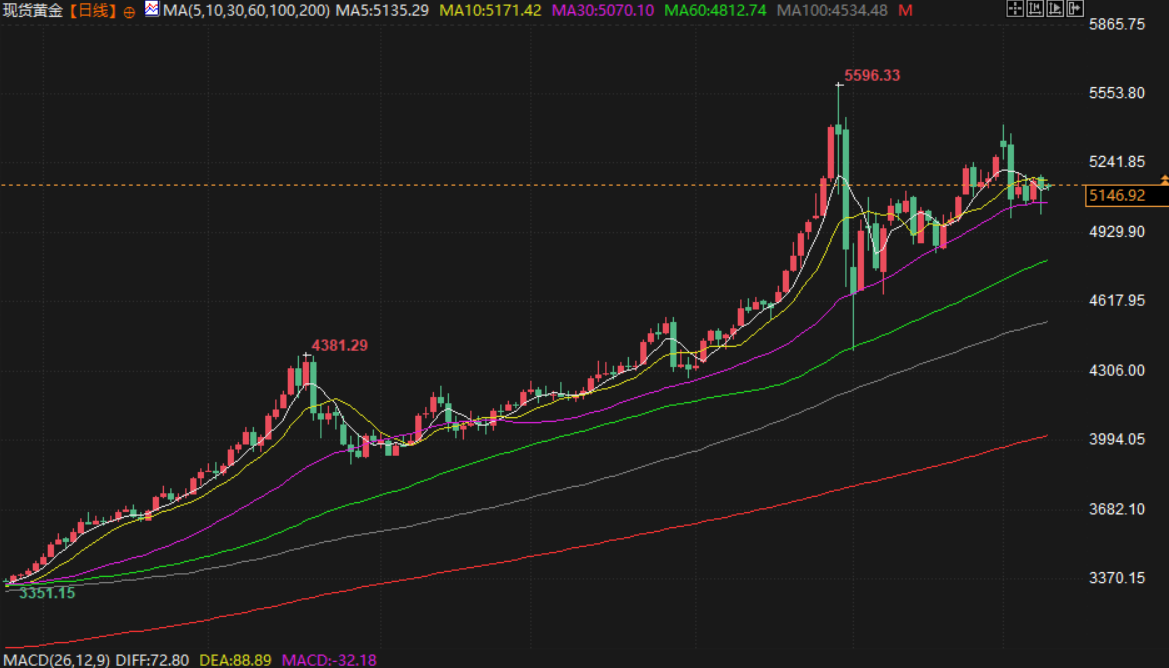
Despite escalating Middle East conflict pushing oil prices near $120 a barrel and exacerbating inflation concerns, investors anticipate that the Federal Reserve may face greater pressure to raise interest rates, diminishing gold's appeal as a safe-haven asset.
Analysts point out that the uncertainty brought about by the war has both supported safe-haven demand for gold and strengthened expectations of interest rate hikes, putting downward pressure on gold prices. The market is currently focused on the US February CPI (Wednesday) and PCE price index (Friday), to be released this week. If inflation data remains high, it could further exacerbate downward pressure on gold prices. Among other precious metals, silver saw a slight decline, while platinum and palladium recorded gains.
Oil prices fluctuated wildly on Monday, surging more than 30% at one point during the session. Brent crude futures hit a high of $119.50 per barrel, a new high since June 2022, before settling at $98.96. This was mainly due to supply cuts by OPEC members, including Saudi Arabia, amid the escalating US-Israel conflict in Iran, and the de facto blockade of the Strait of Hormuz, which exacerbated market concerns about energy supply disruptions. However, oil prices quickly reversed course after the market closed, falling more than 5% in after-hours trading, triggered by reports that the Trump administration was considering further easing of oil sanctions against Russia to curb prices, while Trump hinted that the war against Iran was progressing faster than expected.
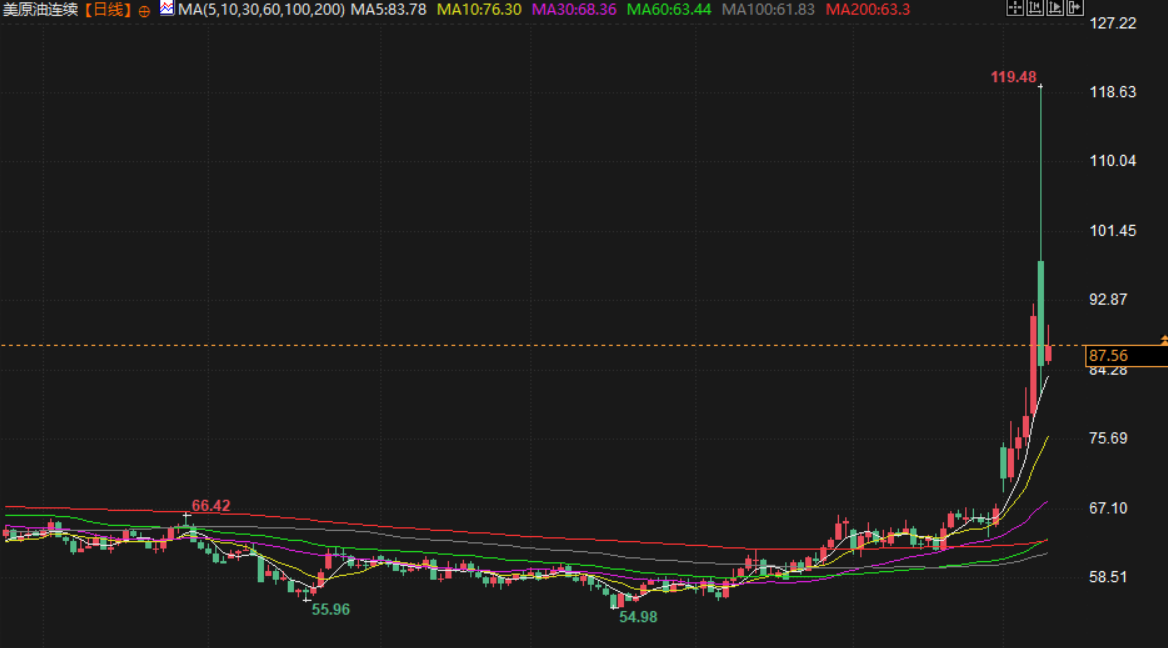
In addition, inflation concerns and news that the G7 is preparing to take necessary measures to address soaring oil prices (including the possible use of strategic petroleum reserves) have also contributed to a pullback in oil prices from their peak. Since the outbreak of the war, the two major oil price benchmarks have still risen by more than 35% cumulatively.
The dollar index reversed course on Monday, rising earlier in the session as investors sought safe haven, reaching a high of around 99.69, its highest level since the end of November last year; however, it retreated towards the close, mainly influenced by comments from US President Trump suggesting that the war against Iran was "very thorough" and progressing faster than expected. This eased market concerns about a protracted conflict and prompted funds to flow back from the dollar to the stock market.
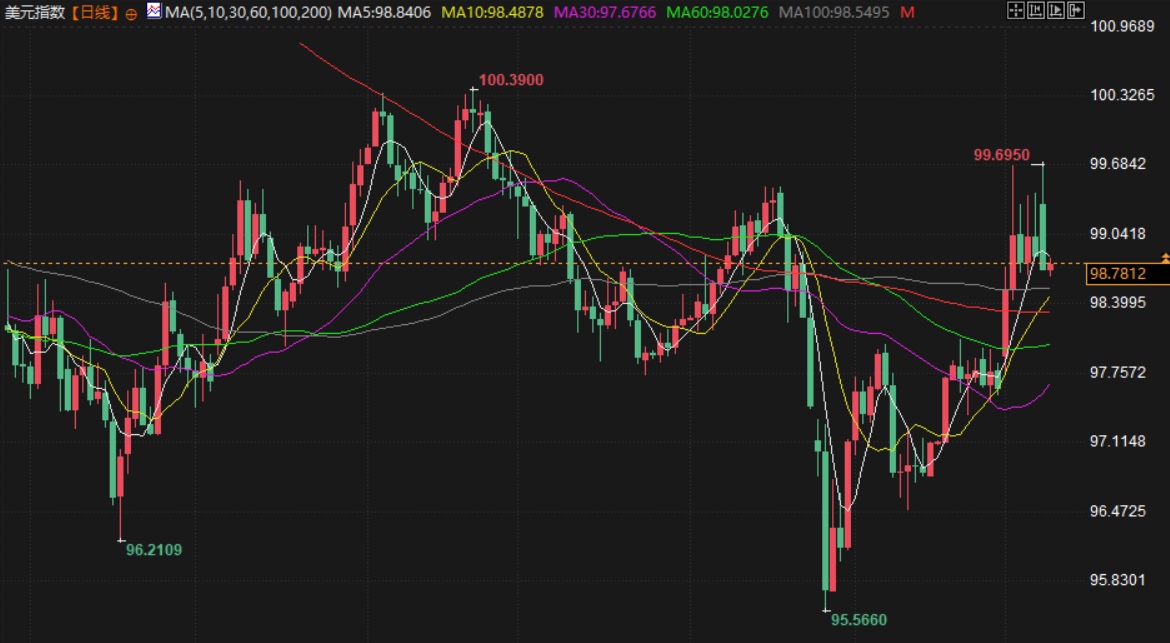
The euro rebounded 0.1% against the dollar to 1.1630, after hitting a more than three-month low; the pound also reversed its losses and rose. The dollar fell 0.1% against the yen, after hitting a six-week high earlier in the session. Despite Iran announcing a new supreme leader indicating that hardliners remain in control, and a surge in oil prices in early trading exacerbating inflation and growth concerns, Trump's remarks briefly boosted market sentiment.
Analysts warn that the outlook for war remains uncertain, and the currency market could quickly reverse course if tensions escalate again. Furthermore, unexpectedly weak US jobs data on Friday initially hampered the dollar's gains, and the market is now focused on inflation data and expectations for Federal Reserve policy, with traders reducing their bets on interest rate cuts this year.
US Energy Secretary: The US government is "discussing" coordinating the release of strategic petroleum reserves.
U.S. Energy Secretary Wright stated that the U.S. government is "discussing" coordinating the release of strategic petroleum reserves to address the current energy market situation. (CCTV News)
EU officials: We are prepared to use our strategic oil reserves.
On March 9th local time, the Eurogroup meeting was held in Brussels, Belgium. At the post-meeting press conference, Eurogroup President Pierakakis stated that the group is closely monitoring market reactions to developments in the Middle East, noting that "we are seeing upward pressure on energy prices." He indicated that the meeting discussed the types of measures member states are considering, and the necessity of maintaining coordinated action while closely monitoring the situation. The meeting also examined structural problems in Europe's energy sector. European Commissioner for Economic Affairs Dombrovskis stated at the press conference that it is too early to discuss specific policy measures regarding the Middle East situation. He also stated that the group is prepared to take necessary measures, including utilizing strategic oil reserves. (CCTV News)
Trump claims the war is essentially over
According to a post on social media by a CBS White House correspondent on the afternoon of March 9th local time, US President Trump stated in a phone interview that the war might be over soon. Trump reportedly said, "I think this war is basically over, almost over. They (Iran) have no navy, no communications system, no air force." Trump also reportedly said that this was "much faster" than his initial estimate of four to five weeks. The reporter also stated that when asked about Iran's new Supreme Leader Mojtaba Khamenei, Trump said, "I have nothing to say to him, absolutely nothing." Trump claimed he "already has someone in mind to succeed Khamenei," but did not elaborate further. (CCTV International News)
The Trump family increases defense spending and deploys a new drone company.
As the Pentagon ramps up spending on unmanned aerial systems, Donald Trump's eldest and second sons are investing in a new drone company, further expanding the family's defense portfolio. Powerus, headquartered in West Palm Beach, Florida, said Monday it will go public in a deal with the backing of Donald Trump Jr. and Eric Trump. According to the statement, the company plans to merge with Nasdaq-listed golf course operator Aureus Greenway Holdings Inc.
UK financing costs soar; UK Treasury urges global coordinated release of oil reserves to ease inflationary pressures.
British Chancellor of the Exchequer Reeves has called on the International Energy Agency (IEA) to release oil reserves to combat soaring energy prices. She warned that rising energy prices could put upward pressure on inflation in the coming months and is currently in discussions with Lloyd's of London regarding shipping in the Strait of Hormuz. British gilt yields have recently risen far more than in other European and American countries, with investors worried that runaway inflation will force the government to increase debt issuance. Interest rate futures indicate that the market has largely ruled out a rate cut by the Bank of England this year.
Zelensky: The planned talks between Ukraine, the US, and Russia this week have been postponed due to the situation in the Middle East.
Ukrainian President Volodymyr Zelenskyy posted on his official social media platform on March 9th, stating that the priorities and full attention of Ukraine's partner countries are currently focused on the situation in the Middle East, thus the meeting originally proposed by the United States and scheduled for this week has been postponed. Zelenskyy stated that he held a meeting with the Ukrainian negotiating team that day and instructed them to communicate with the US negotiating representatives: firstly, to reaffirm Ukraine's willingness to engage in strategic cooperation on security issues, particularly in the defense against drones; and secondly, to reaffirm Ukraine's willingness to undertake substantive work to end the Russia-Ukraine conflict. Previously, in an interview, President Zelenskyy stated that Ukraine values the importance of negotiations and supports continuing trilateral talks between Ukraine, the US, and Russia. The new round of trilateral talks was scheduled to be held in Abu Dhabi from March 5th to 8th, but given the changing situation in the Middle East, the talks may be held in Turkey or Switzerland. (CCTV News)
Trump: It's "too early" to discuss seizing Iranian oil.
Amid the ongoing US military action against Iran, President Trump refused to commit to seizing Iranian oil, calling it "too early" to discuss the matter. However, he acknowledged the idea had been publicly discussed and compared it to the US action in Venezuela. In an interview with NBC News, Trump did not explicitly state whether he wanted the US to control Iranian oil, but he noted that the parties involved had considered this option—similar to the measures the US took to control Venezuelan oil after the capture of President Maduro.
Iranian official: Continued US and Israeli military strikes make it impossible to restore security in the Strait of Hormuz.
Iran's Supreme National Security Council Secretary Larijani stated on the 9th that security in the Strait of Hormuz cannot be restored as long as the United States and Israel continue their military strikes against Iran. Commenting on French President Macron's remarks regarding the Strait of Hormuz on social media that day, Larijani said, "Any security in the Strait of Hormuz is unlikely to be achieved amidst the war ignited by the United States and Israel," especially given that some aspects are contributing to the escalation of the war. Earlier that day, Macron stated that France and its allies were prepared to launch a "defensive" naval operation aimed at restoring normal navigation in the Strait of Hormuz. A senior officer of Iran's Islamic Revolutionary Guard Corps recently stated that Iran "has not closed" the Strait of Hormuz, but any ships belonging to the United States or Israel will become targets for Iranian strikes. The United States and Israel launched a large-scale military operation against Iran on February 28th, and Iran subsequently launched retaliatory strikes against Israel and US military bases in the Middle East. (Xinhua)
The Bank of England is cutting 8% of its staff as a cost-cutting measure, and its voluntary departure scheme has been oversubscribed.
The Bank of England said that about 8% of its staff will leave in the coming months; the layoffs will help alleviate the central bank's financial pressure. A Bank of England spokesperson said that 446 of its more than 5,700 staff will leave, with more than 700 people volunteering to leave than the planned number had been filled. The central bank said it will pay a total of £36 million ($48 million) to departing staff, equivalent to £81,000 per person. This move is an important step for the Bank of England in cutting costs and stabilizing its budget. Previously, modernization reforms recommended by former Federal Reserve Chairman Ben Bernanke had led to a significant increase in its spending.
Trump says he will temporarily waive some oil-related sanctions.
On the afternoon of March 9th, Eastern Time (early morning of March 10th, Beijing Time), US President Trump stated at a press conference at his golf club in Miami, Florida, that oil prices "have not risen as dramatically as he feared," but the US is temporarily waiving some oil-related sanctions to ensure sufficient oil supply and lower prices. Trump said, "We have imposed sanctions on some countries. We will temporarily waive those sanctions until the Strait of Hormuz returns to normal." He did not elaborate, but it is understood that the US issued a 30-day temporary exemption last week, allowing Russian oil currently stranded at sea to be sold to India. (CCTV)
Several small and medium-sized banks announced reductions in deposit interest rates.
Since March of this year, several small and medium-sized banks, including Liaoning Zhenxing Bank, Heilongjiang Youyi Rural Commercial Bank, and Shanghai Songjiang Fuming Rural Bank, have lowered their deposit interest rates, affecting demand deposits and fixed deposit products with various terms. Notably, this adjustment has led to an inversion of interest rates between long-term and short-term deposits at some small and medium-sized banks. For example, Heilongjiang Youyi Rural Commercial Bank's latest five-year fixed deposit rate is 1.6%, lower than its three-year fixed deposit rate of 1.75%. It was also noted that prior to this wave of interest rate cuts by small and medium-sized banks, some large banks, including China Construction Bank, also had inverted deposit product interest rates. Experts analyze that the recent interest rate cuts by small and medium-sized banks are a strategy adopted by banks to stabilize net interest margins under the current moderately loose monetary policy, and the inverted deposit interest rate reflects banks' refined liability management. Industry insiders predict that with the overall social financing costs declining and banks' net interest margins under pressure, banks may continue to lower deposit interest rates. (CCTV Finance)
Key Focus Today
stock market
U.S. stocks rebounded on Monday amid sharp fluctuations, mainly driven by comments from U.S. President Trump suggesting that the war between the U.S. and Israel against Iran might be nearing its end, with the market reversing losses in the final hour of trading.
Despite inflation concerns exacerbated by oil prices hitting their highest level since 2022, subsequent news that the Trump administration was considering easing sanctions on Russian oil caused prices to fall back, easing some of the pressure.
The Dow Jones Industrial Average rose 0.50%, the S&P 500 gained 0.83%, and the Nasdaq Composite climbed 1.38%, with the technology sector leading the gains, while homebuilders, banks, and energy sectors underperformed.
Last Friday's weak jobs report, coupled with high energy costs, fueled market concerns about rising stagflation risks, potentially putting the Federal Reserve in a policy dilemma.
Investors are closely watching this week's CPI, GDP, and PCE data releases to gauge future economic trends and market direction. Trading was active that day, with a total turnover of 22.41 billion shares, exceeding the average daily turnover of the past 20 trading days.
Gold Market
Gold prices fell more than 1% on Monday to settle at $5,091.62 an ounce, mainly pressured by a stronger dollar and rising market expectations of interest rate hikes.
Despite escalating Middle East conflict pushing oil prices near $120 a barrel and exacerbating inflation concerns, investors anticipate that the Federal Reserve may face greater pressure to raise interest rates, diminishing gold's appeal as a safe-haven asset.
Analysts point out that the uncertainty brought about by the war has both supported safe-haven demand for gold and strengthened expectations of interest rate hikes, putting downward pressure on gold prices. The market is currently focused on the US February CPI (Wednesday) and PCE price index (Friday), to be released this week. If inflation data remains high, it could further exacerbate downward pressure on gold prices. Among other precious metals, silver saw a slight decline, while platinum and palladium recorded gains.
oil market
Oil prices fluctuated wildly on Monday, surging more than 30% at one point during the session. Brent crude futures hit a high of $119.50 per barrel, a new high since June 2022, before settling at $98.96. This was mainly due to supply cuts by OPEC members, including Saudi Arabia, amid the escalating US-Israel conflict in Iran, and the de facto blockade of the Strait of Hormuz, which exacerbated market concerns about energy supply disruptions. However, oil prices quickly reversed course after the market closed, falling more than 5% in after-hours trading, triggered by reports that the Trump administration was considering further easing of oil sanctions against Russia to curb prices, while Trump hinted that the war against Iran was progressing faster than expected.
In addition, inflation concerns and news that the G7 is preparing to take necessary measures to address soaring oil prices (including the possible use of strategic petroleum reserves) have also contributed to a pullback in oil prices from their peak. Since the outbreak of the war, the two major oil price benchmarks have still risen by more than 35% cumulatively.
Foreign exchange market
The dollar index reversed course on Monday, rising earlier in the session as investors sought safe haven, reaching a high of around 99.69, its highest level since the end of November last year; however, it retreated towards the close, mainly influenced by comments from US President Trump suggesting that the war against Iran was "very thorough" and progressing faster than expected. This eased market concerns about a protracted conflict and prompted funds to flow back from the dollar to the stock market.
The euro rebounded 0.1% against the dollar to 1.1630, after hitting a more than three-month low; the pound also reversed its losses and rose. The dollar fell 0.1% against the yen, after hitting a six-week high earlier in the session. Despite Iran announcing a new supreme leader indicating that hardliners remain in control, and a surge in oil prices in early trading exacerbating inflation and growth concerns, Trump's remarks briefly boosted market sentiment.
Analysts warn that the outlook for war remains uncertain, and the currency market could quickly reverse course if tensions escalate again. Furthermore, unexpectedly weak US jobs data on Friday initially hampered the dollar's gains, and the market is now focused on inflation data and expectations for Federal Reserve policy, with traders reducing their bets on interest rate cuts this year.
International News
US Energy Secretary: The US government is "discussing" coordinating the release of strategic petroleum reserves.
U.S. Energy Secretary Wright stated that the U.S. government is "discussing" coordinating the release of strategic petroleum reserves to address the current energy market situation. (CCTV News)
EU officials: We are prepared to use our strategic oil reserves.
On March 9th local time, the Eurogroup meeting was held in Brussels, Belgium. At the post-meeting press conference, Eurogroup President Pierakakis stated that the group is closely monitoring market reactions to developments in the Middle East, noting that "we are seeing upward pressure on energy prices." He indicated that the meeting discussed the types of measures member states are considering, and the necessity of maintaining coordinated action while closely monitoring the situation. The meeting also examined structural problems in Europe's energy sector. European Commissioner for Economic Affairs Dombrovskis stated at the press conference that it is too early to discuss specific policy measures regarding the Middle East situation. He also stated that the group is prepared to take necessary measures, including utilizing strategic oil reserves. (CCTV News)
Trump claims the war is essentially over
According to a post on social media by a CBS White House correspondent on the afternoon of March 9th local time, US President Trump stated in a phone interview that the war might be over soon. Trump reportedly said, "I think this war is basically over, almost over. They (Iran) have no navy, no communications system, no air force." Trump also reportedly said that this was "much faster" than his initial estimate of four to five weeks. The reporter also stated that when asked about Iran's new Supreme Leader Mojtaba Khamenei, Trump said, "I have nothing to say to him, absolutely nothing." Trump claimed he "already has someone in mind to succeed Khamenei," but did not elaborate further. (CCTV International News)
The Trump family increases defense spending and deploys a new drone company.
As the Pentagon ramps up spending on unmanned aerial systems, Donald Trump's eldest and second sons are investing in a new drone company, further expanding the family's defense portfolio. Powerus, headquartered in West Palm Beach, Florida, said Monday it will go public in a deal with the backing of Donald Trump Jr. and Eric Trump. According to the statement, the company plans to merge with Nasdaq-listed golf course operator Aureus Greenway Holdings Inc.
UK financing costs soar; UK Treasury urges global coordinated release of oil reserves to ease inflationary pressures.
British Chancellor of the Exchequer Reeves has called on the International Energy Agency (IEA) to release oil reserves to combat soaring energy prices. She warned that rising energy prices could put upward pressure on inflation in the coming months and is currently in discussions with Lloyd's of London regarding shipping in the Strait of Hormuz. British gilt yields have recently risen far more than in other European and American countries, with investors worried that runaway inflation will force the government to increase debt issuance. Interest rate futures indicate that the market has largely ruled out a rate cut by the Bank of England this year.
Zelensky: The planned talks between Ukraine, the US, and Russia this week have been postponed due to the situation in the Middle East.
Ukrainian President Volodymyr Zelenskyy posted on his official social media platform on March 9th, stating that the priorities and full attention of Ukraine's partner countries are currently focused on the situation in the Middle East, thus the meeting originally proposed by the United States and scheduled for this week has been postponed. Zelenskyy stated that he held a meeting with the Ukrainian negotiating team that day and instructed them to communicate with the US negotiating representatives: firstly, to reaffirm Ukraine's willingness to engage in strategic cooperation on security issues, particularly in the defense against drones; and secondly, to reaffirm Ukraine's willingness to undertake substantive work to end the Russia-Ukraine conflict. Previously, in an interview, President Zelenskyy stated that Ukraine values the importance of negotiations and supports continuing trilateral talks between Ukraine, the US, and Russia. The new round of trilateral talks was scheduled to be held in Abu Dhabi from March 5th to 8th, but given the changing situation in the Middle East, the talks may be held in Turkey or Switzerland. (CCTV News)
Trump: It's "too early" to discuss seizing Iranian oil.
Amid the ongoing US military action against Iran, President Trump refused to commit to seizing Iranian oil, calling it "too early" to discuss the matter. However, he acknowledged the idea had been publicly discussed and compared it to the US action in Venezuela. In an interview with NBC News, Trump did not explicitly state whether he wanted the US to control Iranian oil, but he noted that the parties involved had considered this option—similar to the measures the US took to control Venezuelan oil after the capture of President Maduro.
Iranian official: Continued US and Israeli military strikes make it impossible to restore security in the Strait of Hormuz.
Iran's Supreme National Security Council Secretary Larijani stated on the 9th that security in the Strait of Hormuz cannot be restored as long as the United States and Israel continue their military strikes against Iran. Commenting on French President Macron's remarks regarding the Strait of Hormuz on social media that day, Larijani said, "Any security in the Strait of Hormuz is unlikely to be achieved amidst the war ignited by the United States and Israel," especially given that some aspects are contributing to the escalation of the war. Earlier that day, Macron stated that France and its allies were prepared to launch a "defensive" naval operation aimed at restoring normal navigation in the Strait of Hormuz. A senior officer of Iran's Islamic Revolutionary Guard Corps recently stated that Iran "has not closed" the Strait of Hormuz, but any ships belonging to the United States or Israel will become targets for Iranian strikes. The United States and Israel launched a large-scale military operation against Iran on February 28th, and Iran subsequently launched retaliatory strikes against Israel and US military bases in the Middle East. (Xinhua)
The Bank of England is cutting 8% of its staff as a cost-cutting measure, and its voluntary departure scheme has been oversubscribed.
The Bank of England said that about 8% of its staff will leave in the coming months; the layoffs will help alleviate the central bank's financial pressure. A Bank of England spokesperson said that 446 of its more than 5,700 staff will leave, with more than 700 people volunteering to leave than the planned number had been filled. The central bank said it will pay a total of £36 million ($48 million) to departing staff, equivalent to £81,000 per person. This move is an important step for the Bank of England in cutting costs and stabilizing its budget. Previously, modernization reforms recommended by former Federal Reserve Chairman Ben Bernanke had led to a significant increase in its spending.
Trump says he will temporarily waive some oil-related sanctions.
On the afternoon of March 9th, Eastern Time (early morning of March 10th, Beijing Time), US President Trump stated at a press conference at his golf club in Miami, Florida, that oil prices "have not risen as dramatically as he feared," but the US is temporarily waiving some oil-related sanctions to ensure sufficient oil supply and lower prices. Trump said, "We have imposed sanctions on some countries. We will temporarily waive those sanctions until the Strait of Hormuz returns to normal." He did not elaborate, but it is understood that the US issued a 30-day temporary exemption last week, allowing Russian oil currently stranded at sea to be sold to India. (CCTV)
Domestic News
Several small and medium-sized banks announced reductions in deposit interest rates.
Since March of this year, several small and medium-sized banks, including Liaoning Zhenxing Bank, Heilongjiang Youyi Rural Commercial Bank, and Shanghai Songjiang Fuming Rural Bank, have lowered their deposit interest rates, affecting demand deposits and fixed deposit products with various terms. Notably, this adjustment has led to an inversion of interest rates between long-term and short-term deposits at some small and medium-sized banks. For example, Heilongjiang Youyi Rural Commercial Bank's latest five-year fixed deposit rate is 1.6%, lower than its three-year fixed deposit rate of 1.75%. It was also noted that prior to this wave of interest rate cuts by small and medium-sized banks, some large banks, including China Construction Bank, also had inverted deposit product interest rates. Experts analyze that the recent interest rate cuts by small and medium-sized banks are a strategy adopted by banks to stabilize net interest margins under the current moderately loose monetary policy, and the inverted deposit interest rate reflects banks' refined liability management. Industry insiders predict that with the overall social financing costs declining and banks' net interest margins under pressure, banks may continue to lower deposit interest rates. (CCTV Finance)
- Risk Warning and Disclaimer
- The market involves risk, and trading may not be suitable for all investors. This article is for reference only and does not constitute personal investment advice, nor does it take into account certain users’ specific investment objectives, financial situation, or other needs. Any investment decisions made based on this information are at your own risk.