Gold has been consolidating for a week, awaiting its next move: Will renewed expectations of an interest rate cut ignite a market rally?
2026-03-10 17:55:53
On Tuesday, March 10th, the gold market continued its week-long narrow range trading, with traders holding their breath awaiting a clear catalyst to break the equilibrium. The latest spot gold price stabilized around $5180 per ounce, with relatively limited short-term fluctuations. Behind this movement is the continued suppression of stagflation concerns by signals of tightening financial conditions, while recent geopolitical easing expectations have led to a slight decline in US Treasury yields and the US dollar index, temporarily alleviating some downward pressure. However, the market consensus is clear: the future direction will still be dominated by upcoming US economic data: weaker-than-expected data may reignite bets on interest rate cuts, pushing gold prices to test new highs; strong data, on the other hand, will likely perpetuate the range-bound trading pattern or even exert slight downward pressure.
Gold spot prices have remained within a narrow range of approximately $5050 to $5200 per ounce over the past week, lacking a directional breakout. While still high compared to the record high reached in January, this level has seen significantly narrower daily fluctuations, reflecting a temporary balance between bullish and bearish forces. Traders are focusing on the fact that, as a zero-interest asset, gold's holding cost is directly affected by real interest rates and the dollar's performance. In the current environment, the dollar index is hovering around 98.60, and the 10-year US Treasury yield is stable at around 4.10%, both of which constitute implicit downward pressure on gold prices. Nevertheless, recent slight pullbacks have opened up room for a potential rebound.
The following is a recent comparison of key market indicators:
This table clearly shows that the slight weakening of both the dollar and yields has begun to provide marginal support for gold, but the strength is not yet sufficient to trigger a trend breakout.
The current volatility in gold prices is primarily driven by the fact that the tightening of financial conditions has temporarily outweighed concerns about stagflation. The Federal Reserve maintained its target range for the federal funds rate at 3.50% to 3.75%, with the market's expectation of a rate cut at the March meeting nearing zero, indicating a continued cautious policy path. The strong real yield environment has directly increased the opportunity cost of holding gold, leading some institutions to adopt a wait-and-see approach. Meanwhile, February's non-farm payroll data unexpectedly showed a decrease of 92,000 jobs, and the unemployment rate rose to 4.4%, indicating a marginal slowdown in the labor market; however, January's inflation data still showed persistent core pressures, and coupled with oil price volatility, the risk of stagflation has not completely subsided.
The subtlety of this game lies in the fact that if stagflationary characteristics intensify further (slower growth coupled with sticky inflation), gold's appeal as a traditional hedging tool will increase; conversely, if financial conditions continue to tighten (yields remain high), the upside potential for gold prices will be compressed. Recent data shows that the balance of power between the two is in a dynamic equilibrium, and a tilt in either direction could amplify volatility.
Recent statements regarding a potential easing of geopolitical tensions have somewhat dampened market expectations of a hawkish stance from the Federal Reserve. This has led to a weakening of US Treasury yields and the dollar index, providing short-term positive support for gold. As risk appetite improves, market attention will shift back to signs of weakening economic fundamentals, thereby fueling expectations of interest rate hikes. Historical experience shows that such a recovery in expectations often quickly boosts gold prices, especially at current high levels.
However, the sustainability of this support remains questionable. If easing signals continue to emerge, they may reduce gold's safe-haven premium; but if accompanied by weakening economic data, bets on interest rate cuts will overlap, creating a double benefit. Traders should be wary, as this transmission path is highly dependent on subsequent verification, and should avoid overinterpreting a single event.
The future direction of the market will heavily depend on the upcoming combination of US economic data. If key indicators such as the February Consumer Price Index show weakening growth momentum, it will strengthen market pricing in one to two rate cuts by the Federal Reserve this year, and gold prices may challenge recent highs and test a breakout. Conversely, if inflation or employment data are stronger than expected, the logic of tightening financial conditions will regain its dominance, and gold prices may continue to fluctuate within the current range or decline slightly.
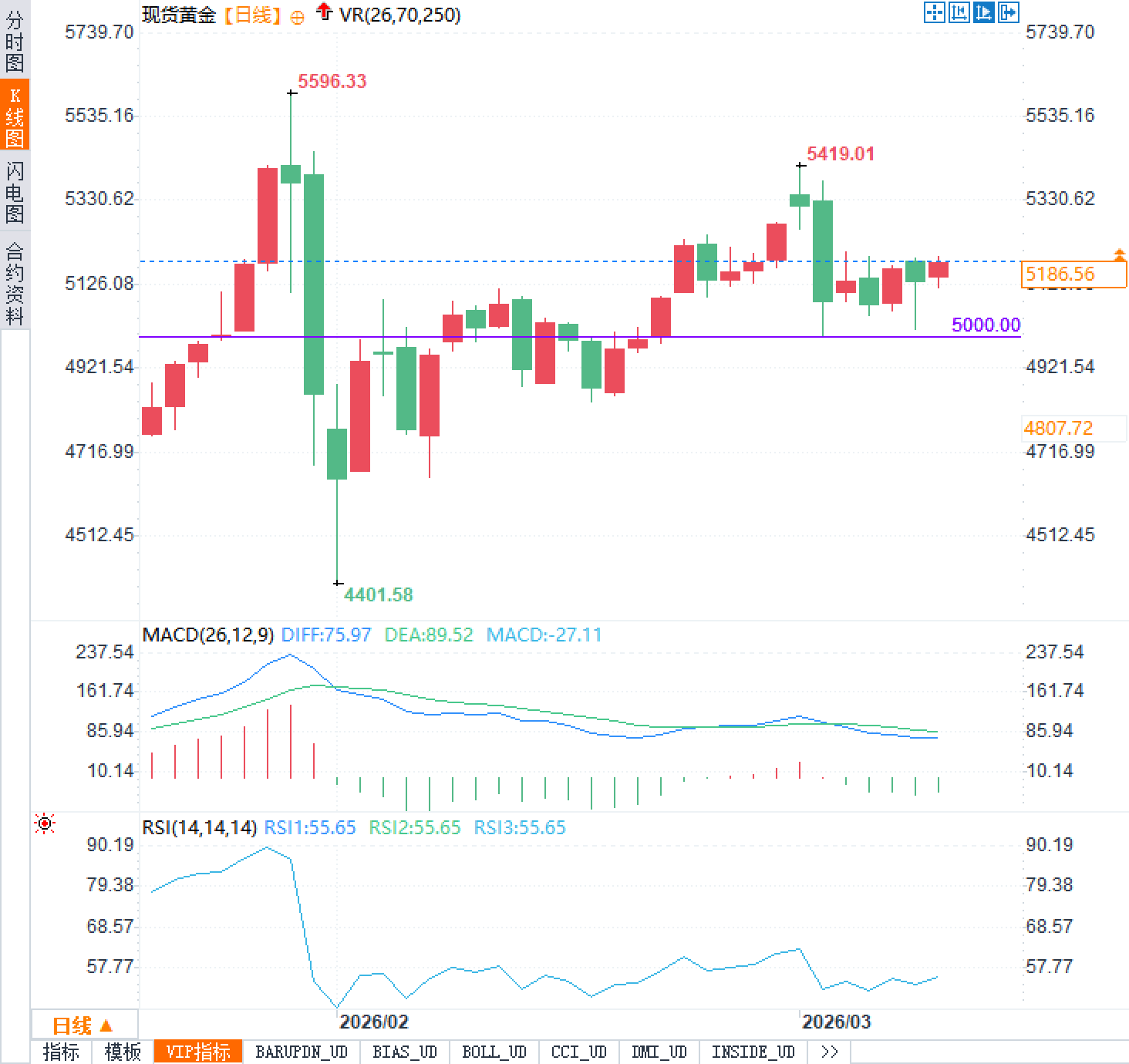
Gold prices are currently in a range-bound trading pattern.
Gold spot prices have remained within a narrow range of approximately $5050 to $5200 per ounce over the past week, lacking a directional breakout. While still high compared to the record high reached in January, this level has seen significantly narrower daily fluctuations, reflecting a temporary balance between bullish and bearish forces. Traders are focusing on the fact that, as a zero-interest asset, gold's holding cost is directly affected by real interest rates and the dollar's performance. In the current environment, the dollar index is hovering around 98.60, and the 10-year US Treasury yield is stable at around 4.10%, both of which constitute implicit downward pressure on gold prices. Nevertheless, recent slight pullbacks have opened up room for a potential rebound.
The following is a recent comparison of key market indicators:
| index | Current level | Recent changes |
|---|---|---|
| Spot gold (USD/ounce) | 5185 | +0.9% |
| US Dollar Index | 98.60 | -0.12% |
| 10-year US Treasury yield (%) | 4.10 | -0.02 |
The interplay between tightening financial conditions and the risk of stagflation
The current volatility in gold prices is primarily driven by the fact that the tightening of financial conditions has temporarily outweighed concerns about stagflation. The Federal Reserve maintained its target range for the federal funds rate at 3.50% to 3.75%, with the market's expectation of a rate cut at the March meeting nearing zero, indicating a continued cautious policy path. The strong real yield environment has directly increased the opportunity cost of holding gold, leading some institutions to adopt a wait-and-see approach. Meanwhile, February's non-farm payroll data unexpectedly showed a decrease of 92,000 jobs, and the unemployment rate rose to 4.4%, indicating a marginal slowdown in the labor market; however, January's inflation data still showed persistent core pressures, and coupled with oil price volatility, the risk of stagflation has not completely subsided.
The subtlety of this game lies in the fact that if stagflationary characteristics intensify further (slower growth coupled with sticky inflation), gold's appeal as a traditional hedging tool will increase; conversely, if financial conditions continue to tighten (yields remain high), the upside potential for gold prices will be compressed. Recent data shows that the balance of power between the two is in a dynamic equilibrium, and a tilt in either direction could amplify volatility.
The short-term transmission of geopolitical easing expectations to interest rate paths
Recent statements regarding a potential easing of geopolitical tensions have somewhat dampened market expectations of a hawkish stance from the Federal Reserve. This has led to a weakening of US Treasury yields and the dollar index, providing short-term positive support for gold. As risk appetite improves, market attention will shift back to signs of weakening economic fundamentals, thereby fueling expectations of interest rate hikes. Historical experience shows that such a recovery in expectations often quickly boosts gold prices, especially at current high levels.
However, the sustainability of this support remains questionable. If easing signals continue to emerge, they may reduce gold's safe-haven premium; but if accompanied by weakening economic data, bets on interest rate cuts will overlap, creating a double benefit. Traders should be wary, as this transmission path is highly dependent on subsequent verification, and should avoid overinterpreting a single event.
US economic data will be a decisive catalyst.
The future direction of the market will heavily depend on the upcoming combination of US economic data. If key indicators such as the February Consumer Price Index show weakening growth momentum, it will strengthen market pricing in one to two rate cuts by the Federal Reserve this year, and gold prices may challenge recent highs and test a breakout. Conversely, if inflation or employment data are stronger than expected, the logic of tightening financial conditions will regain its dominance, and gold prices may continue to fluctuate within the current range or decline slightly.
Frequently Asked Questions
Question 1: Why has gold recently entered a period of range-bound trading?
A: The main reason is that tighter financial conditions (supported by yields and the US dollar) have temporarily outweighed the risks of stagflation, and the market lacks a clear directional catalyst. Latest data shows a marginal slowdown in employment but persistently sticky inflation, leading to cautious expectations for Federal Reserve policy. As a result, the holding cost of gold, a zero-interest asset, remains high, prompting traders to adopt a wait-and-see approach.
Question 2: What impact will the expectation of easing geopolitical tensions have on gold in the short term?
A: Following the relevant statements, yields and the US dollar weakened slightly, rekindling hopes for interest rate cuts, which is a short-term positive for gold prices. However, if the easing of safe-haven demand reduces the support, the strength of this support may weaken. The key lies in whether this expectation can resonate with weak economic data to form sustained upward momentum.
Question 3: How will US data determine the future price of gold?
A: Weak data will fuel bets on interest rate hikes, pushing gold prices to new highs; strong data will reinforce the tightening logic, leading to continued volatility or a slight downward trend. Traders need to pay attention to the CPI and employment data combination; any unexpected changes will disrupt the current equilibrium and amplify price fluctuations.
- Risk Warning and Disclaimer
- The market involves risk, and trading may not be suitable for all investors. This article is for reference only and does not constitute personal investment advice, nor does it take into account certain users’ specific investment objectives, financial situation, or other needs. Any investment decisions made based on this information are at your own risk.