US crude oil prices fell, limiting gold's rebound; caution is advised regarding potential geopolitical turmoil.
2026-03-10 16:57:32
According to the APP, gold (XAU/USD) maintained a slight intraday gain before the European session opened, but lacked sustained buying support and is currently hovering below the $5,200 mark. Continued geopolitical risks, particularly the escalating tensions in the Middle East, are providing support for the safe-haven precious metal, pushing gold to extend its rebound from near the psychological $5,000 level the previous day.

The recent slight rise in gold prices and its holding of key support levels were primarily driven by the combined effect of the following factors:
1. Geopolitical risks in the Middle East escalate again (core safe-haven driver)
Iranian officials refuted Trump's claim that the Middle East conflict would end soon, calling it "absurd" and warning that "regional security is either something everyone has a share of, or nothing at all." The Iranian Islamic Revolutionary Guard Corps went further, stating that Tehran, not Washington, will decide when the war ends. Renewed market concerns about the potential closure of the Strait of Hormuz and supply disruptions fueled safe-haven demand, directly supporting gold prices.
2. Crude oil price rebound amplifies inflation and stagflation concerns. Crude oil prices, which had dramatically retreated from their June 2022 highs the previous day, regained positive momentum today. Investors are worried that a Middle East conflict leading to the closure of the Strait of Hormuz would trigger continued disruptions to energy supplies, pushing up inflation and forcing the Federal Reserve to postpone its interest rate cuts. This expectation of stagflation strengthens the appeal of gold as an inflation hedge.
3. Falling US Treasury yields weaken the dollar (technical positive)
U.S. Treasury yields retreated from their three-month highs reached the previous day, dragging the dollar index further away from its recent peak. Gold, a non-interest-bearing asset, received additional support in a weaker dollar environment, especially given the increasing negative correlation between safe-haven demand and the dollar.
4. Technical indicators show a mild bullish signal.
XAU/USD has been trading within a range on the 4-hour chart for over a week, finding effective support at the rising 200-period EMA (around $5010). This level coincides with the lower edge of the range and serves as a key short-term pivot point. The MACD line has turned positive and crossed above the signal line, with the positive histogram continuing to expand, indicating strengthening upward momentum. The RSI is hovering above 50, suggesting that bullish pressure is accumulating rather than being overbought.
The following table compares the current key technical levels of XAU/USD with market sentiment (based on the latest 4-hour chart data):
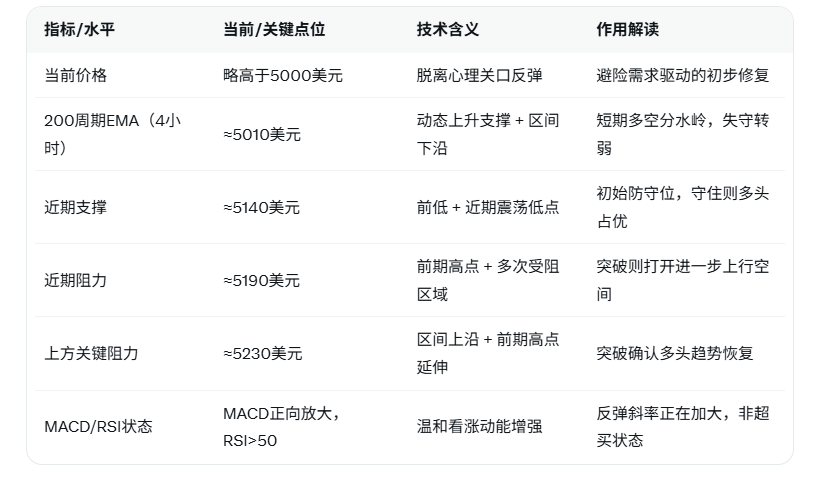
In the short term, gold bulls still need to break through the upper resistance of the trading range around $5200 ($5190-$5200) to confirm stronger upward momentum. Holding the dual support levels of $5140 and $5010 will keep the bullish structure intact. If geopolitical risks continue to escalate or oil prices maintain their rebound, gold could test $5230 or even higher.
From a medium-term perspective, gold's price movement is highly dependent on this week's US inflation data (Wednesday's CPI, Friday's PCE price index). If inflation data exceeds expectations, it will strengthen expectations that the Federal Reserve will postpone interest rate cuts, and a rebound in the US dollar may suppress gold; conversely, if the data is moderate, renewed expectations of interest rate cuts will benefit non-interest-bearing assets. Investors need to pay close attention to developments in the Middle East, especially statements regarding the Strait of Hormuz and Iran.
Risk Warnings: A sudden easing of geopolitical tensions or stronger conciliatory signals from the Trump team could lead to a sharp decrease in safe-haven demand; significantly stronger-than-expected CPI/PCE data could strengthen expectations of a hawkish Fed, causing a strong rebound in the US dollar and suppressing gold prices; a larger-than-expected decline in oil prices could ease inflationary pressures and weaken gold's narrative as an inflation hedge.
Editor's Summary : Gold (XAU/USD) rebounded slightly but remains capped by the $5200 level. Key support stems from escalating geopolitical risks in the Middle East (Iran's rebuttal of Trump's statements and the IRGC's strong response), stagflation concerns triggered by the oil price rebound, and a weakening dollar due to falling US Treasury yields. Technically, the outlook is mildly bullish, with strong support around $5010 from the 200-period EMA. A short-term break above $5200 is crucial for the bulls; this week's CPI/PCE data and the Middle East situation will be the dominant variables.
Frequently Asked Questions
1. Question: Why is the current gold price able to find support and rebound around $5,000?
A: The $5,000 level is a significant psychological barrier, and its breach the previous day triggered a surge in safe-haven buying. Simultaneously, the rising 200-period EMA on the 4-hour chart (around $5,010) coincides with the lower edge of the trading range, forming strong technical support. Escalating geopolitical risks in the Middle East (Iran refuted Trump's statements, and the IRGC stated that the end of the war should be decided by Tehran) directly strengthened safe-haven demand, driving gold's rebound from its lows.
2. Question: What specific impact will the latest statements from Iranian officials and the IRGC have on gold?
A: Iranian officials called Trump's statement that "the conflict will end soon" "absurd," and the IRGC emphasized that "regional security is either something everyone has a share of, or nothing at all," stating that "Tehran, not Washington, decides when the war ends." These strong responses exacerbated market concerns about the protracted conflict in the Middle East and the potential closure of the Strait of Hormuz, leading to increased risk aversion and directly supporting the price of gold as a traditional safe-haven asset.
3. Question: Why is the rebound in crude oil prices beneficial to gold?
A: Crude oil prices retreated from the previous day's highs but regained positive momentum today. Investors are concerned that the Middle East conflict could lead to the closure of the Strait of Hormuz and disruptions to energy supplies, which would push up inflation and increase the risk of stagflation. Gold, as an asset with both inflation-hedging and safe-haven attributes, often finds support when stagflation expectations rise, especially when the Federal Reserve may postpone interest rate cuts due to inflationary pressures, further enhancing its attractiveness.
4. Question: How much impact will this week's CPI and PCE data have on gold prices?
A: The impact is enormous. Wednesday's CPI and Friday's PCE price index are the core basis for the Federal Reserve to judge the path of inflation. If the data exceeds expectations, it will strengthen hawkish expectations, and a rebound in the dollar will suppress gold; if the data is moderate or weak, renewed expectations of interest rate cuts will benefit gold. The market's pricing in the number of Fed rate cuts this year has fluctuated due to geopolitical risks and inflation concerns, and inflation data will become the decisive variable.
5. Question: How should investors view the short- to medium-term opportunities and risks of XAU/USD?
A: In the short term, bulls have the upper hand, but a break above $5200 (the upper limit of the range) is needed to confirm stronger momentum. It is recommended to build long positions in batches while holding the support levels of $5140 and $5010. The medium-term direction depends on this week's inflation data and the situation in the Middle East: if geopolitical risks continue to escalate or inflation remains moderate, gold may test $5230 or even higher; if the situation eases or inflation exceeds expectations, a strong dollar will bring downward pressure. It is recommended to strictly set stop-loss orders below $5010, control position size, and dynamically monitor crude oil, the dollar index, the Middle East situation, and inflation data.
The recent slight rise in gold prices and its holding of key support levels were primarily driven by the combined effect of the following factors:
1. Geopolitical risks in the Middle East escalate again (core safe-haven driver)
Iranian officials refuted Trump's claim that the Middle East conflict would end soon, calling it "absurd" and warning that "regional security is either something everyone has a share of, or nothing at all." The Iranian Islamic Revolutionary Guard Corps went further, stating that Tehran, not Washington, will decide when the war ends. Renewed market concerns about the potential closure of the Strait of Hormuz and supply disruptions fueled safe-haven demand, directly supporting gold prices.
2. Crude oil price rebound amplifies inflation and stagflation concerns. Crude oil prices, which had dramatically retreated from their June 2022 highs the previous day, regained positive momentum today. Investors are worried that a Middle East conflict leading to the closure of the Strait of Hormuz would trigger continued disruptions to energy supplies, pushing up inflation and forcing the Federal Reserve to postpone its interest rate cuts. This expectation of stagflation strengthens the appeal of gold as an inflation hedge.
3. Falling US Treasury yields weaken the dollar (technical positive)
U.S. Treasury yields retreated from their three-month highs reached the previous day, dragging the dollar index further away from its recent peak. Gold, a non-interest-bearing asset, received additional support in a weaker dollar environment, especially given the increasing negative correlation between safe-haven demand and the dollar.
4. Technical indicators show a mild bullish signal.
XAU/USD has been trading within a range on the 4-hour chart for over a week, finding effective support at the rising 200-period EMA (around $5010). This level coincides with the lower edge of the range and serves as a key short-term pivot point. The MACD line has turned positive and crossed above the signal line, with the positive histogram continuing to expand, indicating strengthening upward momentum. The RSI is hovering above 50, suggesting that bullish pressure is accumulating rather than being overbought.
The following table compares the current key technical levels of XAU/USD with market sentiment (based on the latest 4-hour chart data):
In the short term, gold bulls still need to break through the upper resistance of the trading range around $5200 ($5190-$5200) to confirm stronger upward momentum. Holding the dual support levels of $5140 and $5010 will keep the bullish structure intact. If geopolitical risks continue to escalate or oil prices maintain their rebound, gold could test $5230 or even higher.
From a medium-term perspective, gold's price movement is highly dependent on this week's US inflation data (Wednesday's CPI, Friday's PCE price index). If inflation data exceeds expectations, it will strengthen expectations that the Federal Reserve will postpone interest rate cuts, and a rebound in the US dollar may suppress gold; conversely, if the data is moderate, renewed expectations of interest rate cuts will benefit non-interest-bearing assets. Investors need to pay close attention to developments in the Middle East, especially statements regarding the Strait of Hormuz and Iran.
Risk Warnings: A sudden easing of geopolitical tensions or stronger conciliatory signals from the Trump team could lead to a sharp decrease in safe-haven demand; significantly stronger-than-expected CPI/PCE data could strengthen expectations of a hawkish Fed, causing a strong rebound in the US dollar and suppressing gold prices; a larger-than-expected decline in oil prices could ease inflationary pressures and weaken gold's narrative as an inflation hedge.
Editor's Summary : Gold (XAU/USD) rebounded slightly but remains capped by the $5200 level. Key support stems from escalating geopolitical risks in the Middle East (Iran's rebuttal of Trump's statements and the IRGC's strong response), stagflation concerns triggered by the oil price rebound, and a weakening dollar due to falling US Treasury yields. Technically, the outlook is mildly bullish, with strong support around $5010 from the 200-period EMA. A short-term break above $5200 is crucial for the bulls; this week's CPI/PCE data and the Middle East situation will be the dominant variables.
Frequently Asked Questions
1. Question: Why is the current gold price able to find support and rebound around $5,000?
A: The $5,000 level is a significant psychological barrier, and its breach the previous day triggered a surge in safe-haven buying. Simultaneously, the rising 200-period EMA on the 4-hour chart (around $5,010) coincides with the lower edge of the trading range, forming strong technical support. Escalating geopolitical risks in the Middle East (Iran refuted Trump's statements, and the IRGC stated that the end of the war should be decided by Tehran) directly strengthened safe-haven demand, driving gold's rebound from its lows.
2. Question: What specific impact will the latest statements from Iranian officials and the IRGC have on gold?
A: Iranian officials called Trump's statement that "the conflict will end soon" "absurd," and the IRGC emphasized that "regional security is either something everyone has a share of, or nothing at all," stating that "Tehran, not Washington, decides when the war ends." These strong responses exacerbated market concerns about the protracted conflict in the Middle East and the potential closure of the Strait of Hormuz, leading to increased risk aversion and directly supporting the price of gold as a traditional safe-haven asset.
3. Question: Why is the rebound in crude oil prices beneficial to gold?
A: Crude oil prices retreated from the previous day's highs but regained positive momentum today. Investors are concerned that the Middle East conflict could lead to the closure of the Strait of Hormuz and disruptions to energy supplies, which would push up inflation and increase the risk of stagflation. Gold, as an asset with both inflation-hedging and safe-haven attributes, often finds support when stagflation expectations rise, especially when the Federal Reserve may postpone interest rate cuts due to inflationary pressures, further enhancing its attractiveness.
4. Question: How much impact will this week's CPI and PCE data have on gold prices?
A: The impact is enormous. Wednesday's CPI and Friday's PCE price index are the core basis for the Federal Reserve to judge the path of inflation. If the data exceeds expectations, it will strengthen hawkish expectations, and a rebound in the dollar will suppress gold; if the data is moderate or weak, renewed expectations of interest rate cuts will benefit gold. The market's pricing in the number of Fed rate cuts this year has fluctuated due to geopolitical risks and inflation concerns, and inflation data will become the decisive variable.
5. Question: How should investors view the short- to medium-term opportunities and risks of XAU/USD?
A: In the short term, bulls have the upper hand, but a break above $5200 (the upper limit of the range) is needed to confirm stronger momentum. It is recommended to build long positions in batches while holding the support levels of $5140 and $5010. The medium-term direction depends on this week's inflation data and the situation in the Middle East: if geopolitical risks continue to escalate or inflation remains moderate, gold may test $5230 or even higher; if the situation eases or inflation exceeds expectations, a strong dollar will bring downward pressure. It is recommended to strictly set stop-loss orders below $5010, control position size, and dynamically monitor crude oil, the dollar index, the Middle East situation, and inflation data.
- Risk Warning and Disclaimer
- The market involves risk, and trading may not be suitable for all investors. This article is for reference only and does not constitute personal investment advice, nor does it take into account certain users’ specific investment objectives, financial situation, or other needs. Any investment decisions made based on this information are at your own risk.