Gold prices have broken through the $5207.97 mark and may continue their upward trend.
2026-03-10 22:50:21
Gold prices continued to be boosted during the US session on Tuesday (March 10), with spot gold rising about 1.2% to $5,200.29 and April gold futures rising 2.1% to $5,210.70.
Gold prices rose, but remained within a six-day trading range, indicating that investors are currently in a wait-and-see mode, and market volatility is imminent. Generally speaking, the tighter the consolidation range, the stronger the subsequent breakout. Although the direction is still unclear, the relative position of gold prices to the 50-day moving average suggests a stronger upward bias.
Key support and resistance levels analysis
On the daily chart, the mid-range of $5002.31 to $5143.89 has acted as support for gold prices since hitting a low of $4996.27 on March 3. The 50-day moving average at $4898.39 provides further downside cushion. Currently, gold prices are hovering around the Fibonacci level of $5143.89, but face minor resistance at the 50% retracement level of $5207.97. Bulls remain in control, but the strength remains to be seen. A sustained hold above $5143.89 would indicate active buying; a break above $5207.97 would suggest strong buying pressure, potentially fueling momentum to push gold prices towards last week's high of $5419.66 in the short term.
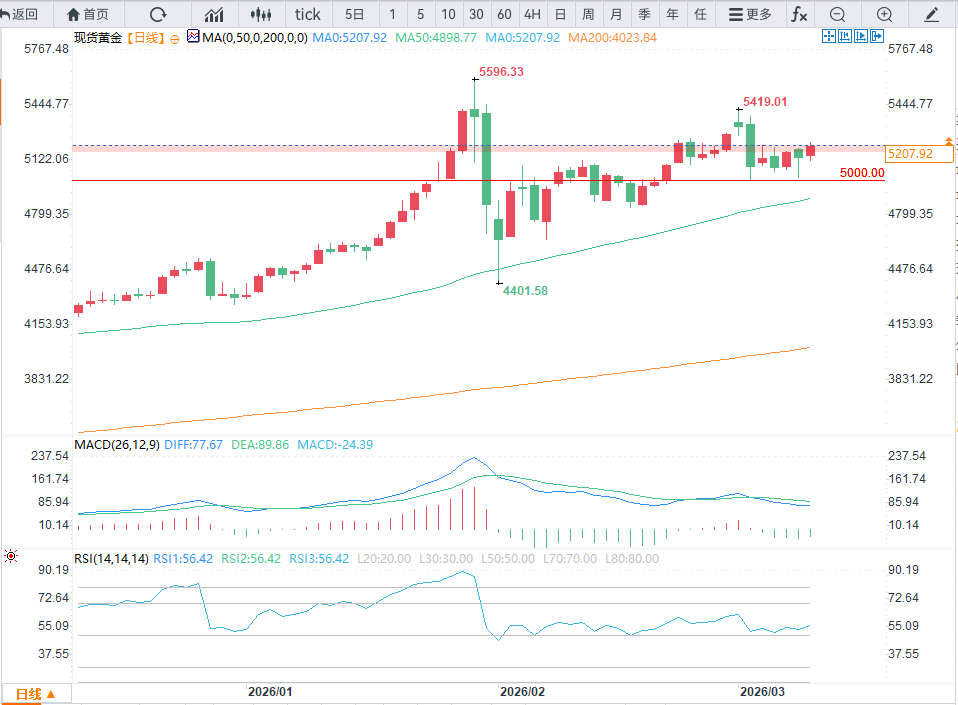
(Spot gold daily chart source: FX678)
Despite ongoing geopolitical conflicts, gold prices have generally declined since the outbreak of the conflicts, indicating that war is not the sole driving factor. Inflation expectations, uncertainty surrounding the timing of Federal Reserve rate cuts, and concerns about monetary policy tightening are limiting further upside for gold. If buying pressure fails to absorb the overhead orders, and the bulls become passive, the 50-day moving average at $4898.39 may once again become a focal point.
Crude oil nears $100: The real threat to gold
From a fundamental perspective, market focus remains on crude oil prices. If crude oil continues to break through $100 per barrel, it will severely damage the global economy, push up inflation, and force central banks to tighten policy, which is not beneficial for gold. High-level fluctuations in crude oil prices have caused gold prices to oscillate within a range until the volatility in oil prices eases.
Uncertainty surrounding the Fed's interest rate cut has kept gold prices stagnant.
Crude oil, US Treasury yields, the US dollar index, and Federal Reserve policy are highly correlated. If crude oil prices remain above $100 for an extended period, it will exacerbate inflationary pressures. Meanwhile, signs of weakness in the US labor market put the Fed in a dilemma: raising interest rates to curb inflation may sacrifice employment, while lowering rates to stimulate employment may allow inflation to spiral out of control. Gold performs better in a low-interest-rate environment. Currently, a rate cut in March is virtually impossible, the outlook for June is also bleak, and the probability of a rate cut in July is only 50/50. Gold bulls have therefore reduced their positions, leading to continued range-bound trading.
Investors are awaiting clearer signals, but given the ongoing geopolitical conflict and high oil prices, a major shift is unlikely in the short term. If the conflict eases and oil prices fall back to the $60 range, the market environment could change rapidly.
Bart Melek, global head of commodities strategy at TD Securities, said that as oil prices have fallen from their peak of over $100—while still posing inflationary pressures and providing some support for gold, but not enough to severely limit the Fed’s room for interest rate cuts—investors are gradually believing that currency devaluation trading may become active again over time.
Investors are focused on the U.S. Consumer Price Index (CPI) and Personal Consumption Expenditures (PCE) data to be released later this week. The Federal Reserve is expected to keep interest rates unchanged at its March 17-18 meeting, but renewed supply chain risks could spark broader discussion.
Gold prices rose, but remained within a six-day trading range, indicating that investors are currently in a wait-and-see mode, and market volatility is imminent. Generally speaking, the tighter the consolidation range, the stronger the subsequent breakout. Although the direction is still unclear, the relative position of gold prices to the 50-day moving average suggests a stronger upward bias.
Key support and resistance levels analysis
On the daily chart, the mid-range of $5002.31 to $5143.89 has acted as support for gold prices since hitting a low of $4996.27 on March 3. The 50-day moving average at $4898.39 provides further downside cushion. Currently, gold prices are hovering around the Fibonacci level of $5143.89, but face minor resistance at the 50% retracement level of $5207.97. Bulls remain in control, but the strength remains to be seen. A sustained hold above $5143.89 would indicate active buying; a break above $5207.97 would suggest strong buying pressure, potentially fueling momentum to push gold prices towards last week's high of $5419.66 in the short term.
(Spot gold daily chart source: FX678)
Despite ongoing geopolitical conflicts, gold prices have generally declined since the outbreak of the conflicts, indicating that war is not the sole driving factor. Inflation expectations, uncertainty surrounding the timing of Federal Reserve rate cuts, and concerns about monetary policy tightening are limiting further upside for gold. If buying pressure fails to absorb the overhead orders, and the bulls become passive, the 50-day moving average at $4898.39 may once again become a focal point.
Crude oil nears $100: The real threat to gold
From a fundamental perspective, market focus remains on crude oil prices. If crude oil continues to break through $100 per barrel, it will severely damage the global economy, push up inflation, and force central banks to tighten policy, which is not beneficial for gold. High-level fluctuations in crude oil prices have caused gold prices to oscillate within a range until the volatility in oil prices eases.
Uncertainty surrounding the Fed's interest rate cut has kept gold prices stagnant.
Crude oil, US Treasury yields, the US dollar index, and Federal Reserve policy are highly correlated. If crude oil prices remain above $100 for an extended period, it will exacerbate inflationary pressures. Meanwhile, signs of weakness in the US labor market put the Fed in a dilemma: raising interest rates to curb inflation may sacrifice employment, while lowering rates to stimulate employment may allow inflation to spiral out of control. Gold performs better in a low-interest-rate environment. Currently, a rate cut in March is virtually impossible, the outlook for June is also bleak, and the probability of a rate cut in July is only 50/50. Gold bulls have therefore reduced their positions, leading to continued range-bound trading.
Investors are awaiting clearer signals, but given the ongoing geopolitical conflict and high oil prices, a major shift is unlikely in the short term. If the conflict eases and oil prices fall back to the $60 range, the market environment could change rapidly.
Bart Melek, global head of commodities strategy at TD Securities, said that as oil prices have fallen from their peak of over $100—while still posing inflationary pressures and providing some support for gold, but not enough to severely limit the Fed’s room for interest rate cuts—investors are gradually believing that currency devaluation trading may become active again over time.
Investors are focused on the U.S. Consumer Price Index (CPI) and Personal Consumption Expenditures (PCE) data to be released later this week. The Federal Reserve is expected to keep interest rates unchanged at its March 17-18 meeting, but renewed supply chain risks could spark broader discussion.
- Risk Warning and Disclaimer
- The market involves risk, and trading may not be suitable for all investors. This article is for reference only and does not constitute personal investment advice, nor does it take into account certain users’ specific investment objectives, financial situation, or other needs. Any investment decisions made based on this information are at your own risk.