After retracing half of its gains, analysis suggests that crude oil has the potential for a rebound.
2026-03-10 22:09:49
On Tuesday (March 10) during the European session, April WTI crude oil futures fell to the $87.8-$89 range, a significant drop from the previous day's four-year high of $119.48. Traders continued to digest President Trump's "peace signals" in his latest CBS interview: he clearly stated that the Middle East wars were "largely over, far beyond initial expectations of the last four to five weeks," and that "the risk of attacks on oil facilities has significantly decreased, and tankers can resume normal passage."

This statement directly triggered selling pressure on the supply side. Yesterday, oil prices surged to $119.48 before quickly falling back to close at $94.77, and today they are further testing the key pullback range. The latest satellite data from the Strait of Hormuz shows traffic volume down 92% from normal levels, but Trump's optimistic remarks have already led the market to price in "rapid de-risking." However, he also cautioned that "the war is still much longer than initially anticipated," and the market remains highly vigilant; any new escalation news could instantly reverse sentiment.
This round of gains began at a low of $54.87 on December 16, 2025, reaching a high of $119.48 (a new high since March 2022), with a cumulative increase of over 118%. Currently, oil prices are testing the 50%-61.8% Fibonacci retracement range: $87.18-$79.55. This range is crucial for the battle between bulls and bears—latest trading data shows that if $87.18 holds, buying will quickly return; if prices break below $79.55 with significant volume, it could accelerate the decline towards the trendline support at $67.68.
Has the rally ended?
From a technical perspective, while the recent plunge from $119.48 was sharp, it was a very typical correction characterized by "first-wave profit-taking + long position liquidation." Excluding emotional factors, the market has already given back approximately 50% of its gains, consistent with the healthy correction patterns seen after historical rallies. The latest CFTC positioning report shows that speculative net long positions remain high, indicating that the market as a whole still maintains a "buy on dips" strategy.
Key price levels currently being monitored by traders
Yesterday's trading range: $119.48 - $81.19
Corresponding pullback resistance range: $100.34-$104.85 (today's most realistic upside target)
Bullish scenario (high rebound potential)
As long as oil prices hold above $87.18, buying interest will quickly return. Combined with Goldman Sachs' latest report, if the Hormuz crisis continues in the short term, oil prices could rebound rapidly to $100.34-$104.85, or even test the $105 level. Rystad Energy's scenario analysis also points out that if the geopolitical risk premium persists, a short-term target of $135 is not impossible.
Short selling scenario (caution advised)
If the price continues to fall below $79.55 (especially with increased volume), selling pressure will dominate, with the downside target pointing towards the trendline at $67.68, and even the swing low of $63.60. Macquarie analysts warn that if the conflict drags on longer than expected, oil prices could surge to $150 in an extreme scenario, but once peace is achieved, the return to normalcy will be "very fast."
Buying the dip or shorting the rally – the speculator's strategy
Most institutions maintain their "buy on dips" strategy. JP Morgan's latest view is that "the war is likely to end soon in a limited way, and in the long term, the average Brent price in 2026 will be around $60. The current pullback is a good opportunity to buy." The main trend line ($67.68), moving average support ($64.53-$61.82), and the significant accumulation of inventories (the latest API and EIA data show a surprisingly large increase in US crude oil inventories) all reinforce the long-term upward bias.
Only when oil prices form a "lower high" around $100.34-$104.85 and then fall back will the market switch from "buying on dips" to "selling on rallies." Before that, speculators are more inclined to buy in batches in the $87.18-$79.55 range rather than aggressively shorting.
Trump's peace rhetoric triggered a supply-side sell-off.
Monday's surge and Tuesday's plunge were both directly linked to supply expectations:
Upside drivers: Market concerns about an escalating conflict between Israel and Iran leading to a prolonged closure of the Strait of Hormuz and continued attacks on oil facilities.
Downside driver: Trump's statement that "it's basically over" caused the risk premium to quickly subside.
Although Trump's remarks were merely predictions, they were enough to reassure the market. Discussions regarding the release of reserves by G7 countries are also underway, further easing expectations of supply shortages. However, the reality of a 92% reduction in traffic in the Strait of Hormuz still keeps some institutions cautious—Goldman Sachs pointed out: "If the disruption continues for another 2-3 weeks, oil prices could still surge above $100 again."
Crude Oil Outlook – Focus on the pullback range and await the next major market move.
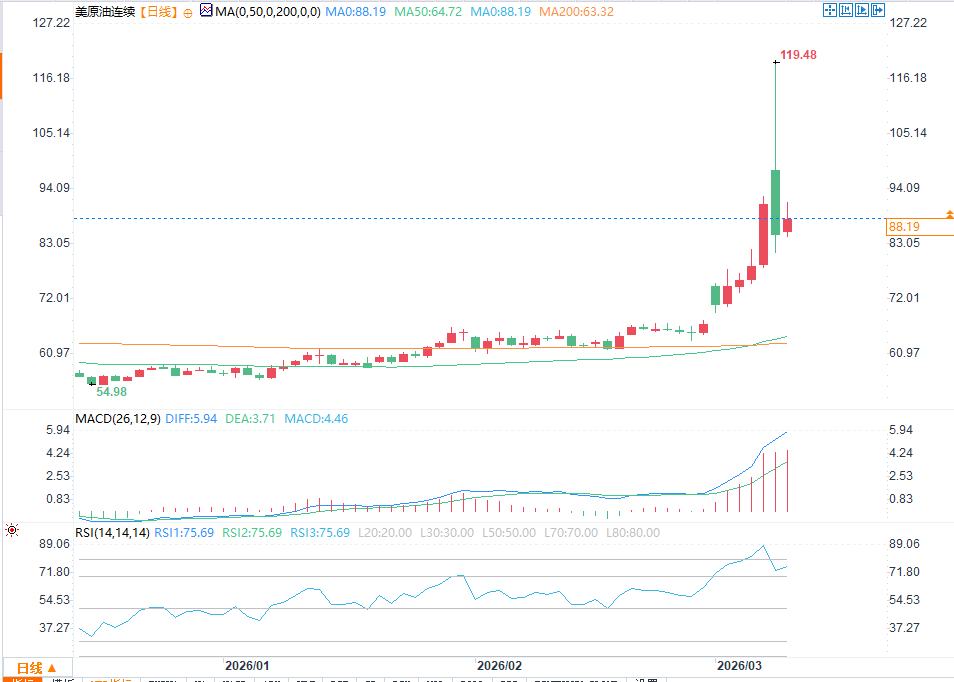
(WTI crude oil daily chart source: FX678)
Before observing how traders respond to the $100.34-$104.85 resistance level, it's too early to conclude that this upward trend has officially peaked. The short-term trading range is expected to be $75-$105; if support holds, a rebound is highly probable. Once peace is confirmed, oil prices will return to normal much faster than the market anticipates.
In the long term, institutions such as JPMorgan and the EIA have warned that global oversupply pressure will gradually emerge in 2026 (OPEC + increased production + high US shale oil production), and the average Brent crude oil price may fall back to around $60. However, as long as geopolitical risks persist, oil prices will remain highly volatile.
This statement directly triggered selling pressure on the supply side. Yesterday, oil prices surged to $119.48 before quickly falling back to close at $94.77, and today they are further testing the key pullback range. The latest satellite data from the Strait of Hormuz shows traffic volume down 92% from normal levels, but Trump's optimistic remarks have already led the market to price in "rapid de-risking." However, he also cautioned that "the war is still much longer than initially anticipated," and the market remains highly vigilant; any new escalation news could instantly reverse sentiment.
This round of gains began at a low of $54.87 on December 16, 2025, reaching a high of $119.48 (a new high since March 2022), with a cumulative increase of over 118%. Currently, oil prices are testing the 50%-61.8% Fibonacci retracement range: $87.18-$79.55. This range is crucial for the battle between bulls and bears—latest trading data shows that if $87.18 holds, buying will quickly return; if prices break below $79.55 with significant volume, it could accelerate the decline towards the trendline support at $67.68.
Has the rally ended?
From a technical perspective, while the recent plunge from $119.48 was sharp, it was a very typical correction characterized by "first-wave profit-taking + long position liquidation." Excluding emotional factors, the market has already given back approximately 50% of its gains, consistent with the healthy correction patterns seen after historical rallies. The latest CFTC positioning report shows that speculative net long positions remain high, indicating that the market as a whole still maintains a "buy on dips" strategy.
Key price levels currently being monitored by traders
Yesterday's trading range: $119.48 - $81.19
Corresponding pullback resistance range: $100.34-$104.85 (today's most realistic upside target)
Bullish scenario (high rebound potential)
As long as oil prices hold above $87.18, buying interest will quickly return. Combined with Goldman Sachs' latest report, if the Hormuz crisis continues in the short term, oil prices could rebound rapidly to $100.34-$104.85, or even test the $105 level. Rystad Energy's scenario analysis also points out that if the geopolitical risk premium persists, a short-term target of $135 is not impossible.
Short selling scenario (caution advised)
If the price continues to fall below $79.55 (especially with increased volume), selling pressure will dominate, with the downside target pointing towards the trendline at $67.68, and even the swing low of $63.60. Macquarie analysts warn that if the conflict drags on longer than expected, oil prices could surge to $150 in an extreme scenario, but once peace is achieved, the return to normalcy will be "very fast."
Buying the dip or shorting the rally – the speculator's strategy
Most institutions maintain their "buy on dips" strategy. JP Morgan's latest view is that "the war is likely to end soon in a limited way, and in the long term, the average Brent price in 2026 will be around $60. The current pullback is a good opportunity to buy." The main trend line ($67.68), moving average support ($64.53-$61.82), and the significant accumulation of inventories (the latest API and EIA data show a surprisingly large increase in US crude oil inventories) all reinforce the long-term upward bias.
Only when oil prices form a "lower high" around $100.34-$104.85 and then fall back will the market switch from "buying on dips" to "selling on rallies." Before that, speculators are more inclined to buy in batches in the $87.18-$79.55 range rather than aggressively shorting.
Trump's peace rhetoric triggered a supply-side sell-off.
Monday's surge and Tuesday's plunge were both directly linked to supply expectations:
Upside drivers: Market concerns about an escalating conflict between Israel and Iran leading to a prolonged closure of the Strait of Hormuz and continued attacks on oil facilities.
Downside driver: Trump's statement that "it's basically over" caused the risk premium to quickly subside.
Although Trump's remarks were merely predictions, they were enough to reassure the market. Discussions regarding the release of reserves by G7 countries are also underway, further easing expectations of supply shortages. However, the reality of a 92% reduction in traffic in the Strait of Hormuz still keeps some institutions cautious—Goldman Sachs pointed out: "If the disruption continues for another 2-3 weeks, oil prices could still surge above $100 again."
Crude Oil Outlook – Focus on the pullback range and await the next major market move.
(WTI crude oil daily chart source: FX678)
Before observing how traders respond to the $100.34-$104.85 resistance level, it's too early to conclude that this upward trend has officially peaked. The short-term trading range is expected to be $75-$105; if support holds, a rebound is highly probable. Once peace is confirmed, oil prices will return to normal much faster than the market anticipates.
In the long term, institutions such as JPMorgan and the EIA have warned that global oversupply pressure will gradually emerge in 2026 (OPEC + increased production + high US shale oil production), and the average Brent crude oil price may fall back to around $60. However, as long as geopolitical risks persist, oil prices will remain highly volatile.
- Risk Warning and Disclaimer
- The market involves risk, and trading may not be suitable for all investors. This article is for reference only and does not constitute personal investment advice, nor does it take into account certain users’ specific investment objectives, financial situation, or other needs. Any investment decisions made based on this information are at your own risk.