New York silver futures plunged more than 3% intraday, currently trading at $86.88 per ounce, as safe-haven demand for precious metals cooled sharply.
2026-03-11 15:57:05
According to the APP, COMEX silver futures fell more than 3% intraday , currently trading at $86.88 per ounce . This rapid decline refreshed the intraday low, with a significant increase in trading volume, indicating a clear easing of short-term risk aversion in the precious metals market.
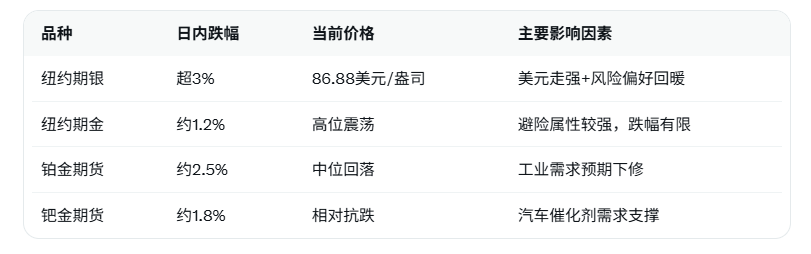
The decline in silver prices was mainly due to the simultaneous strengthening of the US dollar index, coupled with a global stock market rebound leading to capital outflows from defensive assets. Meanwhile, rising market expectations of easing geopolitical risks in the Middle East further weakened silver's safe-haven appeal. As a commodity with both industrial and monetary attributes, silver is more sensitive to economic recovery signals, and this round of decline has erased some of its recent gains. For a direct comparison of the performance of the precious metals sector, the following table summarizes key data for the day:
The recent plunge in silver prices has directly impacted the silver mining sector, with the share prices of major global silver mining companies under pressure, and some small and medium-sized mining companies experiencing declines of over 5%. Silver production costs are relatively fixed, and profit margins are substantial when prices are high. The current decline will compress gross margins, and coupled with inventory pressure, short-term industry profit expectations face the risk of downward revision. However, historically, such 3% corrections often provide buying opportunities for medium- to long-term investors, especially when industrial demand (such as photovoltaics and electronics) continues to recover, the rebound in silver prices remains relatively strong.
Traders are currently focused on the movements of the US dollar index and US Treasury yields. If risk appetite continues to rise, silver prices may test lower support levels; conversely, if geopolitical factors escalate again, safe-haven buying is expected to return quickly. Overall, the precious metals market is in a sensitive phase of "risk appetite switching." Silver's industrial properties make it more volatile than gold, making it the leading decliner in this round of correction.
Editor's Summary : The over 3% plunge in New York silver futures highlights the precious metals market's high sensitivity to macroeconomic sentiment. The dual drivers of the US dollar and risk appetite are reshaping pricing logic. Investors need to continuously track the US dollar index and industrial demand data to seize opportunities in sector rotation.
Frequently Asked Questions
1. Question: Why did New York silver futures plummet by more than 3% to $86.88 per ounce in a single day?
A: The core driver was the rapid strengthening of the US dollar index, coupled with the rebound in global stock markets leading to an outflow of safe-haven funds. Silver possesses both industrial and monetary attributes, making it more sensitive to changes in risk appetite. This round of decline directly reflects the market's optimistic expectations for economic recovery and easing geopolitical risks, and the increased trading volume further accelerated the price decline.
2. Question: What specific impact will the recent drop in silver prices have on the profitability of silver mining companies?
A: Silver mine production costs are relatively rigid, and gross margins are higher in the high-price range. However, the $86.88/ounce level will significantly compress profit margins. Major global silver mining companies are already facing inventory backlogs and capital expenditure pressures. Some small and medium-sized mining companies have revised their profit expectations down by 5%-10%, and their stock prices are under pressure accordingly. However, if industrial demand (such as solar energy and electronic components) remains resilient, there is still a basis for a long-term rebound.
3. Question: Why did silver fall significantly more than gold?
A: Gold has a stronger safe-haven attribute, and institutional demand is stable, with the decline controlled at around 1.2%; while silver is used in industry for more than 50% of the time, making it more sensitive to economic cycles and risk appetite. Therefore, it became the leading decliner in an environment of a strong dollar and a stock market rebound, forming a clear divergence.
4. Question: What impact does the current silver price level have on the costs of downstream industrial enterprises?
A: The decline in silver prices will directly reduce raw material procurement costs for industries such as photovoltaics, electronics, and automotive catalysts, helping to alleviate supply chain pressures and improve the gross profit margins of related companies. However, if the decline is too rapid, it may lead to production cuts by mining companies, and the long-term supply contraction may actually pave the way for a price rebound later.
5. Question: How should ordinary investors operate in the context of a sharp drop in New York silver futures?
A: In the short term, it is recommended to avoid highly leveraged silver mining stocks and long positions in futures, and pay attention to the US dollar index and US Treasury yields as leading indicators. In the medium to long term, it is advisable to gradually build up positions in high-quality silver mining ETFs or physical silver, especially when prices approach key support levels. Set strict stop-loss orders and adjust them dynamically based on industrial demand data to avoid chasing declines and rallies, and maintain cash reserves to capture subsequent rebound opportunities.
The decline in silver prices was mainly due to the simultaneous strengthening of the US dollar index, coupled with a global stock market rebound leading to capital outflows from defensive assets. Meanwhile, rising market expectations of easing geopolitical risks in the Middle East further weakened silver's safe-haven appeal. As a commodity with both industrial and monetary attributes, silver is more sensitive to economic recovery signals, and this round of decline has erased some of its recent gains. For a direct comparison of the performance of the precious metals sector, the following table summarizes key data for the day:
The recent plunge in silver prices has directly impacted the silver mining sector, with the share prices of major global silver mining companies under pressure, and some small and medium-sized mining companies experiencing declines of over 5%. Silver production costs are relatively fixed, and profit margins are substantial when prices are high. The current decline will compress gross margins, and coupled with inventory pressure, short-term industry profit expectations face the risk of downward revision. However, historically, such 3% corrections often provide buying opportunities for medium- to long-term investors, especially when industrial demand (such as photovoltaics and electronics) continues to recover, the rebound in silver prices remains relatively strong.
Traders are currently focused on the movements of the US dollar index and US Treasury yields. If risk appetite continues to rise, silver prices may test lower support levels; conversely, if geopolitical factors escalate again, safe-haven buying is expected to return quickly. Overall, the precious metals market is in a sensitive phase of "risk appetite switching." Silver's industrial properties make it more volatile than gold, making it the leading decliner in this round of correction.
Editor's Summary : The over 3% plunge in New York silver futures highlights the precious metals market's high sensitivity to macroeconomic sentiment. The dual drivers of the US dollar and risk appetite are reshaping pricing logic. Investors need to continuously track the US dollar index and industrial demand data to seize opportunities in sector rotation.
Frequently Asked Questions
1. Question: Why did New York silver futures plummet by more than 3% to $86.88 per ounce in a single day?
A: The core driver was the rapid strengthening of the US dollar index, coupled with the rebound in global stock markets leading to an outflow of safe-haven funds. Silver possesses both industrial and monetary attributes, making it more sensitive to changes in risk appetite. This round of decline directly reflects the market's optimistic expectations for economic recovery and easing geopolitical risks, and the increased trading volume further accelerated the price decline.
2. Question: What specific impact will the recent drop in silver prices have on the profitability of silver mining companies?
A: Silver mine production costs are relatively rigid, and gross margins are higher in the high-price range. However, the $86.88/ounce level will significantly compress profit margins. Major global silver mining companies are already facing inventory backlogs and capital expenditure pressures. Some small and medium-sized mining companies have revised their profit expectations down by 5%-10%, and their stock prices are under pressure accordingly. However, if industrial demand (such as solar energy and electronic components) remains resilient, there is still a basis for a long-term rebound.
3. Question: Why did silver fall significantly more than gold?
A: Gold has a stronger safe-haven attribute, and institutional demand is stable, with the decline controlled at around 1.2%; while silver is used in industry for more than 50% of the time, making it more sensitive to economic cycles and risk appetite. Therefore, it became the leading decliner in an environment of a strong dollar and a stock market rebound, forming a clear divergence.
4. Question: What impact does the current silver price level have on the costs of downstream industrial enterprises?
A: The decline in silver prices will directly reduce raw material procurement costs for industries such as photovoltaics, electronics, and automotive catalysts, helping to alleviate supply chain pressures and improve the gross profit margins of related companies. However, if the decline is too rapid, it may lead to production cuts by mining companies, and the long-term supply contraction may actually pave the way for a price rebound later.
5. Question: How should ordinary investors operate in the context of a sharp drop in New York silver futures?
A: In the short term, it is recommended to avoid highly leveraged silver mining stocks and long positions in futures, and pay attention to the US dollar index and US Treasury yields as leading indicators. In the medium to long term, it is advisable to gradually build up positions in high-quality silver mining ETFs or physical silver, especially when prices approach key support levels. Set strict stop-loss orders and adjust them dynamically based on industrial demand data to avoid chasing declines and rallies, and maintain cash reserves to capture subsequent rebound opportunities.
- Risk Warning and Disclaimer
- The market involves risk, and trading may not be suitable for all investors. This article is for reference only and does not constitute personal investment advice, nor does it take into account certain users’ specific investment objectives, financial situation, or other needs. Any investment decisions made based on this information are at your own risk.