Hormuz's strangulation and IEA's multi-billion barrel clash: who will blink first in the resource battlefield?
2026-03-11 21:13:29
On Wednesday morning in the US, geopolitical tensions in the Middle East continued to escalate, putting downward pressure on gold and silver prices, while the oil market fluctuated wildly amid expectations of record reserve releases and a struggle between supply shortages.
Market attention is focused on the hardline stance on the Iranian battlefield, the ongoing military operations by the US and Israel, global inflation caused by rising oil prices, and whether the International Energy Agency (IEA) will implement the largest oil reserve release plan in history. With multiple factors intertwined, the short-term trends of gold and crude oil are increasingly affecting investors' nerves.
The current conflict between the US and Iran has entered its 12th day, and there are still no obvious signs of easing in the military confrontation between the two sides. The strategic waterway, the Strait of Hormuz, has become the key to the situation.
The United States and Israel continue to bomb military targets inside Iran, while Iran retaliates against US and Israeli assets in the Middle East with missiles and drone swarms, with attacks and air raid sirens reported in many places.
Three ships were attacked in the Middle East, a drone crashed near Dubai airport, Tel Aviv was hit by four rounds of Iranian missile attacks on Tuesday night, and air raid sirens continued to sound in Bahrain, causing a sharp deterioration in the regional security situation.
The escalating security risks in the Strait of Hormuz are directly impacting shipping activities. Maersk has already stranded 10 ships in the Persian Gulf, and it will take another 10 days for operations to resume even if a ceasefire is not reached.
Iran's intention to lay mines near the Strait of Hormuz is clear. The U.S. military announced that it had destroyed 16 Iranian vessels identified as preparing to lay mines and warned Iran against such actions.
At the same time, the conflict has triggered a chain of crises, with Bloomberg's headline pointing out that "the war in Iran is triggering an unprecedented fertilizer crisis," further exacerbating concerns about global supply chains.
On Wednesday (March 11), gold and silver prices fell in tandem during the European and American trading sessions. The resumption of oil price increases and profit-taking by short-term futures traders were the direct pressures. Although the US-Iran war did not break out in February, the release of the US February CPI data still amplified the cautious sentiment.
In February, the overall US CPI remained unchanged at 2.4% year-on-year, the same as in January, the lowest since May 2025. The month-on-month increase was 0.3%, slightly faster than in January. The rebound in gasoline prices may have driven the overall data upward, but the growth of service, food and housing prices slowed down. The core CPI remained stable at 2.5% year-on-year, and the month-on-month growth rate slowed to 0.2%.
However, the lackluster February data has sparked market concerns that the US CPI will inevitably rise in March. The rise in gold and silver prices is partly due to the fact that the March CPI is almost certain to rise due to rising oil prices.
Despite escalating geopolitical conflicts, gold failed to attract strong safe-haven buying. Investors preferred the liquidity advantage of the US dollar, while inflation concerns triggered by high oil prices may cause the Federal Reserve to postpone its interest rate cuts, further suppressing the appeal of gold's non-yielding nature.
As mentioned repeatedly in previous articles, the previous decline in the US dollar and oil prices, along with signs of easing tensions in Iran, stabilized risk sentiment and allowed the gold rebound to continue. However, the current rise in the US 10-year Treasury yield, the rebound in oil prices, and the market's advance bets on the March CPI are directly suppressing the gold bulls.
The crude oil market has become the focus of geopolitical and policy games. Supply concerns triggered by the Middle East wars drove oil prices up in the early stages, while the IEA’s proposed plan to release a record 300-400 million barrels of oil reserves has become the key to reversing market expectations.
This figure far exceeds the 182 million barrels released during the Russia-Ukraine conflict in 2022, and is sufficient to cover the average daily shipments through the Strait of Hormuz for 15-20 days, which is expected to ease the tight supply situation within a few weeks.
Saudi Arabia has shifted its oil exports to the west coast, an adjustment that will effectively extend the window of easing supply, which is highly consistent with investors' general prediction of a 3-4 week conflict duration.
Meanwhile, the Trump administration announced plans to build a new refinery on the southern border of the United States, backed by India’s Reliance Industries. This will be the first refinery in the United States in half a century specifically designed for shale oil, which will improve the processing capacity of U.S. refineries for light, low-sulfur crude oil and further alleviate pressure on refined oil supply.
However, a spokesperson for Iran's Hatem Anbia Central Command issued a stern warning, stating that Iran is fully capable of blocking the Strait of Hormuz.
The spokesperson stated unequivocally: "We will never allow even a single liter of oil to pass through the Strait of Hormuz in a way that benefits the United States and its allies."
He also pointed out that Western countries' attempts to suppress global oil and energy prices through external intervention are doomed to failure. The United States cannot control oil prices through "artificial measures" and should be prepared for oil prices to rise to $200 per barrel.
Subsequently, oil prices rebounded along with US Treasury yields, and the market interpreted the International Energy Agency's release of the largest strategic oil reserve in history as a signal that the conflict with Iran would be prolonged.
The current core contradiction in the market lies in the duration of the Middle East geopolitical conflict and the effectiveness of the IEA's reserve release. These two factors directly determine the expected supply of crude oil and the trend of oil prices. Changes in oil prices are then transmitted to the gold market through inflation and the central level of market interest rates.
In the short term, the IEA's record release of reserves is expected to alleviate the tight oil supply, but Iran's tough stance against aggression and its ability to resist have prolonged the time it has been able to control the Strait of Hormuz.
The release of the US February CPI data also served as a significant catalyst, reminding everyone that a March CPI increase is a foregone conclusion, which may cause the Federal Reserve to postpone interest rate cuts, potentially putting short-term pressure on gold.
Overall, the short-term trends of gold and crude oil will remain closely linked, with the interplay of geopolitical risks and policy intervention continuing to dominate market dynamics. Investors should pay close attention to the implementation of the IEA's reserve release decision and the latest battlefield situation.
From a technical perspective, spot gold is still moving upwards along an upward channel, but there is no sufficient catalyst to break through the upper rail of the channel. Currently, the resistance is at the upper rail of the upward channel, while the support is at the 5-day moving average and the important level of 5130.
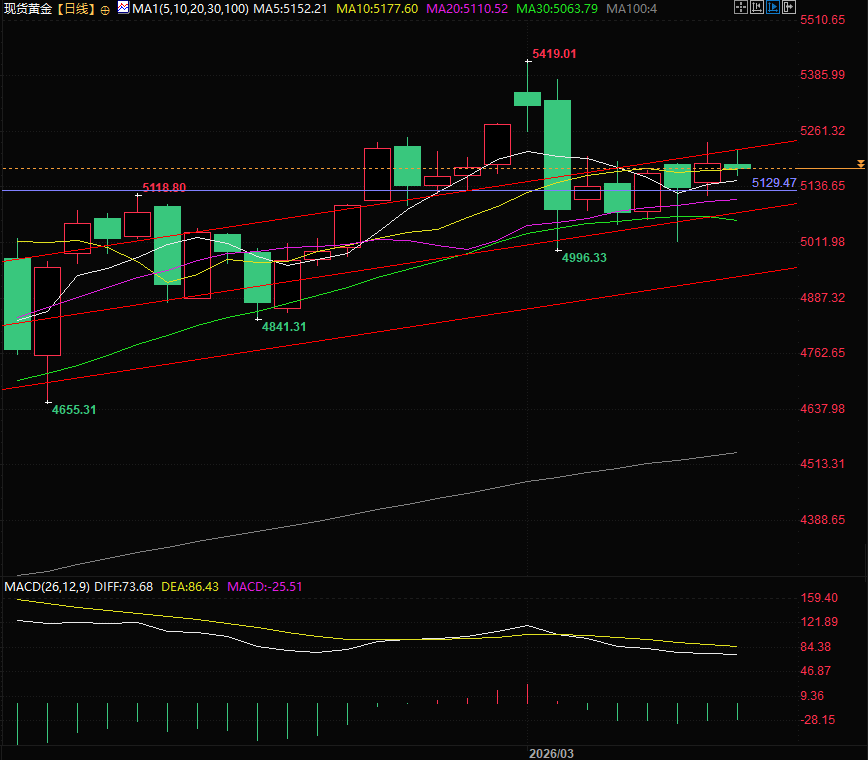
(Spot gold daily chart, source: FX678)
WTI crude oil has been retracing to the 5-day moving average for several consecutive days before breaking through the 0.50 level of this upward move. Technically, it is expected to continue rising in the future, with support at the 5-day moving average and the 0.500 level at 87.18, and resistance around 94.78.
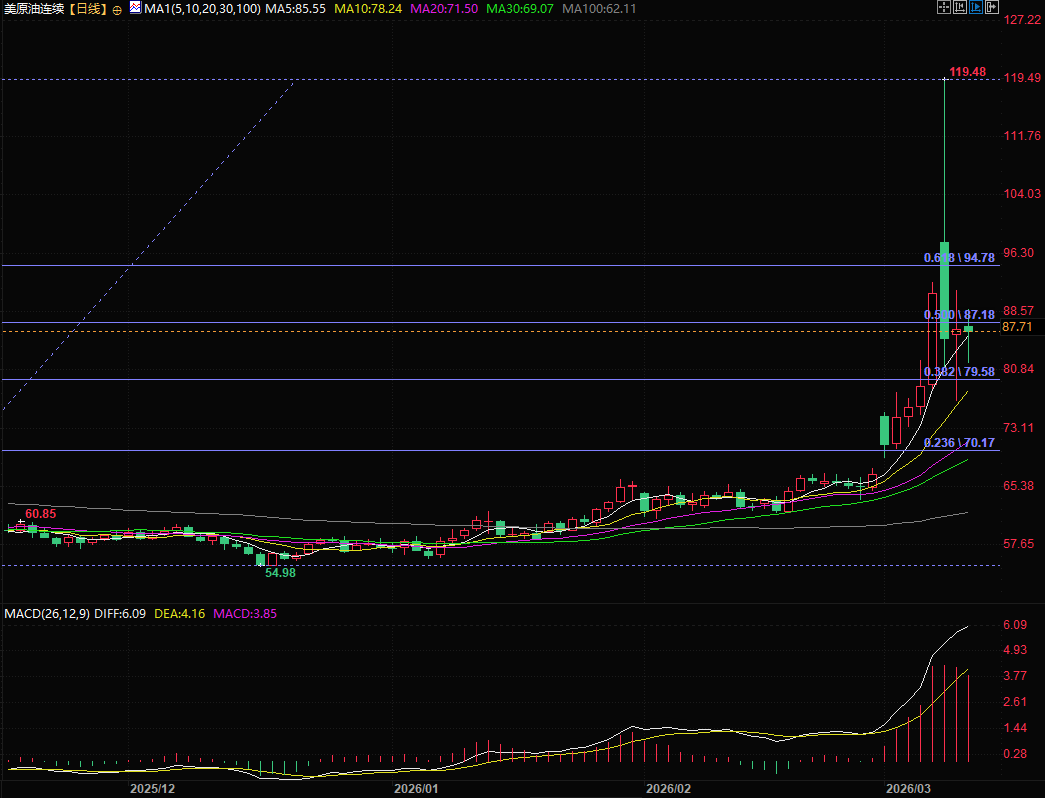
(WTI crude oil futures daily chart, source: EasyForex)
At 21:09 Beijing time, spot gold was trading at $5,174 per ounce, and WTI crude oil futures were trading at $86.12 per barrel.
Market attention is focused on the hardline stance on the Iranian battlefield, the ongoing military operations by the US and Israel, global inflation caused by rising oil prices, and whether the International Energy Agency (IEA) will implement the largest oil reserve release plan in history. With multiple factors intertwined, the short-term trends of gold and crude oil are increasingly affecting investors' nerves.
The US-Iran conflict continues to escalate, with the Strait of Hormuz becoming the core of the power struggle.
The current conflict between the US and Iran has entered its 12th day, and there are still no obvious signs of easing in the military confrontation between the two sides. The strategic waterway, the Strait of Hormuz, has become the key to the situation.
The United States and Israel continue to bomb military targets inside Iran, while Iran retaliates against US and Israeli assets in the Middle East with missiles and drone swarms, with attacks and air raid sirens reported in many places.
Three ships were attacked in the Middle East, a drone crashed near Dubai airport, Tel Aviv was hit by four rounds of Iranian missile attacks on Tuesday night, and air raid sirens continued to sound in Bahrain, causing a sharp deterioration in the regional security situation.
The escalating security risks in the Strait of Hormuz are directly impacting shipping activities. Maersk has already stranded 10 ships in the Persian Gulf, and it will take another 10 days for operations to resume even if a ceasefire is not reached.
Iran's intention to lay mines near the Strait of Hormuz is clear. The U.S. military announced that it had destroyed 16 Iranian vessels identified as preparing to lay mines and warned Iran against such actions.
At the same time, the conflict has triggered a chain of crises, with Bloomberg's headline pointing out that "the war in Iran is triggering an unprecedented fertilizer crisis," further exacerbating concerns about global supply chains.
Gold: Insufficient safe-haven buying puts it under short-term pressure, awaiting data catalysts.
On Wednesday (March 11), gold and silver prices fell in tandem during the European and American trading sessions. The resumption of oil price increases and profit-taking by short-term futures traders were the direct pressures. Although the US-Iran war did not break out in February, the release of the US February CPI data still amplified the cautious sentiment.
In February, the overall US CPI remained unchanged at 2.4% year-on-year, the same as in January, the lowest since May 2025. The month-on-month increase was 0.3%, slightly faster than in January. The rebound in gasoline prices may have driven the overall data upward, but the growth of service, food and housing prices slowed down. The core CPI remained stable at 2.5% year-on-year, and the month-on-month growth rate slowed to 0.2%.
However, the lackluster February data has sparked market concerns that the US CPI will inevitably rise in March. The rise in gold and silver prices is partly due to the fact that the March CPI is almost certain to rise due to rising oil prices.
Despite escalating geopolitical conflicts, gold failed to attract strong safe-haven buying. Investors preferred the liquidity advantage of the US dollar, while inflation concerns triggered by high oil prices may cause the Federal Reserve to postpone its interest rate cuts, further suppressing the appeal of gold's non-yielding nature.
As mentioned repeatedly in previous articles, the previous decline in the US dollar and oil prices, along with signs of easing tensions in Iran, stabilized risk sentiment and allowed the gold rebound to continue. However, the current rise in the US 10-year Treasury yield, the rebound in oil prices, and the market's advance bets on the March CPI are directly suppressing the gold bulls.
Crude oil: IEA's record reserve release is expected to ease supply tensions.
The crude oil market has become the focus of geopolitical and policy games. Supply concerns triggered by the Middle East wars drove oil prices up in the early stages, while the IEA’s proposed plan to release a record 300-400 million barrels of oil reserves has become the key to reversing market expectations.
This figure far exceeds the 182 million barrels released during the Russia-Ukraine conflict in 2022, and is sufficient to cover the average daily shipments through the Strait of Hormuz for 15-20 days, which is expected to ease the tight supply situation within a few weeks.
Saudi Arabia has shifted its oil exports to the west coast, an adjustment that will effectively extend the window of easing supply, which is highly consistent with investors' general prediction of a 3-4 week conflict duration.
Meanwhile, the Trump administration announced plans to build a new refinery on the southern border of the United States, backed by India’s Reliance Industries. This will be the first refinery in the United States in half a century specifically designed for shale oil, which will improve the processing capacity of U.S. refineries for light, low-sulfur crude oil and further alleviate pressure on refined oil supply.
However, a spokesperson for Iran's Hatem Anbia Central Command issued a stern warning, stating that Iran is fully capable of blocking the Strait of Hormuz.
The spokesperson stated unequivocally: "We will never allow even a single liter of oil to pass through the Strait of Hormuz in a way that benefits the United States and its allies."
He also pointed out that Western countries' attempts to suppress global oil and energy prices through external intervention are doomed to failure. The United States cannot control oil prices through "artificial measures" and should be prepared for oil prices to rise to $200 per barrel.
Subsequently, oil prices rebounded along with US Treasury yields, and the market interpreted the International Energy Agency's release of the largest strategic oil reserve in history as a signal that the conflict with Iran would be prolonged.
Summary and Technical Analysis:
The current core contradiction in the market lies in the duration of the Middle East geopolitical conflict and the effectiveness of the IEA's reserve release. These two factors directly determine the expected supply of crude oil and the trend of oil prices. Changes in oil prices are then transmitted to the gold market through inflation and the central level of market interest rates.
In the short term, the IEA's record release of reserves is expected to alleviate the tight oil supply, but Iran's tough stance against aggression and its ability to resist have prolonged the time it has been able to control the Strait of Hormuz.
The release of the US February CPI data also served as a significant catalyst, reminding everyone that a March CPI increase is a foregone conclusion, which may cause the Federal Reserve to postpone interest rate cuts, potentially putting short-term pressure on gold.
Overall, the short-term trends of gold and crude oil will remain closely linked, with the interplay of geopolitical risks and policy intervention continuing to dominate market dynamics. Investors should pay close attention to the implementation of the IEA's reserve release decision and the latest battlefield situation.
From a technical perspective, spot gold is still moving upwards along an upward channel, but there is no sufficient catalyst to break through the upper rail of the channel. Currently, the resistance is at the upper rail of the upward channel, while the support is at the 5-day moving average and the important level of 5130.
(Spot gold daily chart, source: FX678)
WTI crude oil has been retracing to the 5-day moving average for several consecutive days before breaking through the 0.50 level of this upward move. Technically, it is expected to continue rising in the future, with support at the 5-day moving average and the 0.500 level at 87.18, and resistance around 94.78.
(WTI crude oil futures daily chart, source: EasyForex)
At 21:09 Beijing time, spot gold was trading at $5,174 per ounce, and WTI crude oil futures were trading at $86.12 per barrel.
- Risk Warning and Disclaimer
- The market involves risk, and trading may not be suitable for all investors. This article is for reference only and does not constitute personal investment advice, nor does it take into account certain users’ specific investment objectives, financial situation, or other needs. Any investment decisions made based on this information are at your own risk.