Crude oil is no longer driven by fundamentals! It has become a casino for retail investors, with high-frequency trading in both directions.
2026-03-12 20:48:27
As volatility continues to soar, retail investors are flocking to popular crude oil ETFs. However, unlike the 2021 GameStop scenario where retail investors flocked to buy in one direction, the current retail trading in the crude oil market exhibits distinct characteristics of two-way high-frequency speculation. Coupled with factors such as sentiment-driven and high volatility, this market has become a playground for speculators and has also served as a warning to ordinary investors.

The influx of retail investors is not a one-way bet, but a rapid game based on short-term news.
The fluctuating situation in the Middle East, especially the ups and downs of rumors about blocking the Strait of Hormuz, has become a key catalyst for retail trading.
Many investors are using leveraged instruments, including products like USO and OILU that bet on rising oil prices, as well as traders who choose triple-leveraged ETNs like OILD to bet on falling oil prices.
More importantly, most retail investors do not pay attention to the long-term supply and demand pattern of crude oil, but instead focus on breaking news on social media and adopt an extremely short-term strategy of "entering and exiting in seconds".
This trading model has deviated the pricing logic of traditional commodities from the crude oil market, making it more like a "giant casino" that relies on instantaneous reactions to news, further amplifying market volatility.
According to Vanda Research data, as of the relevant statistical date, retail investors' cumulative purchases of a basket of crude oil ETFs reached $154 million in one month, a new high since May 2020. Among them, the largest US crude oil ETF (USO) even saw its largest single-day inflow in history, while inverse leveraged products OILD also saw a large influx of funds during the same period, demonstrating the popularity of two-way trading.
Sentiment-driven factors have completely overshadowed fundamentals and become the core logic behind oil price fluctuations.
Traditionally, crude oil prices are dominated by hard indicators such as inventory data, global production, and macroeconomic cycles. However, today it is extremely sensitive to social media messages—an unverified rumor can trigger a 10% jump or plunge in oil prices.
The most typical example is that, despite the International Energy Agency (IEA) announcing the release of 400 million barrels of strategic reserves and the United States following suit, oil prices did not fall as expected. Instead, they continued to rise due to panic on platforms such as Twitter and Reddit.
Macquarie strategist Thierry Weizmann once bluntly stated that 400 million barrels of reserves are equivalent to only four days of global production or 16 days of regular shipping volume in the Persian Gulf. Strategic reserves are not a long-term solution, and before peace is restored in the Persian Gulf, crude oil will continue to trade "like retail investors holding onto stocks." This illogical and irrational trend is the core characteristic of crude oil's "metamorphosis."
The extremely high volatility further confirms the "retail investor-favored stock" characteristic of crude oil.
As one of the most liquid commodities globally, crude oil has generally maintained a relatively stable price trend. However, its volatility index has recently surged to its highest level since May 2020 – the Chicago Board Options Exchange (Cboe) Crude Oil Volatility Index broke through the 108 mark during the session. If it closes at that level, it will set a multi-year record.
This index, calculated based on the trading activity of options contracts linked to USO, surged amid dramatic daily price swings with multiple "V-shaped" reversals. Seth Meyer of Janus Henderson Investments frankly stated that the unresolved situation in the Strait of Hormuz has fueled persistently strong demand for crude oil volatility trading. "Everything related is being traded," he said, ultimately turning crude oil into a speculative "monster" that is difficult for ordinary investors to grasp.
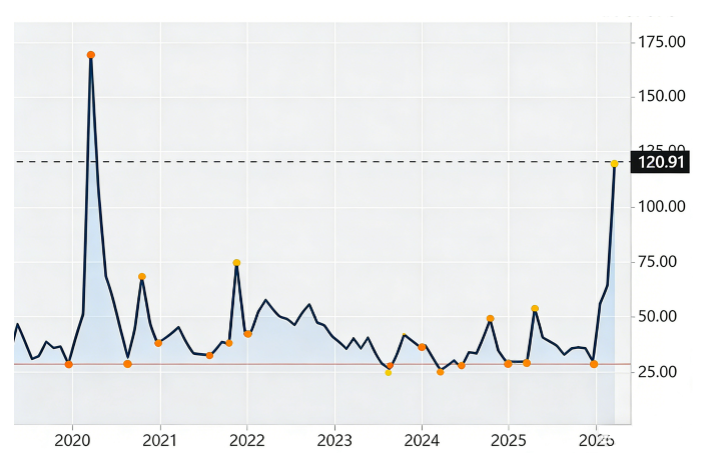
(OVX monthly chart, approaching the peak of volatility in the Russia-Ukraine conflict)
Faced with this situation, institutional traders felt more helpless and offered warnings.
They generally believe that current crude oil price fluctuations have deviated from economic laws and are instead dominated by algorithmic trading and retail investor sentiment, making traditional analytical frameworks difficult to apply.
More importantly, institutions have repeatedly reminded investors that there is a fundamental difference between crude oil ETFs and stocks—crude oil ETFs, represented by USO, have huge rollover costs. If investors hold these positions for the long term like they would stocks, their funds will be continuously depleted even if oil prices remain unchanged.
This is completely different from GameStop's investment logic back then, and blindly following the trend may lead to unexpected risks.
Ultimately, the labeling of crude oil as a "stock held by retail investors" is not primarily due to the collective buying by retail investors, but rather because its volatility logic has shifted to being "driven by sentiment and news."
Driven by the complex interplay of the Middle East situation, retail investor speculation, and leveraged trading, the speculative nature of the crude oil market has been pushed to its extreme. For investors, recognizing its inherently retail-driven nature and being wary of the risks behind volatility is far more important than blindly chasing highs and lows.
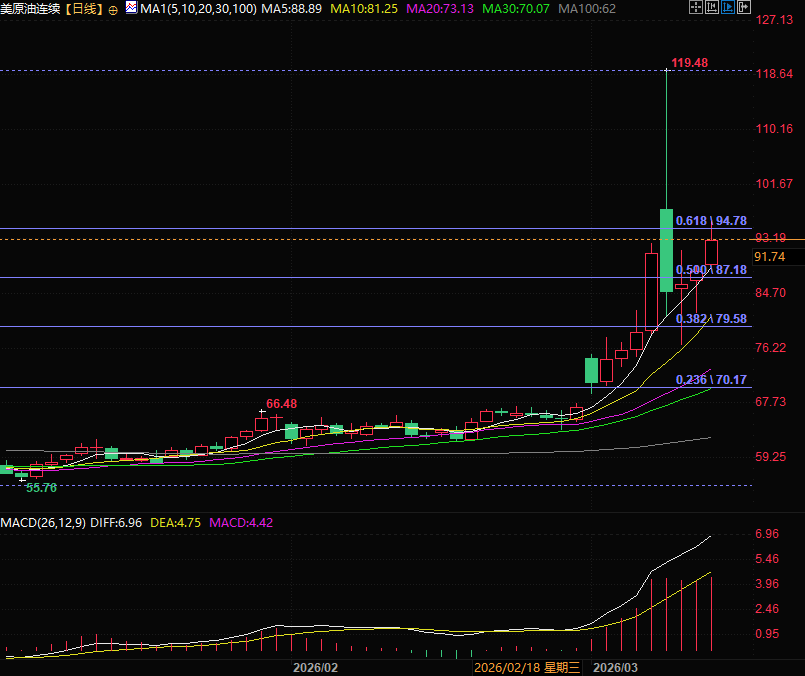
(WTI crude oil futures daily chart, source: EasyForex)
At 20:46 Beijing time, WTI crude oil futures were trading at $93.25 per barrel.
Retail Investors' Two-Way Game: High-Frequency Speculation (Non-One)
The influx of retail investors is not a one-way bet, but a rapid game based on short-term news.
The fluctuating situation in the Middle East, especially the ups and downs of rumors about blocking the Strait of Hormuz, has become a key catalyst for retail trading.
Many investors are using leveraged instruments, including products like USO and OILU that bet on rising oil prices, as well as traders who choose triple-leveraged ETNs like OILD to bet on falling oil prices.
More importantly, most retail investors do not pay attention to the long-term supply and demand pattern of crude oil, but instead focus on breaking news on social media and adopt an extremely short-term strategy of "entering and exiting in seconds".
This trading model has deviated the pricing logic of traditional commodities from the crude oil market, making it more like a "giant casino" that relies on instantaneous reactions to news, further amplifying market volatility.
According to Vanda Research data, as of the relevant statistical date, retail investors' cumulative purchases of a basket of crude oil ETFs reached $154 million in one month, a new high since May 2020. Among them, the largest US crude oil ETF (USO) even saw its largest single-day inflow in history, while inverse leveraged products OILD also saw a large influx of funds during the same period, demonstrating the popularity of two-way trading.
Market sentiment drives volatility: "retail investor herding" detached from fundamentals
Sentiment-driven factors have completely overshadowed fundamentals and become the core logic behind oil price fluctuations.
Traditionally, crude oil prices are dominated by hard indicators such as inventory data, global production, and macroeconomic cycles. However, today it is extremely sensitive to social media messages—an unverified rumor can trigger a 10% jump or plunge in oil prices.
The most typical example is that, despite the International Energy Agency (IEA) announcing the release of 400 million barrels of strategic reserves and the United States following suit, oil prices did not fall as expected. Instead, they continued to rise due to panic on platforms such as Twitter and Reddit.
Macquarie strategist Thierry Weizmann once bluntly stated that 400 million barrels of reserves are equivalent to only four days of global production or 16 days of regular shipping volume in the Persian Gulf. Strategic reserves are not a long-term solution, and before peace is restored in the Persian Gulf, crude oil will continue to trade "like retail investors holding onto stocks." This illogical and irrational trend is the core characteristic of crude oil's "metamorphosis."
Volatility Soars: A "Volatility Monster" Becomes a Frenzy for Speculators
The extremely high volatility further confirms the "retail investor-favored stock" characteristic of crude oil.
As one of the most liquid commodities globally, crude oil has generally maintained a relatively stable price trend. However, its volatility index has recently surged to its highest level since May 2020 – the Chicago Board Options Exchange (Cboe) Crude Oil Volatility Index broke through the 108 mark during the session. If it closes at that level, it will set a multi-year record.
This index, calculated based on the trading activity of options contracts linked to USO, surged amid dramatic daily price swings with multiple "V-shaped" reversals. Seth Meyer of Janus Henderson Investments frankly stated that the unresolved situation in the Strait of Hormuz has fueled persistently strong demand for crude oil volatility trading. "Everything related is being traded," he said, ultimately turning crude oil into a speculative "monster" that is difficult for ordinary investors to grasp.
(OVX monthly chart, approaching the peak of volatility in the Russia-Ukraine conflict)
Institutional warning: Crude oil ETFs are not the same as stocks; beware of hidden risks.
Faced with this situation, institutional traders felt more helpless and offered warnings.
They generally believe that current crude oil price fluctuations have deviated from economic laws and are instead dominated by algorithmic trading and retail investor sentiment, making traditional analytical frameworks difficult to apply.
More importantly, institutions have repeatedly reminded investors that there is a fundamental difference between crude oil ETFs and stocks—crude oil ETFs, represented by USO, have huge rollover costs. If investors hold these positions for the long term like they would stocks, their funds will be continuously depleted even if oil prices remain unchanged.
This is completely different from GameStop's investment logic back then, and blindly following the trend may lead to unexpected risks.
Ultimately, the labeling of crude oil as a "stock held by retail investors" is not primarily due to the collective buying by retail investors, but rather because its volatility logic has shifted to being "driven by sentiment and news."
Driven by the complex interplay of the Middle East situation, retail investor speculation, and leveraged trading, the speculative nature of the crude oil market has been pushed to its extreme. For investors, recognizing its inherently retail-driven nature and being wary of the risks behind volatility is far more important than blindly chasing highs and lows.
(WTI crude oil futures daily chart, source: EasyForex)
At 20:46 Beijing time, WTI crude oil futures were trading at $93.25 per barrel.
- Risk Warning and Disclaimer
- The market involves risk, and trading may not be suitable for all investors. This article is for reference only and does not constitute personal investment advice, nor does it take into account certain users’ specific investment objectives, financial situation, or other needs. Any investment decisions made based on this information are at your own risk.