Crowded trading reverses: The secret weapon behind the dollar's comeback amid high oil prices?
2026-03-13 17:56:20
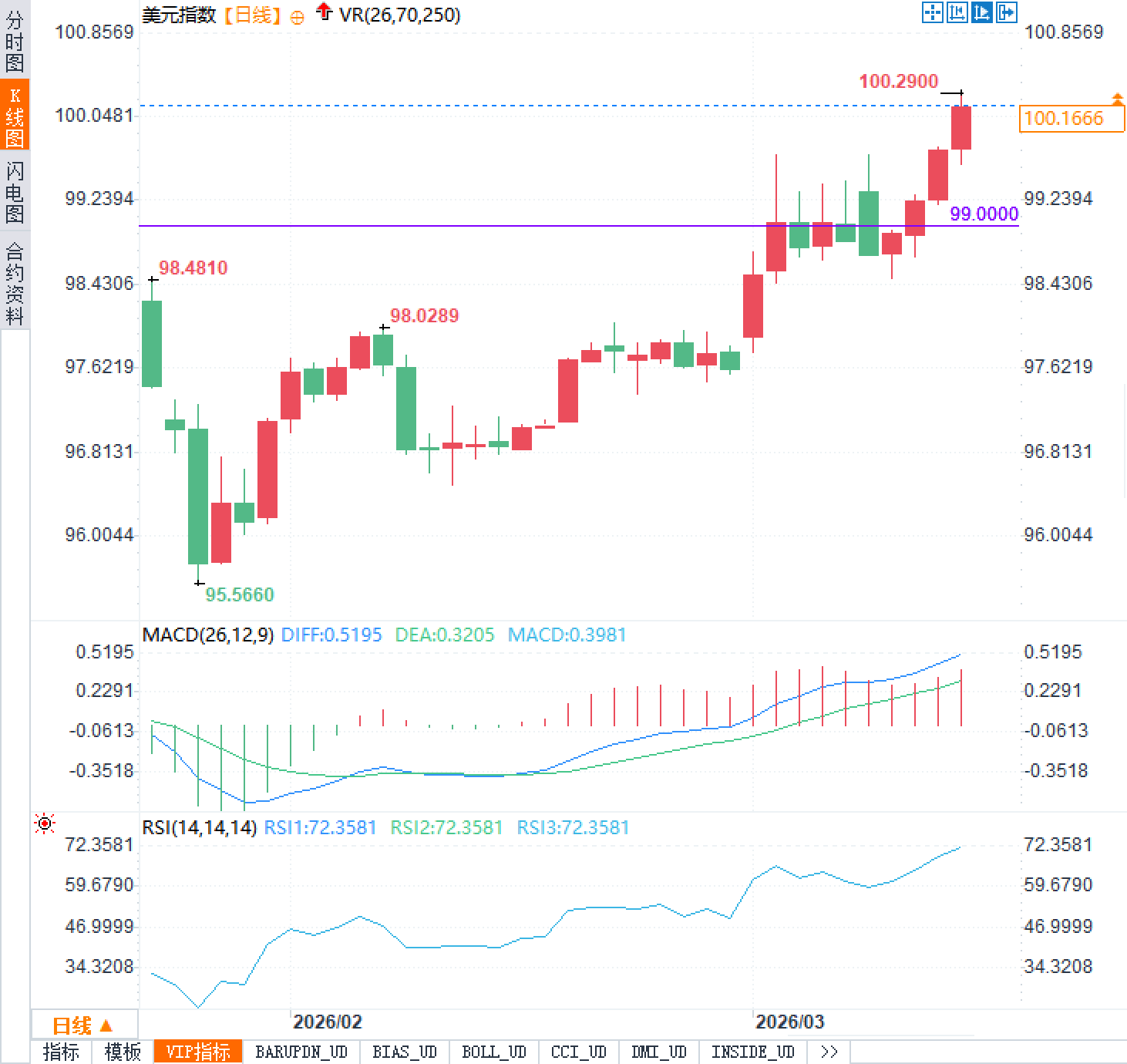
On Friday, March 13, the US dollar index rose to around 100.20, a daily increase of about 0.4%, approaching its recent peak range. Meanwhile, international oil prices remained high, with Brent crude at around $101 per barrel and West Texas Intermediate crude at around $96 per barrel. This price movement stemmed from the latest developments in Middle Eastern geopolitical events, particularly the continued pressure on the Strait of Hormuz shipping lanes, leading to a renewed shift in global risk sentiment towards caution. High oil prices not only amplified inflation expectations but also triggered market concerns about supply disruptions, driving the US dollar's strength amid safe-haven demand and position adjustments.
Recent market news indicates that Trump's comments on the progress of the Iran conflict initially sparked optimism, suggesting a possible easing of supply disruption risks, leading to a brief pullback in oil prices and a rebound in risk assets. However, subsequent reports of actions along the Strait of Hormuz quickly reversed this sentiment, with related measures exacerbating uncertainty in global oil transportation. The G7's discussion of releasing emergency reserves failed to fully quell the pressure, causing oil prices to return to high levels. This geopolitical factor, transmitted through the supply chain, directly increases energy costs and amplifies inflationary pressures. Traders noted that oil price volatility not only affects production costs but also breaks traditional correlations, prompting investors to turn to traditional safe-haven assets. The US dollar has benefited significantly in this environment, while other currency pairs face additional downward pressure, with the euro and pound sterling under greater pressure due to regional energy vulnerabilities.
The risk of imported inflation from persistently high oil prices is altering the monetary policy paths of major economies. Traders at the European Central Bank and the Bank of England have significantly increased their forecasts for a 2026 rate hike, after a sharp decline in previous easing expectations. The Bank of Japan's tightening pace has also received additional support due to rising energy costs. In contrast, while the Federal Reserve faces similar challenges, the market is still pricing in limited easing measures this year. This policy divergence has created an interest rate advantage for the US dollar compared to other currencies, driving up indices. This divergence is not only reflected in benchmark interest rates but also affects cross-border capital flows and currency pair valuations. Imported inflation from oil prices is transmitting more rapidly in Europe, leading to a faster-than-expected tightening of policy, while the Federal Reserve's relatively cautious approach maintains support for the dollar's interest rate differential.
The following is a comparison of recent changes in the interest rate expectations of major central banks in 2026:
This comparison highlights the advantage of the US dollar in a relative policy environment, which traders can observe as evidenced by the continued pressure on currency pairs such as the euro and the dollar.
Market participants observed that last month's fund manager survey showed net short positions in the US dollar reached multi-year highs. Such extreme crowding often triggers rapid corrections when fundamentals shift. Similar to the flash crash in the precious metals market earlier this year, gold and silver fell sharply within days, a result of crowded long positions being liquidated. Currently, the US dollar still has room for further appreciation because the market has not fully priced in the Fed's easing policies, and the liquidation process may continue.
Looking ahead, two main scenarios exist. The first scenario, less likely, involves a continued conflict exceeding expectations, leading to a stock market downturn, tightening financial conditions, and demand destruction even without direct interest rate hikes. This ultimately results in declining inflation expectations, increased bets on rate cuts, and downward pressure on the dollar. The second scenario, more likely, involves oil prices returning to triple digits and the stock market hitting new lows. Leaders may adjust their stance, leading to a market reaction similar to recent comments, but stronger. In this scenario, a rebound in risk appetite may temporarily suppress the dollar, but the overall trend will depend on fundamental developments. Traders should closely monitor the duration of supply disruptions, inventory data, and the speed of policy response, as these variables will determine the dollar's transition point between the two paths.
Geopolitical tensions drive up oil prices and fuel market risk aversion.
Recent market news indicates that Trump's comments on the progress of the Iran conflict initially sparked optimism, suggesting a possible easing of supply disruption risks, leading to a brief pullback in oil prices and a rebound in risk assets. However, subsequent reports of actions along the Strait of Hormuz quickly reversed this sentiment, with related measures exacerbating uncertainty in global oil transportation. The G7's discussion of releasing emergency reserves failed to fully quell the pressure, causing oil prices to return to high levels. This geopolitical factor, transmitted through the supply chain, directly increases energy costs and amplifies inflationary pressures. Traders noted that oil price volatility not only affects production costs but also breaks traditional correlations, prompting investors to turn to traditional safe-haven assets. The US dollar has benefited significantly in this environment, while other currency pairs face additional downward pressure, with the euro and pound sterling under greater pressure due to regional energy vulnerabilities.
The repricing of policy expectations from other major central banks has strengthened the relative position of the US dollar.
The risk of imported inflation from persistently high oil prices is altering the monetary policy paths of major economies. Traders at the European Central Bank and the Bank of England have significantly increased their forecasts for a 2026 rate hike, after a sharp decline in previous easing expectations. The Bank of Japan's tightening pace has also received additional support due to rising energy costs. In contrast, while the Federal Reserve faces similar challenges, the market is still pricing in limited easing measures this year. This policy divergence has created an interest rate advantage for the US dollar compared to other currencies, driving up indices. This divergence is not only reflected in benchmark interest rates but also affects cross-border capital flows and currency pair valuations. Imported inflation from oil prices is transmitting more rapidly in Europe, leading to a faster-than-expected tightening of policy, while the Federal Reserve's relatively cautious approach maintains support for the dollar's interest rate differential.
The following is a comparison of recent changes in the interest rate expectations of major central banks in 2026:
| Central Bank Name | Current policy interest rate range | Recent changes in expectations |
|---|---|---|
| Fed | 3.5% to 3.75% | The expected number of interest rate cuts has narrowed to around one. |
| European Central Bank | 2.15% | The probability of an interest rate hike has risen to the 70% range. |
| Bank of England | 3.75% | There is approximately a 50% chance of an interest rate hike this year. |
| Bank of Japan | 0.75% | Tightening path accelerates support |
Overcrowded short dollar positions trigger a wave of liquidations
Market participants observed that last month's fund manager survey showed net short positions in the US dollar reached multi-year highs. Such extreme crowding often triggers rapid corrections when fundamentals shift. Similar to the flash crash in the precious metals market earlier this year, gold and silver fell sharply within days, a result of crowded long positions being liquidated. Currently, the US dollar still has room for further appreciation because the market has not fully priced in the Fed's easing policies, and the liquidation process may continue.
Outlook for the US Dollar under Two Scenarios
Looking ahead, two main scenarios exist. The first scenario, less likely, involves a continued conflict exceeding expectations, leading to a stock market downturn, tightening financial conditions, and demand destruction even without direct interest rate hikes. This ultimately results in declining inflation expectations, increased bets on rate cuts, and downward pressure on the dollar. The second scenario, more likely, involves oil prices returning to triple digits and the stock market hitting new lows. Leaders may adjust their stance, leading to a market reaction similar to recent comments, but stronger. In this scenario, a rebound in risk appetite may temporarily suppress the dollar, but the overall trend will depend on fundamental developments. Traders should closely monitor the duration of supply disruptions, inventory data, and the speed of policy response, as these variables will determine the dollar's transition point between the two paths.
Frequently Asked Questions
Question 1: Why does rising oil prices drive the US dollar index higher?
A: High oil prices are primarily driven by a dual mechanism. First, they trigger global demand for safe-haven assets, naturally benefiting the US dollar as a traditional reserve currency in a risk-averse environment. Second, they lead other major central banks to tighten policies due to imported inflation, creating an interest rate differential advantage, while the Federal Reserve's relatively loose pricing has not completely disappeared. This dynamic not only strengthens the relative attractiveness of the US dollar but also accelerates the rise of indices through capital flows. Traders have observed that Europe's energy dependence makes inflation transmission faster, leading to policy divergence that amplifies the dollar's advantage.
Question 2: How will the record-high short positions in the US dollar affect short-term market movements?
A: Extremely crowded short positions can easily trigger a stop-loss chain reaction when fundamentals shift, leading to rapid liquidation and accelerated price increases. Similar cases in precious metals earlier this year show that this mechanism can amplify volatility, causing the US dollar to overshoot and deviate from fundamental constraints in the short term.
Question 3: How will the evolution of future conflicts change the path of the US dollar?
A: If the conflict prolongs to the point where recession risks dominate, demand disruption could weaken inflation, leading to a return of interest rate cut expectations and potentially putting pressure on the US dollar. Conversely, if the situation eases quickly, risk sentiment will improve, but oil prices will see limited declines, and the dollar's strength may continue for a period. The key lies in monitoring the duration of supply disruptions and policy responses; traders should pay attention to inventory data and central bank meetings as turning points.
- Risk Warning and Disclaimer
- The market involves risk, and trading may not be suitable for all investors. This article is for reference only and does not constitute personal investment advice, nor does it take into account certain users’ specific investment objectives, financial situation, or other needs. Any investment decisions made based on this information are at your own risk.