













High volatility driven by conflict has pushed oil prices into a phase of tug-of-war between sentiment and reality.
2026-03-13 19:53:55
Table of Contents
- High volatility under the impact of conflict
- Countries have rolled out a flurry of cooling measures, but the market response has been limited.
- The market is gradually becoming immune to policy reassurances in the face of the "wolf is coming" crisis.
- Investment banks believe that the upside risk for oil prices remains relatively high.
- Trump's remarks triggered a drop in oil prices and a brief cooling of war expectations.
- From a technical perspective, a pullback to the 50 level has occurred, and the 618 resistance level still needs to be broken.
- In conclusion, the real variable remains in the Hormuz region.
High volatility under the impact of conflict
Entering mid-March, the international crude oil market remained highly volatile. Since the US and Israel launched military strikes against Iran, Middle Eastern energy infrastructure has been severely damaged, shipping in the Strait of Hormuz was completely blocked, and the global energy supply chain quickly fell into a state of high tension. The International Energy Agency has even pointed out that the global oil market is currently facing the most severe supply disruption in history.

Market data shows that Brent crude oil prices once broke through the $100/barrel mark, and WTI crude oil also approached $98/barrel, reaching a high in recent years. Although oil prices subsequently fell back, they generally remained within a high-level fluctuation range. The core characteristic of this stage was that market sentiment and fundamental expectations continued to correct each other, resulting in oil prices exhibiting a pattern of sharp upward and downward movements.
It is understood that the Strait of Hormuz handles approximately 20% of global oil shipments (International Energy Agency data shows that the strait carries an average of about 20 million barrels of crude oil and petroleum products per day, accounting for 25% of global seaborne oil trade). If shipping continues to be disrupted, the supply-side impact will quickly spread to the global energy market. Multiple institutions have pointed out that the market is currently repricing around the potential risk of supply disruptions, and the forced dumping of crude oil into already fully utilized storage tanks by countries such as Saudi Arabia, Iraq, and Kuwait has further amplified the daily supply gap of 15-18 million barrels.
Countries have rolled out a flurry of cooling measures, but the market response has been limited.
Faced with the risk of soaring oil prices, countries have recently introduced a series of measures in an attempt to stabilize the energy market. First, the 32 member countries of the International Energy Agency (IEA) have reached an agreement to release a record 400 million barrels of strategic petroleum reserves to alleviate current supply pressures. This is the sixth and largest collective release of reserves since the agency was founded in 1974. French President Macron stated that this reserve size is roughly equivalent to the amount of oil transported through the Strait of Hormuz in 20 days.
Secondly, the United States announced it would provide escorts for ships transiting the Strait of Hormuz and support stable shipping order through insurance; at the same time, the US temporarily relaxed some maritime restrictions (including exemptions under the Jones Act) to enhance overall transport capacity. Furthermore, a more symbolic policy was the US government's increased tolerance for India's continued purchases of Russian oil, thereby preventing a further tightening of global oil supplies.
However, judging from market performance, these measures have not significantly changed the underlying logic of oil price movements—oil prices briefly fell after the news was released, but quickly regained support and rebounded. The core reason is that most of these measures are short-term buffers and do not fundamentally solve the core issue of global oil supply security. Analysts at Rezid Energy also pointed out that releasing reserves can only provide "temporary" relief, and the key still depends on the navigation situation in the Strait of Hormuz .
The market is gradually becoming immune to policy reassurances in the face of the "wolf is coming" crisis.
A noteworthy phenomenon is emerging in the current market: the "cooling signals" from policymakers are having a diminishing impact on oil prices. Whenever news emerges that "shipping across the strait may resume" or "regional tensions may ease," oil prices experience a brief dip, but the decline is rarely sustained, and prices quickly rebound.
From a market psychology perspective, this phenomenon is similar to the "boy who cried wolf" effect: when geopolitical risks repeatedly emerge while the actual supply shortage remains unresolved, investors gradually lose sensitivity to policy reassurances and may even become immune. Once the market reaches a general consensus that the risk of a prolonged blockage in the Strait of Hormuz is unavoidable and that there are no clear signs of an end to regional conflicts, oil prices may face even more pronounced risk premium pricing.
Investment banks believe that the upside risk for oil prices remains relatively high.
Recently, several investment banks have raised their crude oil price forecasts, believing that the upside risks to oil prices remain significant in the short term. Goldman Sachs, in its latest report, stated that due to supply uncertainties stemming from the Middle East conflict, it has raised some of its 2026 Brent crude oil price forecasts and expects oil prices to fluctuate around $100 per barrel in the short term. If shipping through the Strait of Hormuz is disrupted for an extended period, the risk premium for oil prices will widen significantly. Its calculations show that, in the event of continued supply disruptions, the "fair price" of Brent crude oil could rise to above $90 per barrel.
Morgan Stanley also noted in its report that the market is currently repricing around potential supply losses, and oil prices could rise further if shipping disruptions in the Strait of Hormuz continue. However, some institutions hold a different view, believing there may be a risk of overpricing in the market. Rating agency Fitch stated that the probability of a complete and long-term closure of the Strait of Hormuz is low, therefore the sharp rise in oil prices may be unsustainable.
Trump's remarks triggered a drop in oil prices and a brief cooling of war expectations.
The recent significant drop in oil prices is closely related to remarks made by former US President Donald Trump. Trump stated that Iran was "close to surrender," a statement interpreted by the market as a signal that the regional conflict might be nearing its end. As a result, market risk premiums quickly declined, leading to a short-term adjustment in oil prices.
However, it's important to note that Trump's statements regarding the war with Iran have been consistently contradictory. He has stated that he seeks Iran's "unconditional surrender," yet also indicated that the US military action against Iran would end "soon." Iran, on the other hand, has explicitly stated that any talk of Iranian surrender is a serious error, and that the current priority is only "decisive defense." From a market structure perspective, this decline in oil prices is more of a correction in sentiment than a reversal of fundamentals. As long as the shipping risks in the Strait of Hormuz remain, the downside potential for oil prices will be significantly limited. Currently, more than 200 crude oil and liquefied natural gas carriers are anchored in the Gulf waters awaiting passage, and the pressure of disrupted shipping has not yet eased.
From a technical perspective, a 50% retracement has occurred, while the 61.8% resistance level still needs to be broken.
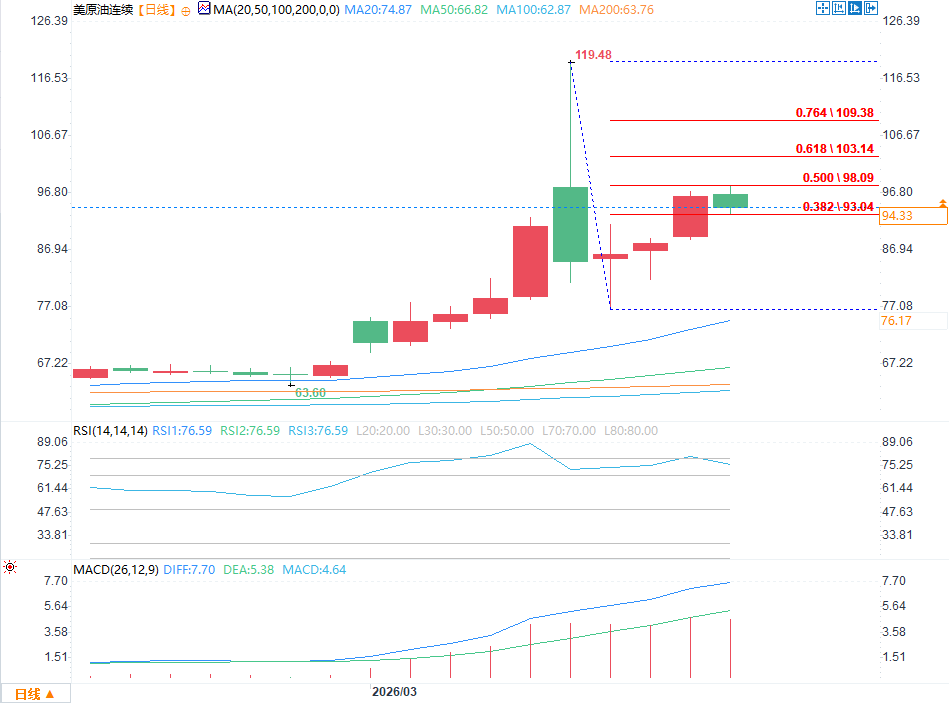
(WTI crude oil daily chart source: FX678)
From a technical perspective, the recent rise in crude oil prices has reached the key 50% Fibonacci retracement level. This level typically corresponds to a strong resistance zone, so the price fluctuations around this level are a normal market reaction. Currently, the market lacks sufficient momentum to challenge the 61.8% Fibonacci retracement level, suggesting that oil prices are more likely to enter a consolidation phase in the short term.
In other words, fundamental factors provide an upside risk premium for oil prices, while technical factors limit the speed of short-term increases. Under the interplay of these two forces, oil prices will likely continue to fluctuate at high levels.
In conclusion, the real variable remains in the Hormuz region.
Overall, the core driver of current oil prices remains the security of shipping through the Strait of Hormuz —a key variable determining future price trends. If shipping through the Strait of Hormuz gradually resumes, market risk premiums will decline rapidly, and oil prices are expected to fall. However, if regional conflicts continue to escalate, or the strait remains effectively closed for an extended period, the market will reprice global energy supply risks, and the upside potential for oil prices should not be underestimated. Currently, due to shipping disruptions, Gulf states such as Saudi Arabia and the UAE have announced crude oil production cuts, further exacerbating expectations of supply shortages.
Therefore, the key to future oil price trends does not lie in short-term policy reassurance, but in a core issue: whether the Strait of Hormuz will resume normal navigation or continue to be a "bottleneck" restricting the global energy market.
Frequently Asked Questions
Question 1: Why does the closure of the Strait of Hormuz have such a huge impact on global oil prices?
A: The Strait of Hormuz is the most critical choke point for global oil transportation, with an average daily throughput of approximately 20 million barrels, accounting for 25% of global seaborne oil trade. If it were to close, exports from countries such as Saudi Arabia and Iraq would be disrupted, resulting in a daily supply loss of 15-18 million barrels, far exceeding the 400 million barrel reserve buffer capacity released by the IEA, causing the risk premium to instantly push up oil prices.Question 2: Why did the release of strategic petroleum reserves by various countries fail to effectively lower oil prices?
A: Although the reserve release was record-breaking, it was a short-term measure and could only cover a shortfall of about 20 days. The market had developed a "boy who cried wolf" mentality, believing that the reserves could not solve the fundamental problem of the long-standing obstruction at Hormuz. Therefore, oil prices rose instead of falling after the announcement.Question 3: Why did Trump's statement that "Iran is close to surrender" only cause a brief pullback?
A: This statement was seen as a positive emotional move, temporarily lowering the risk premium, but it lacked concrete evidence of a ceasefire, and Trump's previous statements were inconsistent. Fundamental supply disruptions persist, with over 200 oil tankers still stranded in the Gulf, and the market quickly returned to reality.Question 4: What role do the 50% and 61.8% Fibonacci retracement levels play in this oil price movement?
A: The 50% retracement level is a strong resistance zone, and the repeated fluctuations in oil prices around this level indicate weakening upward momentum. The 61.8% Fibonacci retracement level is a key level; a break above it would suggest a continuation of the trend. The fact that it hasn't been broken yet suggests that oil prices are more likely to fluctuate at higher levels in the short term.Question 5: What consequences would the global economy face if the Strait of Hormuz were closed indefinitely?
A: Oil prices may test $140-150, pushing up global inflation (US gasoline prices have already risen by 80%), with businesses passing on costs to consumers, postponing expectations of a Federal Reserve rate cut, and even triggering stagflation. Goldman Sachs and Morgan Stanley have both warned that continued disruptions will reshape the energy pricing landscape.
- Risk Warning and Disclaimer
- The market involves risk, and trading may not be suitable for all investors. This article is for reference only and does not constitute personal investment advice, nor does it take into account certain users’ specific investment objectives, financial situation, or other needs. Any investment decisions made based on this information are at your own risk.

