Gold faces a perfect stagflation storm
2026-03-13 22:11:26
In the current global economic landscape, the dual pressures of slowing US economic growth and persistent inflation are brewing an unprecedented "perfect stagflation storm" for the gold market. This economic predicament—stagnant growth coupled with persistently high inflation—perfectly aligns with the core value logic of gold, creating an optimal investment window for this traditional safe-haven asset. According to the latest revised fourth-quarter GDP data released by the US Department of Commerce, the US economy grew by only 0.7%, nearly halved from the initial forecast of 1.4%. This revised data not only directly reflects the continued weakness of the US economic recovery momentum but also releases a clear signal of stagflation, indicating that the US economy may face a dilemma of "weak growth and persistent inflation" in the near future. This is precisely the core catalyst for the continued strength of gold prices. At 22:09 Beijing time, spot gold was trading at $5101.01 per ounce, up 0.43%.

The Safe-Haven Demand for Gold: Expert Opinions and Market Evidence
Against the backdrop of slowing economic growth and persistent inflationary pressures, gold's core value as the "king of safe havens" has once again been highlighted by the market, becoming an important line of defense for investors against economic uncertainty. Kitco News recently conducted in-depth interviews with several senior metal analysts. In one interview, Laks Ganapathi, CEO of Unicus Research, emphasized gold's irreplaceable role in a stagflation environment. He clearly stated: "When economic growth stagnates and inflation remains high, investors' primary choice will inevitably turn to safe-haven assets like gold, especially against the backdrop of continuously declining real yields, where gold's advantages become even more prominent. Gold's core value lies not only in its ability to effectively combat inflationary erosion, but also in providing investors with a reliable function of preserving value in an environment of uncertain economic prospects and increased market volatility, which is unmatched by other financial assets."
This core characteristic of gold has been fully demonstrated in the current market environment. According to data on Personal Consumption Expenditures (PCE) released by the U.S. Department of Commerce, despite continued weak U.S. economic growth, the core PCE inflation rate remains stable at a high level of 2.9%, far exceeding the Federal Reserve's long-term inflation target of 2%. This means that inflationary pressures have not eased with the economic slowdown, but rather exhibit a "stubborn stickiness." This situation has led to renewed market recognition of gold's value as an inflation hedge, with funds continuously flowing into the gold market, driving a steady rise in gold prices and further confirming experts' assessment of gold's dual attributes of safe-haven and inflation hedge.
Inflation and Gold: A Positive Cycle of Mutual Influence
Despite increasingly clear signs of a slowdown in the US economy, several top Wall Street investment banks remain optimistic about gold's upside potential. Goldman Sachs economists, in a recent research report, explicitly stated that gold's upward momentum has not weakened but will instead continue to strengthen in a stagflationary environment. The report noted that as US real yields continue to decline, gold will be one of the biggest beneficiaries, especially given the Federal Reserve's high probability of maintaining a neutral monetary policy for an extended period and refraining from raising interest rates rashly in the short term. This will further reduce the cost of holding gold, enhancing its attractiveness and creating a positive cycle of "high inflation → declining real yields → increased gold demand → rising prices."
In a subsequent interview, Laks Ganapathi further elaborated on this logic, stating, "The decline in real yields is one of the core drivers of rising gold prices. As an asset with no fixed income, gold's relative advantage is amplified when real yields are negative or low. Currently, US inflation remains high, while market expectations for Fed rate cuts are gradually rising, making it difficult for interest rates to rise further. This keeps the cost of holding gold at a low level. At the same time, the pressure of asset devaluation brought about by inflation has significantly increased investors' demand for gold as a hedge against inflation. This combination of supply and demand benefits will continue to drive gold prices higher."
Gold and Global Uncertainty: Additional Geopolitical Support
The strength of gold prices is not only due to the stagflationary environment in the United States, but also to the increasing geopolitical uncertainty worldwide, which provides strong additional support for gold prices. Recently, tensions in the Middle East have continued to escalate, with friction between Iran and its neighboring countries, coupled with threats to shipping safety in the Strait of Hormuz, posing a severe challenge to the global oil supply chain. This has led to a sustained rise in international oil prices, further exacerbating global inflationary pressures and creating a chain reaction: "geopolitical conflict → rising oil prices → increased inflation → increased demand for gold as a safe haven."
A recent feature article in Brazil's Rio Times points out that current global geopolitical conflicts are exhibiting a trend of "multi-point outbreaks and continuous escalation," particularly the tensions in the Middle East, which are constantly exacerbating the volatility of global financial markets. Gold, as a traditional safe-haven asset, consistently performs exceptionally well in such crises. The report explicitly states: "Imported inflationary pressures from rising oil prices, coupled with market panic stemming from geopolitical conflicts, have made gold a 'safe haven' for investors. Both institutional and individual investors are continuously increasing the proportion of gold in their asset allocations. This trend will continue to support gold prices, allowing them to maintain strong upward momentum against the backdrop of escalating global uncertainty."
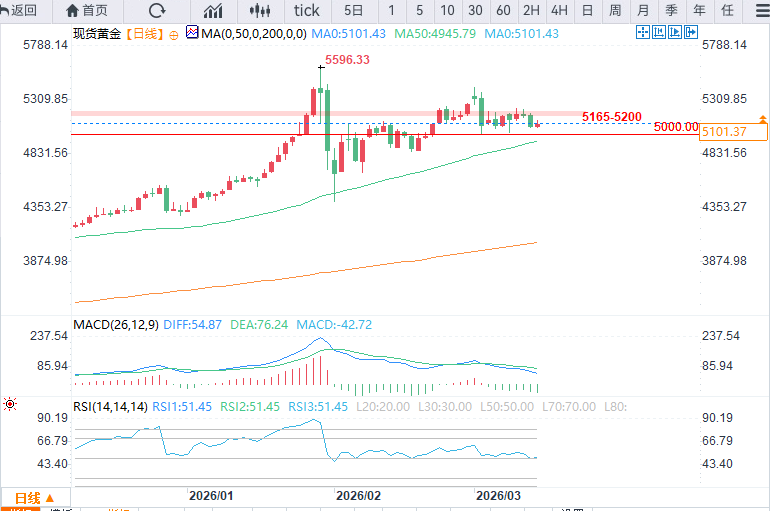
(Spot gold daily chart source: FX678)
This view aligns closely with the analysis from Unicus Research. Laks Ganapathi added, "As global geopolitical uncertainty continues to escalate, gold's value has transcended that of a simple inflation hedge, becoming a core asset for hedging geopolitical risks. In today's world of unstable global supply chains, frequent regional conflicts, and intensified geopolitical competition, gold's function as a store of value and a safe haven has been further amplified, making it an indispensable 'safety cushion' in investors' portfolios. This also provides important support for the long-term strength of gold prices."
Gold's outlook in a stagflationary environment: short-term volatility, long-term positive outlook.
In summary, the current combination of weak economic growth, persistent inflationary pressures, and heightened global geopolitical uncertainty creates a perfect environment for gold's strength, making its long-term prospects particularly bright. However, analysts generally believe that gold may face some short-term pressures, such as a temporary strengthening of the US dollar index, adjustments in inflation expectations due to fluctuations in international oil prices, and short-term selling pressure from profit-taking by some investors. Nevertheless, these factors will not change the long-term upward trend of gold, which, as a safe-haven asset, will continue to benefit from the current stagflationary environment.
A senior analyst at Kitco News clearly stated: "Although gold may experience some volatility in the short term, and even a period of correction, in the long run, against the backdrop of low real yields, high inflation, and global economic uncertainty, gold will continue to outperform most other assets. Currently, more and more investors are beginning to reassess gold's place in asset allocation, especially in a stagflation environment, where gold can effectively balance portfolio risk and provide investors with stable long-term returns. Therefore, holding gold for the long term will become a rational choice for most investors."
Laks Ganapathi further elaborated on his assessment of gold's long-term prospects, stating, "With the continued increase in global economic uncertainty, gold is undoubtedly one of the assets most likely to continue to benefit in the coming years. On the one hand, inflationary pressures are unlikely to be fundamentally alleviated in the short term, and gold's function as an inflation hedge will continue to play a role; on the other hand, rising global debt levels and an uncertain economic recovery outlook will lead to a continued increase in market demand for safe-haven assets. These factors will continuously drive up the demand for gold, supporting a long-term rise in gold prices."
Conclusion: The Strategic Significance of Gold – A "Safety Insurance" in Turmoil
In summary, the current stagflationary environment facing the global economy has provided unprecedented support for gold. From the slowdown in US economic growth to the continued global geopolitical turmoil, and the expectation of potential future interest rate cuts by the Federal Reserve, all core factors are constantly highlighting the value of gold. Gold has long transcended the category of a simple "precious metal asset." It is not only an important tool for combating inflation and resisting asset devaluation, but also, in the volatile global economic landscape, has become the most reliable "safe haven" for investors, and its strategic significance is becoming increasingly prominent.
As Laks Ganapathi, CEO of Unicus Research, said at the end of the interview: "In such an uncertain world, gold is not just a tradable asset, but more like an insurance policy, an asset that can bring peace of mind to investors. No matter how the economy fluctuates or how geopolitical conflicts escalate, gold can provide stable protection for investors' assets with its unique value preservation and safe-haven properties. This is the core reason why gold can stand out in the current stagflation storm."
Looking ahead to the next few years, with the stagflation environment intensifying and global economic uncertainty continuing to rise, gold will continue to play an important role in investors' portfolios as a "safety cushion" and "inflation hedge," providing investors with long-term, stable investment returns and becoming one of the most attractive assets in the global financial market.
The Safe-Haven Demand for Gold: Expert Opinions and Market Evidence
Against the backdrop of slowing economic growth and persistent inflationary pressures, gold's core value as the "king of safe havens" has once again been highlighted by the market, becoming an important line of defense for investors against economic uncertainty. Kitco News recently conducted in-depth interviews with several senior metal analysts. In one interview, Laks Ganapathi, CEO of Unicus Research, emphasized gold's irreplaceable role in a stagflation environment. He clearly stated: "When economic growth stagnates and inflation remains high, investors' primary choice will inevitably turn to safe-haven assets like gold, especially against the backdrop of continuously declining real yields, where gold's advantages become even more prominent. Gold's core value lies not only in its ability to effectively combat inflationary erosion, but also in providing investors with a reliable function of preserving value in an environment of uncertain economic prospects and increased market volatility, which is unmatched by other financial assets."
This core characteristic of gold has been fully demonstrated in the current market environment. According to data on Personal Consumption Expenditures (PCE) released by the U.S. Department of Commerce, despite continued weak U.S. economic growth, the core PCE inflation rate remains stable at a high level of 2.9%, far exceeding the Federal Reserve's long-term inflation target of 2%. This means that inflationary pressures have not eased with the economic slowdown, but rather exhibit a "stubborn stickiness." This situation has led to renewed market recognition of gold's value as an inflation hedge, with funds continuously flowing into the gold market, driving a steady rise in gold prices and further confirming experts' assessment of gold's dual attributes of safe-haven and inflation hedge.
Inflation and Gold: A Positive Cycle of Mutual Influence
Despite increasingly clear signs of a slowdown in the US economy, several top Wall Street investment banks remain optimistic about gold's upside potential. Goldman Sachs economists, in a recent research report, explicitly stated that gold's upward momentum has not weakened but will instead continue to strengthen in a stagflationary environment. The report noted that as US real yields continue to decline, gold will be one of the biggest beneficiaries, especially given the Federal Reserve's high probability of maintaining a neutral monetary policy for an extended period and refraining from raising interest rates rashly in the short term. This will further reduce the cost of holding gold, enhancing its attractiveness and creating a positive cycle of "high inflation → declining real yields → increased gold demand → rising prices."
In a subsequent interview, Laks Ganapathi further elaborated on this logic, stating, "The decline in real yields is one of the core drivers of rising gold prices. As an asset with no fixed income, gold's relative advantage is amplified when real yields are negative or low. Currently, US inflation remains high, while market expectations for Fed rate cuts are gradually rising, making it difficult for interest rates to rise further. This keeps the cost of holding gold at a low level. At the same time, the pressure of asset devaluation brought about by inflation has significantly increased investors' demand for gold as a hedge against inflation. This combination of supply and demand benefits will continue to drive gold prices higher."
Gold and Global Uncertainty: Additional Geopolitical Support
The strength of gold prices is not only due to the stagflationary environment in the United States, but also to the increasing geopolitical uncertainty worldwide, which provides strong additional support for gold prices. Recently, tensions in the Middle East have continued to escalate, with friction between Iran and its neighboring countries, coupled with threats to shipping safety in the Strait of Hormuz, posing a severe challenge to the global oil supply chain. This has led to a sustained rise in international oil prices, further exacerbating global inflationary pressures and creating a chain reaction: "geopolitical conflict → rising oil prices → increased inflation → increased demand for gold as a safe haven."
A recent feature article in Brazil's Rio Times points out that current global geopolitical conflicts are exhibiting a trend of "multi-point outbreaks and continuous escalation," particularly the tensions in the Middle East, which are constantly exacerbating the volatility of global financial markets. Gold, as a traditional safe-haven asset, consistently performs exceptionally well in such crises. The report explicitly states: "Imported inflationary pressures from rising oil prices, coupled with market panic stemming from geopolitical conflicts, have made gold a 'safe haven' for investors. Both institutional and individual investors are continuously increasing the proportion of gold in their asset allocations. This trend will continue to support gold prices, allowing them to maintain strong upward momentum against the backdrop of escalating global uncertainty."
(Spot gold daily chart source: FX678)
This view aligns closely with the analysis from Unicus Research. Laks Ganapathi added, "As global geopolitical uncertainty continues to escalate, gold's value has transcended that of a simple inflation hedge, becoming a core asset for hedging geopolitical risks. In today's world of unstable global supply chains, frequent regional conflicts, and intensified geopolitical competition, gold's function as a store of value and a safe haven has been further amplified, making it an indispensable 'safety cushion' in investors' portfolios. This also provides important support for the long-term strength of gold prices."
Gold's outlook in a stagflationary environment: short-term volatility, long-term positive outlook.
In summary, the current combination of weak economic growth, persistent inflationary pressures, and heightened global geopolitical uncertainty creates a perfect environment for gold's strength, making its long-term prospects particularly bright. However, analysts generally believe that gold may face some short-term pressures, such as a temporary strengthening of the US dollar index, adjustments in inflation expectations due to fluctuations in international oil prices, and short-term selling pressure from profit-taking by some investors. Nevertheless, these factors will not change the long-term upward trend of gold, which, as a safe-haven asset, will continue to benefit from the current stagflationary environment.
A senior analyst at Kitco News clearly stated: "Although gold may experience some volatility in the short term, and even a period of correction, in the long run, against the backdrop of low real yields, high inflation, and global economic uncertainty, gold will continue to outperform most other assets. Currently, more and more investors are beginning to reassess gold's place in asset allocation, especially in a stagflation environment, where gold can effectively balance portfolio risk and provide investors with stable long-term returns. Therefore, holding gold for the long term will become a rational choice for most investors."
Laks Ganapathi further elaborated on his assessment of gold's long-term prospects, stating, "With the continued increase in global economic uncertainty, gold is undoubtedly one of the assets most likely to continue to benefit in the coming years. On the one hand, inflationary pressures are unlikely to be fundamentally alleviated in the short term, and gold's function as an inflation hedge will continue to play a role; on the other hand, rising global debt levels and an uncertain economic recovery outlook will lead to a continued increase in market demand for safe-haven assets. These factors will continuously drive up the demand for gold, supporting a long-term rise in gold prices."
Conclusion: The Strategic Significance of Gold – A "Safety Insurance" in Turmoil
In summary, the current stagflationary environment facing the global economy has provided unprecedented support for gold. From the slowdown in US economic growth to the continued global geopolitical turmoil, and the expectation of potential future interest rate cuts by the Federal Reserve, all core factors are constantly highlighting the value of gold. Gold has long transcended the category of a simple "precious metal asset." It is not only an important tool for combating inflation and resisting asset devaluation, but also, in the volatile global economic landscape, has become the most reliable "safe haven" for investors, and its strategic significance is becoming increasingly prominent.
As Laks Ganapathi, CEO of Unicus Research, said at the end of the interview: "In such an uncertain world, gold is not just a tradable asset, but more like an insurance policy, an asset that can bring peace of mind to investors. No matter how the economy fluctuates or how geopolitical conflicts escalate, gold can provide stable protection for investors' assets with its unique value preservation and safe-haven properties. This is the core reason why gold can stand out in the current stagflation storm."
Looking ahead to the next few years, with the stagflation environment intensifying and global economic uncertainty continuing to rise, gold will continue to play an important role in investors' portfolios as a "safety cushion" and "inflation hedge," providing investors with long-term, stable investment returns and becoming one of the most attractive assets in the global financial market.
- Risk Warning and Disclaimer
- The market involves risk, and trading may not be suitable for all investors. This article is for reference only and does not constitute personal investment advice, nor does it take into account certain users’ specific investment objectives, financial situation, or other needs. Any investment decisions made based on this information are at your own risk.