A chart shows that the Baltic Dry Index continued its upward trend, influenced by rising Capesize vessel freight rates.
2026-03-13 23:12:07
Latest data shows that on March 13, 2026, the Baltic Dry Index (BDI) reached 2028 points, a four-day high, up 2.84% month-on-month (compared to the previous value), marking the largest increase since February 23, 2026, and the third consecutive day of increase (including zero growth). Looking at the short-term charts, the recent 11 BDI data points show: 7 positive increases, 4 negative increases, and 0 zero increases. Specifically, the Panamax Freight Index (BPI) was 1838 points, up 0.16% from the previous value; the Capesize Freight Index (BCI) was 2880 points, up 5.84%; and the Supramax Freight Index (BSI) was 1283 points, down 0.54%. For detailed 720-day and 10-year trend charts of the Baltic Dry Index and its three main sub-indices, please refer to the specially designed charts.
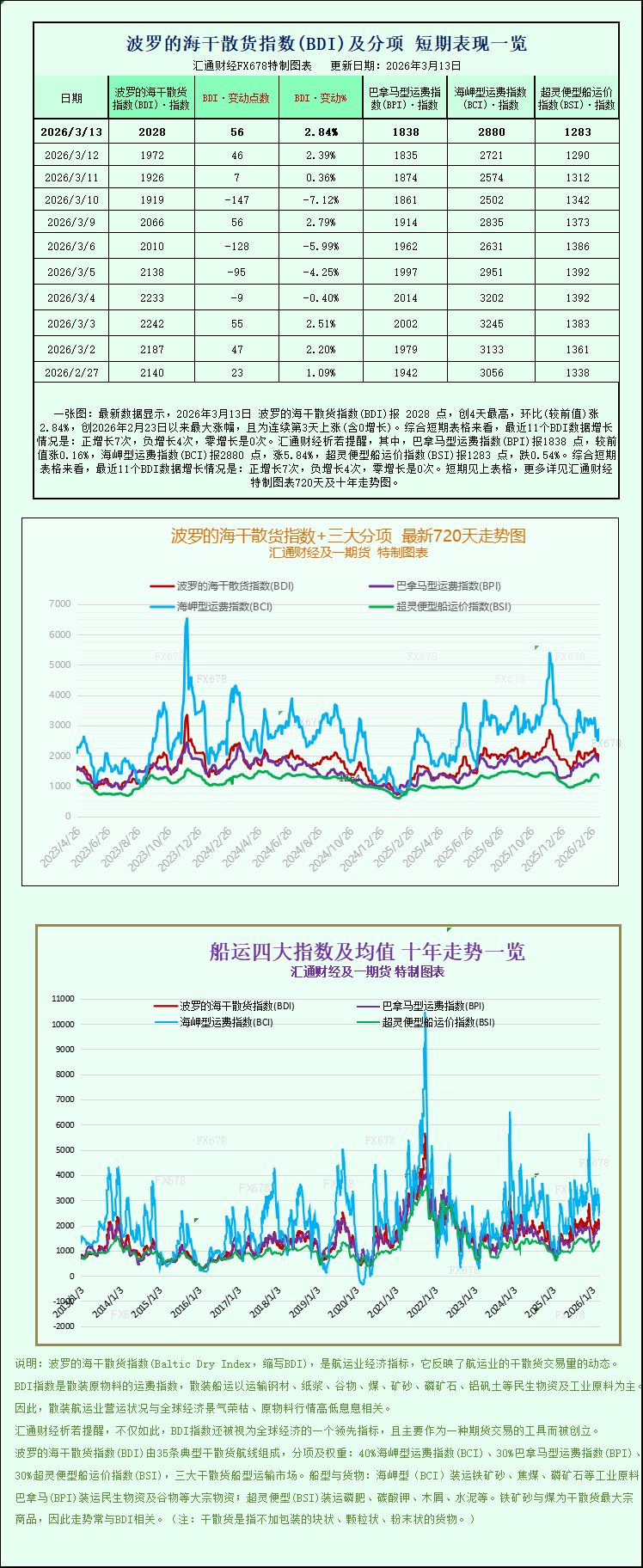
The Baltic Dry Index (BDI), which monitors freight rates for ships transporting dry bulk commodities and is a key indicator of the global dry bulk shipping market, directly reflects the balance between global commodity transportation demand and shipping capacity. The index continued its upward trend on Friday, with a significant increase in Capesize vessel freight rates being the core driving force, boosting overall dry bulk shipping market sentiment and reflecting a temporary recovery in global demand for some bulk commodities. As a key indicator of the global dry bulk shipping market's health, the BDI's fluctuations are closely related to the trading activity of core commodities such as iron ore and coal. This surge broke the previous days' consolidation pattern, highlighting the strong performance of the Capesize vessel segment and its impact on the overall market.
The Baltic Dry Index, which tracks freight rates for Capesize, Panamax, and Supramax vessels, rose 56 points, or 2.8%, to 2,028. The index gained 0.9% this week. While the overall increase was modest this week, Friday's rise was significantly stronger than previous trading days, primarily driven by a surge in Capesize freight rates. The divergent performance of Panamax and Supramax vessels did not significantly drag down the overall index, indicating a current dry bulk market pattern of "large vessels leading the gains, while medium and small vessels diverge."
The Capesize index rose 159 points, or 5.8%, to 2,880. The index has risen 9.5% this week. Capesize vessels, a backbone of global long-distance dry bulk shipping, primarily handle iron ore transport from Australia and Brazil to China, and coal transport from Colombia and South Africa to the Far East. This significant increase in the index directly reflects a temporary surge in global demand for core dry bulk commodities such as iron ore and coal, and is also linked to recent changes in global geopolitical tensions and concerns about commodity supply.
Average daily revenue for Capesize vessels transporting 150,000 tons of cargo, including iron ore and coal, increased by $1,448 to $22,621. This revenue level represents a significant improvement over the same period last week, reaching a near one-month high. This is primarily due to increased global demand for iron ore transportation, coupled with capacity constraints on some routes, which boosted charter demand for Capesize vessels, leading to a steady increase in daily revenue and reflecting improved profitability for shipping companies in the current market environment.
U.S. Defense Secretary Peter Hegses stated at a press conference on Friday that there is no clear evidence that Iran has laid mines in the Strait of Hormuz, contrasting with earlier news reports this week that Iran had laid approximately a dozen mines in the strait. The Strait of Hormuz is a vital global shipping route, handling more than a quarter of the world's seaborne oil and about one-fifth of global liquefied natural gas shipments. Its security directly impacts global shipping capacity scheduling and freight rate trends. The Defense Secretary's statement has alleviated market concerns about the strait's security to some extent, indirectly supporting the stable operation of the dry bulk shipping market and positively influencing the route planning of large vessels such as Capesize ships.
On Friday, iron ore futures in Dalian rose for the third consecutive trading day.
The Panamax index rose slightly by 3 points, or 0.2%, to 1,838, but fell 6.3% for the week. Panamax vessels primarily carry 60,000 to 70,000 tons of coal or grain. The slight increase in the index, though not a significant rise, reflects relatively weak demand in this segment, contrasting sharply with the strong performance of the Capesize market. This is mainly due to stable global grain trade demand. While coal transport demand is supported, ample capacity on some routes has prevented a sustained rise in the index, and the week's decline reflects the current weakness in this vessel type market.
The average daily earnings for Panamax vessels (typically carrying 60,000 to 70,000 tons of coal or grain) increased by $30 to $16,546. Despite a cumulative decline in the Panamax vessel index this week, the average daily earnings still saw a slight increase, primarily due to a short-term boost in coal transport demand in some regions, leading to a temporary recovery in charter demand for this vessel type. However, due to overall weak market demand, the increase in daily earnings was limited and failed to reverse the overall decline for the week.
The Very Large Bulk Carrier (VLCC) index fell 7 points, or 0.5%, to 1,283, a cumulative decline of 7.4% this week. The continued decline in VLCC freight rates was one of the main factors dragging down the overall Baltic Dry Index (BDI) gains. This was primarily due to weak global demand for smaller bulk cargo shipping, coupled with an oversupply of some VLCC vessels, leading to persistently low freight rates. The cumulative decline this week further widened, reflecting a significant supply-demand imbalance in this segment of the market, making a substantial recovery unlikely in the short term.
The Baltic Dry Index (BDI), which monitors freight rates for ships transporting dry bulk commodities and is a key indicator of the global dry bulk shipping market, directly reflects the balance between global commodity transportation demand and shipping capacity. The index continued its upward trend on Friday, with a significant increase in Capesize vessel freight rates being the core driving force, boosting overall dry bulk shipping market sentiment and reflecting a temporary recovery in global demand for some bulk commodities. As a key indicator of the global dry bulk shipping market's health, the BDI's fluctuations are closely related to the trading activity of core commodities such as iron ore and coal. This surge broke the previous days' consolidation pattern, highlighting the strong performance of the Capesize vessel segment and its impact on the overall market.
The Baltic Dry Index, which tracks freight rates for Capesize, Panamax, and Supramax vessels, rose 56 points, or 2.8%, to 2,028. The index gained 0.9% this week. While the overall increase was modest this week, Friday's rise was significantly stronger than previous trading days, primarily driven by a surge in Capesize freight rates. The divergent performance of Panamax and Supramax vessels did not significantly drag down the overall index, indicating a current dry bulk market pattern of "large vessels leading the gains, while medium and small vessels diverge."
The Capesize index rose 159 points, or 5.8%, to 2,880. The index has risen 9.5% this week. Capesize vessels, a backbone of global long-distance dry bulk shipping, primarily handle iron ore transport from Australia and Brazil to China, and coal transport from Colombia and South Africa to the Far East. This significant increase in the index directly reflects a temporary surge in global demand for core dry bulk commodities such as iron ore and coal, and is also linked to recent changes in global geopolitical tensions and concerns about commodity supply.
Average daily revenue for Capesize vessels transporting 150,000 tons of cargo, including iron ore and coal, increased by $1,448 to $22,621. This revenue level represents a significant improvement over the same period last week, reaching a near one-month high. This is primarily due to increased global demand for iron ore transportation, coupled with capacity constraints on some routes, which boosted charter demand for Capesize vessels, leading to a steady increase in daily revenue and reflecting improved profitability for shipping companies in the current market environment.
U.S. Defense Secretary Peter Hegses stated at a press conference on Friday that there is no clear evidence that Iran has laid mines in the Strait of Hormuz, contrasting with earlier news reports this week that Iran had laid approximately a dozen mines in the strait. The Strait of Hormuz is a vital global shipping route, handling more than a quarter of the world's seaborne oil and about one-fifth of global liquefied natural gas shipments. Its security directly impacts global shipping capacity scheduling and freight rate trends. The Defense Secretary's statement has alleviated market concerns about the strait's security to some extent, indirectly supporting the stable operation of the dry bulk shipping market and positively influencing the route planning of large vessels such as Capesize ships.
On Friday, iron ore futures in Dalian rose for the third consecutive trading day.
The Panamax index rose slightly by 3 points, or 0.2%, to 1,838, but fell 6.3% for the week. Panamax vessels primarily carry 60,000 to 70,000 tons of coal or grain. The slight increase in the index, though not a significant rise, reflects relatively weak demand in this segment, contrasting sharply with the strong performance of the Capesize market. This is mainly due to stable global grain trade demand. While coal transport demand is supported, ample capacity on some routes has prevented a sustained rise in the index, and the week's decline reflects the current weakness in this vessel type market.
The average daily earnings for Panamax vessels (typically carrying 60,000 to 70,000 tons of coal or grain) increased by $30 to $16,546. Despite a cumulative decline in the Panamax vessel index this week, the average daily earnings still saw a slight increase, primarily due to a short-term boost in coal transport demand in some regions, leading to a temporary recovery in charter demand for this vessel type. However, due to overall weak market demand, the increase in daily earnings was limited and failed to reverse the overall decline for the week.
The Very Large Bulk Carrier (VLCC) index fell 7 points, or 0.5%, to 1,283, a cumulative decline of 7.4% this week. The continued decline in VLCC freight rates was one of the main factors dragging down the overall Baltic Dry Index (BDI) gains. This was primarily due to weak global demand for smaller bulk cargo shipping, coupled with an oversupply of some VLCC vessels, leading to persistently low freight rates. The cumulative decline this week further widened, reflecting a significant supply-demand imbalance in this segment of the market, making a substantial recovery unlikely in the short term.
- Risk Warning and Disclaimer
- The market involves risk, and trading may not be suitable for all investors. This article is for reference only and does not constitute personal investment advice, nor does it take into account certain users’ specific investment objectives, financial situation, or other needs. Any investment decisions made based on this information are at your own risk.