The US once again declares its victory, but is forced to ease sanctions on Russian oil.
2026-03-13 21:58:16
The situation in the Middle East has escalated dramatically recently, with the confrontation between the US and Iran reaching a fever pitch, causing severe fluctuations in global energy and financial markets.
U.S. Defense Secretary Hergsays has repeatedly sent strong signals, stating that the U.S. is working closely with Israel to prevent Iran from acquiring nuclear weapons as its core objective. He declared that the U.S. military launched the largest airstrike since the start of the war that day, striking more than 15,000 Iranian targets. He said that Iranian defense companies will be completely destroyed, Iranian leaders have moved to underground bunkers, and the Supreme Leader was injured.
Meanwhile, just four days after taking office, Iran's new Supreme Leader, Mojtaba, publicly articulated his worldview for the first time.
Mujtaba fully continued his predecessor's hardline approach: praising the damaged "resistance front," demanding that neighboring countries close US military bases, threatening to continue targeting US interests in the region, and emphasizing the need to close the Strait of Hormuz.
The statement offered no solution to the ceasefire, but instead promised “revenge” for the victims.
The Revolutionary Guard claimed to have attacked and rendered the USS Abraham Lincoln aircraft carrier inoperable, and also released satellite images of the strikes against US military bases in the Gulf.
Iran's deputy foreign minister made it clear that no mines have been laid in the Strait of Hormuz, that only ships from friendly countries are allowed to pass, that ships from warring countries do not have the right of safe passage, and warned that if energy facilities are attacked, regional oil and gas facilities will be engulfed in flames.
Faced with the escalating conflict, the United States has intensified its military strikes while the Treasury Department’s Office of Foreign Assets Control has issued a license to temporarily ease sanctions on Russian oil from March 12 to April 11, allowing the sale, transportation and unloading of Russian oil already loaded on ships. This is intended to alleviate the energy shock caused by the disruption of shipping in the Strait of Hormuz, which also means that the conflict is unlikely to subside quickly in the short term.
On Friday (March 13), WTI crude oil futures traded in a wide range during the Asian and European sessions, currently down 2.61%. This conflict directly impacts the core lifeline of the global crude oil market. The Strait of Hormuz is a transportation channel for about 20%-30% of the world's seaborne crude oil. The disruption of shipping has triggered supply panic, causing oil prices to soar and pushing up global inflation expectations.
In an effort to stabilize energy supplies, the United States eased sanctions on Russian oil, attempting to fill the supply gap and alleviate market concerns about energy shortages.
Rising oil prices not only disrupt global supply chain costs, but also present central banks in Europe and the United States with a dilemma of "fighting inflation and stabilizing growth".
Societe Generale points out that the oil shock has complicated the ECB's interest rate path. Even with rising inflation risks, maintaining the current policy in the short term remains the most likely option. The timing of interest rate hikes, which the market has already priced in, still needs to wait for further clarity on economic, inflation, and oil price data.
Unlike the strong rise in crude oil, gold has been under continuous pressure recently, entering a range-bound trading pattern. Spot gold is fluctuating between $5,000 and $5,200, and is likely to close lower for the second consecutive week, currently trading around $5,100.
The conflict between the US and Iran has driven up oil prices and triggered inflation concerns, reinforcing expectations that global interest rates will remain high for a long time. As a non-interest-bearing asset, gold is directly suppressed by the high interest rate environment, and its safe-haven properties are offset by inflation and interest rate pressures.
Although geopolitical conflicts are usually beneficial to gold, in this round, the upward momentum of gold prices is severely insufficient due to the combined effects of rising inflation driven by oil prices and hawkish expectations from central banks, presenting a pattern of "support from safe havens but no upward momentum".
In terms of their correlation, crude oil and gold have shown a divergent correlation in this round of conflict.
Both share the core trigger of geopolitical conflict; oil price increases stem from the risk of supply disruptions, while gold prices were initially supported by safe-haven demand.
However, subsequent trends diverged. Crude oil remained strong due to blocked energy channels and changes in the supply and demand pattern, while gold was suppressed by high interest rates and inflation expectations.
In the long run, if oil prices remain high and lead to a general rise in inflation, gold's value as an inflation hedge will gradually become apparent, and the two are expected to return to a positive correlation.
In the short term, the divergent trends will continue, influenced by interest rate policies, market expectations, and the pace of conflict.
Currently, besides oil prices, the most important focus of market observation is oil price volatility. If oil price volatility can be reduced at the current price level, it indicates a significant upward shift in the central value of crude oil, thereby further consolidating the narrative of rising global energy prices, ultimately affecting global inflation expectations, downstream chemical plant production plans, and reinforcing the logic of rising global raw material prices.
Overall, the US-Iran conflict is the core driver of current crude oil and gold price movements. Crude oil, influenced by shipping patterns in the Taiwan Strait and supply dynamics, remains strong and dominates global inflation and interest rate expectations.
Gold prices are fluctuating within a range amid a complex interplay of safe-haven demand, inflation, and interest rates. The easing of US sanctions on Russian oil, Iran's countermeasures, and the duration of the conflict will be key variables determining the extent of oil price increases and the direction of gold prices. Meanwhile, the policy direction of central banks in Europe and the US will continue to influence the medium-term trend of these two assets through interest rates.
From a technical perspective, spot gold has broken through the triple support levels of 5130, the 5-day moving average, and the upward channel. If it cannot recover in the short term, it can be considered to be weakening. However, it is highly likely that it will quickly recover to 5130 in the near future. If it does recover, then this break below will be a bear trap, a false breakout before the rise.
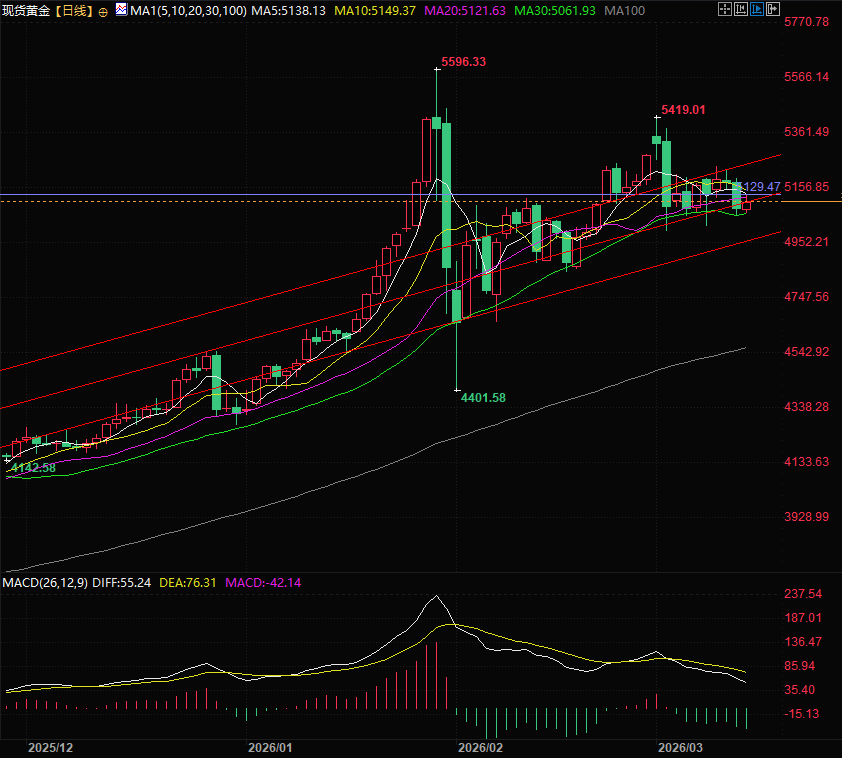
(Spot gold daily chart, source: FX678)
WTI crude oil futures are currently under pressure around 0.618 and have pulled back. The support level is around 92. Oil prices are waiting for the 5-day moving average, and after consolidation, they are expected to continue to rise.
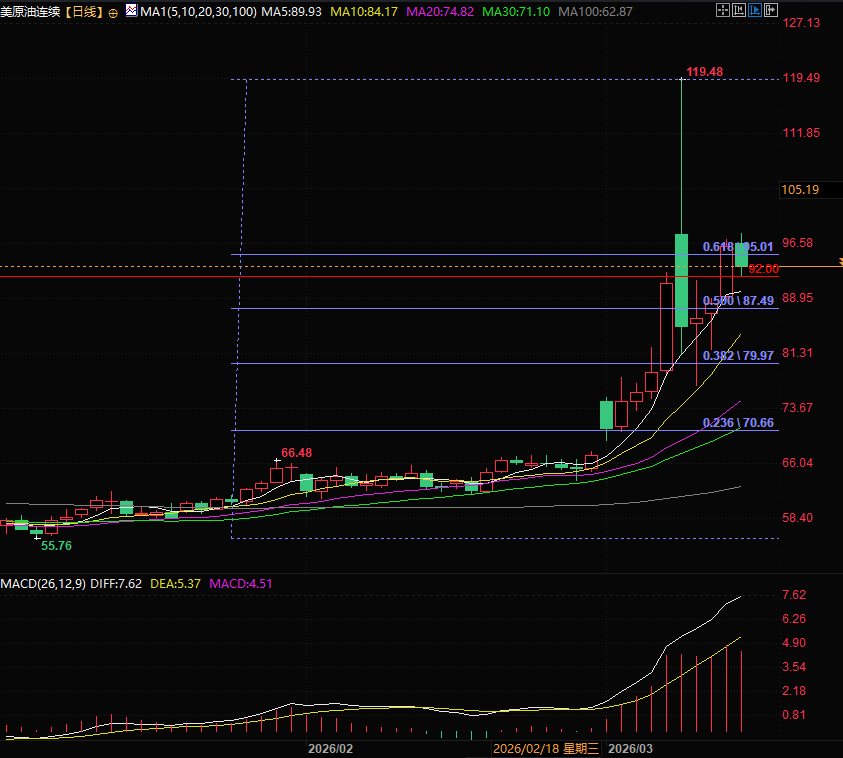
(WTI crude oil futures daily chart, source: FX678)
At 21:56 Beijing time, spot gold was trading at $5,105 per ounce, and WIT crude oil futures were trading at $94.19 per barrel.
U.S. Defense Secretary Hergsays has repeatedly sent strong signals, stating that the U.S. is working closely with Israel to prevent Iran from acquiring nuclear weapons as its core objective. He declared that the U.S. military launched the largest airstrike since the start of the war that day, striking more than 15,000 Iranian targets. He said that Iranian defense companies will be completely destroyed, Iranian leaders have moved to underground bunkers, and the Supreme Leader was injured.
Meanwhile, just four days after taking office, Iran's new Supreme Leader, Mojtaba, publicly articulated his worldview for the first time.
Mujtaba fully continued his predecessor's hardline approach: praising the damaged "resistance front," demanding that neighboring countries close US military bases, threatening to continue targeting US interests in the region, and emphasizing the need to close the Strait of Hormuz.
The statement offered no solution to the ceasefire, but instead promised “revenge” for the victims.
The Revolutionary Guard claimed to have attacked and rendered the USS Abraham Lincoln aircraft carrier inoperable, and also released satellite images of the strikes against US military bases in the Gulf.
Iran's deputy foreign minister made it clear that no mines have been laid in the Strait of Hormuz, that only ships from friendly countries are allowed to pass, that ships from warring countries do not have the right of safe passage, and warned that if energy facilities are attacked, regional oil and gas facilities will be engulfed in flames.
Faced with the escalating conflict, the United States has intensified its military strikes while the Treasury Department’s Office of Foreign Assets Control has issued a license to temporarily ease sanctions on Russian oil from March 12 to April 11, allowing the sale, transportation and unloading of Russian oil already loaded on ships. This is intended to alleviate the energy shock caused by the disruption of shipping in the Strait of Hormuz, which also means that the conflict is unlikely to subside quickly in the short term.
Crude oil market volatility: Supply structure reshaping, oil prices pushing up global inflation.
On Friday (March 13), WTI crude oil futures traded in a wide range during the Asian and European sessions, currently down 2.61%. This conflict directly impacts the core lifeline of the global crude oil market. The Strait of Hormuz is a transportation channel for about 20%-30% of the world's seaborne crude oil. The disruption of shipping has triggered supply panic, causing oil prices to soar and pushing up global inflation expectations.
In an effort to stabilize energy supplies, the United States eased sanctions on Russian oil, attempting to fill the supply gap and alleviate market concerns about energy shortages.
Rising oil prices not only disrupt global supply chain costs, but also present central banks in Europe and the United States with a dilemma of "fighting inflation and stabilizing growth".
Societe Generale points out that the oil shock has complicated the ECB's interest rate path. Even with rising inflation risks, maintaining the current policy in the short term remains the most likely option. The timing of interest rate hikes, which the market has already priced in, still needs to wait for further clarity on economic, inflation, and oil price data.
Gold prices are under pressure as safe-haven demand fails and prices fall into range-bound trading.
Unlike the strong rise in crude oil, gold has been under continuous pressure recently, entering a range-bound trading pattern. Spot gold is fluctuating between $5,000 and $5,200, and is likely to close lower for the second consecutive week, currently trading around $5,100.
The conflict between the US and Iran has driven up oil prices and triggered inflation concerns, reinforcing expectations that global interest rates will remain high for a long time. As a non-interest-bearing asset, gold is directly suppressed by the high interest rate environment, and its safe-haven properties are offset by inflation and interest rate pressures.
Although geopolitical conflicts are usually beneficial to gold, in this round, the upward momentum of gold prices is severely insufficient due to the combined effects of rising inflation driven by oil prices and hawkish expectations from central banks, presenting a pattern of "support from safe havens but no upward momentum".
The logic behind the correlation between oil and gold: short-term divergence, but a return to positive correlation in the long term.
In terms of their correlation, crude oil and gold have shown a divergent correlation in this round of conflict.
Both share the core trigger of geopolitical conflict; oil price increases stem from the risk of supply disruptions, while gold prices were initially supported by safe-haven demand.
However, subsequent trends diverged. Crude oil remained strong due to blocked energy channels and changes in the supply and demand pattern, while gold was suppressed by high interest rates and inflation expectations.
In the long run, if oil prices remain high and lead to a general rise in inflation, gold's value as an inflation hedge will gradually become apparent, and the two are expected to return to a positive correlation.
In the short term, the divergent trends will continue, influenced by interest rate policies, market expectations, and the pace of conflict.
Summary and Technical Analysis:
Currently, besides oil prices, the most important focus of market observation is oil price volatility. If oil price volatility can be reduced at the current price level, it indicates a significant upward shift in the central value of crude oil, thereby further consolidating the narrative of rising global energy prices, ultimately affecting global inflation expectations, downstream chemical plant production plans, and reinforcing the logic of rising global raw material prices.
Overall, the US-Iran conflict is the core driver of current crude oil and gold price movements. Crude oil, influenced by shipping patterns in the Taiwan Strait and supply dynamics, remains strong and dominates global inflation and interest rate expectations.
Gold prices are fluctuating within a range amid a complex interplay of safe-haven demand, inflation, and interest rates. The easing of US sanctions on Russian oil, Iran's countermeasures, and the duration of the conflict will be key variables determining the extent of oil price increases and the direction of gold prices. Meanwhile, the policy direction of central banks in Europe and the US will continue to influence the medium-term trend of these two assets through interest rates.
From a technical perspective, spot gold has broken through the triple support levels of 5130, the 5-day moving average, and the upward channel. If it cannot recover in the short term, it can be considered to be weakening. However, it is highly likely that it will quickly recover to 5130 in the near future. If it does recover, then this break below will be a bear trap, a false breakout before the rise.
(Spot gold daily chart, source: FX678)
WTI crude oil futures are currently under pressure around 0.618 and have pulled back. The support level is around 92. Oil prices are waiting for the 5-day moving average, and after consolidation, they are expected to continue to rise.
(WTI crude oil futures daily chart, source: FX678)
At 21:56 Beijing time, spot gold was trading at $5,105 per ounce, and WIT crude oil futures were trading at $94.19 per barrel.
- Risk Warning and Disclaimer
- The market involves risk, and trading may not be suitable for all investors. This article is for reference only and does not constitute personal investment advice, nor does it take into account certain users’ specific investment objectives, financial situation, or other needs. Any investment decisions made based on this information are at your own risk.