Oil prices sound the alarm for stagflation, and the Republican Party's election prospects accelerate.
2026-03-13 20:47:45
Ryan Sweet, chief global economist at Oxford Economics, and Ben May, head of global macro research, pointed out that although the United States has not yet entered a recession, risks have been gradually accumulating.
In its model, if global oil prices average $140 per barrel within two months, coupled with a scenario of "significantly tightening financial market conditions, exacerbated supply chain disruptions, and continued deterioration of market confidence," the US economy will approach a "temporary standstill," a wave of layoffs will drive up the unemployment rate, and the Eurozone, the UK, and Japan will directly fall into a mild recession.
Even if the situation eases relatively, if oil prices remain around $100 per barrel for two months, global GDP growth will decline by 0.2-0.3 percentage points, and continued inflationary pressures will further erode people's purchasing power.
This assessment is highly consistent with current economic data: although the US inflation rate in 2024 has declined from the peak in 2022, it still remains at a moderately high level of 2.95%. Coupled with the cumulative price increase of 20% during Biden's four years in office, the cost of living for ordinary people has increased significantly - unless wages have increased by 25% in the past five years, their actual purchasing power has declined significantly compared to five years ago.
More seriously, the labor market is showing signs of weakness, with the number of unemployed rising to 6.8 million and the number of new unemployment claims climbing to its highest point in more than a year. The stagflationary characteristics of a weak economic recovery and persistent inflation are becoming increasingly prominent.
Bank of America economist Aditya Buff cautioned that Wall Street may have misjudged the impact of the Middle East situation on policy.
Unlike the strong demand in 2022, the current US labor market is weak and fiscal support is limited. If the oil shock continues to unfold, the Federal Reserve will likely adopt a more dovish policy response, but this will hardly resolve the stagflation dilemma at its root.
The risk of shipping disruptions in the Strait of Hormuz caused by the Middle East conflict has further exacerbated the energy market situation: as the only route for 20% of the world's oil supply, the safety of shipping through the strait directly affects oil price trends.
Data shows that since the US and Israel launched military action against Iran on February 28, the price of West Texas Intermediate crude oil has surged from $67 per barrel to $116. Although it has fallen back to around $90, it is still fluctuating at a high level, adding more uncertainty to the risk of stagflation.
Amid the shadow of stagflation, the election prospects for the November U.S. midterm elections are fluctuating dramatically, with Republican senators issuing a strong warning to President Trump: if the economic crisis is not alleviated, the Republican Party will face a "disastrous election."
During Trump's second term, weak employment data and high inflation were already difficult to resolve. Now, the double impact of the military conflict with Iran and the Supreme Court's overturning of the core provisions of its tariff powers has further escalated economic risks, directly threatening the Republican Party's struggle for control of both the House and Senate.
Kentucky Republican Senator Rand Paul's warning hits the nail on the head: "As the election approaches, if oil prices hit $100 a barrel in September or October, I expect a massive panic to erupt among Republicans."
This concern has spread within the party, with senior Trump administration officials and some Republican colleagues gradually realizing that voter discontent caused by stagflation is becoming the biggest threat to the election.
A poll by Hart Research and Public Opinion Strategy shows that 62% of respondents disapprove of Trump’s handling of inflation and the cost of living, up 7 percentage points from a year ago; while a New York Times poll shows that 28% of people list economic issues as the most critical issue in the election, 6% of respondents particularly emphasize inflationary pressures, and 66% of voters believe that household income is not keeping up with the rising cost of living.
However, it is worth noting that Trump's nominal approval rating was at its lowest during his term, around 38%, and has not yet fallen below that threshold.
Voter discontent is particularly evident in key districts. Maine Republican Senator Susan Collins, facing a fierce re-election race, stated that the state's vast rural areas and the need for many residents to commute long distances have led to widespread discontent among voters due to rising gasoline prices.
Meanwhile, agricultural states, which are key Republican strongholds, are facing "the most severe financial crisis in their memory." High fuel costs, coupled with depressed commodity prices due to trade tensions between the US and China and other major markets, are severely squeezing farmers' profit margins.
Iowa Republican Senator Chuck Grassley revealed that local farmers are losing $1 per bushel on corn and $2 per bushel on soybeans, with rising fuel prices being the final straw.
Kansas Republican Senator Jerry Moran stated that the contradiction between high prices of natural gas, a raw material for fertilizers, and low prices of agricultural products makes it difficult for farmers to maintain their operations. They urgently hope that Trump will complete trade agreement negotiations as soon as possible and reduce tariffs and non-tariff barriers, but the Supreme Court's ruling makes the realization of this demand uncertain.
The low morale within the party has further exacerbated the Republican Party's woes. An anonymous Republican senator revealed that his colleagues were surprised by the escalation of the conflict with Iran and are "trying to figure out where things are going." In last week's Texas primary, Republican voter turnout was lower than that of Democrats, a clear sign that the election is in dire straits.
"Democrats are highly mobilized and have a considerable number of voters. Republican voters, on the other hand, are much less enthusiastic, and we still have a lot of work to do," the congressman admitted.
Despite the Trump administration's emergency measures, including the Department of Energy's announcement of releasing 172 million barrels of strategic petroleum reserves and Grassley's proposal to allow the sale of E15 blended fuel throughout the year, these measures can only provide short-term relief from oil price pressures and are unlikely to fundamentally solve the problems of stagflation and agricultural difficulties.
Currently, besides the direction of oil prices, the market is more concerned about how long oil prices can remain at a certain level. Recently, oil prices have fluctuated wildly, and the market cannot determine the final anchor point of oil prices. If the price center of energy such as crude oil starts to be at a high level and remains stable, then the ultimate panic may arrive.
Regarding the election outcome, Jerry Moran frankly stated that it was difficult to predict, but clearly pointed out that "the overall economic situation, business operating costs, and various difficulties in the agricultural sector are all unfavorable to the Republican Party."
With the midterm elections approaching, the anxieties about people's livelihoods caused by stagflation have transformed into clear political pressure. If the Republican Party cannot resolve the economic predicament and regain voters' trust in the short term, its control of both the House and Senate will be in jeopardy. The policy adjustments of the Trump administration and the development of the situation in Iran will become key variables influencing the election results.
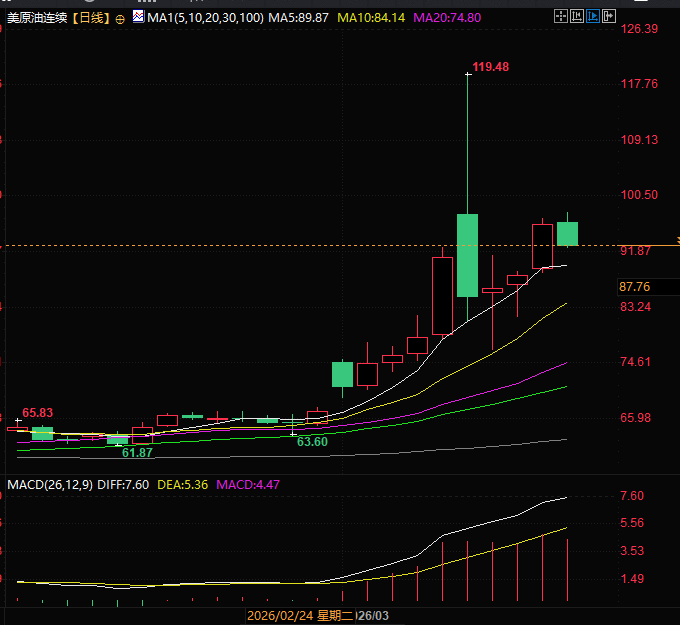
(US crude oil daily chart, source: FX678)
Oil prices show that the 5-day moving average has risen from 60 to 90, and the overall oil price level is steadily rising.
In its model, if global oil prices average $140 per barrel within two months, coupled with a scenario of "significantly tightening financial market conditions, exacerbated supply chain disruptions, and continued deterioration of market confidence," the US economy will approach a "temporary standstill," a wave of layoffs will drive up the unemployment rate, and the Eurozone, the UK, and Japan will directly fall into a mild recession.
Even if the situation eases relatively, if oil prices remain around $100 per barrel for two months, global GDP growth will decline by 0.2-0.3 percentage points, and continued inflationary pressures will further erode people's purchasing power.
Stagflation characteristics become apparent: declining purchasing power and a weak job market.
This assessment is highly consistent with current economic data: although the US inflation rate in 2024 has declined from the peak in 2022, it still remains at a moderately high level of 2.95%. Coupled with the cumulative price increase of 20% during Biden's four years in office, the cost of living for ordinary people has increased significantly - unless wages have increased by 25% in the past five years, their actual purchasing power has declined significantly compared to five years ago.
More seriously, the labor market is showing signs of weakness, with the number of unemployed rising to 6.8 million and the number of new unemployment claims climbing to its highest point in more than a year. The stagflationary characteristics of a weak economic recovery and persistent inflation are becoming increasingly prominent.
Policy Response Conundrum: Fed's Dovish Tendency Fails to Break the Deadlock
Bank of America economist Aditya Buff cautioned that Wall Street may have misjudged the impact of the Middle East situation on policy.
Unlike the strong demand in 2022, the current US labor market is weak and fiscal support is limited. If the oil shock continues to unfold, the Federal Reserve will likely adopt a more dovish policy response, but this will hardly resolve the stagflation dilemma at its root.
The risk of shipping disruptions in the Strait of Hormuz caused by the Middle East conflict has further exacerbated the energy market situation: as the only route for 20% of the world's oil supply, the safety of shipping through the strait directly affects oil price trends.
Data shows that since the US and Israel launched military action against Iran on February 28, the price of West Texas Intermediate crude oil has surged from $67 per barrel to $116. Although it has fallen back to around $90, it is still fluctuating at a high level, adding more uncertainty to the risk of stagflation.
Midterm Election Countdown: Republicans Pushed to the Brink by Economic Crisis
Amid the shadow of stagflation, the election prospects for the November U.S. midterm elections are fluctuating dramatically, with Republican senators issuing a strong warning to President Trump: if the economic crisis is not alleviated, the Republican Party will face a "disastrous election."
During Trump's second term, weak employment data and high inflation were already difficult to resolve. Now, the double impact of the military conflict with Iran and the Supreme Court's overturning of the core provisions of its tariff powers has further escalated economic risks, directly threatening the Republican Party's struggle for control of both the House and Senate.
Kentucky Republican Senator Rand Paul's warning hits the nail on the head: "As the election approaches, if oil prices hit $100 a barrel in September or October, I expect a massive panic to erupt among Republicans."
This concern has spread within the party, with senior Trump administration officials and some Republican colleagues gradually realizing that voter discontent caused by stagflation is becoming the biggest threat to the election.
Polls Reflect Anxiety: Economic Issues Become Core Concern for Voters
A poll by Hart Research and Public Opinion Strategy shows that 62% of respondents disapprove of Trump’s handling of inflation and the cost of living, up 7 percentage points from a year ago; while a New York Times poll shows that 28% of people list economic issues as the most critical issue in the election, 6% of respondents particularly emphasize inflationary pressures, and 66% of voters believe that household income is not keeping up with the rising cost of living.
However, it is worth noting that Trump's nominal approval rating was at its lowest during his term, around 38%, and has not yet fallen below that threshold.
Key electoral districts are in crisis: discontent is concentrated in agricultural states and rural areas.
Voter discontent is particularly evident in key districts. Maine Republican Senator Susan Collins, facing a fierce re-election race, stated that the state's vast rural areas and the need for many residents to commute long distances have led to widespread discontent among voters due to rising gasoline prices.
Meanwhile, agricultural states, which are key Republican strongholds, are facing "the most severe financial crisis in their memory." High fuel costs, coupled with depressed commodity prices due to trade tensions between the US and China and other major markets, are severely squeezing farmers' profit margins.
Iowa Republican Senator Chuck Grassley revealed that local farmers are losing $1 per bushel on corn and $2 per bushel on soybeans, with rising fuel prices being the final straw.
Kansas Republican Senator Jerry Moran stated that the contradiction between high prices of natural gas, a raw material for fertilizers, and low prices of agricultural products makes it difficult for farmers to maintain their operations. They urgently hope that Trump will complete trade agreement negotiations as soon as possible and reduce tariffs and non-tariff barriers, but the Supreme Court's ruling makes the realization of this demand uncertain.
Deteriorating election prospects: voter turnout gap and inadequate emergency measures
The low morale within the party has further exacerbated the Republican Party's woes. An anonymous Republican senator revealed that his colleagues were surprised by the escalation of the conflict with Iran and are "trying to figure out where things are going." In last week's Texas primary, Republican voter turnout was lower than that of Democrats, a clear sign that the election is in dire straits.
"Democrats are highly mobilized and have a considerable number of voters. Republican voters, on the other hand, are much less enthusiastic, and we still have a lot of work to do," the congressman admitted.
Despite the Trump administration's emergency measures, including the Department of Energy's announcement of releasing 172 million barrels of strategic petroleum reserves and Grassley's proposal to allow the sale of E15 blended fuel throughout the year, these measures can only provide short-term relief from oil price pressures and are unlikely to fundamentally solve the problems of stagflation and agricultural difficulties.
In summary: The election outcome is unpredictable; geopolitical variables and the central level of crude oil prices are key factors.
Currently, besides the direction of oil prices, the market is more concerned about how long oil prices can remain at a certain level. Recently, oil prices have fluctuated wildly, and the market cannot determine the final anchor point of oil prices. If the price center of energy such as crude oil starts to be at a high level and remains stable, then the ultimate panic may arrive.
Regarding the election outcome, Jerry Moran frankly stated that it was difficult to predict, but clearly pointed out that "the overall economic situation, business operating costs, and various difficulties in the agricultural sector are all unfavorable to the Republican Party."
With the midterm elections approaching, the anxieties about people's livelihoods caused by stagflation have transformed into clear political pressure. If the Republican Party cannot resolve the economic predicament and regain voters' trust in the short term, its control of both the House and Senate will be in jeopardy. The policy adjustments of the Trump administration and the development of the situation in Iran will become key variables influencing the election results.
(US crude oil daily chart, source: FX678)
Oil prices show that the 5-day moving average has risen from 60 to 90, and the overall oil price level is steadily rising.
- Risk Warning and Disclaimer
- The market involves risk, and trading may not be suitable for all investors. This article is for reference only and does not constitute personal investment advice, nor does it take into account certain users’ specific investment objectives, financial situation, or other needs. Any investment decisions made based on this information are at your own risk.