Despite weak data, the dollar rose against the trend, confirming its strong position.
2026-03-14 01:56:39
Table of Contents
Market Review
On Friday (March 12), the US dollar index continued its strong performance during the US trading session, breaking through the 100 mark and ultimately closing at 100.32, a daily gain of approximately 0.58%. This move not only reached a near four-month high but also solidified a two-week winning streak. During the session, the euro came under significant pressure against the dollar and the dollar against the yen, with the euro falling to a multi-month low and the yen hitting a 20-month low. Overall market sentiment leaned towards risk aversion, significantly increasing the dollar's appeal as a traditional safe-haven currency.
Data Release
Today's key data releases presented a mixed picture, but did not hinder the dollar's rise. Fourth-quarter GDP grew at an annualized rate of 0.7%, significantly lower than the market expectation of 1.4%, reflecting a slowdown in economic growth momentum; the core PCE price index rose in line with the expected 0.4% month-on-month, while the annual rate rose slightly to 3.1%; the trade deficit narrowed to $54.5 billion in January, with clear signs of an export recovery; initial jobless claims remained low, and housing starts data also exceeded expectations. These results were generally neutral to slightly weak, initially putting pressure on the market, but quickly reversed course, with the dollar strengthening against the trend. Investors interpreted this as continued economic resilience, with geopolitical factors dominating the final reaction.
Fundamental Analysis
The core drivers of the US dollar's fundamentals lie in geopolitical risks and energy market dynamics. The escalating conflict in the Middle East, particularly the heightened tensions between the US and Iran and the potential threat from the Strait of Hormuz, has led to a return to high oil prices. This has highlighted the US's independent advantage as a net energy exporter, strengthening the dollar's relative attractiveness. Simultaneously, rising oil prices have directly pushed up global inflation expectations, reducing the room for monetary easing in other economies. Secondary factors include a stable US job market, improved trade data, and overall economic resilience; these elements collectively support the dollar, but their impact is less pronounced than the primary geopolitical factors.
Fed expectations
Expectations for Federal Reserve policy have cooled significantly. The market is currently pricing in only a 25-basis-point rate cut in 2026, possibly delayed until after September. The Fed is highly likely to maintain the 3.5%-3.75% interest rate range at next week's meeting. Morgan Stanley analysts explicitly stated that "the Fed will hold rates steady next week" due to uncertainty surrounding the inflation path caused by oil price fluctuations. The interest rate differential continues to widen, increasing the attractiveness of dollar carry trades. Recent reports from multiple institutions indicate that investors have lowered their expectations for the number of rate cuts, reflecting an acceptance of the persistence of the high-interest-rate environment.
Media Views
Mainstream media outlets generally emphasized the return of the dollar's safe-haven appeal. Reuters noted that "the dollar strengthened due to war concerns, while the euro and yen fell to multi-month lows"; FXStreet analysis stated that "rising oil prices are reinforcing the dollar's status as a safe-haven currency, requiring a reassessment of the Federal Reserve's policy"; Bloomberg and CNBC reports unanimously agree that the dollar's rebound stemmed from risk aversion. A JPMorgan survey showed a significant increase in long dollar positions. Analyst Juan Perez added, "In a chaotic world, the dollar always performs well."
Technical Observation
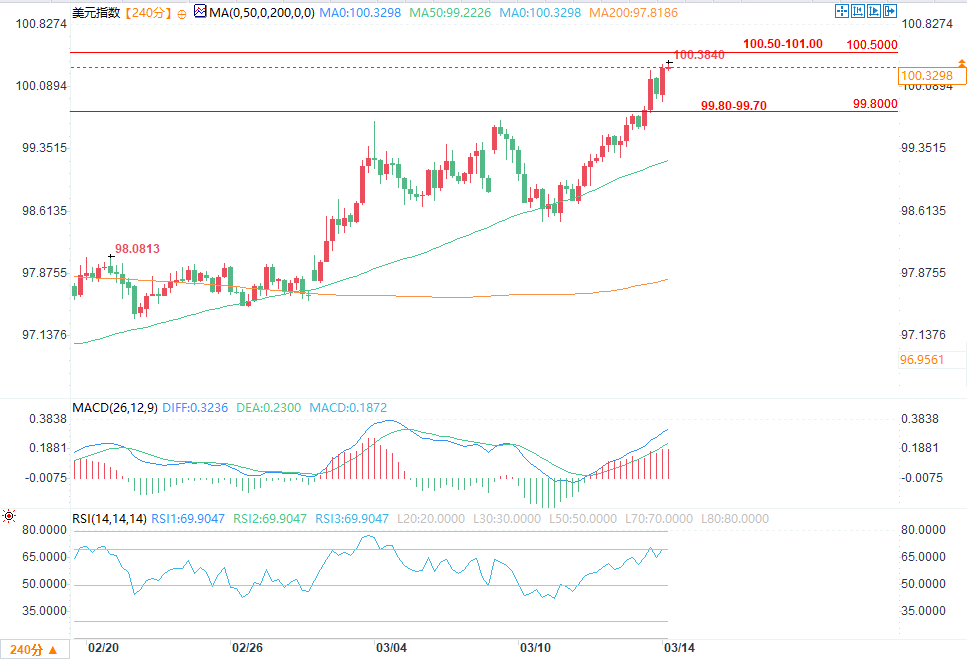
(US Dollar Index 4-hour chart source: FX678)
From a technical perspective, the US dollar index has stabilized above 100, and the 4-hour chart shows a clear bullish structure. Short-term resistance is seen in the 100.50-101.00 range; a break above this level would open up further upside potential. Support lies at 99.80-99.70; any pullback could be seen as a buying opportunity. The RSI indicator is in overbought territory but has not diverged, and the MACD golden cross signal remains valid, indicating overall bullish momentum.
Market Outlook
The US dollar is expected to maintain its strength in the short term, and geopolitical tensions will continue to support its performance unless there are signs of easing. Investors should be wary of the risk of a pullback due to sudden signs of peace or better-than-expected economic data. The highlight of next week's economic calendar is the Federal Reserve meeting on March 17-18, where the dot plot and policy wording will be key indicators. Traders are advised to pay attention to the correlation between oil prices and the US dollar and manage their positions prudently.
Frequently Asked Questions
Q: Why do geopolitical conflicts directly push up the US dollar index?
A: Escalating tensions in the Middle East have fueled global risk aversion, prompting investors to flock to the US dollar, a traditional safe-haven asset. Meanwhile, the US's energy independence allows it to benefit more from high oil prices, mitigating external shocks, while other economies face higher imported inflationary pressures. This asymmetric advantage further amplifies the dollar's attractiveness, creating a positive feedback loop.
Q: Why did today's GDP and PCE data fail to weigh on the US dollar?
A: Although actual GDP growth was lower than expected, the core PCE price index met forecasts, indicating that inflation remains sticky; the narrowing trade deficit and stable employment-related data highlight economic resilience. The market is focusing more on geopolitical factors than individual data points, and weak growth actually reinforces the Federal Reserve's necessity to maintain high interest rates, indirectly benefiting the US dollar.
Q: What is the background to the significant downward revision of the Fed's rate cut expectations in 2026?
A: Rising oil prices have directly increased uncertainty about the inflation path, and coupled with the lack of significant deterioration in the job market, policymakers are inclined to adopt a cautious wait-and-see approach. The market has shifted from expecting multiple rate cuts to only one, reflecting a consensus on the persistence of high interest rates, which maintains the dollar's interest rate advantage.
Q: Why do mainstream media outlets unanimously view the US dollar as a safe-haven asset?
A: Multiple authoritative institutions, such as Reuters, FXStreet, and Bloomberg, have observed that the euro, yen, and other currency pairs have hit lows, while dollar positions have rebounded significantly. The combined effect of war uncertainty and energy price volatility has made the dollar the preferred defensive tool, rather than solely relying on economic data.
Q: How should investors view the long-term prospects of the US dollar in the current environment?
A: The short-term bullish trend is clear, but if geopolitical conflicts ease or inflation unexpectedly declines, the US dollar may face downward pressure. The key is to continuously track the Fed's signals and oil price dynamics, diversify risks, and combine this with carry trade strategies to grasp the core logic rather than short-term fluctuations.
- Risk Warning and Disclaimer
- The market involves risk, and trading may not be suitable for all investors. This article is for reference only and does not constitute personal investment advice, nor does it take into account certain users’ specific investment objectives, financial situation, or other needs. Any investment decisions made based on this information are at your own risk.