Amid geopolitical conflicts and the resulting power struggle, is the price poised to break through the $98 resistance level once again?
2026-03-14 00:26:41
Table of Contents
- Crude oil market experiences violent fluctuations
- Washington political compromise
- G7 Alliance Cracks
- Strait of Hormuz
- Political Speech Fog
- In-depth technical analysis
- Summary and Outlook
Crude oil market experiences violent fluctuations
On Friday (March 13), during the US trading session, the global crude oil market continued to fluctuate amid intense geopolitical conflicts. The WTI crude oil April contract closed at $93.44, down 2.4% on the day, a significant drop from the weekly high of $119.48; the Brent crude oil May contract closed at $98.50, falling below the key $100 level. Despite the technical correction, the cumulative gain over the past 30 days still reached 49.91%, reflecting deep market concerns about a full-blown escalation of the Middle East situation. A deeper analysis reveals that this round of volatility is essentially the result of a double squeeze from supply chain disruptions and anticipated demand: the Middle East conflict has led to a sharp drop of 6.7 million barrels per day in production in Kuwait, Iraq, and Saudi Arabia, coupled with shipping disruptions, directly pushing up spot premiums. While the short-term correction has temporarily alleviated some speculative pressure, it cannot change the tight balance of global crude oil supply. Traders have shifted from "trading based on news" to "trading based on physical data," and any new geopolitical friction could instantly trigger a new round of price surges.
Washington political compromise
The immediate trigger for this round of oil price correction was the US Treasury's 30-day waiver for Russian oil imports. To alleviate domestic inflationary pressures and stabilize gasoline prices, the US allowed countries like India to purchase Russian crude oil that had been stranded at sea. Treasury Secretary Scott Bessant argued that this move was a "necessary painkiller" to stabilize the energy market, merely addressing a short-term supply gap, and not a long-term easing of sanctions. A deeper political and economic analysis suggests this is more like a compromise by Washington under domestic pressure: with retail gasoline prices hitting record highs and the midterm elections approaching, releasing approximately 80 million barrels of Russian oil became a political tool to quickly appease public opinion. In the long run, while this policy may temporarily inject liquidity accounting for about 3% of global demand, it will weaken the deterrent effect of sanctions, send the wrong political signal to Russia, and sow the seeds of a crisis of trust within the G7.
G7 Alliance Cracks
The US's unilateral actions have quickly torn apart the G7 alliance, with Germany at the heart of the opposition. Chancellor Friedrich Merz publicly stated that the other six countries besides the US do not support easing sanctions against Russia. German Economy Minister Leische added that Europe has ample energy reserves, and the crisis is essentially a price issue rather than a supply shortage; the US decision is driven more by domestic political calculations. In-depth analysis reveals that this rift exposes a fundamental divergence in energy interests between the US and Europe: Germany insists on strategic autonomy and fears that exemptions could indirectly finance Russia's war effort; while the US prioritizes its domestic election prospects. If this rift widens, it could lead to the fragmentation of the G7 sanctions system, further increasing global energy uncertainty and forcing Europe to reassess its energy security strategy.
Strait of Hormuz
Despite the temporary respite provided by the Russian oil waiver, the Strait of Hormuz remains a vital choke point for global energy flows. As the passageway for 20% of the world's crude oil, its capacity has been reduced to 20% of pre-war levels, with over 400 oil tankers suspended from navigation, and shipping insurance premiums soaring to over 3% of cargo value. Production in Kuwait, Iraq, Saudi Arabia, and other countries has fallen by 6.7 million barrels per day, which the International Energy Agency (IEA) has defined as "the largest supply disruption in oil history." IEA member countries have agreed to release a record 400 million barrels from strategic reserves, but analysts warn that if the strait is closed for more than 60 days, these reserves would only be enough to support a two-week supply gap. In the long term, a strait blockade would completely reshape the global supply and demand curve, forcing oil prices from a $100 ceiling to a new normal floor.
Political Speech Fog
Market sensitivity to political pronouncements has significantly decreased, and optimistic rhetoric from the White House is unlikely to sway market trends. Trump previously claimed the action against Iran was "completed ahead of schedule" and that Iran was "about to surrender," but after Iran's new Supreme Leader Mojitaba Khamenei vowed to continue the fight and intensify strikes on oil fields, Trump's tone became more cautious. This information misalignment has led traders to completely shift to "trading based on physical data": as long as the threat of drones in the Persian Gulf persists, any attempts at a "political spin" to mask the underlying problems cannot stop safe-haven funds from entering the market in the long term. A deeper analysis reveals that this signifies the maturation of geopolitical risk pricing—political rhetoric has become ineffective; physical supply chain disruptions are the core driver of oil prices.
In-depth technical analysis
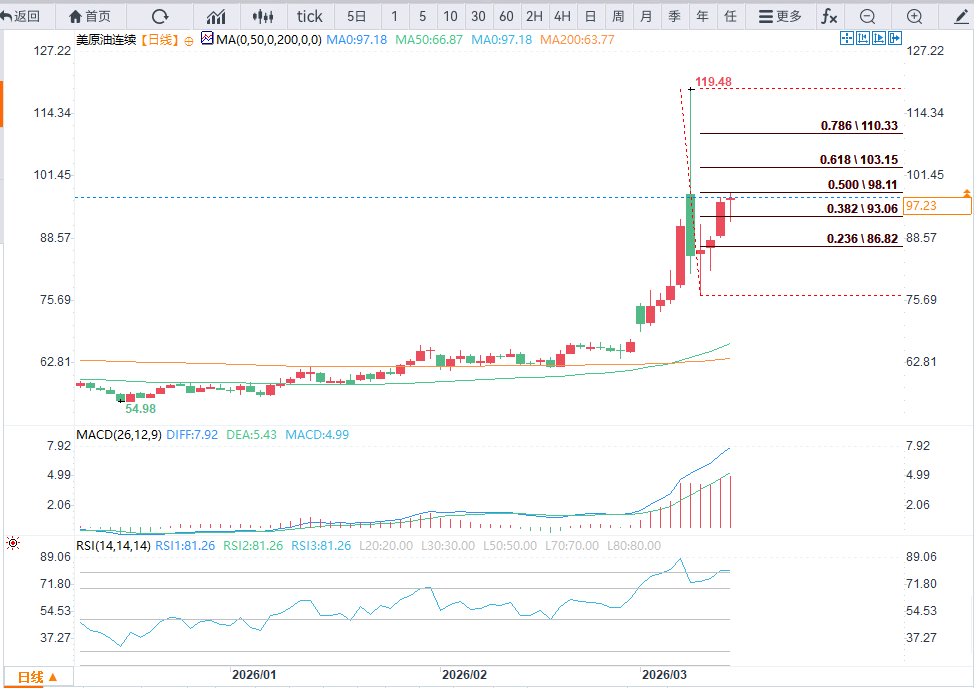
(WTI crude oil daily chart source: FX678)
On the daily chart, WTI crude oil futures are at a crucial crossroads, determining their direction over the next few months. The $98.11-$103.15 range constitutes significant resistance. If geopolitical tensions fuel a bullish breakout, it will retest the previous high of $119.48; conversely, profit-taking could create a secondary high, with initial support at $81.19, and a failure to break down that level leading to a retest of $76.73. The current inverse term structure suggests that extreme scarcity of spot supply remains the cornerstone of the long-term bull market. With both technical and fundamental factors converging, the struggle around the $98.11 resistance level will be a key indicator for short-term oil prices.
Summary and Outlook
Today's oil price decline is more like a "false cooling" after a period of overheating. The 30-day waiver for Russian oil only provides limited hedging and cannot reverse the core tension in global supply; the Strait of Hormuz, however, controls one-fifth of the world's energy lifeline. As long as the Middle East conflict continues, $100 will evolve from a ceiling to a new normal floor. In the short term, attention should be paid to the struggle for resistance at $98.11, while in the long term, the situation of passage through the Strait, adjustments to G7 sanctions, and geopolitical developments will dominate. High oil prices and high volatility will become the norm in the future market.
Frequently Asked Questions
Q1: Why did the United States suddenly issue a 30-day exemption order for Russian oil?
A: The core objective is to alleviate domestic high inflation and gasoline price pressures. With retail gasoline prices breaking historical records and the midterm elections approaching, Washington's release of approximately 80 million barrels of Russian crude oil stranded at sea to quickly stabilize oil prices is a short-term political compromise, not a long-term policy shift. It aims to stabilize public opinion rather than genuinely ease sanctions against Russia.
Q2: What does the blockade of the Strait of Hormuz mean for global oil supply?
A: This strait is a vital passage for approximately 20% of global crude oil transportation. Currently, its capacity is only 20% of pre-war levels, leading to record-breaking supply disruptions. Although the IEA plans to release 400 million barrels of strategic reserves, if the blockade lasts longer than 60 days, the reserves will only last about two weeks. This directly drives up oil prices and transmits inflationary pressures to the global economy, forcing countries to reassess their energy security strategies.
Q3: Why does Germany strongly oppose the US exemption policy?
A: Germany believes that Europe has sufficient energy reserves, and that the current crisis is mainly a price issue rather than a shortage of physical goods. Germany opposes unilateral actions as they would send the wrong signal to Russia and undermine the G7 consensus on sanctions. Germany also believes that the US move is more driven by domestic election considerations than by the overall interests of global energy security.
Q4: Does the current pullback in oil prices indicate a trend reversal?
A: It's not a true reversal. The pullback is merely profit-taking and a technical adjustment. The inverse term structure shows extreme shortages in the spot market, and geopolitical risks have not been eliminated. As long as the conflict in the Middle East continues, the long-term outlook remains bullish, and $100 will become the new normal floor.
Q5: What are the long-term impacts of high oil prices on the global economy?
A: High oil prices will push up global inflation, suppress consumption and investment, and exacerbate the risk of stagflation; at the same time, they will force countries to increase strategic reserves, accelerate energy transition, and may trigger supply chain restructuring and geopolitical adjustments, ultimately affecting the results of the midterm elections and international energy games.
- Risk Warning and Disclaimer
- The market involves risk, and trading may not be suitable for all investors. This article is for reference only and does not constitute personal investment advice, nor does it take into account certain users’ specific investment objectives, financial situation, or other needs. Any investment decisions made based on this information are at your own risk.