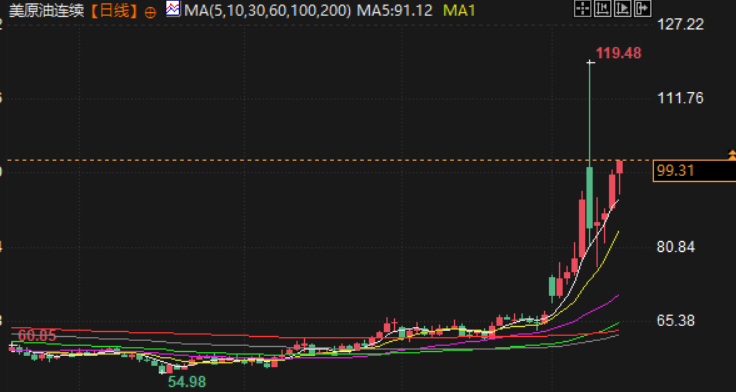
Geopolitical events over the weekend weighed on the oil market, pushing US crude oil near $100, with traders on high alert.
2026-03-14 08:57:05
Oil prices rose more than 3% on Friday, with WTI crude once again approaching the $100 per barrel mark. Oil prices have seen a strong rally this week, with Brent crude rising more than 11% and WTI crude also recording a gain of over 8%. Uncertainty surrounding the situation in Iran is driving oil price movements. The Strait of Hormuz remains blocked, directly impacting the security of approximately one-fifth of the world's oil transportation, and Iran's stance is becoming increasingly hardline.
Market sentiment is extremely sensitive to news. Earlier on Friday, a false report that an Indian-flagged oil tanker had passed through the Strait of Hormuz briefly pressured oil prices. However, when the market quickly clarified that the tanker had actually departed from Oman and was not attempting to cross the blockade, oil prices immediately rebounded and turned positive. This highlights the market's high level of concern about supply disruptions. Analysts remain generally cautious, believing that any unexpected developments over the weekend, two weeks into the conflict, could lead to further volatility in oil prices. Beyond direct transport disruptions, the market's biggest concern is that the conflict could cause severe damage to oil infrastructure, resulting in longer-term supply losses and thus putting sustained upward pressure on oil prices.
Meanwhile, in response to the US-Israeli military action, Iran's new Supreme Leader Mojtaba Khamenei made it clear that Iran would continue the fight and would use the blockade of the Strait of Hormuz as a "tool" against the US and Israel. Iraqi officials also reported that their oil tankers anchored in Iraqi waters were attacked by Iranian vessels, causing the country's oil ports to completely cease operations, further escalating regional tensions and supply risks.
Faced with the severe oil price shock triggered by the Middle East conflict, Asian economies heavily reliant on energy imports were forced to swiftly implement a series of emergency measures to protect their economies and people's livelihoods. The strategies varied depending on each country's resource endowment and reserve capacity, ranging from releasing strategic reserves to implementing price controls and mandating working from home to conserve energy.
As major energy importers, Japan and South Korea have opted for a combination of releasing reserves and price controls. Japan plans to release the equivalent of 15 days' worth of private oil reserves and one month's worth of national oil reserves, and will also set a cap on the average retail price of gasoline nationwide. South Korea, for the first time since 1997, has set price caps on diesel and gasoline, and plans to lower the prices of essential goods such as instant noodles and cooking oil to reduce the cost of living for its citizens.
Asian powers, with their vast strategic reserves and highly diversified energy structures, have demonstrated greater resilience to shocks. India, on the other hand, is striving to adjust its supply chain, diverting approximately 70% of its crude oil imports to other routes and prioritizing domestic liquefied petroleum gas (LPG) supplies to meet household needs, in order to cope with its high import dependence and the disruption of major transportation routes.
Southeast Asian countries are increasingly adopting fiscal subsidies and administrative cost-cutting measures. Thailand has ordered government employees not directly providing public services to work from home and suspended overseas trips to directly reduce energy consumption. The Philippines has introduced fuel subsidies for transport and delivery drivers and is considering legislation authorizing the president to suspend or reduce fuel consumption taxes if necessary. Despite its abundant resources, Indonesia has limited oil reserves and is considering shifting crude oil imports to other regions and may increase fuel subsidies. Singapore, with half of its natural gas demand coming from within the region, is relatively less affected but is still increasing its fuel reserves as a safeguard.
In an effort to stabilize domestic fuel prices ahead of the midterm elections, the U.S. government issued a 30-day authorization allowing other countries to purchase Russian crude oil and petroleum products stranded at sea. However, this measure, intended to alleviate supply shortages, failed to lower oil prices as expected. Market analysis clearly indicates that even if sanctions were completely lifted, their impact on reducing current oil prices would be minimal, due to a key market reality: the sanctions did not substantially affect Russian production, but merely altered its sales markets and prices.
Analysts at financial services firms point out that sanctioned Russian crude oil has already entered the global market through various channels, leaving virtually no additional "incremental" supply. Theoretically, easing restrictions on other sanctioned oil-producing countries like Iran could release over 1 million barrels per day of supply within months, but in reality, much of this so-called incremental oil has already been sold through informal channels. More importantly, Iran, the main source of this theoretical increase, is currently in direct conflict with the United States, and its oil exports are constrained by both political and military conflicts, not just sanctions themselves. Therefore, US waivers fundamentally fail to increase the effective supply in the global market.
Goldman Sachs also noted in its report that energy prices will remain highly volatile due to the ongoing conflict surrounding Iran and uncertainties regarding the extent of damage to Middle Eastern energy infrastructure and the disruption of shipping in the Strait of Hormuz. The firm predicts that while the average Brent crude price may exceed $100 in March, the potential damage to infrastructure caused by the conflict will be the key factor determining the long-term trend of oil prices. Market focus has shifted from "whether it can be bought" to "whether it can be safely shipped out," making any policy measures aimed at increasing supply seem limited in their effectiveness in the face of the current tense military conflict.
As the war enters its third week, the conflict has escalated from initial strikes to a widespread confrontation spanning the entire Middle East. President Trump, in a Fox News interview, vowed that the United States would launch a major strike against Iran "within the next week." Previously, he had granted 30-day waivers for Russian oil imports in an attempt to ease war-driven oil prices, but his repeated statements regarding the duration of the war have exacerbated market volatility. The war has already claimed more than 2,000 lives and displaced millions, making the Gulf region the direct front line of conflict for the first time in decades.
The scope of military operations has expanded significantly. Iran continues to launch missiles and drones at Israel, with its aircraft even entering the airspace of several Gulf states, including Kuwait and the UAE. In response, the Israeli Air Force launched massive airstrikes against western and central Iran, striking more than 200 targets, including missile launchers and air defense systems. The US military was not spared either; an aerial refueling tanker crashed in western Iraq, killing all six crew members. On the ground, Israel deployed additional troops to Lebanon to fight the Iranian-backed Hezbollah and launched airstrikes on the outskirts of Beirut, while warning of further attacks on Lebanese infrastructure.
On the international political level, the United States' unilateral actions have provoked discontent among its allies. The US exemption for purchasing Russian oil has drawn explicit criticism from European allies such as Germany, who believe it sends the wrong signal. Ukrainian President Zelensky also expressed concern, arguing that the move would provide Russia with a huge amount of money and would not contribute to the peace process.
US President Trump declined to predict when the conflict with Iran would end, while emphasizing that Washington is prepared to continue strikes until all objectives are achieved. With the situation in Iran continuing to deteriorate, US crude oil prices may once again rise above $100 per barrel next week.
Market sentiment is extremely sensitive to news. Earlier on Friday, a false report that an Indian-flagged oil tanker had passed through the Strait of Hormuz briefly pressured oil prices. However, when the market quickly clarified that the tanker had actually departed from Oman and was not attempting to cross the blockade, oil prices immediately rebounded and turned positive. This highlights the market's high level of concern about supply disruptions. Analysts remain generally cautious, believing that any unexpected developments over the weekend, two weeks into the conflict, could lead to further volatility in oil prices. Beyond direct transport disruptions, the market's biggest concern is that the conflict could cause severe damage to oil infrastructure, resulting in longer-term supply losses and thus putting sustained upward pressure on oil prices.
Meanwhile, in response to the US-Israeli military action, Iran's new Supreme Leader Mojtaba Khamenei made it clear that Iran would continue the fight and would use the blockade of the Strait of Hormuz as a "tool" against the US and Israel. Iraqi officials also reported that their oil tankers anchored in Iraqi waters were attacked by Iranian vessels, causing the country's oil ports to completely cease operations, further escalating regional tensions and supply risks.
Response measures of Asian countries
Faced with the severe oil price shock triggered by the Middle East conflict, Asian economies heavily reliant on energy imports were forced to swiftly implement a series of emergency measures to protect their economies and people's livelihoods. The strategies varied depending on each country's resource endowment and reserve capacity, ranging from releasing strategic reserves to implementing price controls and mandating working from home to conserve energy.
As major energy importers, Japan and South Korea have opted for a combination of releasing reserves and price controls. Japan plans to release the equivalent of 15 days' worth of private oil reserves and one month's worth of national oil reserves, and will also set a cap on the average retail price of gasoline nationwide. South Korea, for the first time since 1997, has set price caps on diesel and gasoline, and plans to lower the prices of essential goods such as instant noodles and cooking oil to reduce the cost of living for its citizens.
Asian powers, with their vast strategic reserves and highly diversified energy structures, have demonstrated greater resilience to shocks. India, on the other hand, is striving to adjust its supply chain, diverting approximately 70% of its crude oil imports to other routes and prioritizing domestic liquefied petroleum gas (LPG) supplies to meet household needs, in order to cope with its high import dependence and the disruption of major transportation routes.
Southeast Asian countries are increasingly adopting fiscal subsidies and administrative cost-cutting measures. Thailand has ordered government employees not directly providing public services to work from home and suspended overseas trips to directly reduce energy consumption. The Philippines has introduced fuel subsidies for transport and delivery drivers and is considering legislation authorizing the president to suspend or reduce fuel consumption taxes if necessary. Despite its abundant resources, Indonesia has limited oil reserves and is considering shifting crude oil imports to other regions and may increase fuel subsidies. Singapore, with half of its natural gas demand coming from within the region, is relatively less affected but is still increasing its fuel reserves as a safeguard.
Limited Effects of Sanctions Exemptions
In an effort to stabilize domestic fuel prices ahead of the midterm elections, the U.S. government issued a 30-day authorization allowing other countries to purchase Russian crude oil and petroleum products stranded at sea. However, this measure, intended to alleviate supply shortages, failed to lower oil prices as expected. Market analysis clearly indicates that even if sanctions were completely lifted, their impact on reducing current oil prices would be minimal, due to a key market reality: the sanctions did not substantially affect Russian production, but merely altered its sales markets and prices.
Analysts at financial services firms point out that sanctioned Russian crude oil has already entered the global market through various channels, leaving virtually no additional "incremental" supply. Theoretically, easing restrictions on other sanctioned oil-producing countries like Iran could release over 1 million barrels per day of supply within months, but in reality, much of this so-called incremental oil has already been sold through informal channels. More importantly, Iran, the main source of this theoretical increase, is currently in direct conflict with the United States, and its oil exports are constrained by both political and military conflicts, not just sanctions themselves. Therefore, US waivers fundamentally fail to increase the effective supply in the global market.
Goldman Sachs also noted in its report that energy prices will remain highly volatile due to the ongoing conflict surrounding Iran and uncertainties regarding the extent of damage to Middle Eastern energy infrastructure and the disruption of shipping in the Strait of Hormuz. The firm predicts that while the average Brent crude price may exceed $100 in March, the potential damage to infrastructure caused by the conflict will be the key factor determining the long-term trend of oil prices. Market focus has shifted from "whether it can be bought" to "whether it can be safely shipped out," making any policy measures aimed at increasing supply seem limited in their effectiveness in the face of the current tense military conflict.
The spread of war and Trump's warnings
As the war enters its third week, the conflict has escalated from initial strikes to a widespread confrontation spanning the entire Middle East. President Trump, in a Fox News interview, vowed that the United States would launch a major strike against Iran "within the next week." Previously, he had granted 30-day waivers for Russian oil imports in an attempt to ease war-driven oil prices, but his repeated statements regarding the duration of the war have exacerbated market volatility. The war has already claimed more than 2,000 lives and displaced millions, making the Gulf region the direct front line of conflict for the first time in decades.
The scope of military operations has expanded significantly. Iran continues to launch missiles and drones at Israel, with its aircraft even entering the airspace of several Gulf states, including Kuwait and the UAE. In response, the Israeli Air Force launched massive airstrikes against western and central Iran, striking more than 200 targets, including missile launchers and air defense systems. The US military was not spared either; an aerial refueling tanker crashed in western Iraq, killing all six crew members. On the ground, Israel deployed additional troops to Lebanon to fight the Iranian-backed Hezbollah and launched airstrikes on the outskirts of Beirut, while warning of further attacks on Lebanese infrastructure.
On the international political level, the United States' unilateral actions have provoked discontent among its allies. The US exemption for purchasing Russian oil has drawn explicit criticism from European allies such as Germany, who believe it sends the wrong signal. Ukrainian President Zelensky also expressed concern, arguing that the move would provide Russia with a huge amount of money and would not contribute to the peace process.
US President Trump declined to predict when the conflict with Iran would end, while emphasizing that Washington is prepared to continue strikes until all objectives are achieved. With the situation in Iran continuing to deteriorate, US crude oil prices may once again rise above $100 per barrel next week.
- Risk Warning and Disclaimer
- The market involves risk, and trading may not be suitable for all investors. This article is for reference only and does not constitute personal investment advice, nor does it take into account certain users’ specific investment objectives, financial situation, or other needs. Any investment decisions made based on this information are at your own risk.