A safe-haven rush for the US dollar swept through the currency markets, leaving global central banks in a policy maze, alarm bells were raised for yen intervention, and the euro succumbed to pressure.
2026-03-14 09:39:27
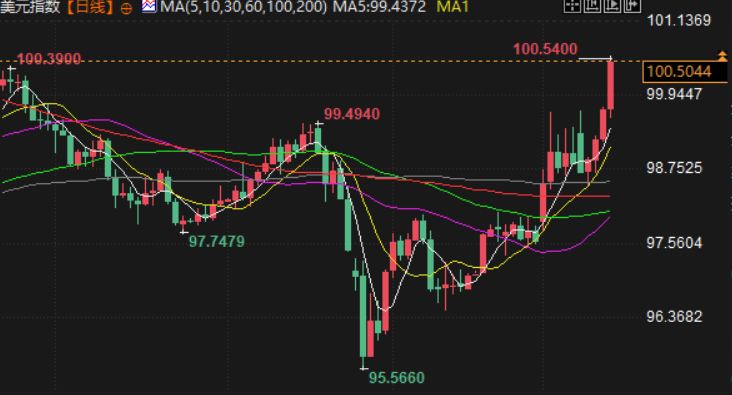
The US dollar index rose across the board on Friday, climbing to its highest level since November last year, closing at 100.50, with a cumulative weekly gain of 1.67%. The core driver of this dollar strength lies in its safe-haven asset characteristics. As President Trump vowed to launch a "fierce strike" against Iran, investors have been reducing their cross-border risk exposure and turning funds to the United States for protection.
However, the strength of the US dollar is not an isolated event; it reflects a significant divergence among major economies due to their varying degrees of energy dependence. The Eurozone and Japan, heavily reliant on crude oil imports, have become the hardest hit by this energy crisis.
The euro fell 0.84% against the dollar, closing at $1.1413. Corpay's chief market strategist, Karl Schamotta, noted that the market is selling off currencies of net energy importers. If oil prices remain high, it will severely impact the economies of Japan and the Eurozone, while the impact on the US, a net oil exporter, will be relatively smaller. However, the market also faces two-way risks; if geopolitical tensions shift and negotiations progress, risk aversion could quickly subside.
Furthermore, the continued depreciation of the yen has raised concerns about potential intervention in the market. The dollar rose to 159.74 yen on Friday, a new high since July 2024. Japanese Finance Minister Satsuki Katayama has warned that Japan is prepared to take necessary measures to deal with sharp fluctuations in the foreign exchange market. Analysts believe that the weak yen will further increase already high import bills, increasing the pressure on authorities to intervene.
The Middle East conflict has not only disrupted the foreign exchange market but could also act as a catalyst for a shift in monetary policy among major central banks, with the Bank of Japan's actions being particularly noteworthy. Four sources familiar with the Bank of Japan's decision-making process revealed that the supply shock triggered by the war is exacerbating inflation risks, which could prompt the central bank to accelerate its hawkish policy process, potentially raising interest rates again as early as April.
This is a stark contrast to the Bank of Japan's past operational logic. In the past, the central bank typically ignored the impact of rising oil prices on inflation, prioritizing support for a weak economy. However, with the potential inflation rate approaching the 2% target, coupled with rising import costs due to a weak yen, inflation expectations among businesses and households have risen sharply. A Bank of Japan survey shows that households expect inflation of 9.8% over the next five years. Bank of Japan Governor Kazuo Ueda has warned that while conflict could damage the economy, it is more likely to push up potential inflation, a risk that must be carefully monitored.
While the market widely expects the Bank of Japan (BOJ) to keep interest rates unchanged at its policy meeting next week, BOJ Governor Kazuo Ueda is likely to reiterate the central bank's determination to continue raising rates at the post-meeting press conference. Ayako Fujita, chief Japan economist at JPMorgan Chase, believes the BOJ's message next week will emphasize maintaining its "policy normalization path" while assessing the uncertainties brought about by the war. Former BOJ official Seiji Kameda also pointed out that the central bank has "fallen behind" in addressing inflationary pressures in the face of rising oil prices and a weakening yen, and the risk of policy lag is increasing.
In the coming week, global investors will focus on the United States, where the Federal Reserve will hold a policy meeting amidst the smoke of conflict in the Middle East. Since the outbreak of the war, soaring oil prices and their impact on inflation have complicated expectations for interest rate cuts this year. Markets are eagerly awaiting clear signals about the future path of interest rates from Wednesday's latest economic projections and Chairman Powell's remarks.
It is widely expected that the Federal Reserve will keep interest rates stable for the second consecutive week next week. However, a new variable brought about by the war—the energy shock—is forcing policymakers to reassess its impact on inflation and economic growth. Investors' expectations for rate cuts have been significantly lowered due to concerns that soaring energy prices will again push up prices. Market bets on rate cuts before the end of the year have now fallen from two before the war to less than one.
TD Wealth's chief investment strategist, Sid Vaidya, believes that high energy prices will only keep the Federal Reserve "on hold for a longer period." Furthermore, this is Powell's penultimate meeting before his term expires in May. The future policy path remains uncertain until Trump's nominee takes over as central banker. LPL Financial strategists point out that news related to Iran will continue to dominate the market, and investors are anxiously awaiting further clarity on the timing of the US exit strategy.
The Bank of England is facing a similar, but more serious, predicament: the risk of stagflation is looming. On the one hand, high energy prices have kept January's inflation rate at 3.0%, well above the 2% target, which typically requires the central bank to raise interest rates to curb price increases. On the other hand, the latest data shows that UK GDP was flat month-on-month in January, indicating weak economic growth, which points to the need for interest rate cuts to stimulate the economy.
This prospect of stagflation—high inflation coupled with weak growth—has left policymakers in a dilemma ahead of their interest rate decision next Thursday. Market expectations have shifted dramatically: pre-war market pricing reflected an 83% probability of a rate cut, but now it has completely turned to the expectation that rates will remain stable, with some even anticipating a rate hike before the end of the year (a 63% probability). This shift in the money market has directly pushed up UK government bond yields, with the 10-year yield hitting a six-and-a-half-month high.
Oxford Economics warns that in the worst-case scenario (oil prices rising to $140), UK inflation could exceed 5%, forcing the central bank to raise interest rates, potentially pushing the UK economy into a mild recession. Economists at Deutsche Bank say the Bank of England's Monetary Policy Committee is facing increasingly difficult trade-offs, and its policy focus may shift from buffering downside risks to combating inflation, at least until the conflict with Iran is resolved.
Faced with the threat of inflation from a new round of war, the European Central Bank is well aware that the situation is fundamentally different from that of the 2022 Russia-Ukraine conflict and that it is in a more advantageous position to respond. Although soaring energy costs have once again fueled market bets on interest rate hikes, officials have hinted that no action will be taken in next week's policy decision, as the current macroeconomic context and policy mix have fundamentally changed.
First, the starting point for inflation and the energy structure differ. The current inflation rate in the Eurozone is 1.9%, slightly below the 2% target and far lower than the 5.1% at the beginning of 2022. Meanwhile, due to a more diversified energy structure, natural gas and electricity prices in countries like Germany are only a fraction of what they were during the worst periods, which will largely curb inflationary pressures. Second, the monetary policy settings differ. At the beginning of 2022, the deposit rate was still negative (-0.5%), representing an ultra-loose policy to stimulate inflation; while the current 2% benchmark interest rate is considered neutral, meaning that minor adjustments can suppress price increases.
Furthermore, the labor market is not as overheated as it was in 2022, and the expansionary nature of fiscal policies in various countries has also weakened. European Central Bank officials emphasized that the duration of the war is a key variable, but the central bank has learned from past mistakes. Slovak Central Bank Governor Peter Kazimir stated that the central bank can "respond more quickly" if necessary and must remain flexible. Analysts generally believe that despite similarities, this round of shocks differs from that of 2022, and the ECB has no reason to deviate from its "see-through" strategy, at least for now.
However, the strength of the US dollar is not an isolated event; it reflects a significant divergence among major economies due to their varying degrees of energy dependence. The Eurozone and Japan, heavily reliant on crude oil imports, have become the hardest hit by this energy crisis.
The euro fell 0.84% against the dollar, closing at $1.1413. Corpay's chief market strategist, Karl Schamotta, noted that the market is selling off currencies of net energy importers. If oil prices remain high, it will severely impact the economies of Japan and the Eurozone, while the impact on the US, a net oil exporter, will be relatively smaller. However, the market also faces two-way risks; if geopolitical tensions shift and negotiations progress, risk aversion could quickly subside.
Furthermore, the continued depreciation of the yen has raised concerns about potential intervention in the market. The dollar rose to 159.74 yen on Friday, a new high since July 2024. Japanese Finance Minister Satsuki Katayama has warned that Japan is prepared to take necessary measures to deal with sharp fluctuations in the foreign exchange market. Analysts believe that the weak yen will further increase already high import bills, increasing the pressure on authorities to intervene.
Bank of Japan's policy shift under inflationary pressure
The Middle East conflict has not only disrupted the foreign exchange market but could also act as a catalyst for a shift in monetary policy among major central banks, with the Bank of Japan's actions being particularly noteworthy. Four sources familiar with the Bank of Japan's decision-making process revealed that the supply shock triggered by the war is exacerbating inflation risks, which could prompt the central bank to accelerate its hawkish policy process, potentially raising interest rates again as early as April.
This is a stark contrast to the Bank of Japan's past operational logic. In the past, the central bank typically ignored the impact of rising oil prices on inflation, prioritizing support for a weak economy. However, with the potential inflation rate approaching the 2% target, coupled with rising import costs due to a weak yen, inflation expectations among businesses and households have risen sharply. A Bank of Japan survey shows that households expect inflation of 9.8% over the next five years. Bank of Japan Governor Kazuo Ueda has warned that while conflict could damage the economy, it is more likely to push up potential inflation, a risk that must be carefully monitored.
While the market widely expects the Bank of Japan (BOJ) to keep interest rates unchanged at its policy meeting next week, BOJ Governor Kazuo Ueda is likely to reiterate the central bank's determination to continue raising rates at the post-meeting press conference. Ayako Fujita, chief Japan economist at JPMorgan Chase, believes the BOJ's message next week will emphasize maintaining its "policy normalization path" while assessing the uncertainties brought about by the war. Former BOJ official Seiji Kameda also pointed out that the central bank has "fallen behind" in addressing inflationary pressures in the face of rising oil prices and a weakening yen, and the risk of policy lag is increasing.
The Federal Reserve's Double Test: Interest Rate Outlook and the Fog of War
In the coming week, global investors will focus on the United States, where the Federal Reserve will hold a policy meeting amidst the smoke of conflict in the Middle East. Since the outbreak of the war, soaring oil prices and their impact on inflation have complicated expectations for interest rate cuts this year. Markets are eagerly awaiting clear signals about the future path of interest rates from Wednesday's latest economic projections and Chairman Powell's remarks.
It is widely expected that the Federal Reserve will keep interest rates stable for the second consecutive week next week. However, a new variable brought about by the war—the energy shock—is forcing policymakers to reassess its impact on inflation and economic growth. Investors' expectations for rate cuts have been significantly lowered due to concerns that soaring energy prices will again push up prices. Market bets on rate cuts before the end of the year have now fallen from two before the war to less than one.
TD Wealth's chief investment strategist, Sid Vaidya, believes that high energy prices will only keep the Federal Reserve "on hold for a longer period." Furthermore, this is Powell's penultimate meeting before his term expires in May. The future policy path remains uncertain until Trump's nominee takes over as central banker. LPL Financial strategists point out that news related to Iran will continue to dominate the market, and investors are anxiously awaiting further clarity on the timing of the US exit strategy.
The Bank of England's stagflation dilemma
The Bank of England is facing a similar, but more serious, predicament: the risk of stagflation is looming. On the one hand, high energy prices have kept January's inflation rate at 3.0%, well above the 2% target, which typically requires the central bank to raise interest rates to curb price increases. On the other hand, the latest data shows that UK GDP was flat month-on-month in January, indicating weak economic growth, which points to the need for interest rate cuts to stimulate the economy.
This prospect of stagflation—high inflation coupled with weak growth—has left policymakers in a dilemma ahead of their interest rate decision next Thursday. Market expectations have shifted dramatically: pre-war market pricing reflected an 83% probability of a rate cut, but now it has completely turned to the expectation that rates will remain stable, with some even anticipating a rate hike before the end of the year (a 63% probability). This shift in the money market has directly pushed up UK government bond yields, with the 10-year yield hitting a six-and-a-half-month high.
Oxford Economics warns that in the worst-case scenario (oil prices rising to $140), UK inflation could exceed 5%, forcing the central bank to raise interest rates, potentially pushing the UK economy into a mild recession. Economists at Deutsche Bank say the Bank of England's Monetary Policy Committee is facing increasingly difficult trade-offs, and its policy focus may shift from buffering downside risks to combating inflation, at least until the conflict with Iran is resolved.
European Central Bank: A starkly different response scenario
Faced with the threat of inflation from a new round of war, the European Central Bank is well aware that the situation is fundamentally different from that of the 2022 Russia-Ukraine conflict and that it is in a more advantageous position to respond. Although soaring energy costs have once again fueled market bets on interest rate hikes, officials have hinted that no action will be taken in next week's policy decision, as the current macroeconomic context and policy mix have fundamentally changed.
First, the starting point for inflation and the energy structure differ. The current inflation rate in the Eurozone is 1.9%, slightly below the 2% target and far lower than the 5.1% at the beginning of 2022. Meanwhile, due to a more diversified energy structure, natural gas and electricity prices in countries like Germany are only a fraction of what they were during the worst periods, which will largely curb inflationary pressures. Second, the monetary policy settings differ. At the beginning of 2022, the deposit rate was still negative (-0.5%), representing an ultra-loose policy to stimulate inflation; while the current 2% benchmark interest rate is considered neutral, meaning that minor adjustments can suppress price increases.
Furthermore, the labor market is not as overheated as it was in 2022, and the expansionary nature of fiscal policies in various countries has also weakened. European Central Bank officials emphasized that the duration of the war is a key variable, but the central bank has learned from past mistakes. Slovak Central Bank Governor Peter Kazimir stated that the central bank can "respond more quickly" if necessary and must remain flexible. Analysts generally believe that despite similarities, this round of shocks differs from that of 2022, and the ECB has no reason to deviate from its "see-through" strategy, at least for now.
- Risk Warning and Disclaimer
- The market involves risk, and trading may not be suitable for all investors. This article is for reference only and does not constitute personal investment advice, nor does it take into account certain users’ specific investment objectives, financial situation, or other needs. Any investment decisions made based on this information are at your own risk.