High Oil Prices in the US: Oil Giants Panic, Energy Secretary Trying to Rescue the Situation, and the Public Long Suffering from High Oil Prices
2026-03-16 09:08:56
US oil industry executives have recently warned the Trump administration that the energy crisis triggered by the situation in Iran is likely to escalate further. In a series of White House meetings on March 11 and recent communications with Energy Secretary Chris Wright and Interior Secretary Bergham, the CEOs of the three major oil giants—ExxonMobil, Chevron, and ConocoPhillips—unanimously pointed out that disruptions to energy transport through the Strait of Hormuz will continue to cause significant volatility in the global energy market.
Executives emphasized that current supply disruptions have already caused oil prices to fluctuate at high levels. If the conflict prolongs, production cuts by Gulf oil-producing countries and saturated storage will further tighten global supply, significantly increasing the risk of an energy crisis. On Monday (March 16) during Asian trading hours, US crude oil prices fluctuated downwards, currently trading around $97.60 per barrel, a daily decline of approximately 1.1%.
The CEOs of the three major oil giants stated bluntly at a White House meeting: the Strait of Hormuz, as the world's most critical oil choke point, would trigger the biggest supply shock since the oil crisis of the 1970s if it were to be interrupted for a long period of time.
With shipping essentially at a standstill and oil storage facilities in the Gulf states fully utilized, forcing them to drastically reduce production, the global daily supply gap has reached millions of barrels. CEOs warn that sharp fluctuations in energy prices will spill over into transportation, chemicals, manufacturing, and agriculture, pushing up core inflation and suppressing economic growth.
U.S. Energy Secretary Chris Wright said last Sunday that the public is feeling the pressure of high oil prices, and this feeling will continue for weeks. However, he emphasized, "Ultimately, we will eliminate the biggest risk to global energy supplies."
Wright pointed out that the United States is mitigating the impact through measures such as naval escorts, pushing the IEA to release reserves, and temporarily exempting some sanctions. Once the Strait of Hormuz resumes navigation or supply improves substantially, the pressure on high oil prices will ease quickly.
When asked whether gasoline prices would fall below $3 a gallon before summer, Wright said it was "very likely," but stressed that the war was fraught with uncertainty and the timeframe was still unclear.
The current average gasoline price across the United States has risen to over $3.60 per gallon, approaching $4 in some areas, while diesel has reached $4.89, a recent high. Wright reiterated that lowering oil prices is a clear goal of the current administration, but the ultimate effect still depends on the course of the conflict and the speed of recovery in the Taiwan Strait.
Since the large-scale airstrikes launched by the US and Israel against Iran, shipping in the Strait of Hormuz has essentially come to a standstill, hindering the export of approximately 20% of global oil and a significant amount of LNG. Gulf oil-producing countries (Saudi Arabia, Iraq, the UAE, Kuwait, etc.) have been forced to drastically reduce production due to saturated oil storage, resulting in a global daily supply shortfall of millions of barrels.
Iran's continued threats to block shipping lanes and attack oil tankers have heightened tensions in the global energy market. Asian importers are facing the biggest impact, with both gasoline and diesel prices in the United States hitting record highs in recent years.
High oil price pressures are unlikely to ease substantially in the short term: the Hormuz trade disruption shows no signs of recovery, and Iran's hardline stance and the activity of its proxies perpetuate supply uncertainty. While measures such as the IEA releasing 400 million barrels from its reserves and the US temporarily waiving Russian oil purchases can provide a buffer, logistical delays are less effective compared to the scale of the supply gap.
The medium- to long-term trend of oil prices depends on: whether Iran escalates its retaliation, the timing of the resumption of navigation in the Strait of Hormuz, and the actual effectiveness of the G7/IEA's reserve releases. If the conflict prolongs, high-level fluctuations in oil prices will become the new normal, further amplifying the risks of global inflation and economic slowdown.
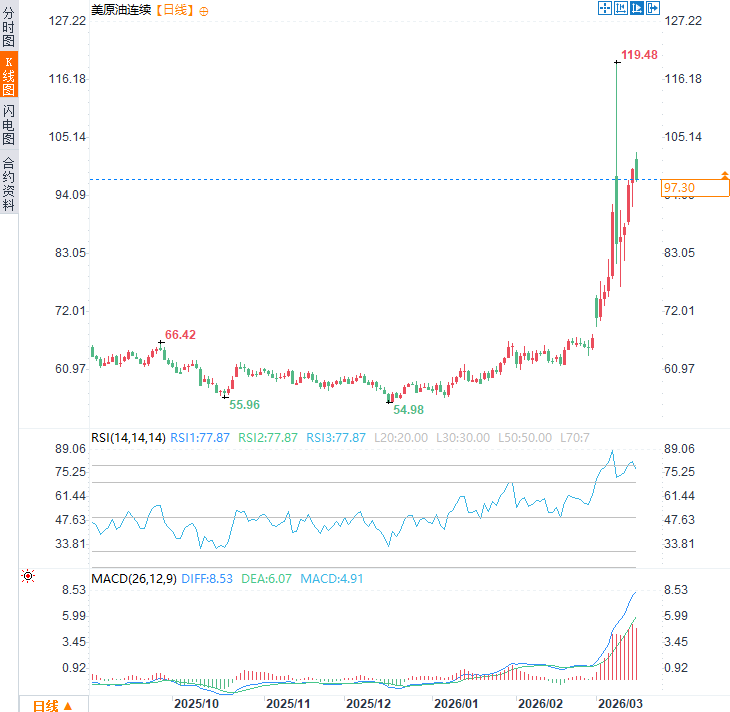
(US crude oil daily chart, source: FX678)
US oil giants collectively warned the Trump administration that the energy crisis triggered by the situation in Iran is likely to escalate further. The CEOs of ExxonMobil, Chevron, and ConocoPhillips pointed out at a White House meeting that the obstruction of the Strait of Hormuz will continue to cause significant volatility.
U.S. Energy Secretary Wright acknowledged that high oil prices will continue to weigh on the public for several weeks, but emphasized that the biggest risks will eventually be eliminated, with gasoline prices expected to fall below $3 per gallon before summer. Currently, the average price of gasoline across the U.S. is $3.60, and diesel is $4.89, both recent highs. The ongoing Hormuz trade disruption and Gulf production cuts have exacerbated global supply shortages.
Short-term high oil price pressures are unlikely to dissipate, while the medium- to long-term outlook depends on the course of the conflict and the effectiveness of reserve releases. Investors should be wary of an escalation of Iranian retaliation triggering a price reversal, and pay attention to the resumption of navigation in the Taiwan Strait and progress in G7/IEA coordination. Uncertainty in the energy market remains high.
At 9:08 Beijing time, US crude oil futures were trading at $97.87 per barrel.
Executives emphasized that current supply disruptions have already caused oil prices to fluctuate at high levels. If the conflict prolongs, production cuts by Gulf oil-producing countries and saturated storage will further tighten global supply, significantly increasing the risk of an energy crisis. On Monday (March 16) during Asian trading hours, US crude oil prices fluctuated downwards, currently trading around $97.60 per barrel, a daily decline of approximately 1.1%.
A blockage at Hormuz will lead to dramatic fluctuations.
The CEOs of the three major oil giants stated bluntly at a White House meeting: the Strait of Hormuz, as the world's most critical oil choke point, would trigger the biggest supply shock since the oil crisis of the 1970s if it were to be interrupted for a long period of time.
With shipping essentially at a standstill and oil storage facilities in the Gulf states fully utilized, forcing them to drastically reduce production, the global daily supply gap has reached millions of barrels. CEOs warn that sharp fluctuations in energy prices will spill over into transportation, chemicals, manufacturing, and agriculture, pushing up core inflation and suppressing economic growth.
US Energy Secretary Wright: High oil price pressures will continue for several weeks, but the biggest risk will eventually be eliminated.
U.S. Energy Secretary Chris Wright said last Sunday that the public is feeling the pressure of high oil prices, and this feeling will continue for weeks. However, he emphasized, "Ultimately, we will eliminate the biggest risk to global energy supplies."
Wright pointed out that the United States is mitigating the impact through measures such as naval escorts, pushing the IEA to release reserves, and temporarily exempting some sanctions. Once the Strait of Hormuz resumes navigation or supply improves substantially, the pressure on high oil prices will ease quickly.
Gasoline prices are expected to fall below $3 per gallon by summer, but war uncertainty remains high.
When asked whether gasoline prices would fall below $3 a gallon before summer, Wright said it was "very likely," but stressed that the war was fraught with uncertainty and the timeframe was still unclear.
The current average gasoline price across the United States has risen to over $3.60 per gallon, approaching $4 in some areas, while diesel has reached $4.89, a recent high. Wright reiterated that lowering oil prices is a clear goal of the current administration, but the ultimate effect still depends on the course of the conflict and the speed of recovery in the Taiwan Strait.
The continued disruption to shipping through the Hormuz region and the exacerbation of global supply shortages by Gulf oil-producing nations' production cuts
Since the large-scale airstrikes launched by the US and Israel against Iran, shipping in the Strait of Hormuz has essentially come to a standstill, hindering the export of approximately 20% of global oil and a significant amount of LNG. Gulf oil-producing countries (Saudi Arabia, Iraq, the UAE, Kuwait, etc.) have been forced to drastically reduce production due to saturated oil storage, resulting in a global daily supply shortfall of millions of barrels.
Iran's continued threats to block shipping lanes and attack oil tankers have heightened tensions in the global energy market. Asian importers are facing the biggest impact, with both gasoline and diesel prices in the United States hitting record highs in recent years.
Short-term pressure on high oil prices is unlikely to dissipate; the medium- to long-term outlook depends on the course of the conflict and the effectiveness of reserve releases.
High oil price pressures are unlikely to ease substantially in the short term: the Hormuz trade disruption shows no signs of recovery, and Iran's hardline stance and the activity of its proxies perpetuate supply uncertainty. While measures such as the IEA releasing 400 million barrels from its reserves and the US temporarily waiving Russian oil purchases can provide a buffer, logistical delays are less effective compared to the scale of the supply gap.
The medium- to long-term trend of oil prices depends on: whether Iran escalates its retaliation, the timing of the resumption of navigation in the Strait of Hormuz, and the actual effectiveness of the G7/IEA's reserve releases. If the conflict prolongs, high-level fluctuations in oil prices will become the new normal, further amplifying the risks of global inflation and economic slowdown.
(US crude oil daily chart, source: FX678)
Editor's Summary
US oil giants collectively warned the Trump administration that the energy crisis triggered by the situation in Iran is likely to escalate further. The CEOs of ExxonMobil, Chevron, and ConocoPhillips pointed out at a White House meeting that the obstruction of the Strait of Hormuz will continue to cause significant volatility.
U.S. Energy Secretary Wright acknowledged that high oil prices will continue to weigh on the public for several weeks, but emphasized that the biggest risks will eventually be eliminated, with gasoline prices expected to fall below $3 per gallon before summer. Currently, the average price of gasoline across the U.S. is $3.60, and diesel is $4.89, both recent highs. The ongoing Hormuz trade disruption and Gulf production cuts have exacerbated global supply shortages.
Short-term high oil price pressures are unlikely to dissipate, while the medium- to long-term outlook depends on the course of the conflict and the effectiveness of reserve releases. Investors should be wary of an escalation of Iranian retaliation triggering a price reversal, and pay attention to the resumption of navigation in the Taiwan Strait and progress in G7/IEA coordination. Uncertainty in the energy market remains high.
At 9:08 Beijing time, US crude oil futures were trading at $97.87 per barrel.
- Risk Warning and Disclaimer
- The market involves risk, and trading may not be suitable for all investors. This article is for reference only and does not constitute personal investment advice, nor does it take into account certain users’ specific investment objectives, financial situation, or other needs. Any investment decisions made based on this information are at your own risk.