A super central bank week is approaching, with geopolitical tensions pushing up oil prices. Expectations for interest rate cuts by the Federal Reserve and the Bank of England have been completely wiped out, while the probability of a rate hike by the European Central Bank has surged.
2026-03-16 10:03:47
According to APP, this week will be a " super central bank week ." While the interest rate decisions from these central banks are not expected to bring any surprises, the policy guidance accompanying these decisions will be closely watched given the ongoing conflict in Iran . The four major central banks—the Federal Reserve, the European Central Bank, the Bank of England, and the Bank of Japan—will announce their decisions this Thursday. In addition, interest rate setters from Australia, Brazil, major Asian countries, Canada, Indonesia, Sweden, and Switzerland will also meet this week.
Aside from the Reserve Bank of Australia potentially taking a slight tightening step, other central banks are likely to keep interest rates unchanged. However, the conflict in Iran has significantly increased the likelihood of a rate hike later this year. Recent market pricing indicates a clearly hawkish response from the interest rate market to the impending energy price shock: expectations of rate cuts by the Federal Reserve and the Bank of England have been completely wiped out, replaced by a possible shift towards rate hikes by the Bank of England this year; expectations of a rate hike by the European Central Bank this year have also risen further. Since the start of the conflict, the Bank of Japan's interest rate path has remained relatively unchanged.
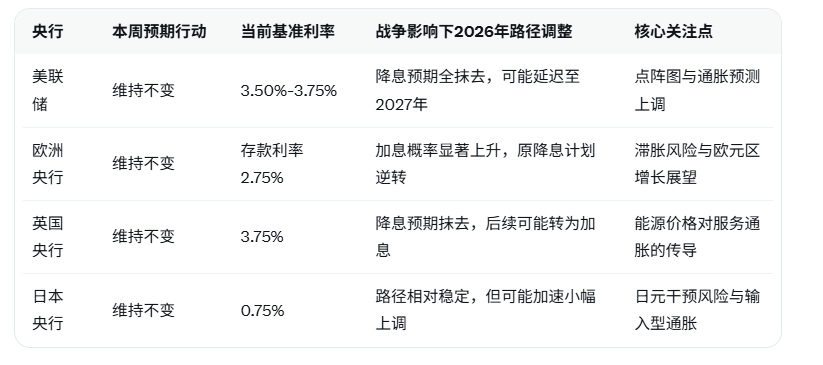
The key focus of this "Super Central Bank Week" lies in policy guidance rather than immediate actions. Brent crude oil prices have surged to around $100 per barrel due to shipping disruptions in the Strait of Hormuz, with rising global energy costs directly pushing up core inflation expectations in various countries. The Federal Reserve's current target range for the federal funds rate is 3.50%-3.75%, and the market's original expectation of at least two rate cuts in 2026 has been completely cancelled; the dot plot may indicate that the first rate cut will be postponed to 2027. The Bank of England's benchmark interest rate remains at 3.75%, and the market's previously priced-in March rate cut has been completely ruled out, with the probability of subsequent rate hikes rising significantly. The European Central Bank's deposit rate is 2.75%, and the originally planned path of multiple rate cuts has shifted to a possible at least one rate hike this year. The Bank of Japan's policy rate is 0.75%, unchanged, but imported inflation caused by geopolitical tensions may accelerate the pace of subsequent small increases.
The transmission mechanism of energy shocks is complex and far-reaching: in the short term, it pushes up inflation (supply side) while suppressing economic growth (demand side), creating a typical risk of "stagflation." This forces major central banks to explicitly define a "data-dependent" framework in their guidance—if the oil price shock continues, prioritizing the protection of inflation targets over stimulating growth. Overall, this round of meetings will be a crucial turning point for global monetary policy, shifting from "expectations of easing" to "cautious observation."
The following is a comparison of the latest scenarios for the four major central banks under the influence of this week's meetings and the war (based on the latest market consensus and official data):
Besides the four major central banks mentioned above, the Reserve Bank of Australia has already entered a tightening cycle due to domestic inflationary pressures, while central banks in emerging and developed markets such as Canada tend to maintain the status quo, focusing on managing market expectations through communication. Geopolitical uncertainties are forcing global central banks to shift from "forward guidance" to "conditional caution," and any sustained high oil prices beyond expectations will amplify the magnitude of this policy shift.
Overall, while this super central bank week lacked dramatic interest rate changes, it reshaped the global monetary policy landscape for 2026 through its guidance. Energy price shocks have become the dominant variable, and investors should closely monitor the press conferences of major central bank governors to glean signals on their stagflation response strategies.
Editor's Summary : Global central banks are collectively facing a new environment dominated by supply shocks: high oil prices are pushing up inflation expectations while simultaneously dragging down growth momentum. While the four major central banks are likely to remain on hold, their policy paths have shifted from easing to cautious or even hawkish, which is expected to significantly impact exchange rates, bond markets, and commodity pricing. Markets need to be wary that if the conflict prolongs, the risk of stagflation will further force more central banks to adjust their full-year guidance. Regional economic resilience and energy substitution capabilities will be key factors determining the speed of recovery.
Frequently Asked Questions
1. What is a "Super Central Bank Week," and what central bank meetings are scheduled for this week?
This week features policy decisions from four major central banks: the Federal Reserve, the European Central Bank, the Bank of England, and the Bank of Japan, as well as interest rate meetings from over ten other institutions, including Australia, Brazil, major Asian countries, Canada, Indonesia, Sweden, and Switzerland. Thursday's announcements from the four major central banks, coupled with earlier meetings by the Reserve Bank of Australia and other institutions, create a concentrated period of global monetary policy announcements. The focus is not on current interest rate changes, but rather on the assessment and guidance of full-year inflation and growth against the backdrop of geopolitical conflicts.
2. How has the conflict with Iran altered the Federal Reserve and the Bank of England's expectations for interest rate cuts?
Geopolitical conflicts have caused Brent crude oil to break through $100 per barrel, pushing up global inflation expectations. The Federal Reserve's original plan for multiple rate cuts in 2026 has been completely priced in by the market, with the latest pricing indicating that there may be no rate cuts this year or even a delay until 2027. The Bank of England has also cancelled its market expectation of a rate cut in March, increasing the probability of subsequent rate hikes. Both are forced to prioritize price stability due to the transmission of energy costs to core inflation and wage pressures.
3. Why are expectations for a European Central Bank interest rate hike rising instead?
As a net energy importer, Europe is more sensitive to oil price shocks. Prior to geopolitical conflicts, the market anticipated multiple interest rate cuts; now, the probability of at least one rate hike this year has increased. The European Central Bank needs to balance the risks of stagflation: oil prices push up inflation while suppressing growth. If it anticipates that short-term shocks may lag behind the yield curve, its guidance will be more hawkish to bolster market confidence in the 2% inflation target.
4. Why has the Bank of Japan kept its policy path relatively unchanged?
Japan has ended its era of negative interest rates, with the current policy rate at 0.75%. While geopolitical conflicts bring imported inflationary pressures, the Japanese economy's sensitivity to oil prices differs from the wage-price transmission mechanism, and the risk of yen intervention remains a major consideration. The market expects the rate to remain unchanged this week, but may subsequently accelerate slightly to 1.00%, as the war has not fundamentally altered its gradual normalization trajectory.
5. How should ordinary investors respond to the potential impact of this super central bank week?
The focus should be on the forward guidance given in the press conferences of the four central bank governors, rather than the interest rates themselves. Dollar assets may remain strong due to the Fed's hawkish stance, while the euro and pound sterling will face pressure, and the yen warrants caution regarding intervention signals. Commodities and energy-related sectors will benefit in the short term, but if the guidance confirms the risk of stagflation, volatility in risk assets will increase.
Aside from the Reserve Bank of Australia potentially taking a slight tightening step, other central banks are likely to keep interest rates unchanged. However, the conflict in Iran has significantly increased the likelihood of a rate hike later this year. Recent market pricing indicates a clearly hawkish response from the interest rate market to the impending energy price shock: expectations of rate cuts by the Federal Reserve and the Bank of England have been completely wiped out, replaced by a possible shift towards rate hikes by the Bank of England this year; expectations of a rate hike by the European Central Bank this year have also risen further. Since the start of the conflict, the Bank of Japan's interest rate path has remained relatively unchanged.
The key focus of this "Super Central Bank Week" lies in policy guidance rather than immediate actions. Brent crude oil prices have surged to around $100 per barrel due to shipping disruptions in the Strait of Hormuz, with rising global energy costs directly pushing up core inflation expectations in various countries. The Federal Reserve's current target range for the federal funds rate is 3.50%-3.75%, and the market's original expectation of at least two rate cuts in 2026 has been completely cancelled; the dot plot may indicate that the first rate cut will be postponed to 2027. The Bank of England's benchmark interest rate remains at 3.75%, and the market's previously priced-in March rate cut has been completely ruled out, with the probability of subsequent rate hikes rising significantly. The European Central Bank's deposit rate is 2.75%, and the originally planned path of multiple rate cuts has shifted to a possible at least one rate hike this year. The Bank of Japan's policy rate is 0.75%, unchanged, but imported inflation caused by geopolitical tensions may accelerate the pace of subsequent small increases.
The transmission mechanism of energy shocks is complex and far-reaching: in the short term, it pushes up inflation (supply side) while suppressing economic growth (demand side), creating a typical risk of "stagflation." This forces major central banks to explicitly define a "data-dependent" framework in their guidance—if the oil price shock continues, prioritizing the protection of inflation targets over stimulating growth. Overall, this round of meetings will be a crucial turning point for global monetary policy, shifting from "expectations of easing" to "cautious observation."
The following is a comparison of the latest scenarios for the four major central banks under the influence of this week's meetings and the war (based on the latest market consensus and official data):
Besides the four major central banks mentioned above, the Reserve Bank of Australia has already entered a tightening cycle due to domestic inflationary pressures, while central banks in emerging and developed markets such as Canada tend to maintain the status quo, focusing on managing market expectations through communication. Geopolitical uncertainties are forcing global central banks to shift from "forward guidance" to "conditional caution," and any sustained high oil prices beyond expectations will amplify the magnitude of this policy shift.
Overall, while this super central bank week lacked dramatic interest rate changes, it reshaped the global monetary policy landscape for 2026 through its guidance. Energy price shocks have become the dominant variable, and investors should closely monitor the press conferences of major central bank governors to glean signals on their stagflation response strategies.
Editor's Summary : Global central banks are collectively facing a new environment dominated by supply shocks: high oil prices are pushing up inflation expectations while simultaneously dragging down growth momentum. While the four major central banks are likely to remain on hold, their policy paths have shifted from easing to cautious or even hawkish, which is expected to significantly impact exchange rates, bond markets, and commodity pricing. Markets need to be wary that if the conflict prolongs, the risk of stagflation will further force more central banks to adjust their full-year guidance. Regional economic resilience and energy substitution capabilities will be key factors determining the speed of recovery.
Frequently Asked Questions
1. What is a "Super Central Bank Week," and what central bank meetings are scheduled for this week?
This week features policy decisions from four major central banks: the Federal Reserve, the European Central Bank, the Bank of England, and the Bank of Japan, as well as interest rate meetings from over ten other institutions, including Australia, Brazil, major Asian countries, Canada, Indonesia, Sweden, and Switzerland. Thursday's announcements from the four major central banks, coupled with earlier meetings by the Reserve Bank of Australia and other institutions, create a concentrated period of global monetary policy announcements. The focus is not on current interest rate changes, but rather on the assessment and guidance of full-year inflation and growth against the backdrop of geopolitical conflicts.
2. How has the conflict with Iran altered the Federal Reserve and the Bank of England's expectations for interest rate cuts?
Geopolitical conflicts have caused Brent crude oil to break through $100 per barrel, pushing up global inflation expectations. The Federal Reserve's original plan for multiple rate cuts in 2026 has been completely priced in by the market, with the latest pricing indicating that there may be no rate cuts this year or even a delay until 2027. The Bank of England has also cancelled its market expectation of a rate cut in March, increasing the probability of subsequent rate hikes. Both are forced to prioritize price stability due to the transmission of energy costs to core inflation and wage pressures.
3. Why are expectations for a European Central Bank interest rate hike rising instead?
As a net energy importer, Europe is more sensitive to oil price shocks. Prior to geopolitical conflicts, the market anticipated multiple interest rate cuts; now, the probability of at least one rate hike this year has increased. The European Central Bank needs to balance the risks of stagflation: oil prices push up inflation while suppressing growth. If it anticipates that short-term shocks may lag behind the yield curve, its guidance will be more hawkish to bolster market confidence in the 2% inflation target.
4. Why has the Bank of Japan kept its policy path relatively unchanged?
Japan has ended its era of negative interest rates, with the current policy rate at 0.75%. While geopolitical conflicts bring imported inflationary pressures, the Japanese economy's sensitivity to oil prices differs from the wage-price transmission mechanism, and the risk of yen intervention remains a major consideration. The market expects the rate to remain unchanged this week, but may subsequently accelerate slightly to 1.00%, as the war has not fundamentally altered its gradual normalization trajectory.
5. How should ordinary investors respond to the potential impact of this super central bank week?
The focus should be on the forward guidance given in the press conferences of the four central bank governors, rather than the interest rates themselves. Dollar assets may remain strong due to the Fed's hawkish stance, while the euro and pound sterling will face pressure, and the yen warrants caution regarding intervention signals. Commodities and energy-related sectors will benefit in the short term, but if the guidance confirms the risk of stagflation, volatility in risk assets will increase.
- Risk Warning and Disclaimer
- The market involves risk, and trading may not be suitable for all investors. This article is for reference only and does not constitute personal investment advice, nor does it take into account certain users’ specific investment objectives, financial situation, or other needs. Any investment decisions made based on this information are at your own risk.