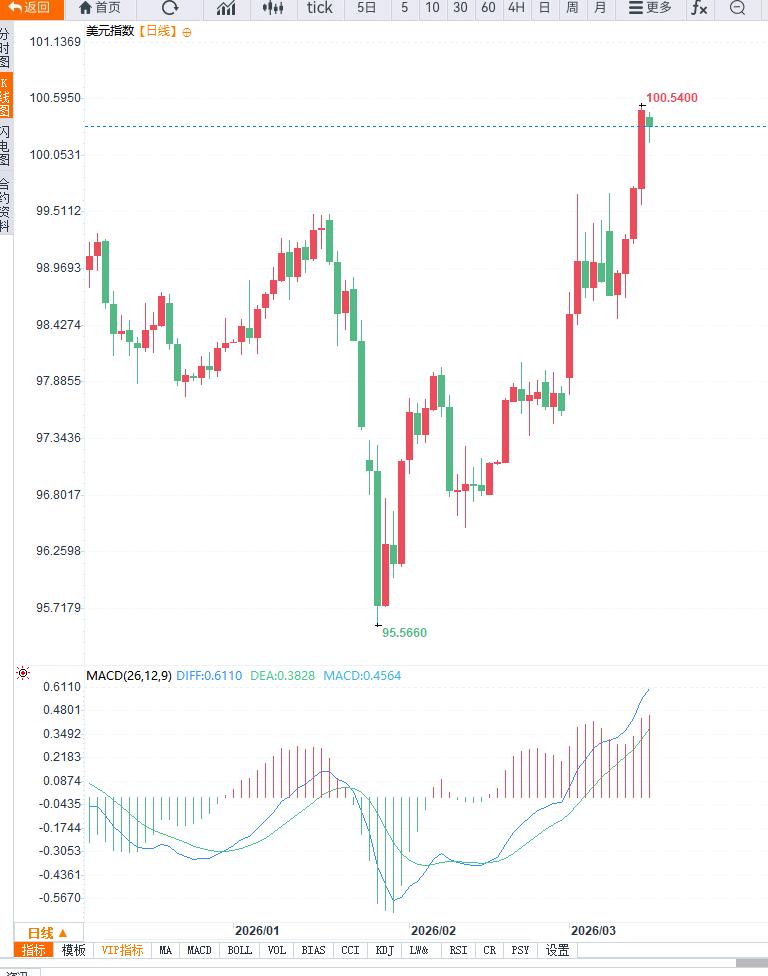
Shipping risks in the Strait of Hormuz are driving up demand for safe-haven assets, pushing the US dollar index to a near ten-month high, but it still faces downward pressure in the medium to long term.
2026-03-16 15:22:49
The ongoing tensions in the Middle East have recently impacted global financial markets, leading to significant fluctuations in investor risk sentiment. With energy transportation security becoming a focal point, the US dollar has once again played its role as a traditional safe-haven asset. The dollar index has strengthened considerably, driven by safe-haven inflows, reaching a near ten-month high , indicating that global funds continue to favor holding dollar assets during periods of uncertainty.

One of the core concerns in the market is the shipping safety of the Strait of Hormuz. This strait is strategically located for energy transport in the Middle East and is a vital channel for global oil supplies. Market estimates indicate that approximately 20% of the world's seaborne crude oil passes through the Strait of Hormuz . Therefore, any disruption to this shipping route could rapidly impact the global energy market, potentially driving up oil prices and triggering volatility in financial markets.
Amid recent market turmoil, international energy prices have also risen significantly. Brent crude oil prices have climbed back above $100 per barrel , reflecting market concerns about supply risks. Rising energy prices not only affect global inflation expectations but also have a ripple effect on currency markets. In this context, the US dollar often becomes one of the main safe-haven assets for global funds.
From a short-term market perspective, the strengthening of the US dollar is closely related to the rising global demand for dollar financing. Because the US dollar occupies a central position in the global financial system, a large amount of international trade settlements, cross-border loans, and international bond issuances are denominated in US dollars. When financial markets experience volatility, financial institutions often need to increase dollar liquidity to meet their financing needs, which drives the dollar's short-term strength.
Furthermore, the US dollar remains a significant component of global foreign exchange reserves. In stressful market environments, financial institutions and investors typically increase their allocation to US dollar assets to ensure liquidity security. Therefore, the US dollar often receives substantial support during periods of heightened global risk sentiment.
However, from a longer-term macroeconomic perspective, some institutions hold a more cautious view on the dollar's trajectory. Although the dollar is currently driven by safe-haven demand, from a cyclical perspective, the dollar index may return to the 96-100 range in the future. The current dollar level is already somewhat higher than the reasonable valuation implied by interest rate differentials, meaning that the dollar's upside potential may be limited.
Meanwhile, the long-term trend of the US dollar is also influenced by structural factors. In recent years, the US fiscal deficit has continued to expand, and the level of government debt has been rising, sparking discussions in the market about fiscal sustainability. As global investors assess long-term asset allocations, these factors may gradually affect their confidence in dollar assets.
From a technical perspective, the US dollar index daily chart currently maintains a clear upward trend. The price continues to trade above major short-term moving averages and has formed a series of relatively high lows, indicating that bullish momentum remains dominant. Technically, the key resistance level for the US dollar index is currently around 100.00 . If the price effectively breaks through this psychological level, the market may further test the 101.50 area.
On the support side, the key short-term support level is around 98.50 , which corresponds to the lower edge of the recent consolidation range. If the US dollar index falls below this level, the price may return to the support area around 97.00 .
Overall, the US dollar may still be supported by safe-haven inflows in the short term, but as the market gradually digests geopolitical risk factors, the future trend of the US dollar index may return to being driven by fundamentals.
Editor's Summary : The current trend of the US dollar is mainly influenced by two forces. On the one hand, tensions in the Middle East and energy transportation risks are driving up safe-haven demand, providing significant support for the dollar in the short term. On the other hand, from a long-term perspective, the uncertainty surrounding US fiscal conditions and policies may exert sustained pressure on the dollar.
Against this backdrop, the US dollar may remain strong in the short term, but its medium- to long-term trajectory remains uncertain. Future market movements will depend on geopolitical developments, changes in global energy prices, and differences in national monetary policies. If risk sentiment gradually eases, the US dollar may return to a more balanced trading range.
Frequently Asked Questions (FAQ)
Question 1: Why does the US dollar usually rise when global financial markets are in turmoil?
The US dollar holds a central position in the global financial system, and therefore typically appreciates during periods of market turmoil. First, the dollar is the world's primary reserve currency, with central banks and financial institutions worldwide holding substantial amounts of dollar assets. When market risks rise, investors tend to increase their allocation to dollar assets to ensure capital safety. Second, a large volume of goods and services in global trade are settled in dollars. Businesses typically need to hold dollar funds when conducting international trade. When market volatility intensifies, businesses may increase their dollar reserves in advance, thereby driving up demand for the dollar. Furthermore, loans and bond issuances in international financial markets are mostly denominated in dollars. When financial institutions face funding pressures, they usually need to increase dollar financing, which further strengthens the dollar. Therefore, during periods of heightened global risk aversion, the dollar often becomes one of the most sought-after safe-haven assets.
Question 2: Why is the Strait of Hormuz so important to the global energy market?
The Strait of Hormuz, located in the Middle East, is a vital shipping route connecting the Persian Gulf and the Gulf of Oman. Large quantities of crude oil from major Middle Eastern oil-producing countries are transported through this route to markets in Asia, Europe, and North America. Market estimates indicate that approximately 20% of global seaborne crude oil transits the Strait of Hormuz. Therefore, any disruption to this shipping route could rapidly reduce global energy supply, driving up oil prices. Historically, significant fluctuations in the energy market have occurred whenever tensions rise in the region. Investors typically price supply risks into oil prices in advance, which is a key reason why oil prices tend to rise during periods of heightened geopolitical risk.
Question 3: Why does rising oil prices drive the dollar higher?
Rising oil prices themselves don't directly drive up the dollar, but they are often linked to changes in global risk sentiment. When oil price increases are triggered by supply risks or geopolitical tensions, markets typically enter a risk-averse mode. In this environment, investors may reduce their holdings in risky assets and increase their allocation to safe-haven assets. Due to the dollar's central role in the global financial system, it often becomes a major destination for capital inflows. Furthermore, rising oil prices can also push up inflation expectations, thereby influencing central bank policies worldwide. If the market anticipates that US interest rates will remain high, the dollar is usually supported.
Question 4: Why do some institutions hold a bearish view on the long-term trend of the US dollar?
While the US dollar typically performs strongly during short-term market fluctuations, some institutions believe its long-term outlook faces challenges. One significant reason is the ever-expanding US fiscal deficit. In the long run, continued increases in government debt could erode investor confidence in dollar assets. Furthermore, the global economic structure is changing. Some countries are pushing to reduce their reliance on the dollar, for example, by increasing the use of other currencies in trade and reserves. If this trend continues, it could gradually impact the dollar's dominance in the global financial system. However, such changes are usually a long-term process, so the dollar may remain relatively strong in the short term.
Question 5: What are the key factors to watch for in the future trend of the US dollar index?
The future trajectory of the US dollar index will primarily depend on three factors. First, global risk sentiment. Continued geopolitical tensions or financial market volatility could continue to support the dollar's safe-haven appeal. Second, US monetary policy. If the Federal Reserve maintains high interest rates while other major central banks begin cutting rates, the interest rate differential could continue to support the dollar. Third, the US economic and fiscal situation. Strong US economic growth could sustain the dollar's strength; however, increased fiscal pressure could impact long-term market confidence in the dollar. Therefore, investors need to comprehensively consider macroeconomic factors, policy changes, and the global market environment when analyzing the dollar's trajectory.
One of the core concerns in the market is the shipping safety of the Strait of Hormuz. This strait is strategically located for energy transport in the Middle East and is a vital channel for global oil supplies. Market estimates indicate that approximately 20% of the world's seaborne crude oil passes through the Strait of Hormuz . Therefore, any disruption to this shipping route could rapidly impact the global energy market, potentially driving up oil prices and triggering volatility in financial markets.
Amid recent market turmoil, international energy prices have also risen significantly. Brent crude oil prices have climbed back above $100 per barrel , reflecting market concerns about supply risks. Rising energy prices not only affect global inflation expectations but also have a ripple effect on currency markets. In this context, the US dollar often becomes one of the main safe-haven assets for global funds.
From a short-term market perspective, the strengthening of the US dollar is closely related to the rising global demand for dollar financing. Because the US dollar occupies a central position in the global financial system, a large amount of international trade settlements, cross-border loans, and international bond issuances are denominated in US dollars. When financial markets experience volatility, financial institutions often need to increase dollar liquidity to meet their financing needs, which drives the dollar's short-term strength.
Furthermore, the US dollar remains a significant component of global foreign exchange reserves. In stressful market environments, financial institutions and investors typically increase their allocation to US dollar assets to ensure liquidity security. Therefore, the US dollar often receives substantial support during periods of heightened global risk sentiment.
However, from a longer-term macroeconomic perspective, some institutions hold a more cautious view on the dollar's trajectory. Although the dollar is currently driven by safe-haven demand, from a cyclical perspective, the dollar index may return to the 96-100 range in the future. The current dollar level is already somewhat higher than the reasonable valuation implied by interest rate differentials, meaning that the dollar's upside potential may be limited.
Meanwhile, the long-term trend of the US dollar is also influenced by structural factors. In recent years, the US fiscal deficit has continued to expand, and the level of government debt has been rising, sparking discussions in the market about fiscal sustainability. As global investors assess long-term asset allocations, these factors may gradually affect their confidence in dollar assets.
From a technical perspective, the US dollar index daily chart currently maintains a clear upward trend. The price continues to trade above major short-term moving averages and has formed a series of relatively high lows, indicating that bullish momentum remains dominant. Technically, the key resistance level for the US dollar index is currently around 100.00 . If the price effectively breaks through this psychological level, the market may further test the 101.50 area.
On the support side, the key short-term support level is around 98.50 , which corresponds to the lower edge of the recent consolidation range. If the US dollar index falls below this level, the price may return to the support area around 97.00 .
Overall, the US dollar may still be supported by safe-haven inflows in the short term, but as the market gradually digests geopolitical risk factors, the future trend of the US dollar index may return to being driven by fundamentals.
Editor's Summary : The current trend of the US dollar is mainly influenced by two forces. On the one hand, tensions in the Middle East and energy transportation risks are driving up safe-haven demand, providing significant support for the dollar in the short term. On the other hand, from a long-term perspective, the uncertainty surrounding US fiscal conditions and policies may exert sustained pressure on the dollar.
Against this backdrop, the US dollar may remain strong in the short term, but its medium- to long-term trajectory remains uncertain. Future market movements will depend on geopolitical developments, changes in global energy prices, and differences in national monetary policies. If risk sentiment gradually eases, the US dollar may return to a more balanced trading range.
Frequently Asked Questions (FAQ)
Question 1: Why does the US dollar usually rise when global financial markets are in turmoil?
The US dollar holds a central position in the global financial system, and therefore typically appreciates during periods of market turmoil. First, the dollar is the world's primary reserve currency, with central banks and financial institutions worldwide holding substantial amounts of dollar assets. When market risks rise, investors tend to increase their allocation to dollar assets to ensure capital safety. Second, a large volume of goods and services in global trade are settled in dollars. Businesses typically need to hold dollar funds when conducting international trade. When market volatility intensifies, businesses may increase their dollar reserves in advance, thereby driving up demand for the dollar. Furthermore, loans and bond issuances in international financial markets are mostly denominated in dollars. When financial institutions face funding pressures, they usually need to increase dollar financing, which further strengthens the dollar. Therefore, during periods of heightened global risk aversion, the dollar often becomes one of the most sought-after safe-haven assets.
Question 2: Why is the Strait of Hormuz so important to the global energy market?
The Strait of Hormuz, located in the Middle East, is a vital shipping route connecting the Persian Gulf and the Gulf of Oman. Large quantities of crude oil from major Middle Eastern oil-producing countries are transported through this route to markets in Asia, Europe, and North America. Market estimates indicate that approximately 20% of global seaborne crude oil transits the Strait of Hormuz. Therefore, any disruption to this shipping route could rapidly reduce global energy supply, driving up oil prices. Historically, significant fluctuations in the energy market have occurred whenever tensions rise in the region. Investors typically price supply risks into oil prices in advance, which is a key reason why oil prices tend to rise during periods of heightened geopolitical risk.
Question 3: Why does rising oil prices drive the dollar higher?
Rising oil prices themselves don't directly drive up the dollar, but they are often linked to changes in global risk sentiment. When oil price increases are triggered by supply risks or geopolitical tensions, markets typically enter a risk-averse mode. In this environment, investors may reduce their holdings in risky assets and increase their allocation to safe-haven assets. Due to the dollar's central role in the global financial system, it often becomes a major destination for capital inflows. Furthermore, rising oil prices can also push up inflation expectations, thereby influencing central bank policies worldwide. If the market anticipates that US interest rates will remain high, the dollar is usually supported.
Question 4: Why do some institutions hold a bearish view on the long-term trend of the US dollar?
While the US dollar typically performs strongly during short-term market fluctuations, some institutions believe its long-term outlook faces challenges. One significant reason is the ever-expanding US fiscal deficit. In the long run, continued increases in government debt could erode investor confidence in dollar assets. Furthermore, the global economic structure is changing. Some countries are pushing to reduce their reliance on the dollar, for example, by increasing the use of other currencies in trade and reserves. If this trend continues, it could gradually impact the dollar's dominance in the global financial system. However, such changes are usually a long-term process, so the dollar may remain relatively strong in the short term.
Question 5: What are the key factors to watch for in the future trend of the US dollar index?
The future trajectory of the US dollar index will primarily depend on three factors. First, global risk sentiment. Continued geopolitical tensions or financial market volatility could continue to support the dollar's safe-haven appeal. Second, US monetary policy. If the Federal Reserve maintains high interest rates while other major central banks begin cutting rates, the interest rate differential could continue to support the dollar. Third, the US economic and fiscal situation. Strong US economic growth could sustain the dollar's strength; however, increased fiscal pressure could impact long-term market confidence in the dollar. Therefore, investors need to comprehensively consider macroeconomic factors, policy changes, and the global market environment when analyzing the dollar's trajectory.
- Risk Warning and Disclaimer
- The market involves risk, and trading may not be suitable for all investors. This article is for reference only and does not constitute personal investment advice, nor does it take into account certain users’ specific investment objectives, financial situation, or other needs. Any investment decisions made based on this information are at your own risk.