War premiums are becoming the norm, and the logic behind crude oil trading continues to strengthen.
2026-03-16 16:45:15
On Monday (March 16), during the Asian and European sessions, international oil prices rebounded sharply after hitting a low. WTI crude oil futures once again climbed back above the $100 mark. Currently, they have fallen slightly by 1.46% and are trading around $100.50. During the session, they once fell to $97.
The ongoing geopolitical conflict in the Middle East, with Iran sending a series of strong signals, has caused continuous disruptions to regional energy infrastructure and shipping routes. The focus of crude oil trading has shifted from price fluctuations to supply security and route stability, and the global energy trade landscape is facing restructuring.
A spokesperson for the Joint Command of the Iranian Armed Forces explicitly stated that the logistics and service center of the USS Ford carrier strike group in the Red Sea region has been identified as a target, further expanding the scope of military confrontation.
Iranian Islamic Revolutionary Guard Corps Navy Commander Tangsiri publicly warned that the United States cannot provide genuine security for the Gulf states and will sacrifice its allies for its own interests if necessary. He stated that the Gulf states have become victims of the strategic ambitions of external powers. He emphasized that only through unity and cooperation among Islamic countries can lasting regional security be achieved in the Middle East.
At the same time, Iranian Ambassador to Saudi Arabia, Enayati, called on Gulf states to abandon external interference, re-examine bilateral relations, and build a new regional security order without the intervention of external powers, further highlighting Iran's position of promoting a regional autonomous security structure.
The port of Fujairah, the only oil export hub in the UAE that can bypass the Strait of Hormuz, was attacked again on Monday, the latest in a series of attacks on the strategic port.
The exact damage caused by the attack is still being assessed. The port had previously experienced a fire caused by a drone attack on Saturday, and related oil loading operations did not gradually resume until the weekend.
A report from the UK's Maritime Trade Operations Office indicates that security threats in the Arabian Gulf, the Strait of Hormuz, and the Gulf of Oman remain at a critical level. There have been no confirmed reports of ship attacks in the past 72 hours, but navigation capacity in the straits has been significantly reduced.
Monitoring data shows that only 3 cargo ships currently pass through the Strait of Hormuz per day, far below the historical average of 138 ships, and the operation of this core global energy channel is almost at a standstill.
Affected by the continued tightening of crude oil supply from the Middle East, Sinopec, China's largest oil refiner, has reduced the processing load of its refineries to cope with the operational pressure caused by the instability of crude oil arrivals.
As a core enterprise in China's refined oil supply, Sinopec's crude oil imports are highly dependent on the Middle East. This adjustment is a passive response to the disruption of shipping.
As the world's largest oil-consuming region, Asia's refineries rely on Middle Eastern crude oil for as much as 65% of their total output.
Wood Mackenzie warned that if the conflict continues and emergency reserves are not activated, crude oil processing volumes in Asia could face a significant reduction in April, putting continued pressure on the regional energy supply and demand balance.
The focus of the current global crude oil market competition has shifted from "weak demand" to "extremely fragile supply." Below are the latest key viewpoints from major institutions:
Daan Struyven, head of commodities research at Goldman Sachs, believes that "the market is no longer focused on OPEC's production cut quotas, but has instead entered a 'physical navigation monitoring' mode. The Strait of Hormuz's navigation volume has fallen to a historic low, meaning that nearly 20% of global crude oil supply is on the verge of a de facto disruption. Even with the activation of alternative routes such as Fujairah, the attacks on its facilities demonstrate the fragility of land-based detours. As long as the risks to the passage remain, crude oil pricing logic will enter a mode of anticipating supply disruptions."
Alan Gelder, Vice President of Global Refining at Wood Mackenzie, stated that "the reduction in operating rates at Asian refineries (especially giants like Sinopec) is a harbinger of a global shortage of refined oil products. Given Asia's 65% dependence on Middle Eastern crude oil, this forced production cut will rapidly increase the crack spread between diesel and jet fuel, and this will be transmitted across regions to the European and American markets, forcing a restructuring of the global energy trade landscape from efficiency-first to safety-redundancy."
Natasha Kaneva, head of energy strategy at JP Morgan, said, "We are at a structural inflection point where geopolitical risks are becoming the norm."
The protracted nature of geopolitical conflicts has led the market to price in a permanent war premium. Even if the conflict de-escalates in the short term, rising insurance rates, the cost of diverting shipping routes, and the need to replenish strategic reserves will significantly shift the volatility center of crude oil trading upwards, potentially transforming the $100 mark from a resistance level into a new value center.
Current institutional assessments of the crude oil market place greater emphasis on supply resilience and risk sustainability, rather than solely focusing on price levels. Key consensuses include:
The security status of the Strait of Hormuz and alternative ports is key to determining the recovery of supply in the medium term;
The adjustments to refinery operating rates in Asia will gradually have a ripple effect on global refined product trade, altering the supply and demand dynamics between regions.
The protracted nature of geopolitical conflicts will lead to a persistent "war premium" in crude oil pricing, keeping trading volatility high.
The core driver of this round of market volatility has shifted from conventional supply and demand fundamentals to geopolitical conflicts and shipping lane security.
The conflict in the Middle East has damaged regional oil and gas production and export facilities, and the economic losses of Gulf oil-producing countries continue to expand.
Although Russia has been granted approval to increase crude oil exports to Asia in an attempt to alleviate some supply pressure, this is unlikely to offset the systemic impact of the disruption of the Hormuz Channel.
International institutions have generally raised the risk premium for crude oil, with trading focusing on three main areas: the operational stability of alternative export routes such as the port of Fujairah, the progress of the resumption of navigation in the Strait of Hormuz, and whether the confrontation between Iran and external forces will escalate further.
For crude oil trading, the real-time development of geopolitical events has become a key variable affecting short-term decisions, and the progress of channel repair will directly determine the pace of market risk appetite shift.
Technical Analysis: WTI crude oil has broken through the 0.618 Fibonacci retracement level of 95 yuan. The next 0.786 Fibonacci retracement level is around 105.88 yuan, which is the next resistance level.
The support levels are the 5-day moving average and the key price level of 95.
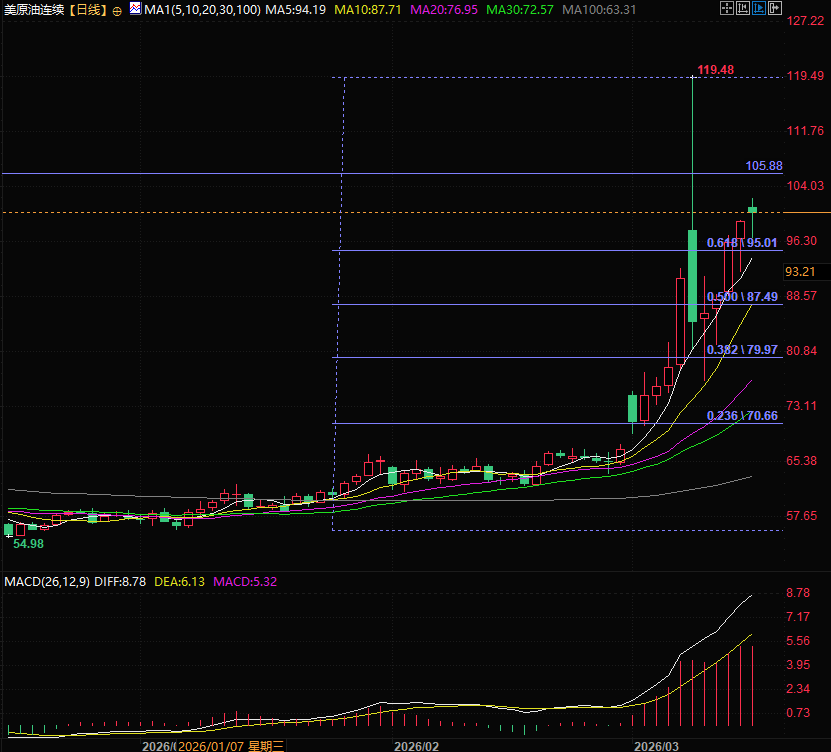
(WTI crude oil futures daily chart, source: EasyForex)
At 16:43 Beijing time, WTI futures were trading at $100.53 per barrel.
The ongoing geopolitical conflict in the Middle East, with Iran sending a series of strong signals, has caused continuous disruptions to regional energy infrastructure and shipping routes. The focus of crude oil trading has shifted from price fluctuations to supply security and route stability, and the global energy trade landscape is facing restructuring.
Iran's tough stance escalates regional military and energy risks.
A spokesperson for the Joint Command of the Iranian Armed Forces explicitly stated that the logistics and service center of the USS Ford carrier strike group in the Red Sea region has been identified as a target, further expanding the scope of military confrontation.
Iranian Islamic Revolutionary Guard Corps Navy Commander Tangsiri publicly warned that the United States cannot provide genuine security for the Gulf states and will sacrifice its allies for its own interests if necessary. He stated that the Gulf states have become victims of the strategic ambitions of external powers. He emphasized that only through unity and cooperation among Islamic countries can lasting regional security be achieved in the Middle East.
At the same time, Iranian Ambassador to Saudi Arabia, Enayati, called on Gulf states to abandon external interference, re-examine bilateral relations, and build a new regional security order without the intervention of external powers, further highlighting Iran's position of promoting a regional autonomous security structure.
Key energy facility attacked, Hormuz tunnel nearly paralyzed
The port of Fujairah, the only oil export hub in the UAE that can bypass the Strait of Hormuz, was attacked again on Monday, the latest in a series of attacks on the strategic port.
The exact damage caused by the attack is still being assessed. The port had previously experienced a fire caused by a drone attack on Saturday, and related oil loading operations did not gradually resume until the weekend.
A report from the UK's Maritime Trade Operations Office indicates that security threats in the Arabian Gulf, the Strait of Hormuz, and the Gulf of Oman remain at a critical level. There have been no confirmed reports of ship attacks in the past 72 hours, but navigation capacity in the straits has been significantly reduced.
Monitoring data shows that only 3 cargo ships currently pass through the Strait of Hormuz per day, far below the historical average of 138 ships, and the operation of this core global energy channel is almost at a standstill.
Supply disruptions lead to passive adjustments by Asian refineries
Affected by the continued tightening of crude oil supply from the Middle East, Sinopec, China's largest oil refiner, has reduced the processing load of its refineries to cope with the operational pressure caused by the instability of crude oil arrivals.
As a core enterprise in China's refined oil supply, Sinopec's crude oil imports are highly dependent on the Middle East. This adjustment is a passive response to the disruption of shipping.
As the world's largest oil-consuming region, Asia's refineries rely on Middle Eastern crude oil for as much as 65% of their total output.
Wood Mackenzie warned that if the conflict continues and emergency reserves are not activated, crude oil processing volumes in Asia could face a significant reduction in April, putting continued pressure on the regional energy supply and demand balance.
Institutional Viewpoint: Focus on Supply Resilience, Be Wary of Long-Term Disruptions
The focus of the current global crude oil market competition has shifted from "weak demand" to "extremely fragile supply." Below are the latest key viewpoints from major institutions:
Daan Struyven, head of commodities research at Goldman Sachs, believes that "the market is no longer focused on OPEC's production cut quotas, but has instead entered a 'physical navigation monitoring' mode. The Strait of Hormuz's navigation volume has fallen to a historic low, meaning that nearly 20% of global crude oil supply is on the verge of a de facto disruption. Even with the activation of alternative routes such as Fujairah, the attacks on its facilities demonstrate the fragility of land-based detours. As long as the risks to the passage remain, crude oil pricing logic will enter a mode of anticipating supply disruptions."
Alan Gelder, Vice President of Global Refining at Wood Mackenzie, stated that "the reduction in operating rates at Asian refineries (especially giants like Sinopec) is a harbinger of a global shortage of refined oil products. Given Asia's 65% dependence on Middle Eastern crude oil, this forced production cut will rapidly increase the crack spread between diesel and jet fuel, and this will be transmitted across regions to the European and American markets, forcing a restructuring of the global energy trade landscape from efficiency-first to safety-redundancy."
Natasha Kaneva, head of energy strategy at JP Morgan, said, "We are at a structural inflection point where geopolitical risks are becoming the norm."
The protracted nature of geopolitical conflicts has led the market to price in a permanent war premium. Even if the conflict de-escalates in the short term, rising insurance rates, the cost of diverting shipping routes, and the need to replenish strategic reserves will significantly shift the volatility center of crude oil trading upwards, potentially transforming the $100 mark from a resistance level into a new value center.
Current institutional assessments of the crude oil market place greater emphasis on supply resilience and risk sustainability, rather than solely focusing on price levels. Key consensuses include:
The security status of the Strait of Hormuz and alternative ports is key to determining the recovery of supply in the medium term;
The adjustments to refinery operating rates in Asia will gradually have a ripple effect on global refined product trade, altering the supply and demand dynamics between regions.
The protracted nature of geopolitical conflicts will lead to a persistent "war premium" in crude oil pricing, keeping trading volatility high.
Summary and Technical Analysis:
The core driver of this round of market volatility has shifted from conventional supply and demand fundamentals to geopolitical conflicts and shipping lane security.
The conflict in the Middle East has damaged regional oil and gas production and export facilities, and the economic losses of Gulf oil-producing countries continue to expand.
Although Russia has been granted approval to increase crude oil exports to Asia in an attempt to alleviate some supply pressure, this is unlikely to offset the systemic impact of the disruption of the Hormuz Channel.
International institutions have generally raised the risk premium for crude oil, with trading focusing on three main areas: the operational stability of alternative export routes such as the port of Fujairah, the progress of the resumption of navigation in the Strait of Hormuz, and whether the confrontation between Iran and external forces will escalate further.
For crude oil trading, the real-time development of geopolitical events has become a key variable affecting short-term decisions, and the progress of channel repair will directly determine the pace of market risk appetite shift.
Technical Analysis: WTI crude oil has broken through the 0.618 Fibonacci retracement level of 95 yuan. The next 0.786 Fibonacci retracement level is around 105.88 yuan, which is the next resistance level.
The support levels are the 5-day moving average and the key price level of 95.
(WTI crude oil futures daily chart, source: EasyForex)
At 16:43 Beijing time, WTI futures were trading at $100.53 per barrel.
- Risk Warning and Disclaimer
- The market involves risk, and trading may not be suitable for all investors. This article is for reference only and does not constitute personal investment advice, nor does it take into account certain users’ specific investment objectives, financial situation, or other needs. Any investment decisions made based on this information are at your own risk.