Inflationary pressures weighed on gold prices, causing them to fall, while Brent crude oil held steady above $106.
2026-03-16 16:19:29
According to APP, gold prices have fallen significantly as rising energy prices have fueled market concerns about a potential US interest rate cut, supporting a stronger dollar . Latest data shows that Brent crude oil futures prices have held steady above $106 per barrel, with a cumulative increase of over 5% since the beginning of the month, directly pushing up global inflation expectations and reducing the Federal Reserve's room for further easing. This week, the market widely expects the Fed to keep interest rates unchanged for the second consecutive meeting, but investors will be closely watching Chairman Powell's speech for clues about the future policy path.

The US Dollar Index (DXY) is currently trading around 100.39, rebounding 0.75% from its recent low. This strong performance is further pressuring the pricing of non-US assets. Gold prices have recently fallen back to around $4,997 per ounce, having dropped as much as 0.41% during the session, reflecting that market concerns about the transmission of inflation from high oil prices have outweighed traditional safe-haven demand. Unlike simple cyclical fluctuations, this round of pressure on gold prices is a typical example of a complex transmission mechanism involving "energy-inflation-exchange rate": after Brent crude oil broke through the $100 mark, the market's pricing of the number of interest rate cuts in 2026 was rapidly revised down from two to zero or even delayed, and the increased attractiveness of the US dollar directly squeezed the cost of holding gold.
Powell's speech will be the biggest variable this week. The Fed's current target range for the federal funds rate remains at 3.50%-3.75%, and it is highly likely that the rate will remain unchanged at this meeting. However, if the dot plot and economic forecasts revise the inflation path upward, it will further solidify the high-interest-rate environment. Strong energy cost stickiness, coupled with geopolitical uncertainties, has led the market to significantly reduce its expectations for rate cuts throughout the year, thus diminishing the attractiveness of gold as a zero-interest asset.
The following is a comparison of the latest scenarios for key assets and policy expectations under geopolitical conflict (based on real-time market pricing and institutional consensus):
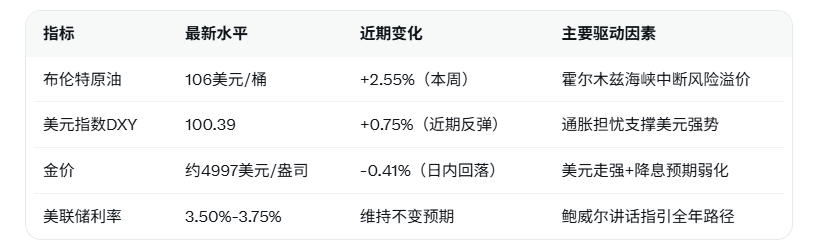
This interconnected effect highlights that energy prices have become a core variable in global asset pricing. High oil prices not only push up inflation but also indirectly suppress precious metals and emerging market currencies through the dollar channel. In the short term, if Powell's speech is cautious, gold prices may continue to test the $4,900 support level; conversely, if he hints at data reliance on flexibility, gold may experience a brief recovery. However, overall, the continued high level of Brent crude oil will continue to limit the scope for interest rate cuts, and the gold price's central value is expected to shift downwards.
Overall, high energy prices have pushed the Federal Reserve's policy from an "easing cycle" to a "data-dependent and cautious mode." Investors should closely monitor Powell's press conference and subsequent inflation data to dynamically adjust their allocation to precious metals and US dollar assets.
Editor's Summary : Rising energy prices have been the direct driver of the current dollar strengthening and gold price decline. Brent crude oil's high of $106 strengthens inflation stickiness, and the probability of the Federal Reserve maintaining interest rates is nearly 100%. Powell's speech will determine the market's repricing of the year's path. The short-term downward pressure on gold prices is likely to continue, but if geopolitical risk premiums are digested in stages, gold still has room for recovery. Global investors need to be wary of the triple linkage between energy, exchange rates, and interest rates, and flexibly manage portfolio risks to cope with the highly volatile environment of 2026.
Frequently Asked Questions
1. Why does rising energy prices directly lead to a drop in gold prices?
Brent crude oil's breakthrough of $106 has boosted global inflation expectations, leading the market to lower its probability of a Federal Reserve rate cut, and the dollar index has rebounded to around 100.39. As a zero-interest asset, gold's opportunity cost of holding has increased, while its safe-haven appeal has been partially offset by "stagflation concerns" triggered by high oil prices, creating downward pressure on its price.
2. Why is it highly likely that the Federal Reserve will keep interest rates unchanged at this week's meeting?
The current federal funds rate is in the 3.50%-3.75% range, and this is the second consecutive meeting. High energy prices are exacerbating inflation stickiness, and the Fed needs to prioritize observing data developments. Market pricing indicates a near 100% probability of maintaining the current rate. Powell's speech will be crucial; any hawkish signals will further suppress expectations of a rate cut.
3. What is the specific transmission mechanism of the strengthening US dollar index to gold prices?
A 0.5% increase in the DXY typically corresponds to a 1-2% decrease in gold prices. The current strength of the US dollar stems from inflation concerns and the attractiveness of relatively high interest rates, directly increasing the dollar-denominated cost of gold. Coupled with a recovery in global risk appetite, this has driven gold prices down by approximately 0.41% from their recent highs.
4. If Powell's speech is dovish, can gold prices rebound quickly?
A short-term technical correction is possible, but energy prices holding above $106 will limit the upside potential. If Powell emphasizes data-driven decision-making rather than clear easing guidance, the market will remain cautious, and gold prices will struggle to break through the $5,000 mark. In the medium to long term, a decline in oil prices or signs of easing tensions are needed.
The US Dollar Index (DXY) is currently trading around 100.39, rebounding 0.75% from its recent low. This strong performance is further pressuring the pricing of non-US assets. Gold prices have recently fallen back to around $4,997 per ounce, having dropped as much as 0.41% during the session, reflecting that market concerns about the transmission of inflation from high oil prices have outweighed traditional safe-haven demand. Unlike simple cyclical fluctuations, this round of pressure on gold prices is a typical example of a complex transmission mechanism involving "energy-inflation-exchange rate": after Brent crude oil broke through the $100 mark, the market's pricing of the number of interest rate cuts in 2026 was rapidly revised down from two to zero or even delayed, and the increased attractiveness of the US dollar directly squeezed the cost of holding gold.
Powell's speech will be the biggest variable this week. The Fed's current target range for the federal funds rate remains at 3.50%-3.75%, and it is highly likely that the rate will remain unchanged at this meeting. However, if the dot plot and economic forecasts revise the inflation path upward, it will further solidify the high-interest-rate environment. Strong energy cost stickiness, coupled with geopolitical uncertainties, has led the market to significantly reduce its expectations for rate cuts throughout the year, thus diminishing the attractiveness of gold as a zero-interest asset.
The following is a comparison of the latest scenarios for key assets and policy expectations under geopolitical conflict (based on real-time market pricing and institutional consensus):
This interconnected effect highlights that energy prices have become a core variable in global asset pricing. High oil prices not only push up inflation but also indirectly suppress precious metals and emerging market currencies through the dollar channel. In the short term, if Powell's speech is cautious, gold prices may continue to test the $4,900 support level; conversely, if he hints at data reliance on flexibility, gold may experience a brief recovery. However, overall, the continued high level of Brent crude oil will continue to limit the scope for interest rate cuts, and the gold price's central value is expected to shift downwards.
Overall, high energy prices have pushed the Federal Reserve's policy from an "easing cycle" to a "data-dependent and cautious mode." Investors should closely monitor Powell's press conference and subsequent inflation data to dynamically adjust their allocation to precious metals and US dollar assets.
Editor's Summary : Rising energy prices have been the direct driver of the current dollar strengthening and gold price decline. Brent crude oil's high of $106 strengthens inflation stickiness, and the probability of the Federal Reserve maintaining interest rates is nearly 100%. Powell's speech will determine the market's repricing of the year's path. The short-term downward pressure on gold prices is likely to continue, but if geopolitical risk premiums are digested in stages, gold still has room for recovery. Global investors need to be wary of the triple linkage between energy, exchange rates, and interest rates, and flexibly manage portfolio risks to cope with the highly volatile environment of 2026.
Frequently Asked Questions
1. Why does rising energy prices directly lead to a drop in gold prices?
Brent crude oil's breakthrough of $106 has boosted global inflation expectations, leading the market to lower its probability of a Federal Reserve rate cut, and the dollar index has rebounded to around 100.39. As a zero-interest asset, gold's opportunity cost of holding has increased, while its safe-haven appeal has been partially offset by "stagflation concerns" triggered by high oil prices, creating downward pressure on its price.
2. Why is it highly likely that the Federal Reserve will keep interest rates unchanged at this week's meeting?
The current federal funds rate is in the 3.50%-3.75% range, and this is the second consecutive meeting. High energy prices are exacerbating inflation stickiness, and the Fed needs to prioritize observing data developments. Market pricing indicates a near 100% probability of maintaining the current rate. Powell's speech will be crucial; any hawkish signals will further suppress expectations of a rate cut.
3. What is the specific transmission mechanism of the strengthening US dollar index to gold prices?
A 0.5% increase in the DXY typically corresponds to a 1-2% decrease in gold prices. The current strength of the US dollar stems from inflation concerns and the attractiveness of relatively high interest rates, directly increasing the dollar-denominated cost of gold. Coupled with a recovery in global risk appetite, this has driven gold prices down by approximately 0.41% from their recent highs.
4. If Powell's speech is dovish, can gold prices rebound quickly?
A short-term technical correction is possible, but energy prices holding above $106 will limit the upside potential. If Powell emphasizes data-driven decision-making rather than clear easing guidance, the market will remain cautious, and gold prices will struggle to break through the $5,000 mark. In the medium to long term, a decline in oil prices or signs of easing tensions are needed.
- Risk Warning and Disclaimer
- The market involves risk, and trading may not be suitable for all investors. This article is for reference only and does not constitute personal investment advice, nor does it take into account certain users’ specific investment objectives, financial situation, or other needs. Any investment decisions made based on this information are at your own risk.